wellnessfitpro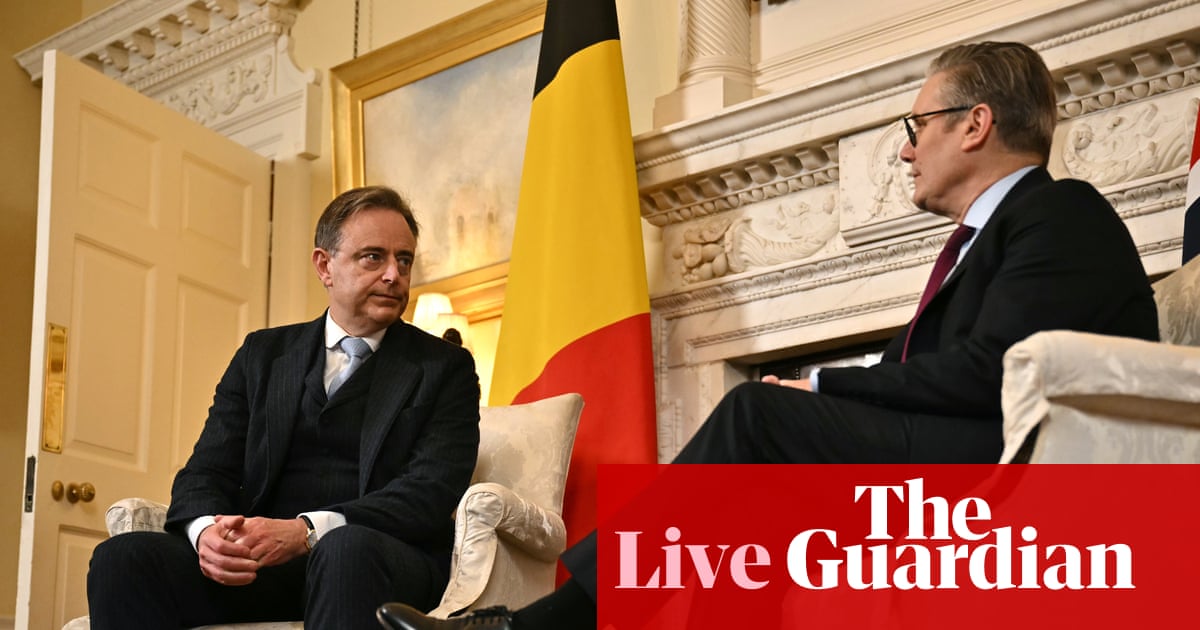
Belgium’s De Wever arrives at 10 Downing Street for talks with Starmer
Belgium’s prime minister Bart De Wever has just arrived at 10 Downing Street for bilateral talks with UK prime minister, Keir Starmer.
The pair will talk about migration, security and economy, among other things, but obviously they will also touch upon the ongoing debate about the use of frozen Russian assets to fund Ukraine.
Belgium continues to oppose the EU plan – and today’s warnings from the Russian central bank will no doubt strengthen their concerns (12:27) – causing a headache for other European leaders willing to show Europe’s important role in the peace process.
Expect Starmer, in his role as the co-chair of the Coalition of the Willing, to follow up on Merz’s arguments from last week to put some pressure on Belgium ahead of the crunch EU summit next week.
Unlike Zelenskyy earlier this week, de Wever didn’t get additionally welcomed by Larry the No 10 Cat.
Key events
-
Zelenskyy to visit Berlin on Monday, joined by ‘many’ European leaders, Germany confirms
-
EU has a plan to use frozen Russian assets to fund Ukraine – how will it work?
-
Belgium’s De Wever accused by MEP of ‘plain cowardice’ in face of Russia’s threats over frozen assets
-
Belgium’s De Wever arrives at 10 Downing Street for talks with Starmer
-
EU agree €3 customs duty for parcels under €150
-
Ukraine could join EU by 2027 under US proposal — report
-
US uses economic power to assert it will, could threaten force against allies and foes, Danish intelligence warns
-
Softening of 2035 ban comes as win for Merz and Germany — snap analysis
-
Germany’s Merz backs softening of 2035 ban on new petrol, diesel cars
-
Ukraine’s Zelenskyy expected in Berlin on Monday, Bild reports
-
EU’s 2035 petrol and diesel car ban will be watered down, says senior MEP
-
Russia’s central bank readying to sue Euroclear over frozen assets plans
-
Germany summons Russian ambassador over campaign to destabilise country, foreign ministry says
-
‘Whole of Donbas belongs to Russia,’ Kremlin says
-
Ukrainians ‘right to be very wary’ of US proposal on Donbas, former UK national security adviser says
-
Kremlin has not seen new proposals, but may not like them, it says
-
Slovakian government pushes ahead with controversial law on whistleblower protection
-
US wants Ukraine to withdraw from Donbas and create ‘free economic zone’, says Zelenskyy
-
Morning opening: The softest of pushbacks

Jakub Krupa
That’s all from me, Jakub Krupa, but Hayden Vernon will guide you through the late afternoon.
Zelenskyy to visit Berlin on Monday, joined by ‘many’ European leaders, Germany confirms
And just like that, the German government has confirmed the earlier reports that Ukrainian president Volodymyr Zelenskyy will visit Berlin on Monday for talks on bilateral relations and peace negotiations over the war.
In the evening, Zelenskyy and Germany’s Merz will be joined by “many European heads of state and government” and top representatives of the EU and Nato for further discussions, its statement said.
Fair to presume it will be Europe’s big show of unity with Ukraine.
The suggestion that Zelenskyy could show in Berlin next week was first reported by Bild earlier today (13:27).
EU has a plan to use frozen Russian assets to fund Ukraine – how will it work?
If you want to catch up on the EU’s plan to use frozen Russian assets, here is a handy explainer by Jon Henley and Jennifer Rankin.
The bottom line is as follows:
Ukraine would get a loan secured on Russia’s central bank assets, which were immobilised by EU sanctions soon after the full-scale invasion of Ukraine in February 2022.
About two-thirds of the estimated €290bn of Russian assets in the west – mostly debt securities in the form of government bonds – are held at Euroclear, a central securities depository in Brussels.
The EU does not plan to confiscate Russia’s sovereign assets, which Russia has said would be an act of theft. Instead, it would sign a contract with Euroclear to provide a loan for Ukraine secured on these funds.
The idea is that when the war is over, Ukraine would repay the EU using theoretical compensation received from Russia for the invasion.
Once Russia pays reparations – a central but not guaranteed assumption of the plan – the EU would lift sanctions and Moscow could recover its frozen assets. Euroclear would have the funds to send to Russia, completing the circle.
The EU and many member states prefer this option since money raised on capital markets – Belgium’s preferred option – would have to be repaid and borrowing would require unanimity among EU countries, which is potentially a high hurdle to clear as Russia-friendly Hungary remains strongly opposed to further funding for Ukraine.
Belgium’s De Wever accused by MEP of ‘plain cowardice’ in face of Russia’s threats over frozen assets
Fair to say that De Wever’s opposition to the use of frozen Russian assets is not winning him many friends in other parts of Europe.
Czech Republic’s MEP Ondřej Kolář has sent him a letter this week in which he picked up on De Wever’s recent comments that his government and he personally had been threatened by Russia.
Kolář said:
“Your comments displayed not prudence but plain cowardice in the face of Russian threats. I know these threats all too well. Since 2019, I have been targeted by the Kremlin, sentenced to five years in prison by a Russian court, and forced to live under police protection for almost a year. My ‘crime’ was nothing more than standing firmas a Prague district mayor against Russian intimidation and making sovereign democratic decisions.”
In the letter, 41-year-old centre-right MEP said:
“I always believed that the role of Kremlin sympathisers and political Trojan horses belonged to certain post-communist states. To my astonishment, that illusion was dispelled when a western European country joined their ranks.
In Central and Eastern Europe, being on the Russian state’s “enemy list” is not shameful; it is an honour.
I would have expected an adult western European leader to share that pride: to understand that opposition to tyranny is the duty of any responsible European official. Instead, your recent remarks suggest the opposite.”
He ended with this invitation to change views:
“I urge you to find the courage to stand with the Union. Support the European Commission’s proposal. And stop lending your voice to Vladimir Putin’s cause. It will not be worth it for Belgium nor its allies.”
Ouch.
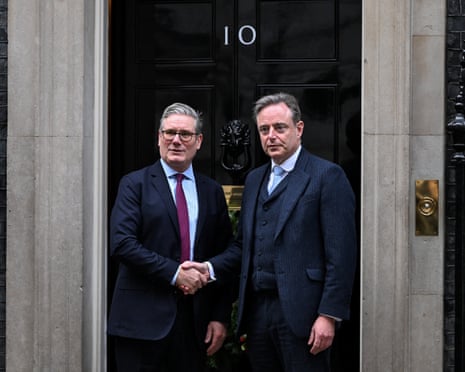
Belgium’s De Wever arrives at 10 Downing Street for talks with Starmer
Belgium’s prime minister Bart De Wever has just arrived at 10 Downing Street for bilateral talks with UK prime minister, Keir Starmer.
The pair will talk about migration, security and economy, among other things, but obviously they will also touch upon the ongoing debate about the use of frozen Russian assets to fund Ukraine.
Belgium continues to oppose the EU plan – and today’s warnings from the Russian central bank will no doubt strengthen their concerns (12:27) – causing a headache for other European leaders willing to show Europe’s important role in the peace process.
Expect Starmer, in his role as the co-chair of the Coalition of the Willing, to follow up on Merz’s arguments from last week to put some pressure on Belgium ahead of the crunch EU summit next week.
Unlike Zelenskyy earlier this week, de Wever didn’t get additionally welcomed by Larry the No 10 Cat.
EU agree €3 customs duty for parcels under €150

Lisa O’Carroll
EU member states have agreed to introduce a €3 customs duty per item on parcels valued under €150.
The move, which will apply from July next year, is designed to curb the impact of cheap goods coming in from China via online platforms such as Temu and Shein.
Duty free parcels have been a huge issue in the EU, the UK and the US where Donald Trump scrapped the “de minimis” duty-free exemption for parcels valued up to $800.
The European Commission said in a statement it welcomed the approval by member states. “The new duty will help protect the competitiveness of European businesses by levelling the playing field between e-commerce and traditional retail.
Ukraine could join EU by 2027 under US proposal — report
Ukraine would be slated to join the European Union by 1 January 2027 under a peace proposal being discussed as part of US-mediated negotiations to bring an end to the Russia-Ukraine conflict, the Financial Times has reported.
The proposal was being negotiated by US and Ukrainian officials with the support of Brussels, the FT added, citing people briefed with the document’s contents.
Ukraine’s president, Volodymyr Zelenskyy, has been under immense pressure from Donald Trump to sign up to the US peace plan, but questions remain about the fairness of the proposals and whether Russia is actually interested in peace.
Pope Leo XIV has urged spy agencies around the world not to use confidential information as a weapon, including against the Catholic church, AFP reports.
The pontiff did not name specific countries, but it is not uncommon for states to base anti-Catholic repression, including the confiscation of property or expulsion of religious figures, on information gleaned from intelligence agencies.
“We must exercise rigorous vigilance to prevent confidential information from being used to intimidate, manipulate, blackmail, or discredit,” the first pope from the US said during an audience at the Vatican with Italian intelligence agents.
“This also applies to the church. Indeed, in several countries, the church is a victim of intelligence agencies that act with malicious intent and repress its freedom,” he said.
US uses economic power to assert it will, could threaten force against allies and foes, Danish intelligence warns
A Danish intelligence agency report has warned that the United States is using its economic power to assert its will and threaten military force against both allies and adversaries, AP reports.
The report, released Wednesday, highlights Washington’s increased assertiveness under the Trump administration. It also notes that China and Russia are trying to reduce western influence.
The Arctic is becoming a focal point, with US interest in Greenland raising concerns. Russian president Vladimir Putin has expressed worries about Nato activities in the region. The report suggests that many countries are now considering strategic agreements with China over the US.
Ukrainian president Volodymyr Zelenskyy said he had visited troops fending off Russian advances near the embattled city of Kupiansk that Moscow claimed to have captured, which Kyiv denies.
“Many Russians talked about Kupiansk – we can see. I was here, I congratulated the guys. Thanks to every unit, to everyone fighting here, to everyone destroying the occupier,” Zelenskyy, wearing a bulletproof vest, said in a video posted on Telegram.
Earlier today, the Ukrainian military said it had liberated several villages near the north-eastern town of Kupiansk, Reuters reported. Khartia Corps claimed on Telegram messenger that several hundred Russian troops had been surrounded in the area.
Softening of 2035 ban comes as win for Merz and Germany — snap analysis
Lisa O’Carroll
The widely expected softening of the 2035 outright ban on the sale of new petrol or diesel cars by the EU, represents a victory for the car industry but also shows that Germany, through chancellor Friederich Merz, is back in the driving seat in Brussels.
The 2035 cut off date was the cornerstone of European Commission Ursula von der Leyen’s flagship Green Deal and only came into force in 2023.
A decision to change it after two years, and 10 full years before the actual deadline, will be seen as a significant rowing back on environmental legislation but also the renewed power of Germany, where the car industry is struggling to transition to electrification.
Last year, Merz’s predecessor Olof Scholz voted against EU tariffs on Chinese EVs in a bid to protect Germany’s interests in China, putting him on a collision course with France and Emmanuel Macron.
But his opposition proved futile with the EU introducing a range of tariffs in a bid to stem the fast growing presence of Chinese cars in the EU.
France and Spain want the EU to uphold the 2035 ban, but all the signs are that it is Germany that will hold sway when von der Leyen pronounces next Tuesday on the future of the car industry.
Germany’s Merz backs softening of 2035 ban on new petrol, diesel cars
Lisa O’Carroll
Meanwhile, German chancellor Friederich Merz said on Friday he “supported” such the softening of the 2035 ban on new petrol or diesel cars, having advocated strongly for changes to the rules on the end of the combustion engine for months.
“The reality is that there will still be millions of combustion engine based cars around the world in 2035, 2040 and 2050,” he said.
Ukraine’s Zelenskyy expected in Berlin on Monday, Bild reports
Ukrainian president Volodymyr Zelenskyy is expected to visit Berlin on Monday for latest round of talks with European leaders, German tabloid Bild has just reported.
The paper quotes “unusually” enhanced security measures adopted by the German authorities affecting the vicinity of the German parliament and airspace above Berlin as the evidence of the visit going ahead.
Zelenskyy is expected to meet with Germany’s Merz, France’s Emmanuel Macron, and Britain’s Keir Starmer, the paper said. It added that it remained unclear whether there would also be a US representative joining them for the talks.
Bild said the German government spokesperson declined to comment.
EU’s 2035 petrol and diesel car ban will be watered down, says senior MEP
Lisa O’Carroll
The EU’s outright ban on the sale of new petrol and diesel cars from 2035 is poised to be watered down, a senior European parliament politician has said.
The decision, expected to be unveiled by the European Commission on Tuesday in Strasbourg, would be a divisive move, angering environmental campaigners who argue it would amount to the “gutting” of the EU’s flagship green deal.
Under the deal, approved two years ago, all cars coming on the market from 2035 had to be zero CO2 emissions, meaning the end of the road for hybrid vehicles as well as those running solely on fossil fuels.
However, Manfred Weber, an MEP and the president of the European People’s party group of conservative and centrist parties in the European parliament, told Germany’s Bild newspaper that the 2035 cutoff date would be softened next week.
“The technology ban on combustion engines is off the table,” he said. “All engines currently manufactured in Germany can therefore continue to be produced and sold.”
The German chancellor, Friedrich Merz, the Italian prime minister, Giorgia Meloni, and most of the car industry have lobbied for the ban to be changed to allow the continued sale of hybrid vehicles. They are likely to hail the EU’s shift as a victory for common sense, giving European carmakers more time to transition to electric vehicles (EVs).
However, the change is not only opposed by green politicians, but also some car manufacturers such as Volvo and Polestar, which argue that shifting the 2035 cutoff for traditional combustion engines would hand a further advantage to Chinese rivals.
Weber said the rule change would be an important signal “to the entire automotive industry and secures tens of thousands of industrial jobs”, reflecting concerns over the future of one of Europe’s most important industries.
He suggested the EU would pave the way for the continued sale of plug-in hybrid cars, including a future generation of powerful hybrids with long ranges, but with backup combustion engines for long journeys, for example more than 373 miles (600km).
“For new registrations from 2035 onwards, a 90% reduction in CO2 emissions will now be mandatory for car manufacturers’ fleet targets, instead of 100%,” Weber told Bild.
A European Commission spokesperson, Paula Pinho, said on Friday that the 2035 deadline was “still being discussed”. She added that the commission president, Ursula von der Leyen, had already said several times that that there was a clear demand for “more flexibility on the CO2 targets”.
#Belgian #meets #Starmer #London #debate #continues #frozen #Russian #assets #Ukraine #Europe #live #Europe