wellnessfitpro
Support for hardline anti-immigration policies linked to ignorance about migration figures, poll suggests
YouGov has released detailed polling on attitudes to immigration that shows a clear link between having hardline anti-immigrant views and being ignorant about the level of illegal immigration into the UK.
It is well known that many people massively over-estimate the extent to which irregular migration contributes to the overall net migration figures, which reached a record high of 900,000 in the year ending June 2023.
The confusion is partly explained by the huge media and political attention given to people arriving illegal in the UK on small boats. But the annual small boat arrival figure has never been higher than the 46,000 total it reached in 2022 – although it is on course to pass that this year.
The YouGov polling suggests that, while cutting migration numbers signifcantly but still allowing some migrants into the country is the policy with most support (very broadly, this is also what Labour and the Tories advocate), almost half of voters either strongly (26%) or somewhat (19%) support “admitting no more new migrants and requiring large numbers of migrants who came to the UK in recent years to leave”.
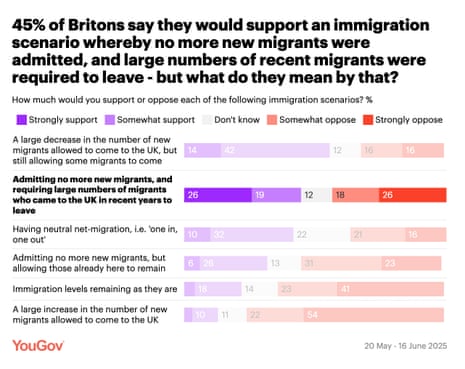
YouGov describes this as “extraordinary”. Advocating for migrants who settled in the UK for years to leave is a policy that has not been supported by anyone in mainstream politics for decade, and even now it is a cause that is principally being championed by people who are unashamedly racist.
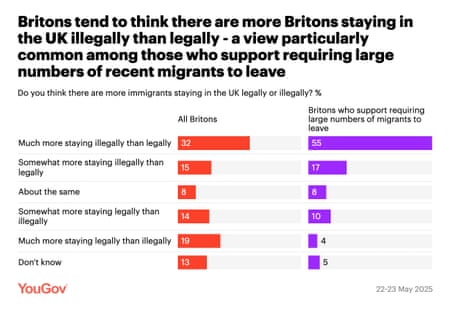
But the YouGov polling also found that almost half of respondents thought there were more immigrants staying in the UK illegally than legally, and that only 19% said that there was “much more” legal than illegal immigration (which is almost certainly the correct answer, even allowing for the very highest estimates of the level of unauthorised migration).
And YouGov established that people saying, wrongly, that there is “much more” illegal migration than legal migration are much more likely to be in the group saying large numbers of recent migrants should be returned.
In his write-up of the research, YouGov’s Matthew Smith says:
Almost half of Britons (47%) think there are more migrants staying in the UK illegally rather than legally … [and] crucially, this view is held by 72% of those who want to see mass removals. However, these perceptions appear to be wide of the mark.
Estimates of the population of illegal migrants living in the UK range from 120,000 to 1.3 million, with Reform UK’s Zia Yusuf recently putting the figure at 1.2 million.
Regardless of which figure from this range is chosen, it does not come close to the number of migrants living in the UK legally, with 2021/2022 census data putting the entire foreign-born population of the UK at 10.7 million.
Although ignorance of the numbers is linked to support for hardline anti-immigration policies, YouGov is not arguing that better public understanding would eliminate all concerns about immigration. It points out that, when asked specifically about legal immigration, a plurality of people say it is too high. And a significant minority of people think even legal migrants have not integrated into British society successfully, YouGov says.
Smith says:
While it is clear that legal migration dramatically outweighs illegal migration, that is not to say that if only the public could be made aware of this fact then immigration would disappear as an issue.
After all, Britons tend to think that legal immigration has been too high as well, and the concerns that many people have extend beyond the economic terms in which immigration is typically justified – anyone seeking to address the issue will need to engage with deeper anxieties about identity, integration, and the perceived erosion of shared national values.
In a post on Bluesky, Alan White, editor of PoliticsHome, says this polling is a terrible indictment of the media.
New YouGov polling. A monumental failure of our political class to educate, a monumental failure of our media to report fairly, for a generation
Key events
National living wage on course for 4.1% increase in 2026, government guidance suggests
The government has today published its 2025 remit for the Low Pay Commission. This sets the guidelines for the commission to follow when it makes its recommendations later in the year for the national living wage (the rate for people over the age of 21) and the national minimum wage (the rate for younger workers) in 2026.
In an analysis, the Resolution Foundation thinktank says the government is adopting
It says:
The new remit again states that the government “is determined to deliver a genuine living wage”.
But despite this ambitious language, the government has again opted for a steady-as-she-goes approach to the adult minimum wage rate for 2026, which is set to rise in line with typical earnings next year. This was also the approach taken to the 2025 uprating. Similarly, despite a bold pledge to get rid of minimum wage rates for younger workers (under the age of 21), which the government says are “discriminatory”, worrying economic data means reality may be less spectacular. The government has asked the Low Pay Commission to consult on changes in the rate for 18-to-20 year olds, which suggests the 18-to-20 year old rate is set for a smaller increase in 2026 than the large 16.3 per cent increase this year.
Given current forecasts for wage growth and the government’s policy announced today, the Low Pay Commission have said they currently expect the National Living Wage (the NLW – which applies to workers aged 21 and above) to reach £12.71 in April 2016, an increase of 4.1 per cent. This would be a smaller cash increase than all but one year (2021) in the post-2015 National Living Wage era.
UKHospitality, the trade body representing the hospitality industry, has urged the commission to be cautious about the rate at which it raises the living wage. Kate Nicholls, its chair, said:
With significant new costs, such as the increase made to employer national insurance contributions, already hitting businesses hard, any significant wage hike may cost jobs. We urge the Low Pay Commission to recognise these cost pressures and recommend a more gradual and sustainable increase this year.
Regrettably, escalating employment costs are already forcing businesses to reduce staff hours and, in some cases, make redundancies. Across the board, the labour market indicators are flashing red, and the Bank of England has also repeatedly voiced concerns about a potential wage-price spiral fuelling inflation. Inflating wages too far, too fast, would be counter-productive, resulting in fewer people earning a little more, but many more facing job losses or reduced hours, ultimately undermining the goal of putting more money in people’s pockets.
Danny Shaw, the former BBC home affairs correspondent who is now a commentator (and who briefly worked for Yvette Cooper as an adviser), has also been looking at the veracity of Robert Jenrick’s claim about asylum seekers being disproportionately likely to be sex offenders. (See 3.42pm.) Like the BBC’s Robert Cuffe, he does not think the figures Jenrick is using are reliable. He has explained why in a thread on social media.
Here are some more pictures from Kemi Badenoch’s visit to a farm in Essex today.
Badenoch calls for ‘full transparency’ about crime suspects – as Tories criticised over claims linking migrants to sex offences
This morning Yvette Cooper, the home secretary, confirmed that the government is cautiously in favour of getting the police to release more information about the ethnicity or immigration status of people who have been charged. Under current guidance, this morning is not normally released. (See 9.54am.)
Kemi Badenoch told journalists today that she wanted “full transparency” in this area. She said:
We should know the ethnicity and the nationality of suspects, of perpetrators, of victims. There shouldn’t be anything to hide.
People will start losing faith in the justice system, in the police, if they feel that things are being hidden. So I would like to see full transparency as much as possible.
Pressure for the routine release of infomation like this is coming in particular from rightwing politicians, in the Conservative party and Reform UK, who believe that asylum seekers are disproportionately likely to engage in criminal behaviour, particularly sexual offending. This is now official Conservative party thinking, and it is a key Reform UK message, as the party illustrated at a press conference yesterday.
Yet Amnesty International UK has warned disclosing information like this after suspects have been arrested could inflame racism. Responding to Cooper’s comments on this, Alba Kapoor, racial justice lead at Amnesty International UK said:
The racist riots of last summer show how exactly how focus – true or false – on a suspect’s ethnicity or immigration status can become a lightning rod for racist sentiment.
Yet almost exactly a year on, the government is choosing to pour fuel on the fire of dangerous narratives, instead of taking action to address racism and hostility. Moreover, the release of this data could further amplify entrenched racism in the police service, as outlined in the Met’s recent Casey Report.
There has also been criticism of the statistics cited by the Tories and Reform to justify their concerns on this. Yesterday Robert Jenrick, shadow justice secretary, claimed that foreigners committed 40% of sexual crimes in London last year, despite comprising 25% of the population, and that groups like Afghans and Eritreans were 20 times more likely to commit sexual offences than British nationals.
Speaking on Radio 4 yesterday, Robert Cuffe, head of statistics at the BBC, said the figure relating to crime in London was “probably an exaggeration”. He explained:
The figures come from the Metropolitan police. The Centre for Migration Control got a Freedom of Information request from them, and they do indeed show that 40% of people proceeded against for sexual offences last year were foreign nationals.
“Proceeded against” – that’s charged or cautioned, not necessarily convicted.
So [Jenrick’s] wrong to say it’s 40% of crimes committed.
But there’s a more important caveat to bear in mind. Analyses like these that look at the number of crimes or charges against the share of the population – they’re missing a really important factor – age. Younger men are more likely to commit or be charged for these types of crimes, and foreign nationals are more likely to be young.
So if you did a proper analysis that really took account of those differences, the gaps would look a lot smaller.
I’ve been talking to people in the field who don’t have an axe to grind, and they say of course it’s possible that there’s something here, these just aren’t the data to tell us.
Cuffe said the second claim, about Afghans and Eritreans being 20 times more likely to commit crimes than Britons, was much more problematic.
He explained:
For this one, I think you’re on much, much, much shakier ground, because all of the problems [with the previous figures] apply here, and some more as well.
Foreign nationals are also less likely to show up in the population stats, because, for example, the ONS don’t go to communal establishments like migrant hostels.
That’s not too big a deal if you’re looking at the share of population as a whole. But if you’re looking at just Eritreans, who account for less than 1% of these offences, or Afghans, then those differences become really, really important. If you miss a small number of people, it can have an outsized effect.
So those numbers like 20 times more likely – run a mile from those.
On the blog yesterday I also highlighted a very good Substack analysis by Emma Monk dismantling Tory claims about asylum seekers being disporportionately criminal.
Kemi Badenoch has restated her opposition to Keir Starmer’s plan to recognise Palestinian statehood. Speaking to reporters on a visit to Essex, she said:
Hamas is a terrorist organisation. We should not be creating a new terrorist state. This is basic stuff, and I don’t understand why Keir Starmer doesn’t understand that …
We’ve been seeing images of a hostage who looks like he’s being starved to death, forced to dig his own grave. This is what Hamas is about.
Now is not the time to reward them for their atrocities and for the massacre they committed on October 7 by giving them statehood recognition.
The Green party has joined Jeremy Corbyn in protesting about the prospect of allotments being sold off. (See 1.15pm.) In a statement responding to the story, the Green peer Jenny Jones said:
Allotments are valuable spaces to promote physical and mental health, help with local food security, encourage a gift culture amongst allotment holders and their neighbours, and offer a sanctuary for nature. Labour should know that they are especially important for people who don’t have the privilege of their own garden, i.e. many of those who vote – or used to vote – Labour.
This policy is another sign that Labour knows the price of everything but the value of nothing. Cash-strapped councils need to be offered proper funding by central government, not pushed into selling off these vital community assets.
Badenoch rejects claims Tories are to blame for backlog in asylum system
Kemi Badenoch has rejected claims that the Conservative party is to blame for the backlog in the asylum system.
Ministers regularly claim that they inherited a “broken” asylum system and that one reason why so many asylum seekers are having to be housed in hotels is because the last government stopped processing claims while it focused all its efforts on trying to launch its Rwanda deportation scheme.
But, on a visit in Essex, Badenoch told journalists she did not accept this case. Asked if she accepted that her party was “partly” to blame for the problem, she replied:
No I don’t accept that at all, because what Labour are doing is just rubber-stamping all of the applications and saying they’re processing.
We need to make sure that when people come to our country illegally, they are deported.
That is our policy. And what we’re seeing right now is an explosion in the use of these hotels because Labour have failed to stop the boats.
The reason why they’ve failed to stop the boats is because they have scrapped the only deterrent that this country had, which was the Rwanda plan.
Here is a chart from a Home Office report showing how the asylum application backlog grew over the past decade.
She also claimed that the “one in, one out” returns scheme with France about to come into force would make no difference to small boat arrival numbers. She said:
This is not going to make any difference whatsoever. 50, at best, migrants being swapped with France is not going to stop the boats.
The thing that would stop the boats was a deterrent. A Rwanda plan, which we had, processing people in a third country, and if they got asylum, keeping them there, is what would have stopped people trying to come to the UK to claim benefits.
Jeremy Corbyn warns new rules on council asset sales threaten allotments
Jeremy Corbyn has criticised Angela Rayner, the local government secretary, over changes that will allow councils to sell allotments to fund day-to-day spending, saying it “makes the future of these precious spaces even more perilous”, Jessica Murray reports.
50% of Reform UK supporters back Online Safety Act, despite party’s pledge to repeal it, poll suggests
Priya Bharadia
Priya Bharadia is a Guardian reporter.
Some 59% of the British public support the Online Safety Act, with seven in ten (71%) saying they prioritise protecting children over free expression and privacy, according to polling by More in Common.
Reform UK voters are the most divided voter group about the legislation. But even though Nigel Farage, the party leader, has pledged to repeal the legislation, 50% of his supporters back the law, while 32% are opposed.
Meanwhile, 71% of Labour voters support the new measures, according to the poll.
Reform voters are also the most likely (25%) voter group to have a virtual private network (VPN) installed on their phone – which could allow the user to circumvent age verification online – compared to 18% of the wider British public.
However, seven in ten Britons are also worried about political content being restricted by social media companies under the law, rising to 83% among Reform voters.
Louis O’Geran, the research and communications associate at More in Common, said:
At first glance, the Online Safety Act looks like a public opinion win.
But beneath the headline support there are real concerns about how the policy will work in practice.
However, Britons think it is worth the trade offs to protect children – prioritising this over freedom of expression or online privacy.
Plaid Cymru marks its centenary saying it is ready to save Wales from ‘failure under Labour or chaos with Reform’
Plaid Cymru, the Welsh nationalist party, is celebrating its centenary today. In a statement to mark the occasion, Rhun ap Iorwerth, the party leader, says Plaid “has remained true to its values whilst other parties have compromised on theirs in the pursuit of power” – in which could be seen as a reference to the fact that, while Plaid has held power at local government level, it has never led a government in Cardiff.
As Bethan McKernan, the Guardian’s Wales correspondent, explains in an interview with ap Iorwerth, that could change in next year’s Senedd elections. Ap Iorwerth tells her:
Wales gave Keir Starmer his big majority but I don’t think [voters] expected this barrage of bad policy, passing on the cost of the failures of successive governments to the most vulnerable.
There is an appetite for breaking that cycle like never before and Plaid Cymru is ready to deliver.
In his statement to mark Plaid’s centenary, ap Iorwerth says:
Next year’s Senedd election offers an opportunity to bring about real change. That change of leadership for Wales is essential if we are to safeguard our nation’s future from years of failure under Labour or self-serving chaos with Reform.
Plaid Cymru is focused on offering the people of Wales the kind of leadership they need and deserve. An ambitious government with fresh ideas on how to cut waiting lists, help households with the cost-of-living, support businesses and ensure that Wales’s voice is not ignored by Westminster.
Whether on HS2, welfare, control over our natural resources or the age-old injustice of how Wales is funded, no London-based party has ever put Welsh interests firsts. That is why Plaid Cymru is different.
Sunder Katwala, director of British Future, a thinktank focusing on immigration and identity, has an interesting thread on Bluesky looking at the YouGov immigration polling. (See 12.25pm.) He is interested in what it reveals about the extent of support for racist/extremist views. He says he is concerned that, with one of the findings suggeesting at least 10% of Britons would support the removal of migrants who have been granted British citizenship, this shows “there is very little challenge in national politics to a concerted attempt to mobilise racist concerns on immigration.”
Support for hardline anti-immigration policies linked to ignorance about migration figures, poll suggests
YouGov has released detailed polling on attitudes to immigration that shows a clear link between having hardline anti-immigrant views and being ignorant about the level of illegal immigration into the UK.
It is well known that many people massively over-estimate the extent to which irregular migration contributes to the overall net migration figures, which reached a record high of 900,000 in the year ending June 2023.
The confusion is partly explained by the huge media and political attention given to people arriving illegal in the UK on small boats. But the annual small boat arrival figure has never been higher than the 46,000 total it reached in 2022 – although it is on course to pass that this year.
The YouGov polling suggests that, while cutting migration numbers signifcantly but still allowing some migrants into the country is the policy with most support (very broadly, this is also what Labour and the Tories advocate), almost half of voters either strongly (26%) or somewhat (19%) support “admitting no more new migrants and requiring large numbers of migrants who came to the UK in recent years to leave”.
YouGov describes this as “extraordinary”. Advocating for migrants who settled in the UK for years to leave is a policy that has not been supported by anyone in mainstream politics for decade, and even now it is a cause that is principally being championed by people who are unashamedly racist.
But the YouGov polling also found that almost half of respondents thought there were more immigrants staying in the UK illegally than legally, and that only 19% said that there was “much more” legal than illegal immigration (which is almost certainly the correct answer, even allowing for the very highest estimates of the level of unauthorised migration).
And YouGov established that people saying, wrongly, that there is “much more” illegal migration than legal migration are much more likely to be in the group saying large numbers of recent migrants should be returned.
In his write-up of the research, YouGov’s Matthew Smith says:
Almost half of Britons (47%) think there are more migrants staying in the UK illegally rather than legally … [and] crucially, this view is held by 72% of those who want to see mass removals. However, these perceptions appear to be wide of the mark.
Estimates of the population of illegal migrants living in the UK range from 120,000 to 1.3 million, with Reform UK’s Zia Yusuf recently putting the figure at 1.2 million.
Regardless of which figure from this range is chosen, it does not come close to the number of migrants living in the UK legally, with 2021/2022 census data putting the entire foreign-born population of the UK at 10.7 million.
Although ignorance of the numbers is linked to support for hardline anti-immigration policies, YouGov is not arguing that better public understanding would eliminate all concerns about immigration. It points out that, when asked specifically about legal immigration, a plurality of people say it is too high. And a significant minority of people think even legal migrants have not integrated into British society successfully, YouGov says.
Smith says:
While it is clear that legal migration dramatically outweighs illegal migration, that is not to say that if only the public could be made aware of this fact then immigration would disappear as an issue.
After all, Britons tend to think that legal immigration has been too high as well, and the concerns that many people have extend beyond the economic terms in which immigration is typically justified – anyone seeking to address the issue will need to engage with deeper anxieties about identity, integration, and the perceived erosion of shared national values.
In a post on Bluesky, Alan White, editor of PoliticsHome, says this polling is a terrible indictment of the media.
New YouGov polling. A monumental failure of our political class to educate, a monumental failure of our media to report fairly, for a generation
Holyrood should do more to help people combine being MSPs with being parents, says deputy FM Kate Forbes
The Scottish parliament should make it easier for people to combine being a parent with being a politician, Kate Forbes, the deputy first minister, has said.
Forbes announced yesterday that she is quitting as an MSP at the Holyrood elections next year because she wants to spend more time with her young family.
In an interview with Radio Scotland today, Forbes said there were many MSPs who faced similar choices. She said:
I’m not the first and, unless anything changes, I’m unlikely to be the last.
So many parents know the pressures and the guilt of balancing all of this, and I’m totally in the same camp as them.
As PA Media reports, Forbes said that for her there was the added stress of having one of Scotland’s most northern constituencies, meaning an “eight hours return trip to my place of work” and sometimes “a minimum three to four hours drive across the constituency before the day even begins”.
Holyrood should offer more help, she said.
There are some areas I think the parliament could do more and do better.
As an example, Forbes cited the Holyrood creche – a service which was seen as a sign of the more family-friendly ethos but which is only available for three hours per day, three days a week.
I don’t know anybody who only works three hours per day, so that doesn’t make sense.
I’m certainly not advocating for the job to be any less demanding or any less all-consuming, it has to be by its very nature of representing people.
But if we can’t even get some of the basic support right, then it will always be difficult for mums and dads.
In her interview, Forbes also said she was not ruling out a return to politics eventually, saying that “maybe” she would consider such a move in the next 20 years.
Prison overcrowding crisis so severe under Tories officials thought collapse would lead to public inquiry, report says
The criminal justice system was within days of collapse on three occasions before being bailed out by “last-minute emergency measures”, an independent review has found. Rajeev Syal has the story.
Here is the report, from a review led by Dame Anne Owers, a former chief inspector of prisons. And here is an extract which reveals that the crisis was so bad under the last government that officials feared it would lead to a public inquiry into why the criminal justice system had collapsed.
In May 2024, following the announcement of a general election, an official-level COBR [or Cobra – government emergency committee] meeting was convened to discuss contingency plans in case the criminal justice system collapsed during the election campaign because prisons were unable to take in any more prisoners. This could involve invoking emergency powers under the Civil Contingencies Act 2004 to release prisoners early, in order to avert the risk of public disorder. Those meetings and discussions continued throughout the election period.
The risk was real: at one point there were fewer than 100 places in adult male prisons. However, the system had in fact been in crisis for over eighteen months. From 2023 onwards, prisons were running very close to the edge of capacity. On three occasions, this was only pulled back at the last minute by the use of early release schemes, gradually decreasing the amount of time many prisoners spent in custody, using powers designed to allow release on compassionate grounds. Senior officials were so concerned about a potential breakdown in the criminal justice system that an audit was kept of all decisionmaking and documents, in case there was a public or parliamentary inquiry.
Cooper defends banning Palestine Action
Yvette Cooper, the home secretary, has defended her decision to ban Palestine Action as a terrorist group.
The decision has been widely criticised and a demonstration against the move is planned for this weekend.
Asked about the issue on LBC, Cooper said:
The proscribing process is based on very extensive security advice and security assessments to me as home secretary, which I have to take immensely seriously. That security assessment looks at the violent attacks, injuries, attacks on national security infrastructure, and also includes assessment and some really troubling information that refers to future attack planning as well. That’s the basis on which this organisation has been proscribed.
And let’s be clear, this is a narrow organisation. This is not about protesting about Palestine, which huge numbers of people lawfully do.
I understand there are people who don’t really know the details of this organisation, who may be thinking about protesting, but who don’t know [full details]. What I would say to them is more information is likely to be revealed about this organisation as various trials go through the legal system. And, really, this is not a non-violent organisation.
Blair pays tribute following death of Tom Sawyer, saying former general secretary ‘instrumental’ in Labour’s 1997 victory
Keir Starmer has led tributes after the death of former Labour party general secretary Tom Sawyer.
Tony Blair, who recruited Sawyer as Labour’s general secretary in 1994, said he was “instrumental” in helping the party to win in 1997. In his tribute Blair said:
Tom Sawyer was the embodiment of strong but serious trade unionism allied to a brilliant understanding of the aspirations and values of working class Britain. He was an outstanding National Union of Public Employees officer, a great member of the Labour party national executive and in 1994 upon becoming Labour leader I was able to persuade him to take on the role of general secretary of the party. He was instrumental both in making the changes which Labour desperately needed to transform itself and in the landslide 1997 election campaign.
He was loyal, tough and deeply committed to ensuring the Labour party could govern for a time long enough to change the country.
He was also one of the nicest people you could meet and stayed true to himself and humble all the way through a remarkable career.
And this is from Alastair Campbell, who was Blair’s communications chief in No 10.
Tom Sawyer RIP. Tom was a crucial part of the New Labour team from 94 through to the landslide win and beyond. It was not easy being general secretary when some in the party and many in the unions thought we were changing the party too much. But Tom never lost his nerve or his cool with anyone. He was a team player and a man whose judgement and character were strong. Really sad to hear of his passing. Love to Liz and the family.
Cooper declines to say how many people will be returned to France under ‘one in, one out’ treaty
In interview this morning Yvette Cooper declined to say how people arriving on small boats arriving in the UK would be removed every week under the “one in, one out” treaty with France. The government had not put numbers on this, she said. But she said she expected the numbers to “start lower and then build”.
On ITV’s Good Morning Britain, the presenter, Kate Garraway, asked if Cooper if she meant the numbers would start below 50 per week, and build up to that figure, or start at 50 per week, and build from there. Cooper replied:
Start lower than where they will finally end up.
Guidance on police disclosing suspects’ ethnicity should change, Cooper says
Official guidance should change to permit police to release the ethnicity or immigration status of criminal suspects, the home secretary, Yvette Cooper, has said. Jessica Elgot has the story.
Yvette Cooper says shallow water launches and overcrowding explain why small boat arrival numbers still rising
Good morning. Keir Starmer has invested a lot of effort in measures that will “smash the gangs” and today the government is announcing the start of one of his big achievements in this area – a returns agreement, of sorts, with France. It is only a pilot, and the numbers are likely to be small, but the Conservatives never negotiated a deal of this kind when they were trying to stop small boat arrivals. (In fact, as a result of Brexit, they achieved the opposite.) Here is Jessica Elgot’s story about the deal.
And here is the Home Office news release.
Yvette Cooper, the home secretary, has been speaking to broadcasters this morning. In media interviews, some politicians are keen to go on the offensive, by opening up new arguments or lines of attack. Cooper is the ultimate defensive player, smothering all awkward questions with splurge of officious, technocratic reasonableness. Journalists find it frustrating, because she tends to be a bit boring, but government spin doctors are happy because she never messes up.
When Starmer and Emmanuel Macron announced the “one in, one out” pilot last month, details about how it would work were sketchy. In her interviews this morning, Cooper did not reveal anything new about how the scheme would operate, arguing that, if she were to release this information, that might help the people smugglers evade the new regime. It has been widely reported that the scheme will start with about 50 people being removed per week, but Cooper would not even confirm this. On numbers, she told the Today programme:
We are not putting an overall figure on this programme. Of course, it will start will lower numbers and then build, but we want to be able to expand it. We want to be able to increase the number of people returned through this programme.
But Cooper did try to counter the key charge being thrown against the government – that all the “smash the gangs” measures it is announcing are failing, because small boat arrivals are at record numbers.
On the Today programme, when she was asked why arrival numbers have been soaring over the past year, Cooper cited two reasons. She said:
What we’ve seen in the course of this year has been the change in tactics by the criminal gangs, and they’ve been doing two things.
First of all, exploiting the French maritime rules, which have meant up until this summer that the French authorities just could not intervene in French waters. That’s why we’ve seen these disgraceful scenes of the loading of people into small boats in shallow waters, and then the French police unable to intervene according to their rules.
And that’s why it’s so important that, as part of this agreement with France, France is changing their maritime rules, and that will be starting later this summer.
The second reason is we’re seeing [a] big increase in the overcrowding of the boats, so far more people being crammed into the boats.
That is why we are seeking to change the law. We have the new border security bill going through parliament at the moment, bringing in the new offence of endangerment, so that people who are getting on overcrowded boats who are frankly putting other people’s lives at risks can themselves be prosecuted for getting on these overcrowded boats. Because it’s those two factors that are particularly driving this.
By citing these two factors as the explanation, and stressing that the government is addressing them, Cooper was implying that the government will be able to reduce arrival numbers.
The Conservatives claim that she is wrong because only a Rwanda-style deterrent policy would work. In an overnight press notice, the party descibed the UK-France deal as the “migrant surrender treaty” (using Boris Johnson’s inflammatory Brexit rhetoric) and Chris Philp, the shadow home secretary, said:
Returning just 50 illegal immigrants a week, and probably less, will make no difference whatsoever. This amounts to just 6% of illegal arrivals. Allowing 94% to stay in the UK will be no deterrent at all. This is a gimmick which won’t work.
The Rwanda removals deterrent, under which 100% of illegal arrivals would be removed, was ready to go last summer but Labour cancelled it just days before it was due to start with no proper replacement plan. As a result, this year so far has been the worst ever for illegal immigrants crossing the channel.
Only removing all illegal immigrants upon arrival will provide the necessary deterrent to stop the crossings. This is the Conservative plan, but Labour is too weak to implement it and as a result they have lost control of our borders.
It’s August, parliament is in recess, and there is almost nothing in the diary for today. This morning the Home Office will publish the text of the “one in, one out” returns treaty with France. And Kemi Badenoch is doing a visit in her North West Essex constituency, where she will be restating the Tories’ opposition to what they call Labour’s “family farm tax”.
If you want to contact me, please post a message below the line when comments are open (normally between 10am and 3pm at the moment), or message me on social media. I can’t read all the messages BTL, but if you put “Andrew” in a message aimed at me, I am more likely to see it because I search for posts containing that word.
If you want to flag something up urgently, it is best to use social media. You can reach me on Bluesky at @andrewsparrowgdn.bsky.social. The Guardian has given up posting from its official accounts on X, but individual Guardian journalists are there, I still have my account, and if you message me there at @AndrewSparrow, I will see it and respond if necessary.
I find it very helpful when readers point out mistakes, even minor typos. No error is too small to correct. And I find your questions very interesting too. I can’t promise to reply to them all, but I will try to reply to as many as I can, either BTL or sometimes in the blog.
#Support #hardline #antiimmigration #policies #linked #ignorance #migration #figures #poll #suggests #politics #live #Politics