wellnessfitpro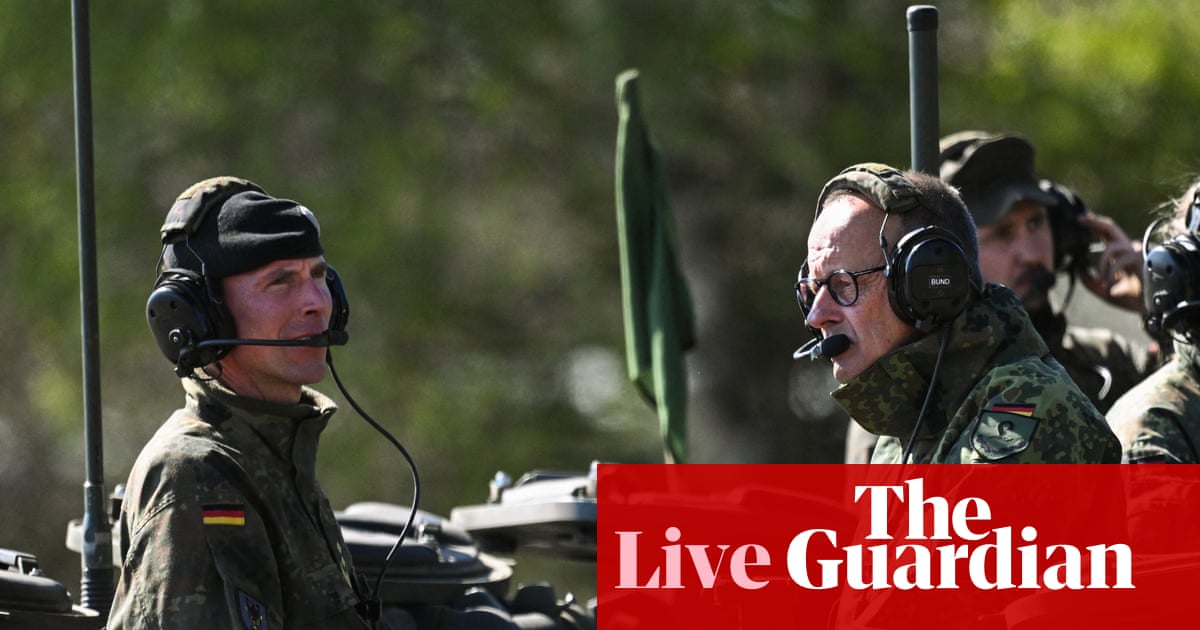
Merz strikes different tone on Iran as he stresses links with US, Nato during army visit
In the last half hour, Merz gave a brief press statement after his visit to the German army in Munster, in which he called for “a reliable transatlantic partnership” – without offering a direct response to Trump’s comments overnight.
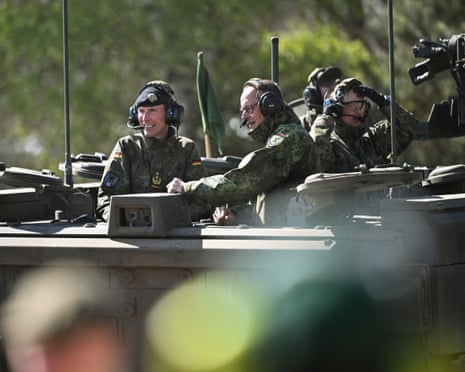
But indirectly there was a lot there that will be read as his indirect response, as he repeatedly stressed the importance of the partnership with the US, of Nato, and of common transatlantic goals.
Merz talked at length about the task of reforming the Bundeswehr to be ready to “fight tonight,” and “prepare for the challenges of tomorrow and the day after.”
He repeatedly and pointedly stressed Germany’s commitment to “a strong, united Nato,” and noted joint work conducted with the US and other Nato allies. A senior US Armed Forces commander was in Muster just yesterday, he noted.
On Iran, he struck a notably different tone than earlier this week (10:01, 10:18), putting the pressure solely on the regime, and saying it “must come to the negotiating table” and “must no longer take the region and ultimately the world hostage” to its interests.
On Iran, he said, Germany worked “in close contact with our partners,” including – again, specifically singed out – Washington and the US.
“We do this in our common transatlantic interest, with mutual respect and fair burden sharing,” he said.
He added that the German position was aligned with the focus on “a strong Nato and a reliable transatlantic partnership,” which he stressed was “particularly close to my heart.”
Key events
In other Hungarian issues, my Brussels colleague Jennifer Rankin has asked the commission for its response to the European parliament’s blistering criticism of Hungary’s commissioner Olivér Várhelyi (Europe Live, Wednesday).
Várhelyi was nominated for the post by the outgoing government led by Viktor Orbán, and given the incoming administration’s view of such appointments, his future could be uncertain.
But asked if the commission had confidence in him in light of the parliament’s criticism, the chief spokeperson Paula Pinho insisted that was the case.
“I can say that the president has confidence in all the members of the college. So there’s no news.”
The Commission was also asked about yesterday’s meeting of Hungary’s incoming prime minister, Péter Magyar.
But we didn’t get much more than what we saw in yesterday’s social media posts from Magyar and the EU’s Ursula von der Leyen.
The pair focused on “the steps which are necessary to unlock the EU funds which are earmarked to Hungary and have been frozen until now due to corruption issues and rule of law concerns,” the commission’s chief spokesperson Paula Pinho said, with other topics – like the EU’s enlargement – parked for now.
She said the commission saw Hungary dropping its veto on the €90bn loan for Ukraine as “a very welcome” step.
US is a vital partner for Europe’s security, but deployment of US troops is also in US interest, EU says
Meanwhile, the issue of the US deployment in Europe also came up during the European Commission’s daily briefing in Brussels.
“The deployment of US troops in Europe is also in the US interest in support of its global role,” the commission’s lead security and foreign affairs spokesperson Anitta Hipper said.
She added that the US is “a vital partner in contributing to Europe’s security and defence.”
Hipper also pointed out that Germany and other European Nato allies are “increasing their defence spending in an unprecedented pace.”
Merz strikes different tone on Iran as he stresses links with US, Nato during army visit
In the last half hour, Merz gave a brief press statement after his visit to the German army in Munster, in which he called for “a reliable transatlantic partnership” – without offering a direct response to Trump’s comments overnight.
But indirectly there was a lot there that will be read as his indirect response, as he repeatedly stressed the importance of the partnership with the US, of Nato, and of common transatlantic goals.
Merz talked at length about the task of reforming the Bundeswehr to be ready to “fight tonight,” and “prepare for the challenges of tomorrow and the day after.”
He repeatedly and pointedly stressed Germany’s commitment to “a strong, united Nato,” and noted joint work conducted with the US and other Nato allies. A senior US Armed Forces commander was in Muster just yesterday, he noted.
On Iran, he struck a notably different tone than earlier this week (10:01, 10:18), putting the pressure solely on the regime, and saying it “must come to the negotiating table” and “must no longer take the region and ultimately the world hostage” to its interests.
On Iran, he said, Germany worked “in close contact with our partners,” including – again, specifically singed out – Washington and the US.
“We do this in our common transatlantic interest, with mutual respect and fair burden sharing,” he said.
He added that the German position was aligned with the focus on “a strong Nato and a reliable transatlantic partnership,” which he stressed was “particularly close to my heart.”
As we are waiting for Merz’s speech later, I am looking at some recent stories in the German press about Trump’s (repeated) threats to pull out of Germany.
And Süddeutsche Zeitung has this brilliant report from Ramstein, with a local entrepreneur giving them this amazing quote that “without Americans, we would be milking cows again.”
The base has some 8,500 service members – more than the population of the neighbouring town it’s named after – and the US military is the third-largest employer in the Rhineland-Palatinate state, showing the importance of the local economy, too.
Talking to SZ, the local mayor is pretty confident about the future as he points out to the importance of the base and the €1bn US military hospital being built just 10 or so kilometers away.
Well, let’s see.
For what it’s worth, Germany’s Merz is expected to visit the German army this morning and then appear at a public event in Salzwedel later today – around 2pm local time – where he will be taking questions at an event marking the upcoming Local Journalism Day.
But safe to say we can expect some questions to be very much, erm, not local.
I will bring you his lines when we have them.
But Trump’s threats to pull US soldiers from Germany may have limited impact (for now?) given that he has been saying these things for years.
Die Welt notes this morning that he made similar comments already during his first term 2017 to 2021.
It adds that the latest US figures suggested there were some 86,000 US soldiers in Europe, of which some 36,000 to 39,000 in Germany – with 20 bases, the largest of which are in Stuttgart and Ramstein – but these numbers tend to change due to rotations and exercises.
The latest DMDC location report from December had the number at 36,436. That’s easily the largest active duty deployment in Europe, ahead of Italy (12,662), the UK (10,156), and Spain (3,814).
But all of this could change soon as the US is conducting a “global posture review,” which could recommend some movements.

Jakub Krupa
Not that it matters for Trump, but Merz isn’t exactly wrong pointing to the Iran war as at least one of the reasons why the German economy is performing a bit worse than expected.
Just this morning, Germany recorded 0.3% growth for the first quarter of 2026, slightly ahead of the expected 0.2%, with 0.5% forecast for the full year. But as Handelsblatt notes, before the war started, some expectations had been closer to 1% or even higher.
Experts fear that some of the energy cost impacts, for example, are yet to be fully felt.
And the other significant source of, erm, uncertainty is Trump-linked, too – and that’s obviously the continued threat of US tariffs, which affected the automotive industry in particular.
“Wars, geopolitical tensions, trade barriers, tighter regulation, and intense competition are creating headwinds,” Volkswagen’s CEO Oliver Blume explained this morning, AFP reported.
But there is also another part of the equation, with growing focus on Merz government’s track record, as he continues to face criticism over slow pace of domestic reforms.
Germany’s finance minister Lars Klingbeil wrote about the government’s plans in the Guardian last week.
But as the government comes up to its first anniversary in office next week, expect lots of commentary on and scrutiny of what has been actually done.
If you want to catch up with what caused the latest spat between Germany and the US, here’s the video of Merz’s controversial comments from earlier this week.
Which reminds me that he also said the Americans “clearly have no exit strategy.”
Ouch.
Ukraine will ‘clarify’ what Putin’s ‘ceasefire’ proposal is about, Zelenskyy says
Meanwhile, Ukraine’s president Volodymyr Zelenskyy has responded to Trump’s comments after his phone call with Russia’s Vladimir Putin.
In a post on social media, he said he instructed his team to contact Trump’s aides to “clarify the details of Russia’s proposal for a short-term ceasefire.”
“Ukraine seeks peace and is doing the necessary diplomatic work to bring this war to a real end. We will clarify what exactly this is about – a few hours of security for a parade in Moscow, or something more.”
This, obviously, is a swipe at Moscow’s decision to hold Victory Day parade next week with no military hardware because of fears of a long-range attack by Ukrainian drones.
Zelenskyy continued:
“Our proposal is a long-term ceasefire, reliable and guaranteed security for people, and a lasting peace. Ukraine is ready to work toward this in any dignified and effective format.”
Morning opening: What were you saying, Mr Merz?
Jakub Krupa
US president Donald Trump threatened to reduce the number of troops deployed in Germany last night, after chancellor Friedrich Merz said this week that the US was being “humilitated” by Iran.
Trump said the US was “studying and reviewing the possible reduction of troops in Germany, with a determination to be made over the next short period of time.”
Earlier yesterday, he posted a separate criticism of Merz’s Germany, saying:
“The Chancellor of Germany, Friedrich Merz, thinks it’s OK for Iran to have a Nuclear Weapon. He doesn’t know what he’s talking about! If Iran had a Nuclear Weapon, the whole World would be held hostage. I am doing something with Iran, right now, that other Nations, or Presidents, should have done long ago. No wonder Germany is doing so poorly, both Economically, and otherwise! President DONALD J. TRUMP”
His comments come just hours after Trump’s phone call with Russia’s Vladimir Putin, and – which is likely to be of significance – after Merz repeatedly criticised Trump’s decision to start the Iran war and partially blamed it for Germany’s worse than expected economic results.
At a recent meeting with high school students, Merz said that the US was “being humiliated” by Iran’s leadership through taking part in negotiations that come to nothing, and that the war “is costing us a lot of money … and a lot of economic strength.”
“This war against Iran has a direct impact on our economic performance, and for that reason it must be brought to an end as soon as possible,” he said.
Ouch.
He still insisted that his relationship with Trump was good though, but not sure that’s the case any more.
Let’s see if we are going to hear a reaction from Germany today.
Elsewhere, I will look out for comments on Trump’s phone call with Putin – including his suggestions that Ukraine is “defeated” and that Putin was working on some sort of temporary ceasefire.
It’s Thursday, 30 April 2026, it’s Jakub Krupa here, and this is Europe Live.
Good morning.
#Merz #calls #reliable #transatlantic #partnership #Trump #threatens #Germany #troop #reduction #Europe #live #World #news