wellnessfitpro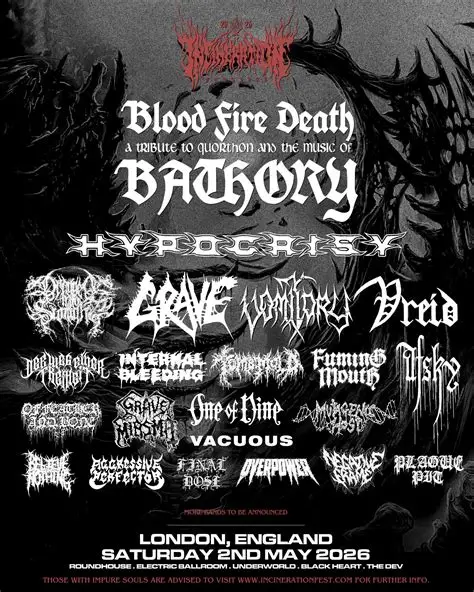
Incineration Festival has fast become one of my annual retreats, a tradition that I am truly privileged to be a part of. It is not just the lineup or the individual performances that make it feel essential, but the sense of continuity it builds year after year, a recurring point in the calendar where everything else briefly falls away and extreme music takes over as both focus and framework. Camden itself becomes an extension of that feeling almost immediately, as though the festival doesn’t arrive so much as gradually takes possession of the area. By the time the first crowds begin to gather, the transformation is already underway, subtle at first but increasingly unavoidable as the day progresses.
But before a single note rang out, Camden itself had already begun to transform. By late morning, the area was awash with black band shirts, hoodies and much-loved battle jackets, each one carrying its own history of shows, tours, and scenes stitched into fabric and fading ink. A slow and steady influx of festival goers seemed to seep into every corner of the district, not as a sudden wave but as a gradual saturation, gathering outside pubs, spilling along pavements, and drifting through the market in loose, unhurried clusters. Their presence was unmistakable but never imposing, more like a shifting current beneath the surface of Camden’s usual rhythm than an interruption to it. What stood out most was the atmosphere: relaxed, friendly, almost disarmingly warm. There was none of the hostility that outsiders might lazily associate with extreme music crowds; instead, it felt like a shared understanding, an unspoken camaraderie between strangers who would otherwise have no reason to cross paths.
This mass of black clad attendees mingled freely with Camden’s usual foot traffic, tourists pausing mid-step casting curious glances, some clearly bemused, others quietly intrigued, as if trying to decode the quiet convergence unfolding around them. The contrast was striking but never uncomfortable, and if anything it added a layer of charm to the day, as two very different worlds overlapped without friction. Laughter spilled out from pub doorways, conversations sparked easily between people who had only just met, and there was a palpable sense of anticipation hanging in the air that seemed to build in waves rather than moments. Camden didn’t just host Incineration Festival this year; it began absorbing it long before the doors officially opened, as if the boundaries between street life and festival space had already begun to blur beyond distinction.
From mid-morning the queues snaked past market stalls and stretched along Camden High Street, folding the entire district into a single, slow-moving current of extreme music culture. Incineration has always thrived on this sense of movement, the constant push and pull between venues, the calculation of whether to stay for one more song or abandon it mid-flow to catch something beginning elsewhere. In 2026 that dynamic felt even more pronounced, almost exaggerated by the density of the day. The Electric Ballroom and the Roundhouse acted like twin gravitational centres, one immediate and compressed, the other vast and echoing, each shaping the music within it in completely different ways. Moving between them wasn’t simply a matter of logistics, it actively reframed how each performance was experienced, as if the physical act of crossing Camden itself altered perception.
That sense of anticipation, however, came with an early complication. A last-minute change to the schedule saw Afsky pull out due to medical reasons, leaving a noticeable gap at the start of the day that immediately altered the rhythm of things. It created a strange early lull where momentum briefly loosened, queues stalled, and people lingered longer than planned, recalibrating their routes and conversations as the day adjusted around the absence. I was genuinely gutted, Afsky had been one of my most anticipated acts and would have been a definite highlight of the day for me, the kind of set I had mentally anchored the morning around. On one hand their absence left a clear structural void in the pacing of the festival’s opening stretch, but on the other it unexpectedly opened up space in a way that felt almost beneficial. It allowed time to drift into The Black Heart for a pint, absorb the atmosphere, and reset before catching Yersin, whose presence would sharply reintroduce intensity into what had briefly become a more fluid and unstructured beginning.
Yersin arrived with a raw, unpolished urgency that felt almost confrontational in its immediacy, as though the set was already in motion before anyone had fully adjusted to it. There was no gradual easing in, no atmospheric build, just a direct and abrasive collision of sound that demanded attention from the outset. The sonic palette leaned heavily into dissonance and unstable rhythmic structures, giving everything a sense of unpredictability that never fully resolved. It constantly felt like it might break apart or collapse into noise, yet it held together through sheer force of intent. Songs didn’t unfold in conventional arcs but instead lurched forward in fractured, jagged segments, each one colliding with the next in a way that felt deliberately unsteady.
What made the set particularly effective in that early afternoon slot was how sharply it contrasted with the more relaxed, conversational energy still lingering outside. Stepping from the pub atmosphere into that kind of concentrated intensity felt like crossing a threshold into a completely different psychological space. The room itself seemed to intensify the experience further, compressing sound and amplifying tension until everything felt tightly contained and immediate. By the end of their set there was a noticeable shift in the room’s energy, not necessarily calmer, but more focused, as if the day had finally begun to commit fully to its own direction.
From there I moved down into The Underworld for Mutagenic Host, who pushed things further into a denser, heavier, and more physically oppressive register of sound. Their performance felt less like a sequence of individual tracks and more like a single, evolving mass of sonic pressure, continuously reshaped but never truly broken apart. The sound was thick, layered, and deliberately suffocating, with guitars and bass merging into a grinding low-end presence that seemed to drag itself forward rather than progress cleanly. Everything felt weighed down by its own density, as though the music was constantly resisting forward motion.
The Underworld’s physical environment amplified this effect significantly. The low ceiling, enclosed walls, and lack of spatial relief turned the set into something claustrophobic in both sound and sensation. Rather than dispersing into the room, the music clung to it, accumulating in corners and surfaces until the entire space felt saturated. Drums hit with blunt force rather than speed or flourish, while vocals emerged from deep within the mix like distant signals buried under layers of distortion. There was no real sense of release, only sustained pressure that built incrementally, turning the act of listening into something closer to endurance than observation.
My Electric Ballroom day started with Der Weg Einer Freiheit, and it felt like an immediate and almost disorientating shift into a more controlled, introspective, and emotionally structured space, especially in contrast to the more abrasive, chaotic, or physically dense performances that had already begun shaping the wider arc of the festival. There was a sense of recalibration in the air from the outset, as though the room itself was adjusting to a different kind of intensity—one built not on impact or sheer weight, but on gradual accumulation, tension, and release. Their Post-Black Metal approach is fundamentally rooted in dynamics, and this was immediately evident in how carefully they constructed their sound, moving between restrained, almost fragile passages and vast, slow-burning crescendos that expanded outward until they filled every corner of the venue.
Rather than relying on immediacy or aggression, the set unfolded with patience and intention, allowing each section to establish its own emotional and structural identity before transitioning into the next. The quieter moments carried a sense of suspended tension, as though the music was holding its breath before release, while the larger passages surged outward with a controlled force that never tipped into excess. This constant oscillation between restraint and expansion gave the performance a strong internal rhythm, one that felt both deliberate and organic, as though it was unfolding according to its own logic rather than any external expectation. As the set progressed, the Ballroom itself seemed to respond to this structure, subtly shifting in atmosphere—filling out with attention during the quieter passages, then tightening collectively during the crescendos as the sound intensified and expanded.
There was also a noticeable shift in the audience’s engagement as the performance developed. What began as a relatively passive reception gradually evolved into something far more focused and absorbed, with attention narrowing as the structure of each composition became more apparent. People were no longer simply reacting to individual moments of intensity, but following the longer emotional arcs embedded within each piece. The music encouraged stillness as much as movement, drawing listeners into its pacing rather than demanding immediate physical response. In that sense, the performance created a shared attentiveness within the room, where the crowd became increasingly aligned not just with the sound itself, but with its underlying structure and intent.
Beneath the surface-level precision of the performance, there remained a clear and persistent emotional current that gave the music its weight and urgency. Despite the technical clarity of the execution, nothing felt detached or mechanical; instead, there was a constant sense of expressive intent running through each transition and dynamic shift. Every build carried with it a sense of inevitability, as though it had been carefully constructed to arrive at that exact point, while every release felt earned rather than automatic or predictable. This balance between control and emotional openness was central to the impact of the set, allowing it to feel both intellectually structured and deeply expressive at the same time.
By the time the performance reached its peak, the entire room had fully aligned with its internal logic, creating a collective focus that felt unusually unified even within the context of a festival environment. There was a shared sense of immersion that extended beyond simple engagement, where audience and performance seemed temporarily bound within the same rhythmic and emotional framework. In that moment, the set established itself as one of the first true turning points of the day, not because of volume or spectacle, but because of the way it reshaped the way attention, time, and emotional progression were experienced within the space.

At the Roundhouse Grave Miasma delivered something entirely different in scale and intent, shifting the atmosphere into something deeply oppressive and ritualistic. Their Death Metal was slow, dense, and heavily atmospheric, but more importantly it was built around accumulation rather than progression. Instead of distinct songs, the set felt like a continuous unfolding of sound, where each passage bled into the next without clear separation, forming a singular, suffocating mass.
The architecture of the Roundhouse played a crucial role in this effect. Its circular structure and natural resonance transformed the music into something almost architectural, as though it was being built within the space rather than projected into it. Low frequencies rolled across the floor and up through the crowd, while higher tones dissolved into a blurred haze that removed any sharp edges from the sound. The band themselves remained visually subdued, reinforcing the idea that presence was secondary to atmosphere. It felt less like watching a performance and more like being enclosed within it. A great success of a much anticipated set.


Back at the Ballroom, Vreid brought a shift in tone that was immediate, unmistakable, and almost refreshing in its contrast to the more oppressive or abrasive sets that had preceded them, injecting a sense of momentum, groove, and outward-facing energy into the flow of the day. Their Black Metal carried a strong sense of forward motion and lived-in confidence, shaped by years of performance experience, and this translated directly into the room in a way that felt both physical and communal. Rather than enclosing the audience in density or force, they opened the space up, allowing air and movement to re-enter the atmosphere of the venue. From the outset there was a looseness in their delivery, not in terms of precision but in attitude and flow, which allowed the set to breathe naturally without ever losing its underlying impact or structural integrity.
That flexibility in pacing became one of the defining features of their performance. They shifted between driving, rhythmic passages and broader, more expansive sections with an ease that felt instinctive rather than calculated, creating a dynamic internal rhythm that kept the set constantly moving without ever feeling rushed. Guitar lines carried a sense of propulsion but also space, allowing riffs to land and resonate rather than simply push forward, while the rhythmic foundation maintained enough weight to anchor everything firmly in place. This balance between movement and stability gave the performance a strong sense of cohesion, where nothing felt isolated or excessive, and every transition felt like a natural extension of what had come before rather than a sharp break or sudden change in direction.
The audience responded almost immediately to this shift in energy, with the atmosphere in the Ballroom becoming noticeably more animated and physically engaged as the set developed. Movement spread through the room in waves rather than concentrated eruptions, creating a more fluid and collective form of interaction that contrasted sharply with the more rigid or explosive responses seen earlier in the day. Heads nodded in unison, bodies shifted in time with the groove, and there was a tangible sense of the crowd leaning into the performance rather than simply reacting to it. The room felt less like a contained space and more like a shared current, carried along by the band’s rhythmic confidence and melodic drive.
Within the performance itself, there was a carefully maintained equilibrium between melody and aggression, with neither element allowed to dominate or dissolve the other. The heavier passages retained enough sharpness and weight to preserve intensity, while the more melodic sections introduced moments of lift and openness that prevented the set from becoming monolithic. This interplay created a dynamic tension that gave the performance depth without sacrificing immediacy, ensuring that the set remained engaging on both a visceral and musical level. At no point did it feel overly restrained or excessively chaotic; instead, it occupied a controlled middle ground that gave it both clarity and strength, allowing each element space to function without overcrowding the overall sound.
By the time the set reached its conclusion, it had established itself as a moment of release within the broader intensity of the day, offering a shift in psychological and physical pacing that felt both necessary and well-timed. It provided a space to recalibrate, to reset after the more oppressive or high-impact performances that had come before, and to prepare mentally and physically for what was still to come. Rather than acting as a peak in itself, it functioned as a pressure valve within the wider structure of the festival, briefly loosening the tension while still maintaining forward momentum.


Vomitory’s set, by contrast, eliminated any sense of transition, pacing, or structural easing entirely, choosing instead to operate in a single sustained register of intensity from the very first moment to the last. It began at full force and remained there without deviation, a continuous surge of old-school Death Metal delivered with unrelenting speed, precision, and an almost mechanical consistency that gave it a relentless forward drive. There was no attempt to build atmosphere or establish gradual escalation; instead, the performance functioned as an immediate and total immersion into velocity and impact, as though the set had already been in motion long before the audience fully registered its beginning.
The effect of this was instantaneous and physical. The room collapsed into motion almost immediately as the first wave of sound hit, with no hesitation or transitional hesitation from the crowd. The pit became a constant, unstable presence almost from the outset, expanding and contracting in unpredictable cycles as the band drove forward without pause or relief. Movement within it was not structured or controlled but reactive, shaped entirely by the force and tempo of the music, which left little space for anticipation or recovery. Everything became compressed into reaction time, with sound and movement locked into a single, continuous feedback loop of aggression and response.
Despite the apparent chaos this created on the surface, the performance itself was executed with striking precision and control. Every riff landed cleanly, every rhythmic shift was sharply defined, and every break or transition—however brief—arrived with clarity rather than confusion. Beneath the overwhelming speed and density, there was a strong underlying structure that held everything together, giving the set a sense of internal order that only became more apparent when observed as a whole rather than in individual moments. This contrast between perceived chaos and actual control gave the performance much of its force, as the sheer intensity never compromised the clarity of execution.
What made the set particularly striking in the context of the day was how completely it altered the perception of time. Rather than unfolding in a recognisable arc, it felt compressed, as though duration itself had been shortened by velocity and repetition. There were no obvious peaks or valleys, no moments of respite or recalibration—only sustained forward motion that flattened any sense of progression into a single continuous block of sound and movement. By the final moments, there was almost no perception of gradual conclusion; instead, the ending arrived abruptly and decisively, followed immediately by a sense of release that felt as sudden as the start had been.


Dragged Into Sunlight pushed the Ballroom into an entirely different psychological and sensory space, one that felt less like a conventional live performance and more like a sustained act of controlled disorientation. From the outset, their presence immediately disrupted any expectation of structure or accessibility, dismantling traditional live frameworks and replacing them with something far more confrontational, unstable, and deliberately abrasive. The stage was engulfed in near-total darkness, with performers often positioned away from the audience or partially obscured, erasing any familiar focal point and forcing attention away from visual anchoring and entirely onto sound. What emerged from that void was not a sequence of songs in any conventional sense, but a shifting mass of sonic violence built from fragmentation, density, and overwhelming, unrelenting force.
Everything about the set actively resisted clarity or resolution, as though any attempt at coherence was being systematically pulled apart in real time. Riffs collided rather than resolved, entering and exiting without warning or conventional structure, while rhythmic patterns fractured, dissolved, and reassembled in ways that denied any stable sense of forward motion. Layers of noise accumulated rapidly, not as embellishment but as structural material, until individual instruments and elements ceased to exist as separable components and instead became part of a single, engulfing sonic pressure system. The result was a sound that felt constantly on the verge of collapse yet never actually broke, sustained by an underlying precision that only became apparent in retrospect rather than in the moment.
Despite the apparent chaos, there was a clear sense of intention behind the violence, a tightly controlled architecture hidden within the apparent collapse of form. It was raw and technical in equal measure, combining extreme abrasion with an almost surgical understanding of timing and density, allowing moments of impact to land with maximum disorientation. The effect was profoundly destabilising, not because it lacked structure, but because that structure refused to reveal itself in any conventional way. Instead of guiding the audience, it overwhelmed them, forcing perception into a narrower, more instinctive mode of engagement where interpretation gave way to absorption.
The audience response reflected this shift almost immediately. Movement diminished, replaced by stillness and fixed attention, as though the usual physical release associated with extreme music had been temporarily suspended. Rather than reacting outwardly, the crowd became internally focused, drawn into the performance in a way that felt more psychological than physical. It was not a shared moment of catharsis, but a shared state of containment, where the weight of the performance pressed inward rather than outward. In the context of the festival, it stood as one of the most extreme examples of how live music can operate not through clarity or connection, but through disruption, force, and the deliberate dismantling of expectation.


Grave followed with a set in the Roundhouse that leaned heavily into weight and deliberate, grinding momentum, creating a stark and immediate contrast with Vomitory’s earlier barrage of speed and relentless forward motion. Rather than chasing velocity or aggression through acceleration, they built their impact through patience and density, allowing each passage to settle fully before the next one arrived. The slower, more crushing approach gave the riffs space to breathe and expand, each one landing with a sense of inevitability rather than urgency, as though the music was unfolding according to its own gravitational logic rather than any traditional sense of tempo or drive. There was a confidence in that restraint, a willingness to let heaviness exist without decoration or excess, trusting its natural force to carry the performance.
In the Roundhouse, that heaviness took on an almost physical dimension, shaped and amplified by the venue’s vast circular architecture and its natural, lingering resonance. The sound didn’t simply fill the space—it accumulated within it, layering itself until it felt embedded in the very structure of the room. Low-end frequencies rolled through the floorboards and up into the bodies of the crowd, not just heard but physically registered, while the upper textures dissolved into a thick atmospheric haze that blurred the edges of individual instruments. The effect was less like watching a band perform and more like standing inside a slowly moving sonic mass, one that pressed outward in all directions without ever breaking its own continuity. The Roundhouse became less a venue and more a vessel for weight itself.
As the set progressed, the atmosphere shifted in response, moving away from the earlier volatility of the day into something more controlled, deliberate, and internally focused. Where other performances had encouraged motion, reaction, or release, Grave encouraged absorption, drawing attention inward rather than outward. Movement in the crowd became minimal and measured, with heads still nodding but now in time with the music’s slow, crushing cadence rather than reacting against it. The sense of collective stillness wasn’t passive, but concentrated, as if the entire room had aligned itself with the pace and density of the performance. There was a quiet intensity in that shared restraint, a different kind of engagement that relied on endurance rather than eruption.
The band’s stage presence reinforced this approach, remaining understated and largely secondary to the sound itself. There was no theatrical framing, no attempt to dominate visually or distract from the music’s internal logic. Instead, they allowed the sonic weight to define the experience entirely, trusting its accumulation to carry meaning without embellishment. In doing so, they created a set that felt cohesive, immersive, and deeply satisfying in a way that didn’t rely on spectacle or escalation. Paired with Vomitory’s earlier assault, it highlighted the breadth and internal diversity of death metal in a particularly effective way, showing how extremity can be achieved through opposite means—one through velocity and impact, the other through density and sustained pressure—both equally valid, both equally powerful when executed


Closing the Ballroom, Hypocrisy delivered a performance that felt expansive, controlled, and deeply assured, operating with the kind of command that comes only from long-standing experience and complete familiarity with both their material and their audience. Their set balanced heaviness with clarity, aggression with melody, and structural discipline with emotional weight, creating a sense of cohesion that felt entirely appropriate for its late position in the day. Rather than relying on shock, excess, or escalation, they worked through refinement and precision, shaping each transition and dynamic shift with careful intent so that nothing felt accidental or overstated. What stood out most was the consistency of their delivery—everything was sharply defined, tightly executed, and yet never sterile, allowing force and detail to coexist without compromising either.
Across the set, they moved fluidly between heavier, more direct material and broader melodic passages that expanded the emotional and sonic range of the performance. The heavier sections carried a deliberate, weight-bearing impact, grounded in rhythmic solidity and guitar tones that hit with clarity rather than blur, while the more melodic moments opened the space of the Ballroom, introducing lift and contrast without disrupting the underlying momentum. This interplay created a dynamic structure that felt carefully paced rather than simply sequenced, as though the set had been designed to guide the room through distinct emotional phases rather than a linear progression of songs. Nothing felt rushed, forced, or overstated; instead, every shift arrived with a sense of inevitability that reflected both confidence and deep structural awareness.
There was also a strong sense of control in how the band managed energy over time. Even as fatigue began to settle into the crowd and the broader intensity of the day started to accumulate, Hypocrisy maintained a steady and unbroken sense of forward motion. They neither overreached nor underplayed, instead occupying a measured middle ground that allowed the performance to sustain itself without strain. This restraint gave the set its strength, ensuring that impact was maintained through consistency rather than escalation, and that emotional weight came through composition and delivery rather than volume or excess. The result was a performance that felt balanced in every sense—sonically, structurally, and emotionally.
It was Swedish Death Metal at its finest, not in the sense of nostalgia or genre shorthand, but in the disciplined, melodic, and structurally refined form that defines the best of the style when executed at this level. There was authority in their performance that required no embellishment, no dramatics, and no external framing; everything was contained within the music itself. By the time the set concluded, the Ballroom felt fully drained yet completely satisfied, as though every thread of tension that had accumulated throughout the day had been gathered, processed, and resolved into a final, coherent release.


Headlining the Roundhouse, and the festival as a whole, Blood Fire Death delivered a set that functioned as both culmination and invocation. The project itself is rooted in Bathory’s most mythic and transitional era, particularly the Blood Fire Death album, which marked Quorthon’s shift from raw early Black Metal into something far more expansive and elemental in scope. Bathory’s influence on extreme metal cannot be overstated, and this project exists as a live reimagining of that legacy rather than a simple tribute.
The ensemble is formed from a rotating collective of musicians drawn from across the Scandinavian extreme metal lineage, including members associated with Enslaved, Mayhem, Watain, and Dark Funeral. Rather than functioning as a fixed band, it operates more like a ceremonial gathering, where identity shifts depending on the role being performed within each piece.
The set opened with ‘A Fine Day to Die’, immediately establishing scale and intent, with Grutle and Kristian sharing vocal duties. From there, the performance unfolded as a constantly shifting reinterpretation of the material, with Erik Danielsson, Apollyon, and Attila each taking key vocal moments that altered the emotional texture of the songs in real time. Each transition subtly reshaped the atmosphere, giving the set a fluid, evolving identity rather than a fixed structure.
The Roundhouse itself became an active component of the performance. Its architecture, resonance, and spatial depth amplified everything, turning riffs into vast, echoing structures and allowing atmosphere to expand outward in all directions. Where earlier sets had focused on immediacy or density, Blood Fire Death operated on a far broader scale—slower, more ceremonial, and more elemental in its pacing. It didn’t feel like a traditional headliner so much as a final dissolution of everything that had come before.
What ultimately defines Incineration Festival isn’t just the quality of the individual performances, but the way they interact across time and space. Moving between the venues, each with their own distinct identity, creates a constantly shifting perspective where each set is shaped not only by the band playing it but by what came before and what comes after. You miss things, you double back, you catch half a set here and a full one there, but that fragmentation is part of the experience. It forces you to engage actively, to make choices, and to accept that you can’t see everything. In return, it offers something rare: a day where extreme music in all its forms is not just presented, but lived, loud, chaotic, and unforgettable.
See you next year Camden.
Related
#Live #Review #Incineration #Festival #Camden #London