wellnessfitpro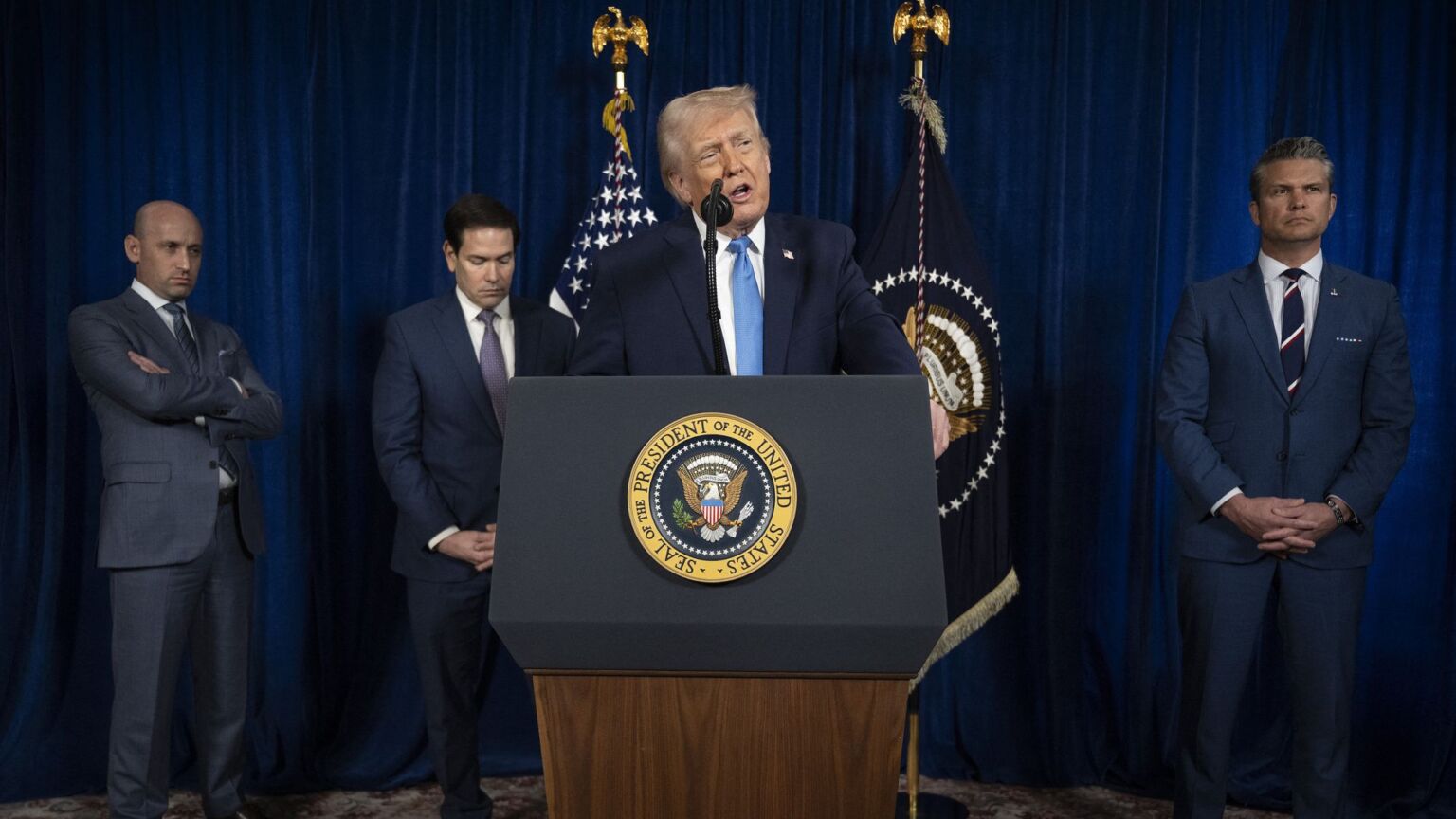
On 3 January, US special forces removed Venezuela’s president and brutal despot Nicolás Maduro from power. A few hours later, at a hastily arranged press conference, US president Donald Trump seemed even more pleased with himself than usual. Perhaps his excitement explains the Freudian slip. ‘I watched last night one of the most precise attacks on sovereignty’, he said, before quickly correcting himself – ‘I mean, it was an attack for justice’. But the truth was out.
This act of what we might call regime tweaking – sending in the US military to remove Maduro while leaving the rest of his retinue and repressive state apparatus in situ – was exactly that: an attack on another nation’s sovereignty. It may have seen off a democracy-denying tyrant. And it certainly didn’t scale the barbaric, interventionist heights of the Clinton-Bush-Obama era – this was no Iraq or Afghanistan or Libya. Nevertheless, it was an attack on a people’s capacity, as restricted and thwarted as that had been by Maduro, to determine their own future. An attack that expressed the right of a powerful external actor to get stuck into the internal affairs of another country.
But Trump’s legion loathers among our political and cultural elites are not seeing the Venezuela intervention as an attack on national sovereignty. No, they’re casting it above all as an attack on the so-called rules-based order itself. An attack on the international laws, norms and conventions that have supposedly governed relations between states around the world for decades.
Trump’s myriad elite detractors tend to trace the rules-based order back to the aftermath of the Second World War. As they see it, this is when the victorious Allies set about constructing an international legal and institutional framework that, in the words of the 1945 preamble to the United Nations Charter, would ‘save succeeding generations from the scourge of war’. The aim, as Article 1 has it, was to develop ‘friendly relations among nations based on respect for the principle of equal rights and self-determination of peoples, and to take other appropriate measures to strengthen universal peace’. To this end, the permanent members of the UN Security Council, comprising the US, the UK, France, Russia and China (yet to be divided by the Cold War), would ‘promote international cooperation in the political field and encourage the progressive development of international law and its codification’.
Up until 1989, this rules-based order (though it wasn’t called that at the time) was limited to the West. It was only after the disintegration of the USSR that this incipient ‘liberal international order’, to use the name given to it in the 1990s by US political scientist John Ikenberry, came into its own. From the moment US president George HW Bush announced the coming of a New World Order in 1991, where the UN-sanctioned rule of law would govern all nations, and then won near unanimous backing for the first Gulf War, more and more of the globe was brought into this order’s legal, political orbit.
New global institutions, such as the World Trade Organisation (1995) and the International Criminal Court (1998), were established, adding to, but never replacing, the UN, the International Court of Justice, the World Bank and the International Monetary Fund. As a result, a class of lawyers, professional experts in international law, grew ever larger, as did globalised NGOs. And they did so under the grand banner of ‘humanitarianism’.
The result of this post-Cold War institution-building, lawmaking and propagandising was what Western elites call the rules-based international order. A system of laws and regulations governing global affairs and supposedly establishing comity between nations. As then British prime minister Tony Blair put it in his famous 1999 speech in Chicago: ‘We are witnessing the beginnings of a new doctrine of international community. By this I mean: the explicit recognition that today, more than ever before, we are mutually dependent [and] that national interest is to a significant extent governed by international collaboration.’ By 2013, then US secretary of state Hillary Clinton was extolling the virtues of a ‘just rules-based international order, a system that [provides] clear rules of the road for everything from intellectual-property rights to freedom of navigation to fair labour standards’.
This, then, is the anti-Trumpers’ much-cherished rules-based order. A system subordinating nations great and small to the rule of international law. A ‘just’ system for the governance of the world. A vast, morally upright legal edifice, built from the ruins of the Second World War, and extended in the aftermath of the Cold War.
And now it is supposedly being wrecked by President Trump and his henchmen. Torn down by the US itself, as if the world’s one-time policeman has suddenly gone rogue.
This view has dominated the political and cultural elites’ response to the Venezuela intervention. ‘By casting off any pretence of adhering to international law and the so-called rules-based order’, runs a piece the New Statesman, ‘Trump is endorsing a dangerous new era of “might makes right”’. He is cementing ‘a new system in which the naked self-interest of two or three “great powers” dominates’ the world, claims a Guardian op-ed. As does a piece in Foreign Policy. Trump has ‘shredded what little is left of international norms and opened the way to new acts of aggression’, it claims.
In fact, everywhere one looks across the media and among mainstream politics, this view predominates. As the BBC has it, Trump is almost single-handedly undermining the West’s ‘commitment to defend democracy, human rights and the rule of law’, and tearing down the ‘rules-based international order, built… by a generation that had come of age during an era of Great Power geopolitics, and had seen that system descend, twice, into catastrophic global conflict’.
There is an acknowledgement among Trump’s myriad detractors that the US and its Western allies have not always adhered to the hallowed rules of the rules-based order in the past. They point usually to the wars in Vietnam and Iraq. Yet they then ultimately dismiss these seeming violations of international law as exceptions that prove the rule, disastrous but aberrational ventures attributable to bad-apple politicians.
So keen are some to vindicate the rules-based past, in order to damn the Trumpian present, that they even express nostalgia for the attempts of Tony Blair and George W Bush to dress up the invasions of Iraq or Afghanistan as virtuous. ‘There were at least concerted attempts to justify unilateral interventions and illegal wars in the name of global security, and even a moral duty to liberate the women of Afghanistan or “free the Iraqi people”’, runs a Guardian op-ed.
But this angry lament for the rules-based order, this misty-eyed invocation of a world governed by the righteous imperatives and humanitarian instincts of international law, is pure myth-making. The order that began to emerge after the end of the Second World War, before consolidating itself as the so-called rules-based international order during the 1990s and 2000s, was not morally righteous, let alone a force for global peace and harmony. It was, rather, an expression of the shifting balance of geopolitical power, from the bipolar, US-vs-USSR Cold War order to its aftermath, the unipolar moment of US-led supremacy. All that is now being hailed as right was always in reality an expression of might.
That certainly goes for the ideology of ‘international law’ and its culmination in the rules-based order. In a national context, the rule of law depends on the existence of a power capable of enforcing it. A power that stands above those subject to the law. In an international context, no such power exists. There are international institutions, from the UN Security Council to the WTO to the International Criminal Court. But these bodies are not independent of the dominant state powers that created them. They have no life or power of their own. They are instruments of, rather than limits on, geopolitical power. And if and when they are formally at odds with the wishes of a powerful state, in particular the US, they are simply ignored.
This isn’t just the view of external critics of what has become known as the rules-based order. It’s the view of some of its earliest architects, too. British political scientist Alfred Zimmern was a driving force behind the League of Nations, the interwar precursor to the UN. But even he admitted that international law was little more than ‘a decorous name for the convenience of the chancelleries’ – that is, a fig leaf for what states might wish to do anyway – which was most useful when it ‘embodied a harmonious marriage between law and force’.
Hypocrisy is inherent to the rules-based order. The laws and rules of the postwar and certainly the post-Cold War order were not drawn up to police the US and its Western allies. They were written to regulate and sanction the behaviour of what were then smaller powers. The talk of acting in the interests of humanity as a whole – the ideology of humanitarianism – didn’t seem to apply to the Western world. It was targeted at despots and dictators in the developing world. The wars waged by the dominant powers in the post-1990s era have invariably been presented as blue-helmeted humanitarian actions upholding international law. It’s the wars waged by anyone else that are condemned as violations of international law. The rules-based order has consistently prohibited others from doing what the US and its allies have been free to do.
Over and over again during the post-Cold War era, this same pattern emerges. A rules-based order that is presented as universal is used for the particular purposes of Western powers. The White House helped set up the International Criminal Tribunal for the Former Yugoslavia, and later the International Criminal Court during the 1990s and 2000s, while exempting Americans from its jurisdiction. So when the US and its NATO allies launched a war on Serbia in 1999, they excluded any of their actions – including the bombing of the Chinese Embassy in Belgrade – from the subsequent war-crimes investigations. This made sense, explained NATO’s press officer at the time, because ‘it was the NATO countries who established the Tribunal, who fund and support it on a daily basis’.
The very idea of the ‘rules-based international order’ is itself a piece of US power projection. The notion of a rules-based system was first talked up during the 1990s by policymakers and academics in relation to trading relationships and the emergent WTO. It was only in the 2010s that leading US politicians started to use variations of the term to refer to the US-led world order as a whole. And they did so as part of an attempt to keep the burgeoning economic powerhouse of China in check. Indeed, as political scientist Jerome Roos shows, US secretary of state Hillary Clinton was using the term ‘rules-based order’ in opposition to China as early as 2011. In a speech on ‘America’s Pacific Century’, she called for the creation of ‘a rules-based order that is open, free, transparent and fair’. In a less guarded moment in 2016, President Obama revealed exactly what a rules-based order really meant: ‘America should write the rules. America should call the shots. Other countries should play by the rules that America and our partners set, and not the other way around.’
Advocacy of the rules-based order – essentially, a technocratic attempt to rein China in – continued into the decadent Biden era. As then secretary of state Antony Blinken put it in 2021: ‘Our purpose is… to uphold this rules-based order that China is posing a challenge to. Anyone who poses a challenge to that order, we’re going to stand up and defend it.’
But by this point, the writing was already on the wall for the so-called rules-based order. A Western-run world no longer reflected the real geopolitical balance of power. European nations and the US itself had been ravaged by the 2008 financial crisis and, by the mid-2010s, were experiencing considerable populist pushback against their failing globalist elites. At the same time, China and India, the two most populous nations in the world, had become economic powerhouses, far outstripping the US and Europe in dynamism. The Indo-Pacific region was already accounting for the majority of global GDP. And Russia, the world’s largest nation, had become increasingly revanchist, annexing Crimea in 2014 while intervening extensively in the Middle East. Add to that the US’s calamitous withdrawal from Afghanistan in 2021, which opened the way for the return of the Taliban, and it was clear that the so-called rules-based order was already unsustainable even as the Biden administration talked it up.
The American might enshrined in the order had long since withered. The tectonic plates of geopolitical power had shifted, tearing at the ground on which the rules-based order was built.
The unravelling of a world order established in the now distant glow of Cold War victory has only accelerated since Blinken’s bout of wishful thinking in 2021. Russia invaded Ukraine in 2022 and China continues to eye Taiwan. And yet, all the while, domestically unpopular Western political and cultural elites, complacent beneficiaries of the era of US-led dominance and globalisation, continue to cling to this fast-vanishing world order like drowning men to a deflating lifeboat. They still talk up international law, invoke the rules-based order. But without American let alone European power to enforce it, it is mere bloviation.
The Trump administration is not then bringing down the rules-based order. It has already fallen. The geopolitical conditions that sustained it no longer pertain. The White House’s intervention in Venezuela and its designs on Greenland are certainly crass violations of national sovereignty. But they are symptoms as much as drivers of a geopolitical struggle to rebalance global power.
As opposed to the globalist nostalgia of the Biden White House, Trump’s iteration is at least candid. As US secretary of state Marco Rubio put it at his Senate confirmation hearing in February, the postwar global order is ‘obsolete’; ‘we must now confront the single greatest risk of geopolitical instability and generational global crisis in the lifetime of anyone alive here today’.
Team Trump followed that up in the dead of night early last month, when it published its National Security Strategy (NSS). There is none of the emphasis on America’s continued leadership of the ‘rules-based international order’ that characterised the last pre-Trump NSS, published at the fag-end of the Obama administration in 2015. No assumption of ongoing US hegemony, of its need to ‘uphold’ existing commitments, ‘affirm’ present arrangements, ‘continue’ the status quo.
Instead, there is a clear awareness that the era of American global leadership has long since passed. That the post-Cold War period during which ‘American foreign-policy elites convinced themselves that permanent American domination of the entire world was in the best interests of our country’ is well and truly over. ‘The affairs of other countries are our concern only if their activities directly threaten our interests’, the new NSS reads
The strategy is naturally shot through with typical Trumpist bombast – you’re never more than five sentences away from a big old boast. But beyond the bragging, there is a clear sense of a historical rupture. A sense of new geopolitical realities, new limits on what the US can do. ‘The days of the United States propping up the entire world order like Atlas are over’, the document asserts (principally in relation to Europe and NATO).
‘Not every country, region, issue, or cause – however worthy – can be the focus of American strategy’, the strategy continues. Trump’s State Department will instead prioritise the countries, regions, issues and causes that are most vital to the US’s own ‘national interest’. There will be no more ‘wasting blood and treasure to curtail the influence of all the world’s great and middle powers’, the strategy states, before adding that the ‘outsized influence of larger, richer, and stronger nations is a timeless truth of international relations’.
The result is a strategic focus on countries far closer to home in the Western hemisphere. The NSS calls this the ‘Trump Corollary’, an abrasive re-assertion of the 1823 Monroe Doctrine, which reserved the US’s right to intervene in the affairs of Latin American countries and the Western hemisphere more broadly, in order to prevent further incursions by foreign powers (back then, the old-world empires; today, China). After this month’s Venezuela intervention, Trump is calling his strategy ‘the Don-roe doctrine’.
Trump’s foreign policy, then, is a reflex response to the crumbling of the post-Cold War world order. An attempt to push back against America’s geopolitical rivals asserting their growing power. A move, in particular, to counteract China’s economic expansion into America’s near abroad. It further confirms – after Russia’s invasion of Ukraine – the emergence of a more open Great Power politics, with all the damage to neighbouring and nearby nations that entails. Sovereign entities, whole peoples, are at risk of being reduced to mere pawns in their nearest great power’s ‘sphere of influence’.
Nevertheless, the smug, centrist attacks on Trump for violating international law, the elite lamentations for a rules-based order routinely flouted by the West, are worse than useless. They obscure the ‘morbid symptoms’ of the decaying post-Cold War order, while ignoring the dangerous reality of a multipolar world struggling to be born.
We need to reckon with this reality. And we need to defend the rights of all peoples to determine their own future. These rights are just as threatened by this new, emergent order as they were by the old, rules-based one.
Tim Black is associate editor of spiked.
#Dont #mourn #fall #rulesbased #order