wellnessfitpro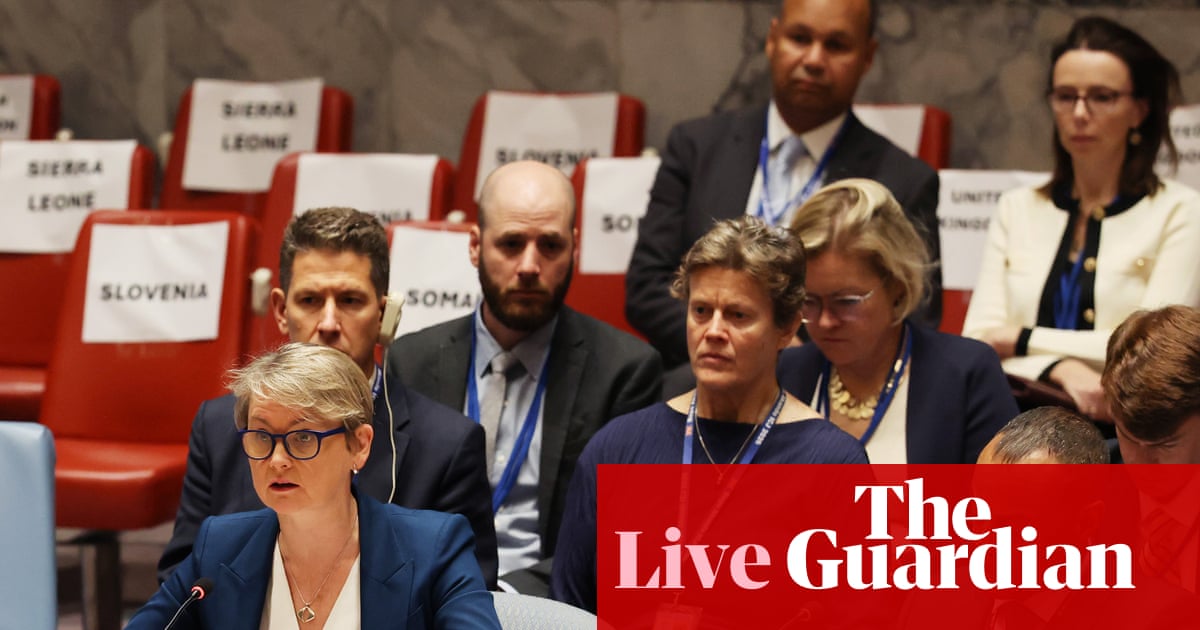
‘If we need to confront planes operating in Nato airspace without permission, we will,’ UK’s Cooper warns, as she warns Putin ot risking armed confrontation with Nato
UK foreign secretary Yvette Cooper is up next.
She says Russia keeps “violating its most basic obligations under the UN Charter” with “escalating” attacks on Ukraine, and “reckless” acts of incursion into Polish, Romanian and Estonian airspace.
“These latest acts are dangerous and reckless.
At worst, they are a deliberate attempt to undermine the territorial integrity of sovereign nations and European security.
They risk miscalculation, they open the door to direct armed confrontation between Nato and Russia.”
In a strong passage, Cooper says that “Nato’s combined strength is unparalleled and its determination to defend peace and security is unshakeable.”
“To President Putin, I say your reckless actions risk a direct armed confrontation between Nato and Russia.
Our alliance is defensive, but be under no illusion.
We stand ready to take all steps necessary to defend Nato skies and Nato’s territory. We are vigilant.
We are resolute, and if we need to confront planes that are operating in Nato airspace without permission, then we will do so.”
She continues:
“Russia’s imperialist warmongering is a threat to international peace and security.
It is a threat to the values and principles that underpin this organisation, this organisation that has done so much to support stability and prosperity these past 80 years, we must counter it for the sake of us all.”
Key events
-
US will defend every inch of Nato territory, US ambassador says
-
Russian diplomat attacks Europe for ‘primitive hatred’ of Russia from ‘small time blinkered russophones’ in Europe
-
‘If we need to confront planes operating in Nato airspace without permission, we will,’ UK’s Cooper warns, as she warns Putin ot risking armed confrontation with Nato
-
‘Three is a pattern,’ Greek foreign minister says of Russian repeated violations of EU airspace
-
‘Russia’s neighbours, not unreasonably, fear they could be next’ after Ukraine, Danish FM says
-
We can’t risk for this situation to ‘spiral out of control,’ senior UN official warns
-
Russian provocations represent ‘destabilising escalation’ that brings region ‘closer to conflict than at any time in recent years,’ Estonia’s foreign minister says
-
UN security council meeting on Russian jets over Estonia to begin shortly
-
Germany’s response to Gaza prompts questions about its relations with Israel
-
German chancellor Merz’s absence at UN general assembly on Palestine prompts questions
-
Thousands protest in solidarity with Gaza on second day of Italian strikes
-
Disruption of European airports confirmed as ransomware attack, ENISA says
-
Poland ready to shoot down objects violating its airspace, PM says, but signals caution when violations are not clearcut
-
‘Irrefutable evidence’ of Russian violation of Estonian airspace, diplomat says
-
Kremlin denies violating Nato airspace, accuses Estonia of ‘escalating tensions’
-
Flight delays continue across Europe after weekend cyber-attack
-
Nato ambassadors to meet for talks on Russian jets in Estonia on Tuesday
-
Russian provocation in Estonia ‘part of pattern of unacceptable behaviour,’ Estonian diplomat says
-
Morning opening: Growing concerns about Russian provocations in eastern Europe
The Korean representative also warns that the Russian incursion inside Estonian airspace “appears to represent a significant breach of the sovereignty of a UN member state,” and it could “further threaten European and international security.”
He notes it was “just the latest occurrence in a series of concerning actions” by Russia.
US will defend every inch of Nato territory, US ambassador says
New US ambassador to the UN, Mike Waltz, is next.
He says that “just nine days ago, this council met to discuss Russia’s violation of Poland’s airspace with a large number of military drones,” and urged Russia “to end the war in Ukraine and stop actions that could risk it escalating into a broader conflict.”
He says that despite that, Russia “again violated the airspace of a Nato member.”
He then says very clearly:
“The United States and our allies will defend every inch of Nato territory. Russia must urgently stop such dangerous behaviour.
He says the US expects Russia to “seek ways to de-escalate, not risk expansion.”
He then forcefully says:
“This event, following on the heels of the Russian drone incursion into Polish airspace creates the impression that Russia either wants to escalate and pull more countries into this conflict with Ukraine, or doesn’t have full control of those who operate its fighter planes and drones.
So either scenario is very disconcerting.”
He ends on a broader point:
“I once again urge Russia, as a permanent member of this Council, to uphold international peace and security, to respect the sovereignty of its neighbours, to cease violating their airspace. And I call on Russia to negotiate directly with Ukraine to end that war.”

Jakub Krupa
I will keep monitoring this debate to bring you more key lines if/when we get them.
Russian diplomat attacks Europe for ‘primitive hatred’ of Russia from ‘small time blinkered russophones’ in Europe
Russia’s representative, first deputy representative Dmitry Polyanskiy, is up next.
He wastes no time and he goes on the attack straight away saying that “gone for good” is the time when Europe was associated with the Renaissance, the enlightenment, culture, and science, as he accuses it of “primitive hatred” of Russia instead.
He says that “Voltaire, Rousseau, Kant” were replaced by “von der Leyens, Kallases, Johnsons and other small time blinkered russophobes.”
“Thanks to their efforts, primitive hatred for our country in an attempt to portray Russia as the main threat to pan-European security is, before our very eyes, becoming the only ideology of European states,” he says.
He says that “all events are immediately interpreted through an anti-Russian prism,” with “the very idea that war with Russia is unavoidable being frantically pounded into the heads of the European populace.
He accuses Europe for “spreading blatant lies” with “paranoia … reaching heights never seen before.”
Going back to the previous UNSC meeting over the Russian drones incursion into Poland, he says Polish accusations against Russia two weeks ago were “groundless” and advanced with “not a single piece of evidence.”
He says Poland rejected the Russian offer to consult on drones, and attacks Warsaw for using it as a “pretext for a new wave of the Russophobia campaign they are engaged in.”
(The Polish foreign minister, Radosław Sikorski, is in attendance today.)
He says the Estonian accusations are part of the same “spectacle entitled ‘blame Russia for everything’.
He insists Russian fighter jets never crossed into Estonian airspace, but conducted a planned flight to an airbase in Kaliningrad, “carried out in strict accordance with international airspace use rules.”
Polyanskiy then goes on fierce attack against Ukraine and Volodymyr Zelenskyy, which he accuses of corruption, theft, violation of human rights, among others.
He then goes back to his original claim that European leaders try to “whip up anti-Russian hysteria,” before extensively quoting JD Vance’s speech at the Munich conference earlier this week and repeating the US vice-president’s point that the main threat facing Europe is “not Russia, not China, but … within.”
“Europe today is like an unhinged, paranoid individual, unable to respond to criticism, nor is it able to remember the lessons of history,” he says.
And so on. I mean, you get the idea.
He ends by saying:
“If you want to get hysterical, to ferment and to continue levy baseless accusations, go right ahead, but do that without our participation.
We won’t be partaking in this theatre of the absurd, and you don’t need us there.
When you decide that you want to engage in a serious discussion about European security, about the fate of our common continent, about how to make this continent prosperous and secure for everybody, we’ll be ready, you know where to find us.”
Speaking on behalf of China, its deputy permanent representative Geng Shuang speaks about “complex and sensitive nature of the current European security situation.”
He says there is an “urgent” need to find “a political resolution to the Ukraine crisis as soon as possible.”
As long as the Ukraine crisis remains unresolved and the war continues, similar incidents are likely to reoccur.
“China urges the party discontent to remain calm and exercise restraint, clarify facts and dispel doubts through dialogue and communication, avoid misunderstandings and misjudgments and prevent the situation from expanding or escalating,” he says.
No condemnation of Russia there, as far as I could make it (through the interpreter).
Somalian representative who followed him struck a similarly cautious tone.
The French representatives makes his comments in a similar vein, as he says:
“France condemns in the strongest terms this dangerous and irresponsible incursion, which constitutes a blatant violation of international law, and we stand firmly alongside Estonia to whom we express our friendship and our full and unwavering solidarity.”
Slovenia’s deputy minister Melita Gabrič is up next.
She says Slovenia condemns “this escalation at a time when tensions are already dangerously high.”
She warns that “these deliverate provocations are symptomatic of the time we live in, a time in which violations of international law are tolerated to an extent we have not seen in modern history.”
“Despite the best efforts by President Trump in Alaska, we still await a meaningful gesture from Russia, a sincere willingness to come to the negotiating table,” she notes.
‘If we need to confront planes operating in Nato airspace without permission, we will,’ UK’s Cooper warns, as she warns Putin ot risking armed confrontation with Nato
UK foreign secretary Yvette Cooper is up next.
She says Russia keeps “violating its most basic obligations under the UN Charter” with “escalating” attacks on Ukraine, and “reckless” acts of incursion into Polish, Romanian and Estonian airspace.
“These latest acts are dangerous and reckless.
At worst, they are a deliberate attempt to undermine the territorial integrity of sovereign nations and European security.
They risk miscalculation, they open the door to direct armed confrontation between Nato and Russia.”
In a strong passage, Cooper says that “Nato’s combined strength is unparalleled and its determination to defend peace and security is unshakeable.”
“To President Putin, I say your reckless actions risk a direct armed confrontation between Nato and Russia.
Our alliance is defensive, but be under no illusion.
We stand ready to take all steps necessary to defend Nato skies and Nato’s territory. We are vigilant.
We are resolute, and if we need to confront planes that are operating in Nato airspace without permission, then we will do so.”
She continues:
“Russia’s imperialist warmongering is a threat to international peace and security.
It is a threat to the values and principles that underpin this organisation, this organisation that has done so much to support stability and prosperity these past 80 years, we must counter it for the sake of us all.”
‘Three is a pattern,’ Greek foreign minister says of Russian repeated violations of EU airspace
Greek foreign minister Giorgos Gerapetritis strikes a similar chord as he says:
“Reckless acts of this kind are not new, but their successive recurrence indicates they are not mere coincidences.
As the saying goes, once is an accident, twice is a coincidence, three is a pattern.”
He urges Russia to “cease these unlawful acts immediately and respect its obligations under international law,” as he notes that “it is evident this new escalation is a direct result of the Russia’s war in Ukraine.”
In a direct appeal to US president Donald Trump, he notes that “these [Russian] violations … contradict the spirit of the Anchorage meeting” with Putin.
‘Russia’s neighbours, not unreasonably, fear they could be next’ after Ukraine, Danish FM says
Danish foreign minister Lars Løkke Rasmussen opens the floor.
He says it was a “reckless and dangerous” violation of Estonian airspace, “penetrating 10 kilometer deep, north of Tallin.”
“Let there be no doubt: I condemn this latest violation of Estonia sovereignty and territorial integrity by Russia. Our support for Estonia remains steadfast,” he says.
He calls out Russian “escalations and provocations” which he says seek to “intimiate countries to stop supporting Ukraine and to test our resolve.”
“Russia clearly feels it can act with impunity in Ukraine, the Baltic Sea, the Black Sea, the whole of eastern Europe,” he warns.
But he says that “Denmark and its allies will not be provoked by Russia.”
“We have seen this playbook before the invasion of Georgia, the annexation of Crimea, the invasion of the Donbas, the full scale invasion of Ukraine. Russia’s neighbours, not unreasonably fear, they could be next,” he says.
“Therefore, we tell the Russian Federation today: step back, step back. Take another path. We will not allow [for] the unravelling of the European security architecture,” he says.
We can’t risk for this situation to ‘spiral out of control,’ senior UN official warns
We are now getting a bit more detail on the incident itself.
According to the Estonian Ministry of Defence, the incursion took place between 9:58 and 10:11am on Friday in the Gulf of Finland in the Baltic Sea, with three MiG-31 fighter jets entering Estonian airspace without permission, with transponders switched off, and with no flight plans.
Italian F-35 fighter jets were scrambled in response.
Presenting the case, UN assistant secretary general Miroslav Jenča notes that Russia denies entering Estonian airspace, but sets out the context of previous Russian violations of Polish and Romanian airspace, too.
He says “this series of recent incidents further underscored the already high tensions that endanger European security as the war continues to rage in Ukraine.”
“The world simply cannot afford such danger to spiral out of control, and for the devastating war in Ukraine to further escalate and expand,” he warns.
Apart from the Security Council members, Estonia, Germany, Latvia, Netherlands, Poland, Romania, Sweden, Ukraine are also invited to join today’s meeting.
EU’s foreign policy chief Kallas is also joining.
The main meeting is about to start shortly as ministers move towards the security council chamber.
You can watch it below, but I will bring you the key lines here.
Russian provocations represent ‘destabilising escalation’ that brings region ‘closer to conflict than at any time in recent years,’ Estonia’s foreign minister says
Flanked by foreign ministers and senior diplomats from other countries, Estonia’s Tsahkna reads out a statement on behalf of 50 countries and the EU condemning the incident in which three Russian fighter jets violated Estonian airspace last week.
He says it was “a dangerous escalation,” and “the fourth violation of Estonia’s airspace by Russia this year.”
“We are here today because this incident concerns not only Estonia, but the entire international community,” he says.
He warns its “part of the wider pattern of Russian provocations against its neighbours.”
“Russia’s reckless actions represent not only a breach of international law, but also a destabilising escalation that brings the entire region closer to conflict than at any time in recent years,” he stresses.
He urges Russia to “cease, without delay, its war of aggression against Ukraine,” and to “end all provocations and threats against its neigbhours’ sovereignty and territorial integrity.”
Tsahkna is making his comments now, surrounded by the EU’s foreign policy chief and former Estonian prime minister Kaja Kallas, and numerous foreign leaders, including Ireland’s foreign minister Simon Harris.
UN security council meeting on Russian jets over Estonia to begin shortly
The UN security council meeting, requested by Estonia, is set to begin at the top of the hour, and we are expecting to hear from the country’s foreign minister Margus Tsahkna very shortly.
I will bring you the key lines from the statement here.
Germany’s response to Gaza prompts questions about its relations with Israel

Kate Connolly
in Berlin
But it is not that Israel’s offensive on Gaza has not sparked huge outrage and condemnation in Berlin. Far from it.
This has been growing over the past few months and led to division even within Merz’s own conservatives, who take their historical responsibility towards Israel especially seriously and some of whom were outraged about restrictions the chancellor recently put on weapons shipments to support the Israeli government.
But Germany’s relationship with Israel remains unique, due to its overwhelming responsibility for the Holocaust in which six million Jews were slaughtered by the Nazis. Israel’s right to exist and its security, it is repeatedly stressed, are anchored in Germany’s own Staatsräson, or reason of state/reason of being.
This is the line the German federal government has emphasised for decades and continues to reiterate whenever its caution over criticising Israel is questioned, even as constitutional experts have increasingly been stressing that this historical responsibility does not and cannot mean unconditionally supporting Israel in everything it does.
In an in-depth report on the subject on public broadcaster DLF, Daniel Marwecki of the University of Hong Kong, who has written a book on the topic called ‘Whitewashing and Statebuilding’, talks of the growing recognition in Berlin that continuing to support the government of Benjamin Netanyahu in particular over his war on Gaza is also in danger of leading to the growing international isolation of Germany and that it will therefore Berlin will be forced sooner rather than later into considering whether it should continue to do so.
In the same broadcast, Ofer Waldman, head of the Heinrich Böll Foundation’s Tel Aviv office, stressed that Germany was learning to recognise that its close relationship with Israel, nurtured slowly over decades, also brought with it a special responsibility to be able to advise Israel in matters related to its own interests.
While acknowledging it was not easy for Germany, carrying as it does the weight of its guilt for the crimes of the Nazi era, to criticise Israel, Waldman said in the context of the current course of action leading Israel into at best “a dead end” at worse “an abyss”, it was relevant and appropriate to ask: “does a true act of friendship and solidarity”, not actually also mean “being able to say to Israel, ‘not like this’?”.
Merz’s non-attendance at the UNGA might also jeopardise Germany’s candidacy for a seat on the Security Council, for which it is effectively competing against Austria and Portugal.
The leaders of those countries will be present and lobbying for votes. This seat will ensure that Germany continues to have a relevant place at the table not just on Palestinian issues, but many other pressing matters.
#confront #Russian #planes #Nato #airspace #foreign #secretary #warns #Putin #risks #armed #clash #Europe #live #Russia