wellnessfitpro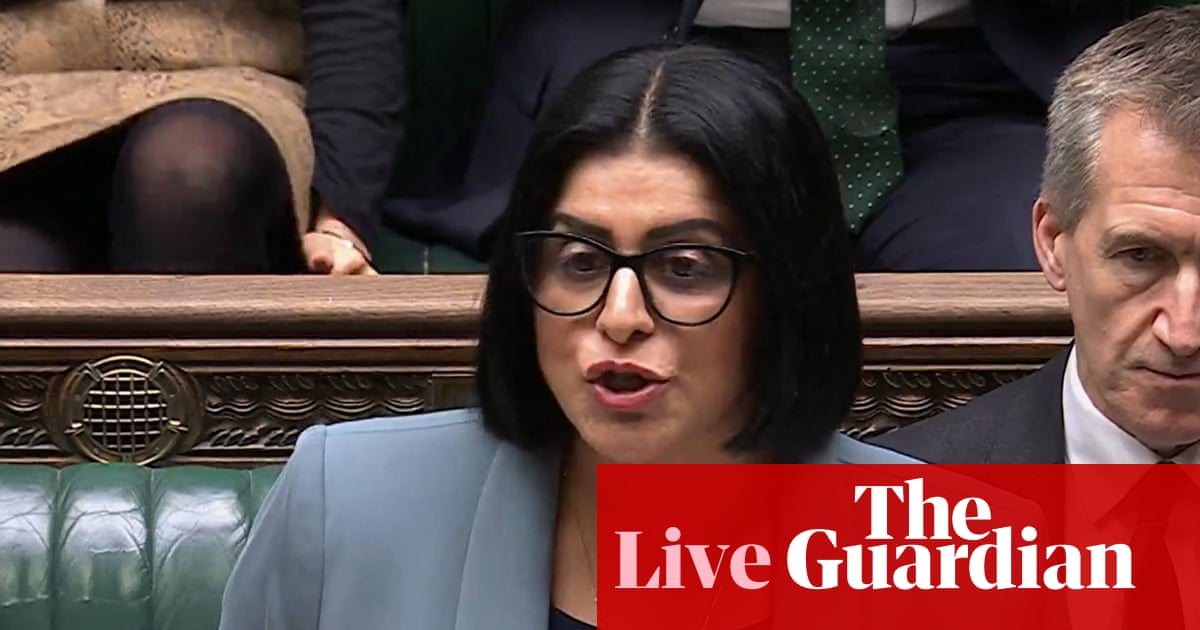
Mahmood tells MPs asylum system feels ‘out of control and unfair’ to public
Shabana Mahmood, the home secretary, is making her statement to MPs.
Before she started, Caroline Nokes, the deputy speaker, criticised the Home Office for releasing so much information about the policy before the statement to the Commons.
She says Labour strongly criticised the last government when they pre-announced information in this way.
Mahmood that the asylum system feels “out of control and unfair” to members of the public.
She says if the government does not bring the asylum system under control, there will be more hatred.
The last government left the system in a mess, she says. Labour had a “dreadful inheritance”.
She says stability has been restored.
Key events
-
Badenoch dismisses asylum plan as ‘baby steps’ – and urges government to cooperate with Tories on reform plan
-
Mahmood says courts have applied ‘expanding interpretation’ of article 8 of ECHR, and says she will restrict it in 3 ways
-
Mahmood criticises ‘absurdity’ of current asylum welfare rules, saying one claimaint able to buy Audi got free housing
-
Mahmood tells MPs asylum system feels ‘out of control and unfair’ to public
-
Speaker tells MPs ministers would have resigned in past over sort of budget leaks that have come out recently
-
Removing financial support for asylum seekers who cannot work will fuel modern slavery, campaigners warn
-
Mahmood says UK government in past has been ‘unwilling to show necessary toughness’ over asylum removals
-
Home Office says more refused asylum families with children face deportation, suggesting past ‘hesitancy’ about this wrong
-
Home Office publishes its asylum policy document
-
Labour MP Nadia Whittome describes government’s asylum plans as ‘dystopian’ and ‘cruel’
-
Asylum policy not just ‘morally wrong’, but ‘politically disastrous’ too, says Labour MP Richard Burgon
-
Reform UK deputy leader Richard Tice complains about Send children wearing ear defenders in schools
-
Plaid Cymru and SNP condemn ‘performative cruelty’ of Labour’s asylum plans
-
BBC chair Samir Shah tells staff Trump has ‘no basis’ for libel case and corporation ‘determined’ to fight it
-
Mahmood’s asylum statement delayed until after 5pm, after speaker grants 3 UQs
-
Reform UK deputy leader won’t criticise student wing president who says UK-born BAME people not necessarily British
-
No 10 defends asylum plans, saying voters want system brought under control
-
Trump and Starmer have yet to speak about BBC and $1bn damages claim, despite president proposing call over weekend
-
Labour MP Sarah Owen describes jewellery removal threat in asylum plan as ‘repugnant’
-
Labour MP Abtisam Mohamed says asylum plans likely to create further ‘chaos, cost and division’
-
Asylum seekers won’t lose ‘family heirlooms’ under plan to make them contribute if they have assets, minister says
-
Labour MP Simon Opher criticises asylum plans, saying party should challenge Reform UK’s ‘racist agenda’, not ‘echo it’
-
‘Truly frightening’ and ‘awful’ – Diane Abbott condemns government’s asylum plans
-
Reform UK and Tories claim Labour’s proposed asylum changes won’t be implemented
-
Minister rejects claim new, hardline policies risk stigmatising asylum seekers as cheats
-
Minister suggests most asylum seekers would be able to avoid 20-year wait for permanent settlement under new rules
-
Changing how courts interpret ECHR unlikely to have big impact on asylum returns, Labour MP says
-
Why Labour is going Danish on immigration – podcast
-
Starmer braced for backlash from Labour MPs as Mahmood sets out asylum plans
Badenoch dismisses asylum plan as ‘baby steps’ – and urges government to cooperate with Tories on reform plan

Andrew Sparrow
Kemi Badenoch responded to Mahmood on behalf of the Tories. Normally it would be a job for the shadow home secretary, Chris Philp, but Kemi Badenoch has quite often jumped in to take the lead herself on Commons occasions like this involving an issue important to the party, and to her personally.
Repeating a line used by the party over the weekend, Badenoch offered to cooperate with Labour on asylum reform.
Badenoch said some of the measures in the government’s plan would not work, but some were positive – albeit “baby steps”, she said.
She said her party’s proposals, which included leaving the ECHR, were better. She went on:
So I urge [Mahmood] to take me up on my offer to work together, not just because we have some ideas she might find useful, but because, judging by her own backbenchers reaction today, she may find more votes come in handy.
That is all from me for today. My colleague Lucy Campbell is taking over now.
Mahmood says courts have applied ‘expanding interpretation’ of article 8 of ECHR, and says she will restrict it in 3 ways
Mahmood said the courts in the UK had adopted an “expanding interpretation” of article 8 of the European court of human rights, guaranteeing the right to family life. She said the government would change this in three ways.
The courts have adopted an ever expanding interpretation of this right, and as a result, many people have been allowed to come to this country when they would otherwise have had no right to. And we have been unable to remove others when the case for doing so seems overwhelming.
This includes cases like an arsonist sentenced to five years in prison. His deportation was blocked on the grounds that his relationship with his sibling may suffer.
Mahmood said that article 8 was a qualified right, and she said this meant its application could be limited. The government would do this in three ways, she said.
First, she said the government would strengthen the public interest test for deportation, meaning the circumstances in which article 8 rights could outweigh the public interest in a deportation would be limied.
Second, she said the government would limit who counts as family to immediate family.
And, third, she said the government would limit the circumstances in which people can make article 8 applications.
Mahmood criticises ‘absurdity’ of current asylum welfare rules, saying one claimaint able to buy Audi got free housing
In an interview this morning Alex Norris, the border security and asylum minister, referred to an asylum claimaint receiving benefits even though he had an Audi. (See 10.11am.)
In her opening statement, Mahmood referred to the same case. She said:
We will also remove our duty to support those who have a right to work. It is right that those who do receive support pay for it, if they can, so those with income or assets will have to contribute to the cost of their stay.
This will end the absurdity that we currently experience, where an asylum seeker receiving £800 each month from his family and who had recently acquired an Audi, was receiving free housing at the taxpayer’s expense, and the courts judged that we could do nothing about it.
Mahmood is now summing up the measures in the policy document.
Here is Rajeev Syal’s snap story on the plan.
Mahmood tells MPs asylum system feels ‘out of control and unfair’ to public
Shabana Mahmood, the home secretary, is making her statement to MPs.
Before she started, Caroline Nokes, the deputy speaker, criticised the Home Office for releasing so much information about the policy before the statement to the Commons.
She says Labour strongly criticised the last government when they pre-announced information in this way.
Mahmood that the asylum system feels “out of control and unfair” to members of the public.
She says if the government does not bring the asylum system under control, there will be more hatred.
The last government left the system in a mess, she says. Labour had a “dreadful inheritance”.
She says stability has been restored.
Speaker tells MPs ministers would have resigned in past over sort of budget leaks that have come out recently
Ministers would have resigned in the past over the sort of budget leaks that have come out in recent weeks, Lindsay Hoyle, the speaker, told MPs.
He was speaking during an urgent question tabled by Mel Stride, the shadow chancellor, who demanded to know whether Rachel Reeves, the chancellor, had authorised briefings to journalists about potential tax measures in the budget, and OBR forecasts.
James Murray, the chief secretary to the Treasury, sidestepped Stride’s questions.
Hoyle told MPs:
It isn’t normal for a budget to have been put in the press? It’s the hokey cokey budget – one minute it’s in, the next minute it’s out.
I am very worried, like the previous government, which also had to be reprimanded for putting leaks out.
It is not good policy. At one time a minister would be resigning for anything that was released, so what I would say is this house should be sacrosanct in all decisions, it should be heard here first.
Hoyle was referring to Hugh Dalton, who resigned as chancellor after telling a journalist from a London evening paper details of some of his budget measures minutes before they were announced. They made a printed edition before the budget speech was finished, and Dalton resigned – even though the leak had little or no practical impact.
Removing financial support for asylum seekers who cannot work will fuel modern slavery, campaigners warn

Chris Osuh
Chris Osuh is a Guardian community affairs correspondent.
The government’s new asylum plan proposes removing the legal obligation to financially support asylum seekers and instead make housing and weekly allowances “discretionary”, as well as proposing that refugee status is reviewed every two-and-a-half years during a 20-year wait for eligibility for settlement.
The Work Rights Centre, the London-based social mobility and employment charity for disadvantaged Britons and migrants, said the plans would be a “gift to traffickers and exploiters”.
Dr Dora-Olivia Vicol, CEO of Work Rights Centre said:
It is very difficult for people with time-limited leave to secure good work, as most employers look for certainty. Shutting refugees out of sustainable, secure work only pushes them closer to precarious roles where they can be exploited for profit.
How does the government expect people without the right to work or access to benefits to support themselves? Without the basic safety net of housing and financial support, asylum seekers – who are not allowed to work for the most part – will see no way to survive but by taking up dangerous work on the black market, where they risk exploitation and trafficking. This is not a deterrent to dangerous crossings, it is a new low in the history of hostility to migrants that actively creates the conditions for modern slavery.
Meanwhile, a new report from London School of Economics, commissioned by Public and Commercial Services Union (PCS) and the coalition Together With Refugees, proposes changes to create a “fair and humane” asylum system that it says would generate a net benefit to the economy of £266,000 for each refugee, by the time they were five years past settlement. The report proposes that investment is made to ensure claims are processed within six months, that people receive legal assistance at all stages of the application process, English language support from the day of arrival and employment support from the day of arrival as an alternative to Mahmood’s plans to toughen the system.
Fran Heathcote, PCS general secretary said:
The government’s latest plans to decimate the safety we offer to people fleeing war and persecution are not just morally reprehensible, they are also inconsistent with their aim of achieving economic growth, which continues to flatline. This report proves that there is an economic value to compassion. This country is currently lumbered with an asylum system that is unnecessarily costly and cruel. A more humane system would improve the working conditions of our members, save the taxpayer money and boost the economy, benefiting the government’s growth agenda.
This is what the asylum policy document says about taking assets from some asylum seekers (which theoretically could include jewellery, but not heirlooms – see 11.53am).
Contributions mechanism. In addition, we will require individuals to contribute towards the cost of their asylum support where they have some assets or income, but not enough to support themselves independently. We will also take action to recover support costs in scenarios where any assets are not convertible into cash or declared at the point that asylum support is initially provided but become convertible or are discovered at a later date.
Colin Yeo, the immigration lawyer, blogger and author, has posted a useful thread on Bluesky with commentary on what the asylum policy document says.
This is what he says about the “work and study visa route” plans. (See 4.57pm.)
This passage is key. What will criteria and fee for this new route be? How many refugees are expected to qualify? Some refugees will be unable to work or study and they will be very harshly treated under this plan.
A refugee’s ability to live with their family — and therefore the safety of their family — will depend on their ability to work or study.
The Home Office document says that people seeking asylum will be offered something called “core protection” if they qualify, not permanent protection. They might have to wait up to 20 years before they can apply for the right to remain in the UK permanently.
This morning Alex Norris, the border security and asylum minister, argued that in practice many asylum seekers would not have to wait 20 years. (See 9.52am.) This is what the document says about how this might work.
A longer path to settlement. In the future there will be no path to indefinite settled status in the UK on core protection, until a refugee has spent 20 years in the country, an increase on the current five years. Settlement requirements will be considered in an upcoming consultation on earned settlement, covering both legal and illegal migrants.
Protection “work and study” visa route. The government does not believe that refugees should seek to remain on core protection long-term. We want to encourage refugees to integrate more fully into the communities providing them sanctuary. To address this, we will encourage refugees to switch out of the core protection route wherever possible. We will introduce a new, in-country “protection work and study” route. A person granted protection will be eligible to apply to move into this route if they obtain employment or commence study at an appropriate level and pay a fee. Once on this route, they will become eligible to “earn” settlement sooner than they would under core protection alone.
In her foreword to the asylum policy document, Shabana Mahmood, the home secretary, says:
We have become the destination of choice in Europe, clearly visible to every people smuggler and would-be illegal migrant across the world.
The asylum policy expert Sunder Katwala points out on Bluesky that this is untrue because, in the year ending March 2025, four other countries were getting more asylum applications.
Mahmood says UK government in past has been ‘unwilling to show necessary toughness’ over asylum removals

Rajeev Syal
Rajeev Syal is the Guardian’s home affairs editor.
The government has failed to show the “necessary toughness” to enforce the removal of families whose asylum claims have been refused, Shabana Mahmood has claimed.
In a policy document published today as the government sets out plans for the biggest shake-up of asylum laws in 40 years, the home secretary also set out plans to consult on measures to allow the removal of financial support for families with children under the age of 18 if they have been refused asylum. (See 4.14pm.)
In her foreword to the document, Mahmood says:
This country’s asylum system was designed for an earlier and simpler era, and has not been updated to reflect our changing times. Asylum seekers in the UK receive generous support, funded entirely by the taxpayer. To be granted refugee status is to essentially receive the ability to live in this country, forever. Until very recently, a refugee’s family could expect the same.
Where asylum seekers have failed in their claims, many frustrate our attempts to remove them. We have shown ourselves unwilling to show the necessary toughness or resolve to assert our right to return those with no right to be here.
As we have held rigidly to the old model, other countries have tightened theirs. This has been most notable in Denmark, though not exclusively so. There, a radical transformation of the asylum system has taken place. Refugee status has become temporary, and not permanent. Refuge lasts only as long as a safe harbour is genuinely required. And the state has taken a far more concerted effort to remove those who are failed asylum seekers. Last year, asylum claims in Denmark fell to a 40-year low.
Home Office says more refused asylum families with children face deportation, suggesting past ‘hesitancy’ about this wrong
This is from my colleague Jessica Elgot.
NEW – The government’s asylum plan confirms that there is an intention to considerably ramp up the deportation of families – including children.
Two senior Labour sources cited this to me as a major cause of unease within other parts of government
And this is what the document says on this topic.
Our appetite for returning failed asylum seekers has been too limited. Asylum seekers have known that should their claim fail, there is a good chance that the UK government will not return them. Our goal will always be to remove people voluntarily, but where this option is not taken, we must show the consequence will be enforced return. Otherwise, our hesitancy will be used against us …
We do not currently prioritise the return of families. As a result, many families of failed asylum seekers continue to live in this country, receiving free accommodation and financial support, for years on end. Our hesitancy around returning families creates particularly perverse incentives. To some, the personal benefit of placing a child on a dangerous small boat outweighs the considerable risks of doing so. Once in the UK, asylum seekers are able to exploit the fact that they have had children and put down roots in order to thwart removal, even if their claim has been legally refused. For instance, there are around 700 Albanian families whose asylum claims have been rejected, yet their removal is not currently being enforced by the Home Office, despite Albania having a goldstandard of cooperation with the UK on returns and being a signatory to the European Convention on Human Rights (ECHR).
The government will offer all families financial support to enable them to return to their home country. Should they refuse that support, we will escalate to an enforced return. We will launch a consultation on the process for enforcing the removal of families, including children.
Under today’s legislation, families who have one or more children under the age of 18, at the point they were refused asylum, continue to receive support until the youngest of those children turns 18. This is true even if the family has exhausted all their appeals and is not cooperating with the returns process. This creates a perverse incentive to remain in the UK without status, undermining the integrity of the system. Therefore, as part of the aforementioned consultation, we will consult on commencing measures in the 2016 Immigration Act which will allow us to remove support from families who do not have a genuine obstacle to leaving the country.
Home Office publishes its asylum policy document
The Home Office has published its asylum policy document. It’s a 32-page paper called Restoring Order and Control.
The New Statesman is keeping a tally of all the Labour MPs who have criticised the asylum plans (including those who are doing criticism via retweet – see 10.56am). Most of the names are one that are already covered here, but they have also got:
-
Brian Leishman, who told the New Statesman: “We need to build a caring compassionate society that looks after people from the UK and also from other countries. And that needs to be done with real Labour party values.”
-
Ian Byrne, who has described the policy on social media as “morally bankrupt and politically disastrous”.
Labour MP Nadia Whittome describes government’s asylum plans as ‘dystopian’ and ‘cruel’
During Home Office questions in the Commons the Labour MP Nadia Whittome described the asylum plans being proposed by the government as “dystopian”.
She said:
The Denmark-style policies briefed in the last couple of days are dystopian.
It’s shameful that a Labour government is ripping up the rights and protections of people who have endured unimaginable trauma. Is this how we’d want to be treated if we were fleeing for our lives? Of course, not.
How can we be adopting such obviously cruel policies? Is the home secretary proud that the government has sunk such that it is now being praised by Tommy Robinson?
Responding to Whittome, Shabana Mahmood, the home secretary, replied:
I’m disappointed at the nature of the question from my friend. I hope she will look at the detail of the reforms, and what I’ve said already on these matters is that we have a problem, that it is our moral duty to fix, our asylum system is broken. The breaking of that asylum system is causing huge division across our whole country.
#Shabana #Mahmood #tells #MPs #asylum #system #control #unfair #Labour #backlash #proposals #politics #live #Politics