wellnessfitpro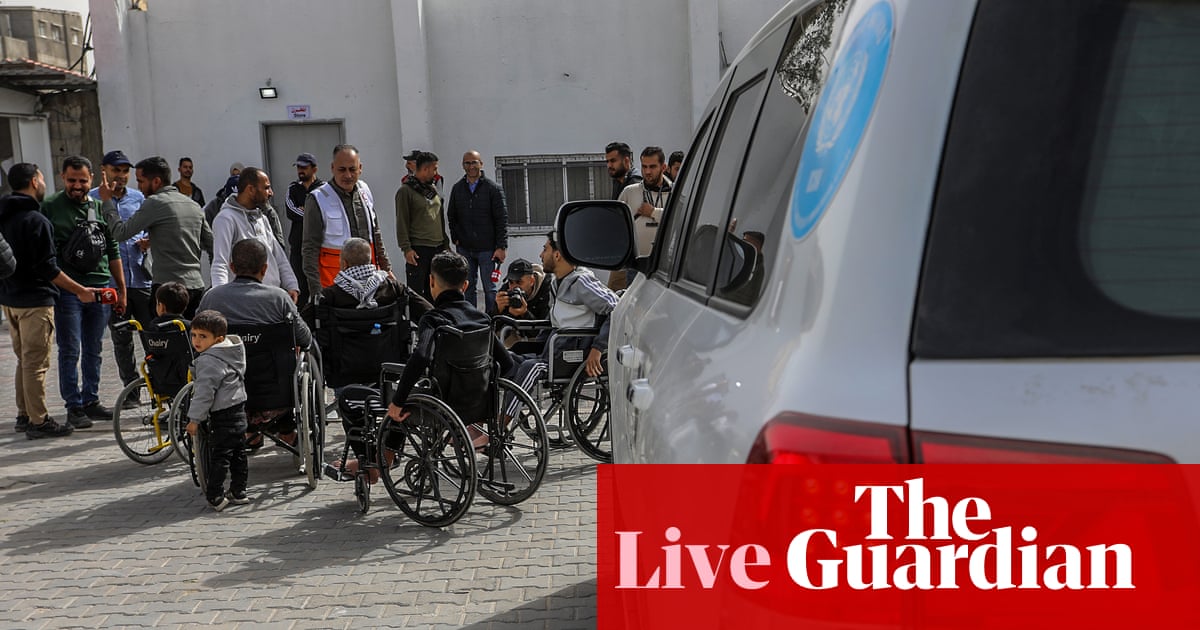
Palestinian patients arriving in Egypt via Rafah crossing – report
The first medical evacuee from Gaza has entered Egypt after the Rafah crossing reopened on Monday.
It represents a key step in the ceasefire between Israel and Hamas but mostly symbolic as few Palestinians will be allowed to cross in either direction daily. No goods will pass through, AP reported.
About 20,000 Palestinian children and adults needing medical care hope to leave devastated Gaza via the crossing, according to Gaza health officials.
Thousands of other Palestinians outside the territory hope to enter and return home. The crossing had been closed since Israeli troops seized it in May 2024.
The number of travellers is expected to increase over time if the system is successful. Israel has said it and Egypt will vet people for exit and entry.
Key events
Some images of Palestinian patients who were set to be transferred from Gaza to Egypt through the Rafah crossing on Monday are starting to come through on the news wires.
One shows two adult men and a boy in wheelchairs preparing for evacuation at the Red Cross hospital in Khan Younis.
Another shows a barefoot boy using a walking frame. A third is of a Palestinian girl and her companion waiting outside for transportation.
Summary
-
The first medical evacuee from Gaza has entered Egypt after the Rafah crossing reopened on Monday. It represents a key step in the ceasefire between Israel and Hamas but mostly symbolic as few Palestinians will be allowed to cross in either direction daily. No goods will pass through, AP reported.
-
The head of a Palestinian technocratic committee established to oversee the day-to-day governance of Gaza said Monday that Israel’s reopening of the Rafah border crossing offered a “window of hope” for Palestinians in the territory. “This step is not merely an administrative measure; rather, it marks the beginning of a long process to reconnect what was severed and to open a genuine window of hope for our people in the Gaza Strip,” Ali Shaath said in a statement.
-
According to health officials in Gaza, there are about 4,000 people with official referrals for treatment to third countries who are unable to cross the border. “I have appealed to humanitarian groups, to the WHO, to the Palestinian Authority – to anyone – so that I can leave, save my life, and reunite with my family,” Tamer al-Burai, 50, who has obstructive sleep apnoea and relies on a CPAP machine to breathe during sleep, told Reuters.
-
Following his meeting with Netanyahu tomorrow, Donald Trump’s special envoy Steve Witkoff is expected to meet Iran’s foreign minister, Abbas Araqchi, on Friday in Istanbul to discuss a possible nuclear deal, Axios has reported on Monday, citing two sources with knowledge of the matter.
-
Israel’s military struck several locations in south Lebanon on Monday, including in two villages where it issued evacuation warnings, saying it was hitting Hezbollah targets, AFP reported. The Israeli military said it struck “several Hezbollah weapons storage facilities in southern Lebanon, in order to prevent reestablishment attempts”.
-
The World Health Organization has warned that winter conditions in Gaza, coupled with inadequate water and sanitation facilities, are contributing to an increase in acute respiratory infections, including severe cases requiring intensive care. At least 11 children have reportedly died from hypothermia in the territory since winter began.
-
More than 400 European former top diplomats and officials have urged the EU to increase pressure on Israel to end “excesses and unremitting violations of international law” over Gaza and the West Bank. The statement, due to be sent to EU leaders on Monday, calls on the bloc and its member states to take action in line with its support for a UN resolution for a two-state solution and a just and lasting peace in the Middle East.
-
Israel says it will suspend Médecins Sans Frontières’s operations in Gaza after the humanitarian organization refused to hand over personal details of its staff members to Israeli authorities.
-
Israel’s ban on Doctors Without Borders’ humanitarian operation in Gaza spells deeper catastrophe for the Palestinian territory’s people, the head of the medical charity told AFP on Monday.
-
The Palestinian technocratic committee will return to the Gaza strip later this week, a US official and Arab diplomat has told The Times of Israel. The National Committee for the Administration of Gaza (NCAG), which has 12 members, has been meeting in Cairo after being unveiled last month.
-
Reuters is reporting that the Iranian leadership is increasingly worried a US strike could break its grip on power by driving an already enraged public back onto the streets, according to six current and former officials.
Reuters is reporting that the Iranian leadership is increasingly worried a US strike could break its grip on power by driving an already enraged public back onto the streets, according to six current and former officials.
In high-level meetings, officials told supreme leader Ayatollah Ali Khamenei that public anger over last month’s crackdown – the bloodiest since the 1979 Islamic Revolution – has reached a point where fear is no longer a deterrent, four current officials briefed on the discussions said.
The officials said Khamenei was told that many Iranians were prepared to confront security forces again and that external pressure such as a limited US strike could embolden them and inflict irreparable damage to the political establishment.
One of the officials told Reuters that Iran’s enemies were seeking more protests so as to bring the Islamic Republic to an end, and “unfortunately” there would be more violence if an uprising took place.
“An attack combined with demonstrations by angry people could lead to a collapse [of the ruling system]. That is the main concern among the top officials and that is what our enemies want,” said the official, who like the other officials contacted for this story declined to be named due to the sensitivity of the matter.
Israel’s ban on Doctors Without Borders’ humanitarian operation in Gaza spells deeper catastrophe for the Palestinian territory’s people, the head of the medical charity told AFP on Monday.
Israel announced on Sunday that it was terminating all the activities in Gaza and the West Bank by the organisation, known by its French acronym MSF, after it failed to provide a list of its Palestinian staff.
MSF slammed the move, which takes effect on 1 March, as a “pretext” to obstruct aid.
“This is a decision that was made by the Israeli government to restrict humanitarian assistance into Gaza and the West Bank at the most critical time for Palestinians,” MSF secretary-general Christopher Lockyear warned in an interview with AFP at the charity’s Geneva headquarters.
“We are at a moment where Palestinian people need more humanitarian assistance, not less,” he said. “Ceasing MSF activities is going to be catastrophic for the people of the Gaza Strip and the West Bank”.
Cate Brown
A US disaster response firm submitted a plan to White House officials that would guarantee 300% profits and a seven-year monopoly over a new trucking and logistics plan for Donald Trump’s Board of Peace in Gaza, according to a November proposal obtained by the Guardian.
The draft plan from Gothams LLC would allow it to collect a fee for every truck moving goods into Gaza, and charge for the use of its warehousing and distribution system.
The Guardian first reported in December that Gothams was the frontrunner for a lucrative deal that would be doled out by a future Trump-chaired Board of Peace, but the scale of the profit margin was not clear.
Though the firm’s CEO, Matthew Michelsen, told the Guardian in December he was halting his proposal, a company partner is still involved, records show, and a new Gaza supply system (GSS) is being discussed by administration officials and businesspeople affiliated with Trump’s Board of Peace. Michelsen declined to talk to the Guardian for this story.
Chris Vanek, a partner at Gothams, has been coordinating with White House officials about GSS in recent weeks, according to two sources familiar with the process and records reviewed by the Guardian.
Five patients seeking to leave Gaza for medical treatment, each escorted by two relatives, were driven to the Rafah crossing compound from the Gaza side in a vehicle escorted by World Health Organization personnel, health officials said.
Later on Monday, Palestinian and Egyptian sources said Gaza patients had crossed into the Egyptian side of the passage and would be directed towards Egyptian hospitals.
Palestinian officials blamed delays on Israeli security checks. Israel’s military had no immediate comment, Reuters reported.
The Palestinian technocratic committee will return to the Gaza strip later this week, a US official and Arab diplomat has told The Times of Israel.
The National Committee for the Administration of Gaza (NCAG), which has 12 members, has been meeting in Cairo after being unveiled last month.
The group is meant to be apolitical and staffed by technocrats and experts rather than political factions.
Ali Shaath, a former deputy minister in the Palestinian Authority, has been appointed to lead the group.
Some more now on the Palestinians patients and war-wounded began arriving in Egypt via the Rafah border crossing with the Gaza Strip on Monday.
An unnamed Egyptian health official told AFP earlier today:
They have begun arriving in Egyptian ambulances, accompanied by several escorts.
Three ambulances have arrived so far carrying a number of the sick and injured, who were immediately screened upon arrival to determine to which hospital they will be transferred.
Palestinian patients arriving in Egypt via Rafah crossing – report
The first medical evacuee from Gaza has entered Egypt after the Rafah crossing reopened on Monday.
It represents a key step in the ceasefire between Israel and Hamas but mostly symbolic as few Palestinians will be allowed to cross in either direction daily. No goods will pass through, AP reported.
About 20,000 Palestinian children and adults needing medical care hope to leave devastated Gaza via the crossing, according to Gaza health officials.
Thousands of other Palestinians outside the territory hope to enter and return home. The crossing had been closed since Israeli troops seized it in May 2024.
The number of travellers is expected to increase over time if the system is successful. Israel has said it and Egypt will vet people for exit and entry.
Witkoff ‘to meet Iran’s Araqchi on Friday to discuss nuclear deal’
Following his meeting with Netanyahu tomorrow, Donald Trump’s special envoy Steve Witkoff is expected to meet Iran’s foreign minister, Abbas Araqchi, on Friday in Istanbul to discuss a possible nuclear deal, Axios has reported on Monday, citing two sources with knowledge of the matter.
The White House has confirmed reports (see post at 11.11) that US envoy Steve Witkoff will arrive in Israel tomorrow to meet Israeli prime minister Benjamin Netanyahu.
Reopening of Rafah crossing ‘lifeline’ for ‘Gaza’s sick and wounded’, EU’s foreign policy chief says
The EU’s foreign policy chief, Kaja Kallas, has welcomed the reopening of the Rafah crossing, describing it as a “lifeline” for injured and sick Palestinian people in Gaza.
In a post on X, Kallas, who coordinates the bloc’s foreign policy on behalf of the 27 national governments and the European Commission, wrote:
The opening of the Rafah crossing marks a concrete and positive step in the peace plan. The EU’s civilian mission is on the ground to monitor crossing operations and support Palestinian border guards.
For Gaza’s sick and wounded, the reopening is a lifeline. It will allow families to reunite after far too long apart.
Practical steps like this help move the truce plan forward and must continue. At the same time, Gaza remains in urgent need of aid. Its reconstruction will depend on Hamas’ demilitarization.
Israeli forces took control of the Rafah crossing – Gaza’s only crossing not shared with Israel – in May 2024. Its reopening followed the return of the last Israeli hostage, Ran Gvili, whose body was found at a cemetery in northern Gaza and returned to Israel last week.
Israel says it struck Hezbollah targets in Lebanon after warnings
Israel’s military struck several locations in south Lebanon on Monday, including in two villages where it issued evacuation warnings, saying it was hitting Hezbollah targets, AFP reported.
The Israeli military said it struck “several Hezbollah weapons storage facilities in southern Lebanon, in order to prevent reestablishment attempts”.
It added that one of the targets was “in the heart of a civilian area”, accusing the group of “continued operations from within civilian infrastructure”.
The Israeli army had previously sent evacuation warnings for the towns of Kfar Tibnit and Ain Qana in southern Lebanon (see post 13.22 GMT).
Lebanon’s state-run National News Agency (NNA) reported strikes on the targeted buildings in both towns.
The head of a Palestinian technocratic committee established to oversee the day-to-day governance of Gaza said Monday that Israel’s reopening of the Rafah border crossing offered a “window of hope” for Palestinians in the territory.
“This step is not merely an administrative measure; rather, it marks the beginning of a long process to reconnect what was severed and to open a genuine window of hope for our people in the Gaza Strip,” Ali Shaath said in a statement.
The crossing – the main gateway between Gaza and Egypt – was reopened in a limited capacity earlier on Monday.
Israel’s military warned on Monday it would soon strike what it called Hezbollah targets in southern Lebanon, issuing evacuation warnings for buildings in two villages, AFP reported.
Despite a November 2024 truce that sought to end more than a year of hostilities including two months of all-out war between Israel and the Iran-backed group, Israel has kept up regular strikes on Lebanon and has maintained troops in five areas it deems strategic.
The Israeli military’s Arabic-language spokesman, Avichay Adraee, said Monday that the army would soon “strike military infrastructure belonging to the Hezbollah terrorist organisation, in response to its prohibited attempts to rebuild its activities in the area”.
In an X post, he told residents of certain buildings in Kfar Tibnit and Ain Qana “to evacuate them immediately”.
Lorenzo Tondo
Lorenzo Tondo is an international correspondent for the Guardian
According to health officials in Gaza, there are about 4,000 people with official referrals for treatment to third countries who are unable to cross the border.
“I have appealed to humanitarian groups, to the WHO, to the Palestinian Authority – to anyone – so that I can leave, save my life, and reunite with my family,” Tamer al-Burai, 50, who has obstructive sleep apnoea and relies on a CPAP machine to breathe during sleep, told Reuters.
For some, the reopening came too late. Dalia Abu Kashef, 28, died last week while waiting for permission to cross for a liver transplant. “We found a volunteer – her brother – who was ready to donate part of his liver,” her husband, Muatasem El-Rass, told Reuters. “We were waiting for the crossing to open so we could travel and do the surgery, hoping for a happy ending. But she deteriorated badly and died.”
The WHO says 900 people, including children and cancer patients, have already died while awaiting evacuation.
The limited reopening of the Rafah crossing also offers a rare opportunity for families torn apart by more than two years of war to reunite. Many families who fled to Cairo early in the war never expected to remain for so long. You can read the full story here:
Palestinian people have reportedly started to enter the Rafah border crossing
It is not clear how many people have entered the Rafah border crossing between the Gaza Strip and Egypt today.
Dr Mohammed Abu Salmiya, director of Gaza’s al-Shifa hospital, has given an interview with Al Jazeera, in which he said that although Israel agreed to allow 50 patients – accompanied by one or two relatives – out of Gaza for healthcare every day, today authorities have only so far let five people through to Egypt. We have not been able to independently verify this information.
“We’re still losing lives every day. Allowing only 50 patients out of Gaza each day is not proper. This dynamic is very dire and we’re going to lose more lives,” Abu Salmiya told Al Jazeera.
“Hospitals are working at the minimum of medical supplies and personnel. Israel continues to deny the entry of supplies, ambulances, and volunteer doctors. We are unable to treat patients here and preventing their exit is a death warrant issued against them.”
About 150 hospitals across Egypt are ready to receive Palestinian patients evacuated from Gaza through Rafah, authorities said earlier. About 20,000 sick and injured Palestinian people are waiting to leave Gaza for treatment after the territory’s healthcare system collapsed due to Israel’s relentless attacks on hospitals throughout the war.
According to an Egyptian official, speaking anonymously to the Associated Press, only 50 Palestinians will be permitted to cross in each direction on the first day of operations. Al Qahera News TV reported this morning that the Rafah crossing had “received the first batch of Palestinians returning from Egypt to the Gaza Strip”.
The UK’s foreign secretary, Yvette Cooper, has welcomed the limited reopening of the Rafah border crossing between the Gaza Strip and Egypt, but stressed that much more still needed to be done. In a post on X, she wrote:
I welcome Rafah reopening for people to cross both ways on foot, allowing some in desperate need to access medical care in Egypt. But much more still needs to be done. Aid must flow in, restrictions on essential supplies must ease, & aid workers must be allowed to operate.
Cooper became foreign secretary in September 2025 after twelve months as home secretary.
The UK government has been criticised for its failure to publish its legal response to the advisory opinion of the international court of justice (ICJ) in July 2024 that ordered Israel to end its unlawful occupation of Palestine, for allowing the export of F-35 fighter jet components to Israel, and for not taking a tougher stance against Israel during the course of the war, which caused a catastrophic humanitarian crisis and has seen an extremely high civilian death toll caused by Israeli attacks.
As the Guardian’s diplomatic editor, Patrick Wintour, notes in this story, Mark Smith, a diplomat who quit his Foreign Office job over the UK’s refusal to stop selling arms to Israel in August 2024, has said civil servants who challenged the IDF’s methods were routinely pressed to tone down their findings “so it sounded less bad”.
“Thousands of conversations within the walls of the Foreign Office on the most controversial aspects of our arms sales policy will never be seen by the public [and] never be put to a court because they were held in person,” he said.
The UK, which has funded aid and supported airdrops and evacuations, has criticised delays in aid being allowed into Gaza.
US envoy to visit Israel for meetings with Netanyahu and Israel’s military chief
The Reuters news agency is reporting that the US envoy Steve Witkoff is expected to visit Israel for meetings with the country’s prime minister, Benjamin Netanyahu, and its military chief, Eyal Zamir, citing two senior Israeli officials.
Witkoff’s visit will reportedly begin tomorrow. We don’t know exactly what will be discussed but the trip comes as the Gaza ceasefire agreement edges forward despite Israel’s frequent killing of Palestinian people in violation of its terms.
The next phases of Donald Trump’s plan for Gaza require governance to be handed to Palestinian technocrats, Hamas to lay down its weapons and Israeli troops to withdraw from the territory while Gaza is rebuilt.
Hamas has so far rejected disarmament and Israel has repeatedly indicated that if the militant group is not disarmed peacefully, it will use force to make it do so. Witkoff’s visit also comes amid heightened tensions between Tehran and Washington.
Trump has said Iran is talking to the US, hinting at a deal that would avoid the use of military strikes. The US president, emboldened by the recent capture of the former Venezuelan president, Nicolás Maduro, in an operation which is widely seen as having broken international law, has threatened to intervene in Iran over its nuclear programme and following its brutal crackdown on anti-government protests.
#medical #evacuee #leaves #Gaza #Rafah #crossing #reopens #handful #Palestinians #latest #updates #Gaza