wellnessfitpro
Rebecca Sheppard specializes in untangling other people’s financial messes. But for nearly a year, the Colorado accountant has been unable to fix a glaring error on her own credit report.
Her credit score plunged roughly 85 points because of a $240,000 student loan debt she does not owe. She repeatedly asked the nation’s big three credit reporting companies to correct the mistake, submitting documentation showing the debt belonged to her ex-husband. Even the loan’s account manager confirmed she wasn’t responsible.
Still, the credit bureaus refused to remove it, jeopardizing her plans to move with her disabled father into a more accessible home. “There’s no way in the world I could qualify for the purchase,” she said.
Sheppard should have been able to count on the federal government to pressure the credit bureaus to take her dispute seriously. For years, the Consumer Financial Protection Bureau wielded the threat of fines and lawsuits to make companies fix errors and engage with consumers. Under the Biden administration, a rigorous supporter of the agency, consumers’ rates of relief for such complaints rose to about 10 times as high as in 2020.
But Sheppard needed help under the Trump administration, which has drastically curtailed the CFPB’s mission, including its policing of credit bureaus. With the agency weakened, two of the three major credit bureaus, TransUnion and Experian, have sharply reduced the share of consumer complaints they resolved in customers’ favor, according to a ProPublica analysis of federal complaint data.
TransUnion’s relief rate, which had remained relatively steady for several years, began plunging in the summer of 2025. By October it was providing relief roughly half as often.
Joel Jacobs/ProPublica
Experian’s drop was even more dramatic. The company resolved nearly 20% of complaints in consumers’ favor in 2024. Last year, that figure fell to less than 1%.
Joel Jacobs/ProPublica
The third major bureau, Equifax, did not show a similar decline. Just days before President Donald Trump was inaugurated, the company entered into a consent order with the CFPB over deficient dispute and investigation practices. Under the agreement, the company committed to reforms and ongoing oversight.
Equifax’s consumer relief mostly kept up with complaints.
Joel Jacobs/ProPublica
The timing of the drops at TransUnion and Experian coincides with the Trump administration’s dismantling of the CFPB.
In February 2025, Russell Vought, a White House official who oversaw sweeping cuts across federal agencies, took control of the CFPB as acting director. He quickly ordered a stop to nearly all agency work. Under his leadership, the CFPB has attempted to fire most of its staff, frozen investigations and dropped enforcement actions, including against TransUnion. One of the CFPB’s new lawyers leading the pullback on enforcement represented Experian for years before joining the administration.
The credit bureaus “want to do as little as possible,” said Chi Chi Wu, director of consumer reporting at the National Consumer Law Center, which is a plaintiff in a lawsuit that has so far blocked some of the administration’s dismantling efforts.
“The thing that is making them do any kind of effort is a lawsuit or a regulator, and now we don’t have the regulator,” Wu said.
In statements to ProPublica, the credit bureaus said that many complaints are illegitimate, including a large volume filed by credit repair organizations that charge customers to challenge negative information on their reports. Experian said in a statement that some of those companies “mislead consumers into believing they can remove accurate information,” adding that it investigates “all legitimate” complaints. The company did not respond to specific questions about its decline in relief.
Third parties are allowed to submit complaints on behalf of consumers if they disclose their involvement and get permission. Federal regulators have acknowledged that bad actors exist, but the CFPB and a House subcommittee found that the credit bureaus’ systems for identifying third-party involvement were overly broad and dismissed legitimate concerns.
Asked about the decline in relief, TransUnion said it recently changed its processes to handle third-party complaints and now redirects those with insufficient documentation to “a more appropriate” internal channel for review.
For years, the CFPB’s complaint system has served as a public middleman: forwarding consumer issues to the bureaus, requiring responses and publishing data showing how companies handled them.
But the companies have successfully lobbied the Trump administration to start steering some consumers away from the transparent process and toward their internal systems.
A CFPB spokesperson said the complaint system was inundated with submissions from bots and third-party credit repair firms, and the agency was working to address that so legitimate consumers can more effectively get help. The agency did not respond to written questions about the decline in relief or enforcement.
How many consumers get help — or don’t — when using the credit bureaus’ internal systems is not public. But CFPB data shows that since Trump’s inauguration in January 2025, more than 2.7 million credit reporting complaints submitted to the CFPB have gone without relief, leaving some people at risk of being denied loans, housing or employment and subject to higher rates from insurers and lenders.
One anonymized complaint came from a Texan who said a fraudulent account remained on their credit report despite their disputes. “I have an important deal that I need to complete that is important for the safety and survival of my family,” the person wrote. CFPB records show that Equifax provided relief, while TransUnion and Experian did not.
Also among those who complained was an Air Force veteran and elections organizer in Arkansas who said the bureaus refused to restore his erroneously deleted mortgage history. ProPublica interviewed the man, Kwami Abdul-Bey, who said the error left him unable to refinance his home or car even after going to multiple lenders.
“Each time they tell me that I do not have enough years of credit. I was paying on that mortgage for a decade before that trade line disappeared,” he said.
After ProPublica contacted his mortgage servicer, Wells Fargo, the company reached out to Abdul-Bey to apologize for his situation and said it would investigate.
Equifax and Experian did not reply to questions about individual consumers who filed complaints. TransUnion declined to comment on individual situations but said in a statement that the company “has multiple resources available to consumers to help with every step of the dispute process.”
Everyday Americans cannot opt out of having their financial data collected and sold by credit bureaus. Congress passed the Fair Credit Reporting Act in 1970, giving consumers the right to flag errors. But more recently, the credit bureaus have employed a limited number of workers — often overseas — to handle enormous volumes of investigations.
TransUnion, for example, had 171 workers responding to consumer disputes covering 38 million line items in 2021. A TransUnion spokesperson said in an email that the company has since added staffing but would not provide a number.
“These ‘investigators,’ they have a stack of disputes like a mile high that they have to go through every day,” said Liam Hayden, a Chicago attorney who has represented consumers in credit reporting cases. “A real, authentic investigation costs money.”
After the 2008 financial crisis, Congress created the CFPB to protect Americans from unfair and abusive practices. By 2015, the big three credit bureaus had become the most complained about firms in the agency’s complaint system.
Credit Reporting Complaints About the Three Major Credit Bureaus Have Surged in Recent Years
Complaints about Equifax, TransUnion and Experian vastly outnumber all other complaints, for matters such as credit cards, loans or debt collection.
Joel Jacobs/ProPublica
In 2022, identifying a lack of responsiveness by the credit bureaus to consumer issues, the CFPB released a critical report, alongside guidance on how the companies should address “shoddy investigation practices.” Over the next few years, relief rates rose as the companies provided more individualized responses to complaints filed through the agency.
Announcements on the CFPB’s website show the agency has brought a dozen enforcement actions against consumer reporting companies since 2015.
Just days before Trump took office, the CFPB announced an enforcement action against Equifax. The company settled, agreeing to pay $15 million and operate under a legally binding consent order designed to fix its dispute process.
Among the reforms, the company agreed to improve its web interface for submitting disputes, avoid relying on faulty information from creditors and not automatically dismiss repeated concerns from the same consumer. The agreement did not specifically mention the company’s handling of CFPB complaints. Equifax was given about a year to put many of the changes in place and has to remain compliant for five years after.
ProPublica found that the agency had approved a similar action against TransUnion in July 2024, but it was never brought. Settlement talks ended shortly after the change in administration.
“Given recent changes in CFPB leadership, our engagement with the agency on this matter has paused,” TransUnion wrote in a February 2025 Securities and Exchange Commission filing. “We cannot provide an estimate of when, or if, such engagement will resume.”
That month, the CFPB dropped a lawsuit against TransUnion and a former company executive over alleged deceptive practices. TransUnion denied the allegations, calling them “meritless.” The CFPB later ended an agreement meant to fix the company’s failure to promptly place and remove credit freezes.
The CFPB sued Experian shortly before the administration changed, alleging failures in its dispute handling processes. Experian has denied the allegations in court, called the suit “completely without merit” and said the company investigates “every consumer dispute thoroughly.”
The Experian case remains active. A CFPB spokesperson said that Victoria Dorfman, the new senior legal adviser who previously represented Experian, has recused herself from the case.
In a July public comment letter, Experian argued it should not be required to respond to individual CFPB complaints and that the vast majority of those filed recently are illegitimate. The industry’s lobbying arm, the Consumer Data Industry Association, has urged the CFPB to route more consumers away from the complaint system and make the remaining complaints private.
This year, just a week after receiving a letter from the lobbying group, the CFPB added three notices for consumers to click through before filing a public complaint, warning them that their requests might be ignored if they have not already disputed issues directly with credit bureaus — a standard the agency previously said companies cannot reliably verify.
In a statement to ProPublica, the CDIA highlighted that a notice instructing consumers to first dispute directly had been present in the CFPB complaint portal briefly around 2012. The new changes are “necessary to address the widespread misuse of the portal” that divert resources away from legitimate concerns, the group said.

But consumer advocates contend that the industry-friendly changes present even more obstacles for consumers like Sheppard who are trying to get their issues resolved.
She twice disputed the student loan error directly with the bureaus. Then in June, she turned to the CFPB. All three responded that they had verified that the debt was hers without addressing documentation she provided to the contrary.
In December, she sent another dispute by certified mail, but TransUnion replied with a postcard stating it believed the submission had not come from her.
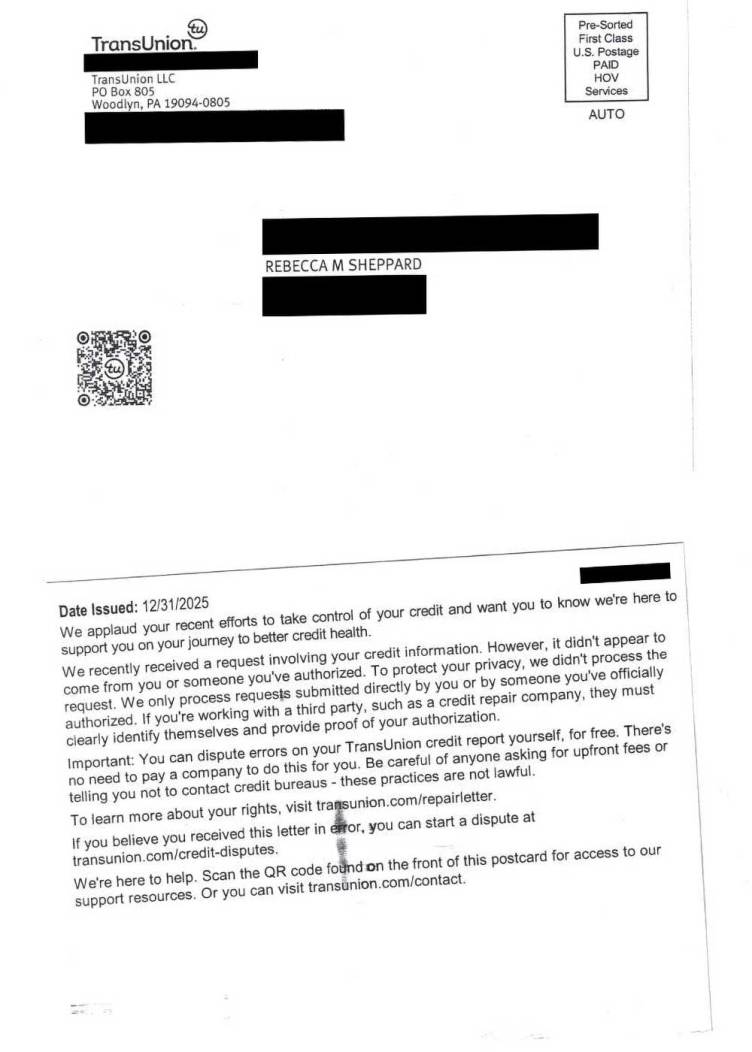
“They didn’t even try,” Sheppard said. “The fact that they sent that little postcard was just ridiculous.”
TransUnion did not provide a response regarding Sheppard’s situation but said in a statement that it “cannot change information furnished to us absent sufficient documentation and clear instruction from the consumer.”
In her mailed dispute, Sheppard included a letter she received from the loan account manager stating that she was not responsible for the debt.
With no other options, Sheppard sued the three credit bureaus in January. The companies have not yet responded in court.
Without a functioning CFPB, enforcement may fall to state attorneys general and private lawsuits. The Federal Trade Commission can bring cases but lacks the authority to conduct routine supervision.
A future without a CFPB will leave consumers increasingly trapped, said Hayden, the Chicago attorney. “In five years, the resolution of consumer disputes is going to be worse, credit reports are going to be worse and it’s going to be harder for folks to fix them, guaranteed.”
#Experian #TransUnion #Leaving #Mistakes #Credit #Reports #ProPublica