wellnessfitpro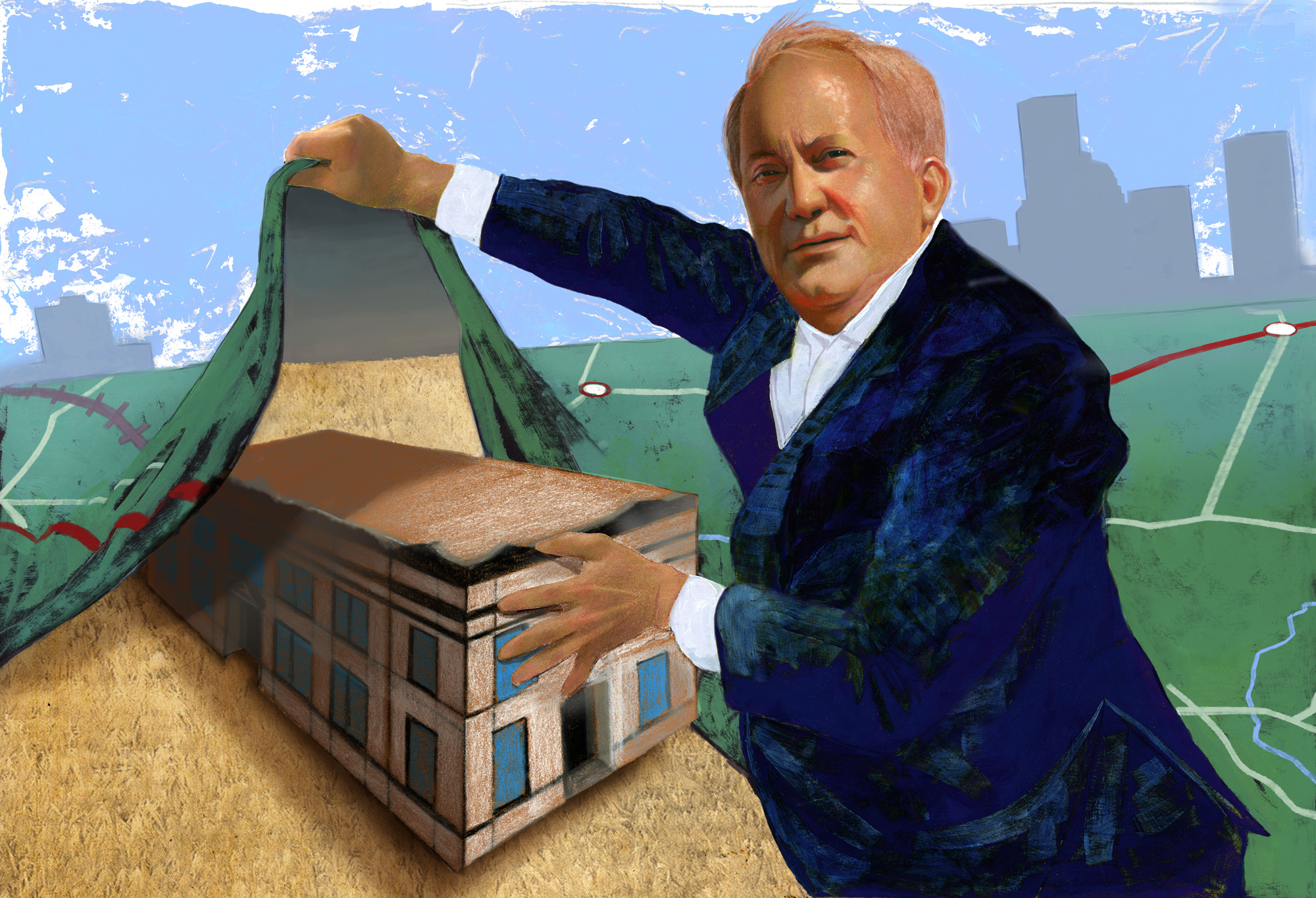
Reporting Highlights
- Pushing Boundaries: Texas’ attorney general has sued big businesses in counties with weak links to the cases, despite lawmakers’ efforts to crack down on the practice, called forum shopping.
- Once a Critic: Paxton urged the Supreme Court to limit forum shopping. But his office has since pursued at least 30 cases with tenuous connections to the counties where they were filed.
- Novel Argument: Paxton’s office has argued that if a company has a website, it can be sued anywhere. Legal experts said that would obliterate state law on where suits can be filed.
These highlights were written by the reporters and editors who worked on this story.
In October, Texas Attorney General Ken Paxton sued pharmaceutical companies tied to Tylenol in state court, repeating claims made a month earlier by Health and Human Services Secretary Robert F. Kennedy Jr. that the pain relief drug was linked to autism and ADHD in children.
Paxton, a close ally of the Trump administration who had already announced a U.S. Senate bid, accused drugmakers of marketing Tylenol to pregnant mothers without disclosing its dangers. “The reckoning has arrived,” the state’s attorneys wrote in the lawsuit against pharmaceutical companies Johnson & Johnson, Kenvue Brands and Kenvue Inc.
“By holding Big Pharma accountable for poisoning our people, we will help Make America Healthy Again,” Paxton proclaimed in a news release that echoed Kennedy’s slogan.
Paxton hired the Chicago law firm Keller Postman to argue the case in state court. The firm had served as lead counsel in a similar case about Tylenol’s safety that was dismissed a year earlier by a New York federal judge who found the plaintiffs’ expert witnesses unreliable.
But the court the attorneys chose to bring the suit in wasn’t in Austin or any of the state’s large counties that have extensive experience and multiple judges handling large, complex litigation. It was in Panola County, a community of 23,000 residents on the Louisiana border that Trump carried by 67 points two years ago and whose sole state district court judge is a Republican.
At a hearing that month in the three-story brick courthouse in the county seat of Carthage, Kim Bueno, the lawyer representing the drugmakers, accused Paxton’s office of pushing a baseless lawsuit through forum shopping — seeking out judges and juries that plaintiffs believe will be most favorable to them, rather than filing suit in the courts that most commonly handle similar cases.
“These claims have been rejected over and over and over again in courts of law by the same plaintiff’s counsel,” said Bueno, who declined an interview request. “And now they’re trying, once again, to suggest that Tylenol is harmful for women when pregnant. And it’s been soundly rejected.”
The case was not the first that Paxton’s office had filed in a county with little connection to the allegations of wrongdoing made by his office. ProPublica and The Texas Tribune have identified at least 30 cases filed by the attorney general over the past nine years that have a tenuous connection to the counties in which they were filed.
The filings mark a striking departure from Paxton’s previous opposition to the practice. In a 2017 legal brief that Paxton wrote on behalf of 17 states, he urged the U.S. Supreme Court to crack down on forum shopping in federal courts. The practice, he wrote, “has the pernicious effect of reducing confidence in the fairness and neutrality of our Nation’s justice system.”
Paxton’s approach also subverts what the Legislature intended when it passed a law in the 1990s that required plaintiffs to file lawsuits in counties where a “substantial” part of the alleged violation took place, according to three legal experts. That was done at the behest of conservatives who felt trial lawyers were flocking to venues favorable to them to win big damage verdicts against businesses.
“It looks like the attorney general’s office is interested in engaging in litigation games that it would otherwise decry if the shoe were on the other foot,” said Michael Ariens, a professor at St. Mary’s University School of Law in San Antonio, who has studied laws regulating where lawsuits can be filed.
Neither of Paxton’s Republican predecessors, Gov. Greg Abbott and U.S. Sen. John Cornyn, appears to have employed this strategy. ProPublica and the Tribune reviewed hundreds of cases filed outside of the state’s five large urban counties during their tenures. Each had a clear connection to the venue Abbott or Cornyn chose.
Neither Abbott nor Cornyn, who Paxton is trying to unseat, responded to requests for comment. Trump on Tuesday endorsed Paxton in the race.
Texas’ major consumer protection law gives the attorney general some flexibility with those cases despite the state’s broader restriction on forum shopping. The office does not have to prove that a substantial part of the events in a consumer protection case happened in the place where it files suit but can instead file in counties where a defendant has done business.
But Paxton has stretched the boundaries of that law, too, according to legal experts and to former staffers of the attorney general’s office who argued against him in court. Last year, for example, the attorney general filed a lawsuit against the gaming platform Roblox in King County, a ranching community of about 200 people east of Lubbock. Its key justification for selecting the tiny county was that residents there had internet access.
Paxton, who did not respond to requests for comment or to written questions, has not spoken publicly about his office’s decisions to file lawsuits in courts with little connection to the cases.
At the November hearing in Panola County, Judge LeAnn Rafferty, a Republican first elected in 2016, did not question the attorney general’s office on its venue choice but asked, “Do you disagree with the defendants’ assertion that Tylenol is the safest choice for pregnant women who have a fever?”
“It depends on — oh, you said for having a fever? That probably is true,” replied J.J. Snidow, a partner at Keller Postman. “There are not alternatives in the pain relief space to Tylenol that don’t also have risks.”
Tylenol makers, Rafferty said, already tell pregnant women to consult with a doctor before taking the drug. Rafferty declined to comment about the case. Snidow said Keller Postman had no comment. Paxton has repeatedly turned to the firm as he has grown increasingly reliant on private attorneys to litigate major cases for his office.
Kenvue directed ProPublica and the Tribune to a statement on its website that said there is “no proven link” between acetaminophen, the active ingredient in Tylenol, and autism. A spokesperson for Johnson & Johnson said the company has had nothing to do with making or selling the drug since splitting with Kenvue in 2023.
Rafferty threw out five of the six claims in the attorney general’s lawsuit. She dismissed one for insufficient evidence. In the other four, Rafferty ruled that the state did not have jurisdiction over Johnson & Johnson and Kenvue Inc. because they do not manufacture or sell Tylenol in Texas.
She allowed one claim to proceed that alleged Kenvue Brands had violated the state’s consumer protection act by making false claims about Tylenol’s safety.
With most of the claims thrown out, the attorney general’s office doubled down on its strategy.
Two weeks later, it filed a new case against the pharmaceutical companies.
This time, it chose Bailey County, a community of 7,000 residents on the New Mexico border.
Paxton’s Pivot
For decades, plaintiffs’ attorneys from across the U.S. swarmed courts in small Texas counties that had reputations for sympathetic judges and generous juries. The practice became so ubiquitous that The Wall Street Journal branded the Texas judicial system a “Wild West embarrassment.”
In 1995, Robert Duncan, then a Republican state representative from Lubbock, resolved to crack down on the practice. He authored a bill that required a “substantial part” of a lawsuit’s claims be connected to the county of filing.
An attorney himself, Duncan recalls traveling hundreds of miles from his home in the Texas High Plains to the Rio Grande Valley for cases that had no connection to the border region. Forum shopping, Duncan told ProPublica and the Tribune, had led to too many attorneys choosing courts where there was “no reason to be there other than the bias or prejudice of whatever the plaintiff’s lawyer is trying to establish that would favor the case, as opposed to giving the defendant a fair opportunity.”
Duncan declined to comment on Paxton’s practice of filing lawsuits in counties with little connection to the allegations of wrongdoing.
Paxton was not in the Legislature when Duncan’s bill passed but, as a freshman representative in 2003, he supported legislation that gave judges more power to dismiss lawsuits they concluded belonged in another state.
He also railed against “rampant forum shopping,” asserting that the U.S. Supreme Court in 2017 should restrict the practice after plaintiffs in patent infringement lawsuits began flocking to courts that most often ruled in their favor. The Eastern District of Texas had become the most popular venue for the lawsuits, even though few of the cases had clear connections to the area. Most cases landed on the docket of a judge based in rural Harrison County, 140 miles east of Dallas, where plaintiffs won 78% of the time, according to legal researchers.
That waned after justices ruled that federal courts must strictly enforce a decades-old law requiring corporations in patent disputes to be sued only in their home states.
Since then, Paxton has repeatedly engaged in forum shopping in state courts, legal experts said. In fact, his office, or attorneys on behalf of his office, have filed 11 cases in Harrison, the same county where he argued that federal courts should limit plaintiffs from filing.
“It’s hypocritical for the AG to criticize patent litigants for forum shopping but then to forum shop himself,” said Paul Gugliuzza, a professor at the University of Texas School of Law. “Forum shopping, judge shopping — it’s usually not unlawful, but it is highly opportunistic, and, in many circumstances, probably shouldn’t be lawful.”
Paxton notched one of the biggest wins of his tenure in Harrison County. He secured a $1.4 billion settlement from Meta after alleging that the Facebook parent company captured Texans’ biometric data without their consent. Paxton’s office contended in court filings that Harrison was a proper venue for the 2022 lawsuit because the company had done business in the county and a substantial part of the alleged lawbreaking occurred there. The office did not provide specifics.
Meta has an office in Travis County, home to Austin, not in Harrison, where only about 0.2% of Texans live, but the company did not challenge the venue. The company didn’t admit to wrongdoing in the settlement and did not respond to questions about the case. It’s unclear why its lawyers did not seek a different venue, but the judge in the case, Republican Brad Morin, denied a transfer in at least one other lawsuit involving Paxton during the Meta litigation.
Paxton has not limited his efforts to find more favorable courts solely to small counties. The attorney general has repeatedly filed cases, particularly political ones, in Tarrant, the state’s largest Republican county and home to Fort Worth.
In August, Paxton’s office chose the county as the venue to sue former Democratic U.S. Rep. Beto O’Rourke and his political organization, Powered By People, after the group helped pay expenses for Democratic members of the Texas Legislature who left the state to block the passage of new congressional maps. The maps, drawn at Trump’s behest, favored the GOP.
The attorney general’s office stated in court documents that the case had a “substantial” connection to Tarrant County because the group planned a rally in Fort Worth. When O’Rourke sought to move the case to El Paso County — where he lives and where the group is headquartered — Paxton accused him of forum shopping. O’Rourke did not respond to an interview request.
Paxton secured a court order in Tarrant that prohibited Powered by People from fundraising while the case was pending. But within weeks, the 15th Court of Appeals overturned the decision. It noted that Paxton was a Republican candidate for U.S. Senate, which created an incentive to blunt Democrats’ ability to campaign. The judges said the order infringed on the organization’s free speech rights before a court had determined guilt.
Legal experts say such forum shopping erodes trust in the court system. It is especially problematic when it comes from the attorney general, who is supposed to defend state laws and preserve public trust in the justice system, they said.
“It’s hard to respect the system if you think it’s being employed in a way you fundamentally think is unfair,” said Paul Grimm, a former U.S. district judge in Maryland and an advocate of restricting forum shopping.
“Not the Law”
In at least two recent cases, Paxton has tested a novel interpretation of state law governing where lawsuits can be filed. His office has argued that if a company does business over the internet, it can be sued in any Texas county.
One such case was a 2022 lawsuit against pharmaceutical giant AstraZeneca. Two law firms filed the case against the company under a law that allows private attorneys to sue on behalf of the attorney general. The lawsuit accused AstraZeneca of defrauding Medicaid by giving kickbacks to healthcare workers in exchange for prescribing the company’s products. The company, which did not respond to a request for comment, said in legal filings that the lawsuit sought to punish its innocuous outreach to doctors and did not identify a single patient harmed or taxpayer dollar wasted.
Paxton’s office formally joined the case in July. Attorneys working on behalf of his office argued that Harrison County was the proper venue because the firm’s website could be accessed from there, company salespeople had visited the county and a local clinic had a brochure for one of the company’s drugs.
When AstraZeneca asked Morin, the lone Harrison County judge, to transfer the case to Travis County, he refused without explanation. The company appealed and, in November, the 15th Court of Appeals overruled Morin’s decision. The court concluded that he abused his discretion in declining to move the case. Morin did not respond to a request for comment.
The court also found that Paxton’s office failed to provide proof that any of the alleged lawbreaking occurred in Harrison County. It ordered the case transferred to Travis County, where it is ongoing.
That month, the attorney general’s office argued that Roblox could be sued in King County, an expanse of rolling plains with no incorporated communities, because third-party retailers there sold gift cards to access the online gaming company.
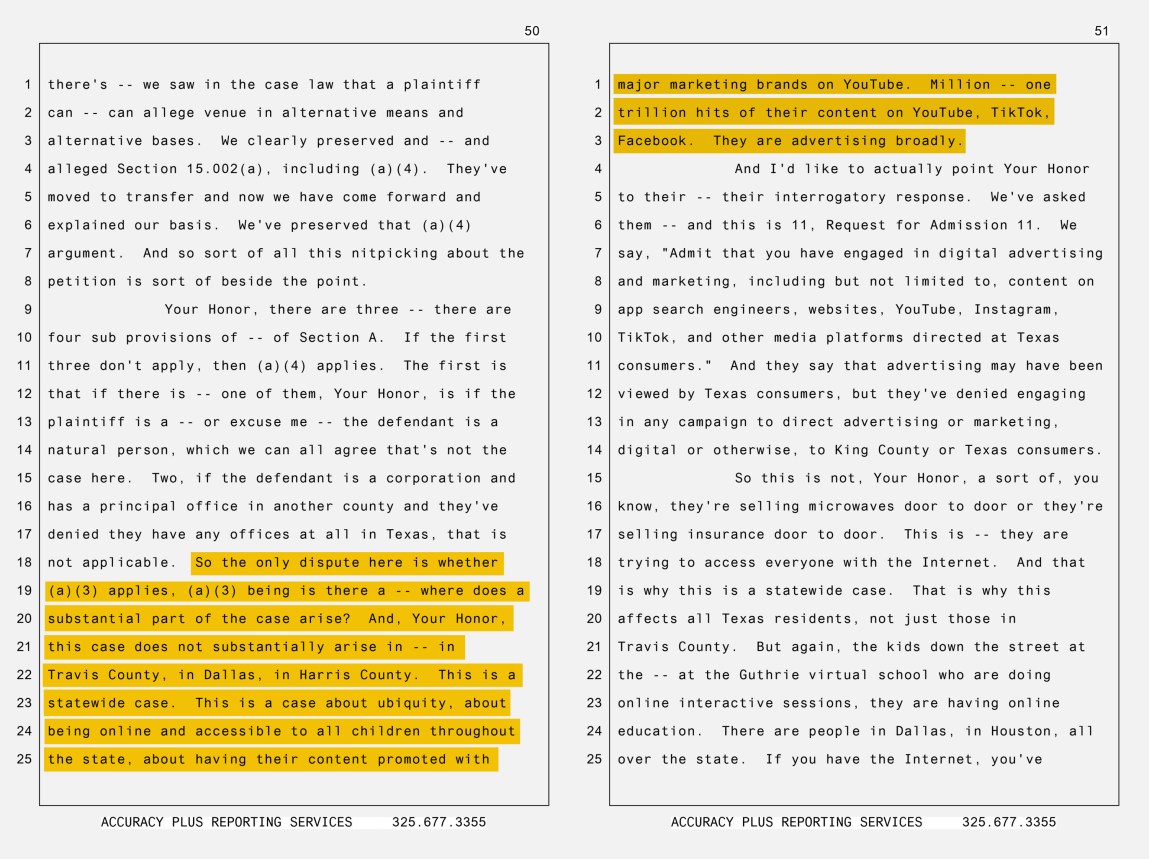
Then the office made another bold claim: that companies with websites can be sued anywhere, no matter how small the county.
“This is a case about ubiquity, about being online and accessible to all children throughout the state,” Mark Pinkert, a Florida lawyer whom Paxton’s office had hired as outside counsel, argued at a hearing to discuss a request from Roblox that the case be moved to Travis County. “They are advertising broadly.”
Pinkert did not respond to a request for comment.
Roblox’s attorney Ed Burbach was stunned by the argument. He’d previously led the civil litigation division at the attorney general’s office under Abbott. The office’s longstanding practice, Burbach told the judge, was to file statewide consumer protection cases in Travis County.
This new argument by the attorney general’s office would obliterate the Legislature’s attempts to limit forum shopping by allowing any company to be sued in any county, Burbach said.
“That is simply not the law,” Burbach said, adding that most Texans, including lawmakers, would “be shocked to hear that outside counsel of the AG’s office would be arguing that.”
The judge transferred the case to Travis County, where it is ongoing.
Burbach declined to comment, but Paul Rogers, a law professor at Southern Methodist University in Dallas, warned of the dangers if Paxton succeeds at getting courts to side with his expansive interpretation. The attorney general, he said, would have “a lot of power to file any lawsuit, in any county, for any reason, whether the underlying lawsuit has merit or not.”
Doubling Down
In Washington, Trump and Kennedy’s public rebukes of Tylenol have tapered off. Paxton, however, continues to vigorously pursue his lawsuit against the drugmakers in state court.
After the setback in Panola County, the attorney general’s office filed an urgent request in Bailey County, arguing that Johnson & Johnson and Kenvue should be barred from selling any products in Texas until they filed paperwork and paid a $750 fee to register with the secretary of state. (Such registration would allow Paxton’s office to strengthen its case in Panola County.)
Though Paxton’s office was already involved in a lawsuit against the pharmaceutical companies in Panola County, the attorney general’s office stated in court filings that it did not know the companies’ attorneys, so it could not notify them of the suit.
Without hearing from the drugmakers’ lawyers, Judge Gordon Green ordered the companies to register. He said they could be barred from doing business in Texas if they didn’t. Paxton proclaimed the ruling a “major win” over Big Pharma.
The victory was short-lived. A week later, the drugmakers’ lawyer Aaron Nielson, who had previously served under Paxton as the state’s solicitor general, attended a hearing in Green’s court. He accused Paxton’s office of sleight of hand by trying to relitigate claims that had already failed to persuade the Panola County judge.
“This is blatant forum shopping and taking another bite at the apple,” said Nielson, who did not respond to a request for comment. “They decided to bring Your Honor into this, rather than let the Court that they chose continue with its own proceedings, which we think is highly improper.”
At the end of the hearing, Green withdrew the order requiring the companies to register. He did not respond to a request for comment.
The Panola and Bailey county cases are awaiting a ruling from the 15th Court of Appeals.
In the meantime, the attorney general’s office tried yet another gambit in Panola, where the judge had allowed one of its original claims to move forward.
Paxton’s lawyers amended their original lawsuit in the county. They noted that Green had ordered the drugmakers to register to do business in Texas, which meant Texas now had jurisdiction to pursue the claims that had been dismissed.
They omitted the fact that Green voided that order.
By referencing the order as if it were still in effect, the attorney general’s office risks losing credibility with the Panola County judge, Gugliuzza said.
“If you knowingly are presenting false information to the court, that is textbook sanctionable conduct,” Gugliuzza said.
#Texas #Ken #Paxton #Filed #Cases #Counties #Connection #Allegations #ProPublica