wellnessfitpro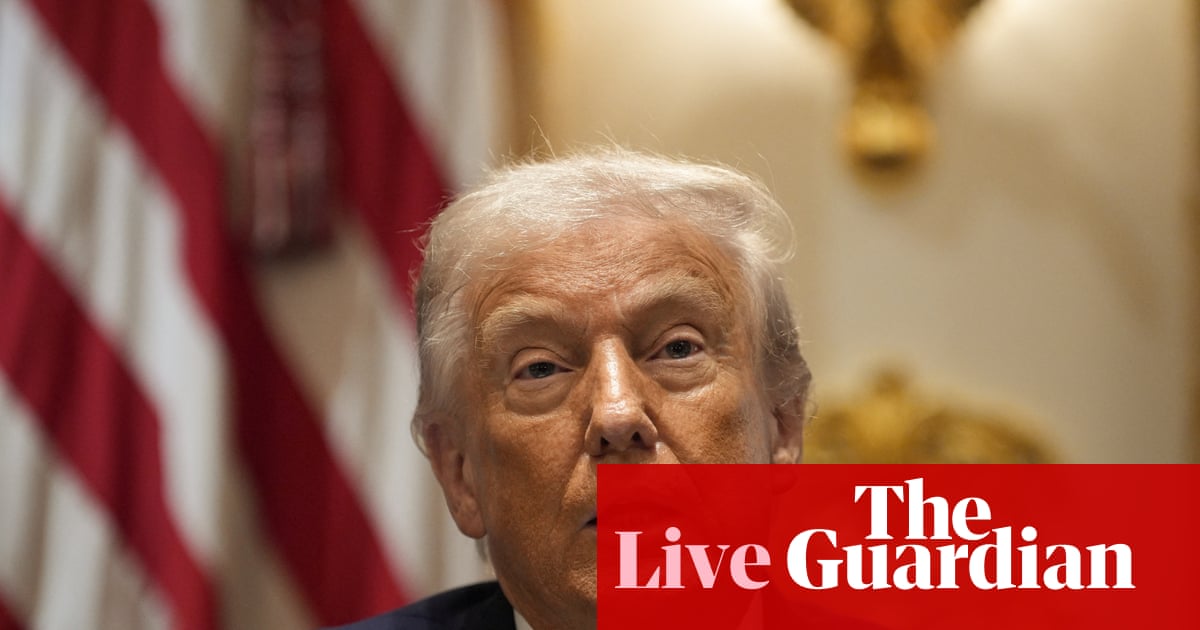
Trump confirms $12bn in assistance for American farmers
At his roundtable in the White House’ cabinet room, Donald Trump announced $12bn in assistance for American farmers. “We love our farmers,” the president said. “They’re the backbone of our country.”
Trump also noted that China had committed to buying $40bn in American soybeans. “I asked president Xi if he could even up it, and I think he’ll do that,” the president added.
The package comes as farmers – some of Trump’s most loyal supporters – have expressed frustration at the rising costs associated with the president’s sweeping tariffs, and the repercussions of escalating trade tensions with China.
Key events

Shrai Popat
I’ve been speaking with Carl Tobias, a professor at the University of Richmond School of Law, about today’s supreme court arguments. He notes that while the court may side with the administration in Slaughter’s case, they “might not do that in a sweeping way, and take each independent agency as it comes to them”.
Tobias added that the justices seemed to acknowledge that the Federal Reserve “deserves unique treatment”, which is relevant in the case of governor Lisa Cook – who the president sought to fire this year. The supreme court said that Cook could remain on the Fed board while they prepare to hear her case in January.
Slaughter’s removal, and today’s arguments, ultimately “undermines” Congress as a co-equal branch of government, according to Tobias. “I don’t think we’re having a wholesale end of the modern administrative state, but each one of these is hopefully going to be taken up on its own merits,” he added.
As reported earlier, Crockett entered the Senate race in Texas after former Democratic representative Colin Allred announced he was dropping out.
Here’s what the former Dallas congressman said in a statement:
“In the past few days, I’ve come to believe that a bruising Senate Democratic primary and runoff would prevent the Democratic Party from going into this critical election unified against the danger posed to our communities and our Constitution by Donald Trump and one of his Republican bootlickers Paxton, Cornyn, or Hunt. That’s why I’ve made the difficult decision to end my campaign for the U.S. Senate.”
Allred also expressed that he is “nowhere near done serving my community and our state” and that he is running in the new 33rd District, a Democratic seat that was redrawn by a Republican-led redistricting effort.
“The 33rd district was racially gerrymandered by Trump in an effort to further rig our democracy but it’s also the community where I grew up attending public schools and watching my mom struggle to pay for our groceries. … It’s the community where I was raised, and where Aly and I are now raising our two boys. It is my home,” Allred said.
Lucy Campbell
Representative Jasmine Crockett of Texas filed to run for US Senate, a move expected to shake up the race after rising to fame amid her fierce clashes with Republicans, especially during Texas’ controversial mid-decade redistricting effort.
Crockett, one of Congress’ most outspoken Democrats, entered the race on the final day of qualifying in Texas. The 44-year-old is running for the Senate seat held by Republican John Cornyn, who is seeking reelection in the GOP-dominated state.
Crockett’s announcement came hours after former representative Colin Allred ended his own campaign for the Democratic nomination in favor of attempting a House comeback bid.
She faces a 3 March primary against Democratic state representative James Talarico, a former teacher with a rising national profile fueled by viral social media posts challenging Republican policies such as private school vouchers and requiring the Ten Commandments in classrooms.
Read the full story here:
In another back and forth with Scott – this time on the topic of Obamacare subsidies that are set to expire at the end of this year – the president was forthright that he wants to “pay the people”.
“I want the money to be paid to the people to go out and buy their own healthcare instead of paying to the you know, the insurance companies,” he said.
If the tax credits do lapse, it will mean that premium payments would more than double, according to an analysis from KFF.
The president repeatedly derided ABC News’ Rachel Scott today. After she asked Trump whether he would order defense secretary Pete Hegseth to release the video of a “double-tap” strike on a suspected drug vessel from 2 September, the president said that “whatever [Hegseth] decides is OK with me”.
When Scott followed up on Trump’s explanation about the alleged drug-trafficking boats, the president snapped back. “Let me just tell you, you are an obnoxious, a terrible, actually, a terrible reporter, and it’s always the same thing with you,” he said.
Donald Trump continued to blame the Biden administration for inheriting high prices when he returned to office in January.
“I think the prices are going to be going down already. I mean, the prices are way down,” he said at the White House today. “Now inflation is essentially gone. We have it normalized, and it’ll go down even a little bit further. You don’t want it to be deflation either. You have to be careful.”
The president and Brooke Rollins, the agriculture secretary, just went back and forth as she explained that the US Department of Agriculture (USDA) will be dispensing $11bn to Farmer Bridge Assistance program, and “holding back” $1bn for some “speciality crops”.
Donald Trump went on to say that “this money would not be possible without tariffs”. However, the assistance program is not using tariff revenue, but funding from USDA.
Trump confirms $12bn in assistance for American farmers
At his roundtable in the White House’ cabinet room, Donald Trump announced $12bn in assistance for American farmers. “We love our farmers,” the president said. “They’re the backbone of our country.”
Trump also noted that China had committed to buying $40bn in American soybeans. “I asked president Xi if he could even up it, and I think he’ll do that,” the president added.
The package comes as farmers – some of Trump’s most loyal supporters – have expressed frustration at the rising costs associated with the president’s sweeping tariffs, and the repercussions of escalating trade tensions with China.
Trump’s former lawyer resigns as top prosecutor following court ruling
Donald Trump’s former lawyer, Alina Habba, has stepped down from her position as the acting US attorney for the district of New Jersey.
Her announcement comes after an appeals court ruled last week that Habba has been serving unlawfully as the top federal prosecutor in the Garden state. The panel of judges sided with a lower court’s decision earlier this year.
“This decision will not weaken the justice department and it will not weaken me,” Habba wrote in a statement. “My fight will now stretch across the country. As we wait for further review of the court’s ruling.”
She added that she would continue to serve as the senior adviser to the attorney general, Pam Bondi.
“Make no mistake, you can take the girl out of New Jersey, but you cannot take New Jersey out of the girl,” Habba concluded.
In a short while we’ll hear from Donald Trump at the White House. He’s set to appear at a roundtable alongside the treasury secretary and agriculture secretary to unveil a new $12bn support package for American farmers. We’ll bring you the key lines here.
Key takeaways from supreme court hearing on FTC firing case
After more than two hours of oral arguments in the high-stakes case of Slaughter v Trump, the nation’s highest court appeared poised to back a historic expansion of executive power, signaling support for Donald Trump’s firing of independent board members that for almost a century have been protected from presidential whims.
At the heart of the issue is Trump’s March decision to fire Rebecca Slaughter from the Federal Trade Commission (FTC) before the end of her term, despite a federal law designed to insulate the agency from political interference.
John Yoo, who served as a justice department lawyer under George W Bush, told Reuters the case presents “one of the most important questions over the last century on the workings of the federal government”. “The future of the independence of the administrative state is at issue,” he said.
The justices appeared pretty firmly split down partisan lines, with the 6-3 conservative wing – including the sometimes swing vote of Justice Amy Coney Barrett – seeming to side with the Trump administration’s argument that the president should be able to fire members of independent agencies, and expressing scepticism to concerns raised by the other side that this could lead to a significant remaking of the federal government.
Solicitor general John D Sauer repeatedly argued that independent agencies like the FTC are a “headless fourth branch” with limited government oversight and that, in general, “independent agencies are not accountable to the people”. He argued that the key 90-year precedent, Humphrey’s Executor, “must be overruled”, describing the ruling as a “decaying husk with bold, and particularly dangerous pretensions”.
Regarding the 1935 precedent ruling, chief justice John Roberts said, that historic precedent has “nothing to do with what the FTC looks like today”. That decision, he said, “was addressing an agency that had very little, if any executive power”. Justice Samuel Alito also said he was skeptical of wide-ranging ramifications of allowing the president to fire leaders of multi-member independent commissions. Justices Bret Kavanaugh, Roberts and Coney Barrett also aimed to draw distinctions between the FTC and the Federal Reserve, seeming likely to back continuing to shield the Fed from political interference.
The liberal justices, on the other hand, appeared sympathetic to Slaughter’s lawyer’s warning that “there are real-world risks that are palpable” in allowing a president the power to fire leaders of independent agencies. Doing so meant that “everything is on the chopping block”, Amit Agarwal said.
Sounding the alarm, liberal justice Sonia Sotomayor said that independent agencies had existed throughout US history. “You’re asking us to destroy the structure of government and to take away from Congress its ability to protect its idea that a government is better structured with some agencies that are independent,” she said. Justice Elena Kagan warned that the court should not ignore “the real-world realities” of what its decisions do. “The result of what you want is that the president is going to have massive, unchecked, uncontrolled power,” she told Sauer. “What you are left with is a president … with control over everything.”
Justice Ketanji Brown Jackson also expressed doubt that more presidential firing power is better for democracy and emphasized that centering so much power under presidential control would undermine issues that Congress decided should be handled by non-partisan experts in independent agencies. “Having a president come in and fire all the scientists, and the doctors, and the economists and the PhDs, and replacing them with loyalists and people who don’t know anything is actually not in the best interest of the citizens of the United States,” she said.
A decision in the case is expected before the end of June next year.
Liberal justice Ketanji Brown Jackson also expressed doubt that more presidential firing power is better for democracy.
“You seem to think that there’s something about the president that requires him to control everything as a matter of democratic accountability, when, on the other side, we have Congress saying we’d like these particular agencies and officers to be independent of presidential control for the good of the people,” she told Sauer.
Jackson also emphasized that centering so much power under presidential control would undermine issues that Congress decided should be handled by non-partisan experts in independent agencies.
So having a president come in and fire all the scientists, and the doctors, and the economists and the PhDs, and replacing them with loyalists and people who don’t know anything is actually not in the best interest of the citizens of the United States.
And to expand on liberal justice Sonia Sotomayor’s comments that we reported earlier, she said independent agencies have existed throughout US history, and challenged Sauer to explain why the court should make such a drastic change to the structure of government.
Neither the king, nor parliament nor prime ministers in England at the time of the founding [of the United States] ever had an unqualified removal power.
You’re asking us to destroy the structure of government and to take away from Congress its ability to protect its idea that a government is better structured with some agencies that are independent.
Earlier, liberal justice Elena Kagan said the court should not ignore “the real-world realities” of what its decisions do. She told Sauer:
The result of what you want is that the president is going to have massive, unchecked, uncontrolled power – not only to do traditional execution, but to make law through legislative and adjudicative frameworks.
What you are left with is a president … with control over everything, including over much of the lawmaking that happens in this country.
Sauer countered that the impact would be the president “having control over the executive branch, which he must and does have under our constitution”.
#Trump #confirms #12bn #assistance #American #farmers #concerns #trade #high #prices #live #supreme #court