wellnessfitpro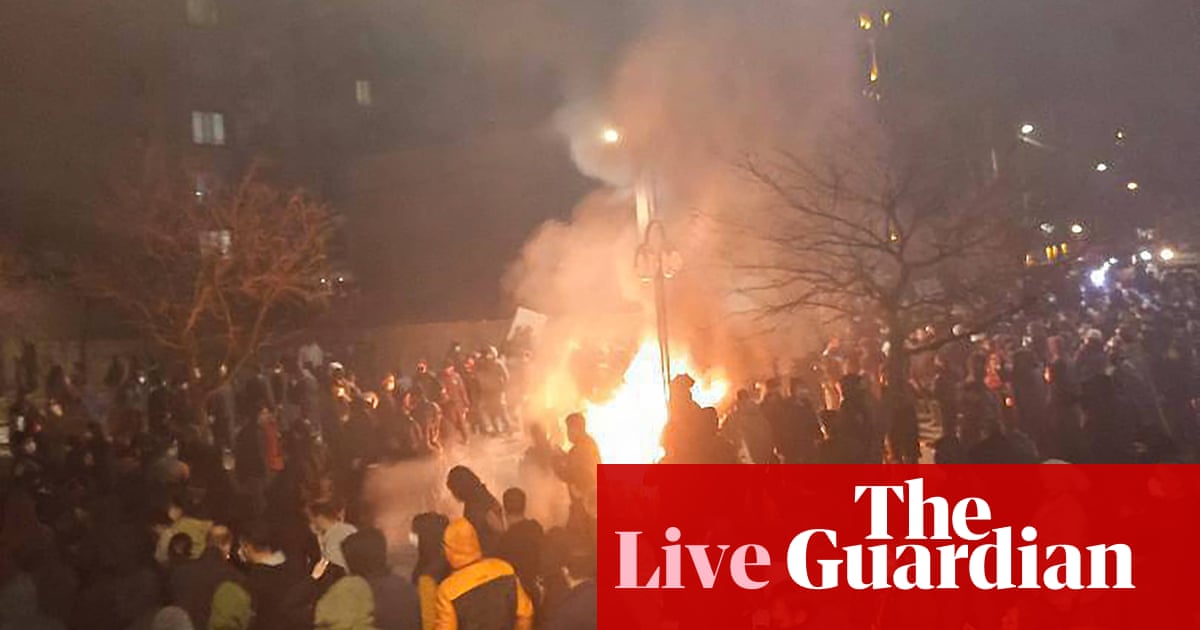
UN human rights chief says ‘cycle of horrific violence’ in Iran ‘cannot continue’
Commenting on the protests, the UN high commissioner for human rights Volker Türk said:
This cycle of horrific violence cannot continue. The Iranian people and their demands for fairness, equality and justice must be heard.
“The killing of peaceful demonstrators must stop, and the labelling of protesters as ‘terrorists’ to justify violence against them is unacceptable,” Türk said.
It also was “extremely worrying” to hear some public statements from judicial officials mentioning the prospect of the use of the death penalty against protesters through expedited judicial proceedings, Türk added.
Asked to comment on the scale of the death toll, the UN rights office spokesperson Jeremy Laurence drew on information given by the UN’s sources in Iran and told reporters: “The number that we’re hearing is hundreds.”
Key events
EU to ‘swiftly’ propose further sanctions on Iran, von der Leyen says
The European Commission President Ursula von der Leyen has said the bloc will “swiftly” propose further sanctions on those responsible for the “repression” of demonstrations in Iran.
“The rising number of casualties in Iran is horrifying. I unequivocally condemn the excessive use of force and continued restriction of freedom,” she wrote in a post on X.
“The European Union has already listed the Islamic Revolutionary Guard Corps in its entirety under its human rights sanctions regime.”
The EU has already adopted a wide-ranging set of sanctions against Iran, mainly in the form of travel bans and asset freezes.
The Guardian’s diplomatic editor, Patrick Wintour, has written an analysis piece exploring the factors the US is considering as it weighs up a potential attack on Iran. Donald Trump’s national security team is expected to hold a meeting at the White House to consider its options later. Here is an extract from Patrick’s story:
A major intervention by Washington, some are warning, will only fuel the fire of an Iranian government narrative that the protests are being manipulated as part of an anti-Islamic plot being led by the US and Israel.
Trump has promised that he will “shoot at Iran” if Iranian security services attack protesters; however, analysts suggested the speed of the crisis meant his team has no developed response ready.
There has been no major movement of US military assets, and many of his closest Middle East partners such as Qatar are urging restraint. Military options and other possibilities were being placed in front of the unpredictable president, the New York Times and Wall Street Journal reported. The US secretary of state, Marco Rubio, spoke to the Israeli prime minister, Benjamin Netanyahu, on Saturday.
The population density of Tehran – where roughly 12 million Iranians live – means it is hard to mount a targeted campaign from the air without risking many civilian casualties, as the US-Israeli assault in June showed. More than 1,000 Iranians died, creating a new, now apparently dissipated, nationalism.
Iranian foreign minister Abbas Araghchi gave an interview with Al Jazeera on Monday in which he warned the US that his country was ready for war if Washington wants to “test” it.
“If Washington wants to test the military option it has tested before, we are ready for it,” Araghchi said, adding that he hoped the Trump administration would choose “the wise option” of dialogue, while warning of “those trying to drag Washington into war in order to serve Israel’s interests”.
The foreign minister suggested Iran’s military preparedness was greater than it was last June when the US launched strikes on Iran’s three major nuclear sites (which subsequent satellite imagery suggested caused more limited damage than Donald Trump had claimed).
After the US struck Iran’s nuclear enrichment sites last year, Iran carried out a telegraphed strike – which was seen as largely symbolic – on a US military base in Qatar, which did not lead to any deaths among US military personnel.
In his interview with Al Jazeera, Araghchi also said that “terrorist elements” had “infiltrated the crowds of protesters and targeted security forces and demonstrators” in Iran.
Trump has repeatedly threatened to intervene if Tehran killed protesters. The White House on Monday said the US president was not afraid to use military force, but wanted diplomacy.
Spain has summoned Iran’s ambassador to Madrid to express “strong repudiation and condemnation” of the deadly crackdown on protests that has reportedly killed nearly 650 people, the foreign minister said.
“The right of Iranian men and women to peaceful protest, their freedom of expression, must be respected” and “arbitrary arrests must cease”, Jose Manuel Albares told Catalunya Radio.
Finland’s foreign minister, Elina Valtonen, meanwhile, said she would summon Iran’s ambassador. In a post on X, she said:
Iran’s regime has shut down the internet to be able to kill and oppress in silence. This will not be tolerated. We stand with the people of Iran – women and men alike.
I will summon the Iranian ambassador this morning. Together with the EU, Finland is exploring measures to help restore freedom to the Iranian people.
Non-essential French embassy staff have left Iran, two sources with knowledge of the matter told Agence France-Presse. The personnel left on Sunday and Monday, the sources added, without saying how many people had departed. “The protection of our personnel and our citizens is a priority,” a French foreign ministry official told AFP.
UN human rights chief says ‘cycle of horrific violence’ in Iran ‘cannot continue’
Commenting on the protests, the UN high commissioner for human rights Volker Türk said:
This cycle of horrific violence cannot continue. The Iranian people and their demands for fairness, equality and justice must be heard.
“The killing of peaceful demonstrators must stop, and the labelling of protesters as ‘terrorists’ to justify violence against them is unacceptable,” Türk said.
It also was “extremely worrying” to hear some public statements from judicial officials mentioning the prospect of the use of the death penalty against protesters through expedited judicial proceedings, Türk added.
Asked to comment on the scale of the death toll, the UN rights office spokesperson Jeremy Laurence drew on information given by the UN’s sources in Iran and told reporters: “The number that we’re hearing is hundreds.”
About 2,000 people killed in Iran protests, Iranian official tells Reuters
About 2,000 people, including security personnel, have been killed in the protests in Iran, an Iranian official has told the Reuters news agency. We have not been able to independently verify this figure yet. It is difficult to do so because of the ongoing internet blackout in Iran. The official did not give a breakdown of who had been killed to Reuters.
Australia’s foreign minister Penny Wong has urged her country’s nationals in Iran to leave “now” as tensions remain high between Washington and Tehran as the US reportedly weighs a series of potential military options in Iran.
In a post to X, Wong said:
Australia stands with the brave people of Iran in their struggle against an oppressive regime.
We unequivocally condemn the Iranian regime’s brutal crackdown on its own people – the killing of protesters, the use of force, and arbitrary arrests must stop.
Our ability to provide services in Iran is extremely limited. I urge any Australians still in Iran to leave now while commercial options are available.
Australians in need should call the Consular Emergency Centre on 1300 555 135 (within Australia) or +61 2 6261 3305 (overseas).
Why are people protesting in Iran?
The protests, which began in Tehran on 28 December, were triggered by the collapse of the Iranian currency – the rial – and soon morphed into nationwide anti-regime demonstrations with people also angry at social and political restrictions imposed by the government.
As my colleague William Christou notes in this story, the currency has continued to depreciate, while the government announced the end of a subsidised exchange rate for importers – a move that caused the price of groceries to soar.
In September, widespread UN sanctions against Iran came back into effect for the first time in a decade after being triggered by the UK, France and Germany (the ‘E3’) as Tehran failed to convince western powers it would address their concerns over its nuclear programme.
They were are a “snapback” of measures frozen in 2015 when Iran agreed to major restrictions on its nuclear programme under a deal negotiated by the former US president Barack Obama.
Iran was already under huge economic strain caused by US sanctions that cut the country off from global finance.
International sanctions have played a major role in worsening economic conditions for ordinary Iranians who are having to contend with high inflation, soaring prices and a huge devaluation of the rial.
Iran’s economic crisis worsened again after Israel and the US launched strikes last June in a 12-day war that targeted several of the country’s nuclear sites.
US citizens urged by virtual embassy in Iran to leave the county ‘now’
The US virtual embassy in Iran has urged for US citizens to get out of the country “now” (if possible) and to have a plan for leaving that does not “rely” on US government help.
In a security alert published on Tuesday, the embassy said:
Protests across Iran are escalating and may turn violent, resulting in arrests and injuries. Increased security measures, road closures, public transportation disruptions, and internet blockages are ongoing.
The government of Iran has restricted access to mobile, landline, and national internet networks. Airlines continue to limit or cancel flights to and from Iran, with several suspending service until Friday, January 16.
It recommends for US citizens to avoid demonstrations, “keep a low profile” and, if it is safe to do so, consider leaving Iran “by land” to Armenia or Turkey.
If leaving is impossible, the virtual embassy said people should find a “secure location” within their residence or another safe building, and keep a supply of essential items including food, water and medication.
As of yesterday, protests were reported to have taken place in at least 186 cities across all 31 provinces in Iran.
Iran’s internet shutdown has lasted over 108 hours, monitor says
Iran’s internet shutdown has passed the 108-hour mark, according to an update from the internet tracking agency NetBlocks posted about four hours ago.
The tracking agency has said the blackout, which has seriously hampered the media’s ability to report on what is going on inside of Iran, could be circumvented with shortwave radio, connecting to cell coverage at borders, Starlink and satellite phones.
For the first time in days Iranian authorities allowed members of the public to make phone calls abroad, the Associated Press reported this morning. But there are still restrictions on the internet and texting services have reportedly not been restored.
More than 90 million people have been cut off from the internet since the demonstrations in Iran began, according to the human rights organisation Witness.
As we mentioned in the opening post, Donald Trump said in a Truth Social post on Monday that countries doing business with Iran would be hit with a 25% tariff on trade with the US, a move that is likely to impact major economies like China and India.
You can keep up to date with the latest market reaction and how the price of oil has been impacted by the announcement in our business live blog.
Iranian government in its ‘final days and weeks’, German chancellor says
We are restarting our live coverage of the ongoing anti-government protests in Iran which are widely seen as the most serious challenge to the country’s Islamic Republic in recent years.
At least 648 protesters have been killed in the ongoing crackdown, according to the Norway-based NGO Iran Human Rights. Thousands more people have been injured since the demonstrations started on 28 December over the collapse of the Iranian currency and general economic malaise.
Speaking while on a diplomatic visit to India earlier today, German Chancellor Friedrich Merz said he believes the Iranian government is in its “final days and weeks”, adding that the regime lacks “legitimacy through elections in the population”.
“If a regime can only keep itself in power by force, then it’s effectively at the end,” Merz said.
The Iranian regime has been condemned by many world leaders for its harsh crackdown including mass arrests, internet blackouts and public warnings that participation in the demonstrations could carry the death penalty.
On Tuesday morning, the Associated Press reported mobile phones in Iran were able to make international calls, although restrictions on the internet reportedly remain in place.
Meanwhile, the US president, Donald Trump, has said any country that does business with Iran will face a tariff rate of 25% on trade with the US.
The White House press secretary, Karoline Leavitt, told reporters on Monday that airstrikes were among the “many, many options” that Trump was considering but that “diplomacy is always the first option for the president”. Trump’s national security team is expected to meet later to discuss options. Stick with us as we bring you the latest lines.
#Iran #crisis #live #cycle #horrific #violence #Iran #official #killed #crackdown #Iran