wellnessfitpro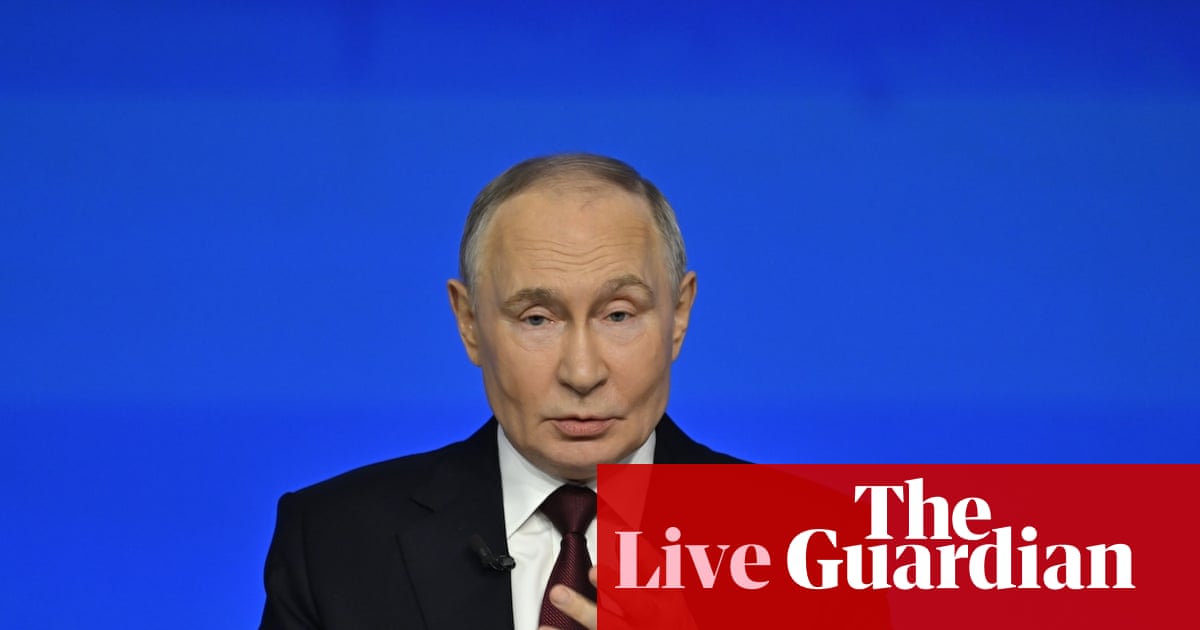
Putin says ball in west and Ukraine’s court to move on ending war
After a number of domestic questions (including one on, erm, aliens), Putin is back talking about Ukraine.
He praises Trump’s “serious efforts to conclude this conflict,” and says the US president is “sincere” in his attempt to end the war.
He claims that Russia has been asked to make some compromises during the Anchorage talks with Trump and broadly agreed to them (it’s not entirely clear what is that he means here), so “saying that we reject anything or turn anything down is inappropriate and groundless.”
“The ball is entirely in the court of our western so-called opponents, the chief of the Kyiv regime, and … their European sponsors,” he says.
Key events
Poland’s Nawrocki then talks about various bilateral issues – including on history – and economy.
He also pointedly praises Trump, saying he is the only leader capable of making Putin move on Ukraine to achieve a peace settlement in the war.
Over to Zelenskyy now.
Nawrocki also says the two leaders share their views that Russia is a “neoimperial, post-Soviet” power that poses danger to the region.
But he then highlights the importance of Poland’s ongoing support for Ukraine, with past aid from Poland and 90% of the broader European aid for Ukraine coming through the country.
He says the two countries are fully aligned on strategic issues, but says that there is a sense that Poland’s support weren’t properly appreciated by Ukraine, and he raised this in his talks with Zelenskyy.
Zelenskyy, Poland’s Nawrocki address media after Warsaw talks

Jakub Krupa
Poland’s Nawrocki and Ukraine’s Zelenskyy are now speaking to the media.
Nawrocki says that Zelenskyy’s visit is “bad news for Moscow”, as shows the unity of thinking on security and defence between Warsaw, Kyiv and other partners in the region.
He makes it very clear what he thinks of Russia, as he says it seeks to “disrupt the international order” and destabilise political systems, with “hybrid” attacks taking place on an “almost daily basis.”
He reiterates Poland’s support for strict sanctions against Russia.
I will bring you more lines here.
Meanwhile, Putin was asked about the prospect of having more normalised relations with Nato.
He responded with his longstanding grievance about the alliance’s expansion eastwards in the last 30 years to cover larger parts of central and eastern Europe which he said happened despite Russia getting guarantees it would not and in practice “entailed moving military infrastructure closer to our border, which causes our legitimate concern.”
(No reflection on why these countries wanted to join Nato in the first place and if it perhaps had anything to do with the perceived threat from Russia.)
He once again says that ending the Ukraine war would require resolving “the root causes of the conflict,” which – as we know from his previous speeches – includes some far-reaching demands regarding Nato’s presence in this part of Europe.
Just a reminder that you can watch Putin’s press conference with English translation here:
Zelenskyy meets Poland’s Nawrocki in Warsaw
Jakub Krupa
By the way, we should also hear from Ukraine’s Zelenskyy at some point in the next hour or so.
He is in Poland, meeting with the country’s president Karol Nawrocki for talks this morning. The pair have a tricky relationship, with Nawrocki – while supportive of Ukraine’s war effort – occasionally deploying rather critical rhetoric about Ukraine and Ukrainians in Poland, both in his electoral campaign and in his time in the office.
Earlier this month, Nawrocki demanded that Zelenskyy show more gratitude for Poland’s support for Ukraine throughout the war, after the country welcomed millions of Ukrainian refugees and as it serves as the main logistics hub for Ukraine aid.
Let’s see what they say after today’s talks.
Putin says ball in west and Ukraine’s court to move on ending war
After a number of domestic questions (including one on, erm, aliens), Putin is back talking about Ukraine.
He praises Trump’s “serious efforts to conclude this conflict,” and says the US president is “sincere” in his attempt to end the war.
He claims that Russia has been asked to make some compromises during the Anchorage talks with Trump and broadly agreed to them (it’s not entirely clear what is that he means here), so “saying that we reject anything or turn anything down is inappropriate and groundless.”
“The ball is entirely in the court of our western so-called opponents, the chief of the Kyiv regime, and … their European sponsors,” he says.
Belgium’s de Wever hails ‘stable, legally robust’ solution on Ukraine funding as he shows frustration with pro-Russian accusations
Belgium’s Bart de Wever put out a fairly nuanced explanation of his thinking on frozen assets at his lengthy press conference last night.
In his opening comments, he said that “supporting Ukraine is not charity, it is the most important investment we can make in our own security.”
He stressed that “there was never any debate about whether we would help; the only real question was how we should help.”
De Wever added that “if Europe had walked away today with a without an agreement, we would not only have failed Ukraine, we would have failed ourselves.”
The Belgian prime minister insisted what was adopted was “a stable, legally robust and financially credible” solution, with Ukraine getting “urgent, predictable and reliable” financing it needed.
He added that the compromise solution “protected Europe’s economic and financial credibility,” and safeguarded “trust in European institutions, markets and the euro, and that is vital if we want Europe to remain competitive and able to finance future priorities.”
He explained:
“We avoided stepping into a precedent that risks undermining legal certainty worldwide. We safeguarded the principle that Europe respects law even when it is hard, even when we are under pressure, and we delivered a strong political signal that Europe stands behind Ukraine, Europe remains united, Europe acts responsibly, and Europe still matters. I am proud that we have been able to contribute to this outcome by being constructive, firm and responsible.”
But in a bizarre exchange with a Politico reporter later in the briefing, de Wever could not hide his frustration with the outlet’s characterisation of Belgium in the build up to the summit as Russia’s “most valuable asset” (ouch).
Inviting a Politico reporter to ask his question, he joked that as a politician he had to let go of his emotions “even if these emotions are pure anger, vengeance and maybe even violence.”
He begun by stressing that at the end of the day, the decision was “unanimous,” so there was no unusual divisions between the EU countries.
He added:
“There’s always (some) division at the European table. This is Europe, 27 countries, different interests, different public opinions, close to Russia, far from Russia. We’re not all playing in the same ballgame, but at the end of the day, there is a decision with unanimous support, so what’s your problem?
We found a solution for the financing of Ukraine, and we were unanimous. Three countries didn’t want to be implicated, okay, fine, but we’re there.”
And that’s where the presser took a slightly bizarre turn, as he joked:
“But now I have to go to my dacha in St Petersburg, where my neighbour is Depardieu, and then across the street there is Assad. And I think I can become mayor of that little, little village, maybe that could be your [headline],” he snarked, prompting some laughter in the room.
Walking out the room, he felt the need to clarify “that was a joke; if you write this, you must add ‘laughter’”.
You can kind of see where it came from though: a very humane, if unusual and awkward, moment after a particularly difficult and tense summit, revealing the immense human toll of these negotiations and the pressure he found himself under (from all directions).
Jakub Krupa
It’s only fair to say that the European response to that – as put forward by Germany’s Merz at his press conference in the middle of the night – would be to note that as a result of last week’s decision in the build up to the summit, the Russian assets have now been permanently frozen.
That changes the dynamic compared to the previous system of rolling decisions every six months, always fraught with risk of last minute block from Hungary or someone else.
As a result, they can be more sustainably used to fund or guarantee funds for Ukraine going forward – it’s just that the order of doing things is different now.
So, in Merz’s words, “that stays on the table.”
(He’s also getting some domestic criticism from his political rivals, the far-right Alternative für Deutschland, as they frame the agreed solution as simply taking on more debt.)
Jakub Krupa
Looking at that last Putin line on “robbery,” that’s exactly what I meant earlier (10:46).
Rightly or wrongly, Putin will see the EU’s decision to move away from the reparations loan backed by frozen Russian assets as a win for his campaign of intimidation.
Just think of all these Kremlin warnings about “severe consequences” for Belgium specifically and the EU more broadly – they clearly seem to have influenced the thinking of some EU countries when coming to the summit.
Putin calls EU reparations loan idea ‘robbery’ and warns about consequences
Oh, Russia’s Putin has now offered his take on the idea of using frozen Russian assets, calling it a “robbery” and saying the leaders failed to agree fearing that “the consequences could be really harsh for the robbers.”
He said the move, if passed, would have undermined the confidence in the eurozone, with worrying precedent that could be abused in the future against other countries or groups.
“No matter what they steal, sooner or later, they will have to give it back, and most importantly, we will go to court to protect our interests. We will do our utmost to find a jurisdiction that will be independent from the political context,” he warned.
EU summit secures money for Ukraine, but politically its outcome is more complicated – snap analysis
Jakub Krupa
If you only read the headline, you would think that the outcome of this council is exactly as expected. Ukraine gets its 2026 funding, Zelenskyy is relieved after his warnings about financial difficulties, and Europe shows its continued backing for Kyiv.
Well, the reality is somewhat more complex.
Behind the scenes, this was not a victory lap, but more of a last minute fix to save the day.
For days, most senior EU figures like commission president Ursula von der Leyen and key leaders like German chancellor Friedrich Merz insisted in strong words that the use of frozen Russian assets was the best – morally and financially – option for funding Ukraine. In the process of doing that, they actively played down the alternatives (including the very one they ended up agreeing on!).
But during the summit, faced with multi-faceted opposition from various partners, their original view did not hold.
In the end, Belgium’s determined opposition to the proposal amid pressure from Russia and the central European Awkward Three’s clever use of their veto threat forced the leaders to change their tactic and settle for what had been a less preferred option.
Financially, the outcome is essentially the same, and Ukraine gets the money it so needed to continue defending itself from Russia’s aggression.
Zelenskyy – after a pretty dramatic warning yesterday that any shortfall would directly impact Ukraine’s ability to fight the war – will be relieved to see the money confirmed in black and white. In that sense, the fix does the job.
But politically, it does not quite send the defiant, determined and united signal the EU so much wanted to send when proposing to use frozen Russian assets in the first place, with the strong message about the aggressor having to pay for its war.
Instead, critics will not unreasonably say that we have once again seen the reality of bitter divisions between the countries – even in the face of actual war – and that Russia’s active campaign of putting pressure on Belgium and other countries to block the EU’s proposal effectively allowed Moscow to fend off the proposal it did not like.
Both of these could be worrying signs for the future.
But, as is so often the case with the EU: for now, we live to fight another day.
In this case, quite literally.
Asked about Zelenskyy’s recent social media clip recorded on a visit to Kupyansk, Putin dismisses it by saying he’s not surprised “he’s an actor and a talented one to boot,” but notes that the monument where it was recorded is “one kilometre or so from the city.”
“Well, if the city is under their control, why do not come into the city itself?” he taunts him.
Unsurprisingly, Putin also says that “our forces are advancing along the whole line of conflict,” a claim contested by Ukraine.
#Ukraine #war #live #Putin #praises #Trump #lengthy #speech #Zelenskyy #welcomes #EUs #90bn #loan #Ukraine