wellnessfitpro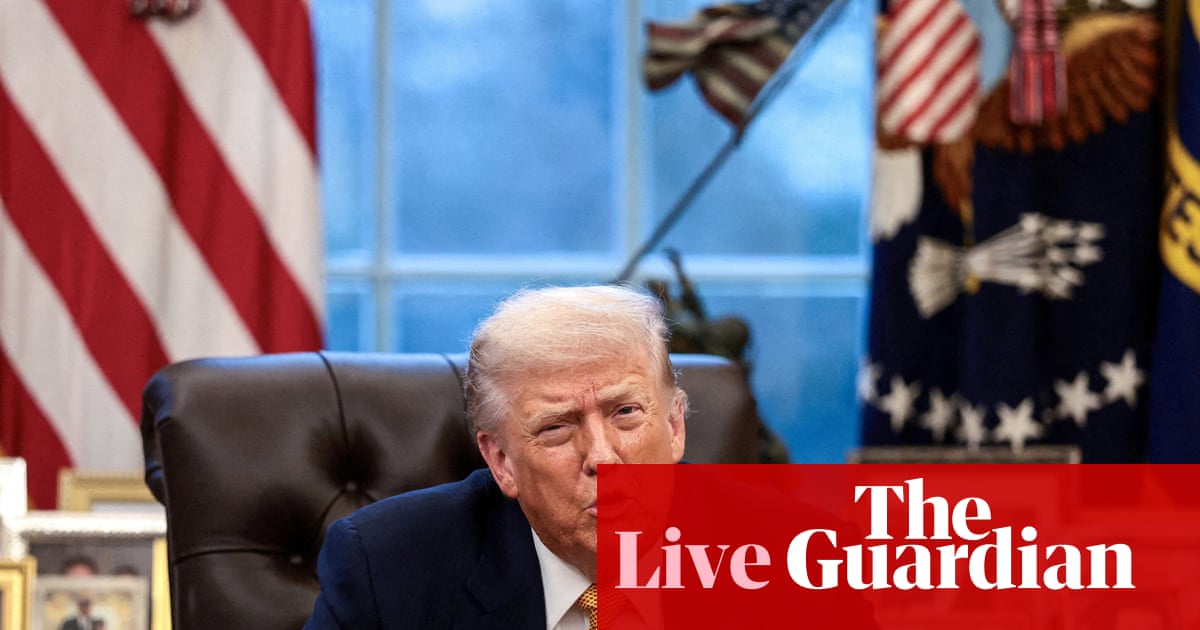
Introduction: Stock markets fall as Trump renews tariff threats
It looks like it will be a rocky start to the week for investors after Donald Trump threatened eight European countries with new tariffs until they support his ambition to acquire Greenland.
The US president is planning to impose new trade levies of 10% on goods from Denmark, Norway, Sweden, France, Germany, the UK, the Netherlands and Finland from 1 February, rising to 25% on 1 June.
Investors in Europe are spooked: futures for the continent’s European Stoxx 50 index are down 1.51%. Futures for the UK’s FTSE 100 blue chip index are down 0.48%, while the French Cac 40 is posed to fall 2.1% and the German Dax pointing to a 1.35% drop at the open.
In Asia, the picture has been more mixed as investors digested reports from China that its economy expanded at a 5% annual pace in 2025, though it slowed in the last quarter. In Japan, the Nikkei 225 slipped 0.7%.
Oil prices and the dollar are falling too. Brent crude is down 0.73% to $63.66 a barrel, while West Texas Intermediate is down 0.61% to $59.08 a barrel. The US Dollar index, which tracks the dollar against a basket of other major currencies, is down 0.23%.
And gold, which is seen as a “safe haven” asset during periods of instability, hit another fresh high this morning, rising to as much as $4,689.39 per ounce. It is now trading up around up 1.6% at $4,668. Spot silver is also up by about 3.8% to $93.39 per ounce, after hitting a record high of $94.08.
The US markets will be closed today to commemorate Martin Luther King Jr. Day. But US futures for now are pointing to a 1% drop when the market opens on Tuesday.
Jim Reid, of Deutsche Bank, notes while markets are spooked this morning, the shock could wane.
There will be hundreds of different opinions on how this will all pan out but remember that the tariffs announced on Liberation Day were ultimately softened a week later, on the day that long-end US Treasury yields saw a scary Asian session as international investors started to vote with their feet in terms of US funding. So financial markets may play a big part in how this situation resolves itself.
The main Achilles Heel of the US is the huge twin deficits. So while in many ways it feels like the US holds the economic cards, it doesn’t hold all the funding cards in a world that will be very disturbed by the weekend’s events. It also remains to be seen what political benefit there would be for President Trump domestically given that the mid-terms are widely believed to likely be about the cost of living.
In addition, a Reuters/Ipsos poll last week suggested that only 17% of US citizens supported efforts to acquire Greenland, with 47% against. Only 4% approved of using military force with only 8% of Republican voters agreeing.
That all being said, the tariff threats are still very real, he says.
Europe also needs the US in terms of helping with Ukraine. As such expect diplomacy to be going into overdrive over the next 12 days. There has been lots of talk over the weekend around the EU activating its anti-coercion instrument (ACI) which officially came into force at the end of 2023.
It has a high bar to be activated but this episode could well pass that threshold. Macron yesterday called on it to be used but he also wanted it used last year on China and talked of its use with the US after Liberation Day.
One of the problems is that it would likely take months to come to fruition as the formal and legal processes would need to follow due process. Given the extended timeline and potential difficulty in agreeing ACI use, last night EU ambassadors also explored the option of activating the EUR 93bn in retaliatory tariffs that were prepared in response to Trump’s tariffs last year but never implemented.
We’ll find out over the next few days how coordinated Europe is as it tries to respond, with an emergency summit of EU leaders being scheduled for this week, likely Thursday according to Politico.
Elsewhere this morning, chancellor Rachel Reeves is in London this morning, expected to hail a “new golden age” for the City.
This morning new regulatory rules come into effect for businesses considering an IPO or raising capital, reducing paperwork and costs following changes to UK Listing Rules.
She is expected to say:
Two years ago, some said the City’s best days were behind it. They were wrong.
We have taken a significant step forward today and I look forward to continuing to work closely with everyone here to ensure that our capital markets remain world-leading.
As the FTSE 100 reaches record highs and global firms once again choose London, we are seeing the first signs of a new golden age for the City.
London has thrived because it is open, dynamic and forward-looking. With simpler, faster prospectuses and a more competitive listings regime, we are reinvigorating that spirit – making the UK the best place in the world to start, scale and list a company, and ensuring the benefits of this new golden age for the City are felt in jobs and higher living standards in every part of our country.”
Key events
Shares in insurer Beazley surge to all-time high on takeover interest
Shares in the FTSE 100 insurer Beazley have shot up by more than 40% to an all-time high of £11.57 per share after the Swiss group Zurich Inusrance revealed it had made a £7.7bn takeover offer for the company.
Zurich said it made an offer of £12.80 per share, at a 56% premium to Beazley’s closing share price on 16 January 2026, the last business day before it submitted its offer to the business.
The company said it had previously tabled a bid of £12.30 per share, which Beazley rejected on the grounds that it undervalued the business.
Beazley, which is headquartered in London and employs about 2,500 people, is one of the biggest specialist insurers in the world. Its expertise ranges from cybersecurity to fine art.
Zurich’s chief executive Mario Greco told the Financial Times that the latest bid was the group’s fifth offer for Beazley since its first takeover approach about a year ago.
He told the paper:
It was time to go public and eventually have [Beazley’s] shareholders say what they think.
The dollar is still falling today, now down 0.23% against a basket of other major currencies.
Meanwhile other traditional safe haven assets, such as the Swiss franc, are rallying.
The euro is up about 0.3% against the dollar, to $1.163 and the pound is still up by about 0.2% to $1.3415.
Khoon Goh, head of ANZ, told Reuters:
Typically you would think tariffs being threatened would lead to a weaker euro.
But, as we’ve seen last year as well, when the ‘Liberation Day’ tariffs were getting put in place, the impact in FX markets actually has been more towards dollar weakness every time there is heightened policy uncertainty emanating from the United States.”
Jane Foley, at Rabobank, warned against assuming that the US dollar no longer had its safe haven status. She said:
Even if non-US investors decided to take their money out, where would they go? Other markets aren’t big enough to maintain that. The sheer size of the [US] market means that there is always going to be some safe-haven value associated with US assets.”
Greenland tariffs could hit UK’s GDP by 0.1%-0.2%, says Goldman
Analysts at Goldman Sachs have made a more conservative estimate about the potential economic impact of Trump’s latest tariff threat.
Goldman thinks if Trump goes ahead with a further 10% tariff, it would lower real GDP by 0.1%-0.2% across the countries affected, including the UK.
Sven Jari Stehn, an economist at Goldman, wrote:
We estimate the largest hit for Germany worth about 0.2% if implemented as a 10% incremental reciprocal tariff (which seems most likely) and 0.3% if implemented as a blanket tariff.
For the euro area as a whole, the implied GDP drag is around 0.1%, similar to the UK.
The hit could be larger should there be adverse confidence or financial market effects. But the drag would be smaller if countries rerouted trade through EU countries not subjected to the additional tariff.
The GDP hit across countries would rise to a 0.25-0.5% hit for a 25% tariff. All of these GDP hits would come on top of the 0.4% real GDP drag we estimated from last year’s tariff increases.”
Analysts at Capital Economics thinks the potential further tariffs could lead to UK GDP shrinking by 0.3%-0.75%.
BritishAmerican Business, a transatlantic trade association, has said Trump’s latest tariff threats are “a step too far”.
Chief executive Duncan Edwards said while he understood a case could be made for Trump’s reciprocal tariffs due to “higher tariffs and non-tariff barriers of some of its trading partners and America’s large trade deficit in goods”, he believed no such case could be made when tariffs were being used in another geopolitical issue.
He said:
A separate argument about the importance of Greenland to the security of the United States and the North Atlantic might also be made, but the threat of tariffs to force Denmark to the table seems totally unreasonable.
We need to see what happens before making a full judgement and the decision of the supreme court on the use of IEEPA for the reciprocal tariffs may make this question moot, but this certainly feels like a step too far by the administration and the threat should be withdrawn”.
Greenland tariffs could push UK into recession, economists warn
The UK would be at risk of recession if Donald Trump goes ahead with his latest tariff threats, a leading economist has warned.
Paul Dales, of the consultancy Capital Economics, said UK GDP would shrink by 0.3%-0.75%.
If the existing tariff of 10% with some exceptions has reduced UK GDP by around 0.3%, then a rise in tariffs to 20% could subtract another 0.3% and a subsequent rise to 35% could take off another 0.45%.
So in a worse-case scenario in which the tariffs threatened by Trump apply to all products, they could subtract up to 0.75% from UK GDP.
Our tariff impact model…suggest the worse-case scenario could reduce UK GDP by 0.6% in three years’ time.
The actual influence would probably be smaller as some exports destined for the US are sold to other countries instead.
As a result, it makes sense to think about a possible hit to UK GDP in a range of perhaps 0.30-0.75%. With the UK economy currently growing by 0.2-0.3% a quarter, if this hit came all at once it could trigger a recession.
But it’s likely to be spread over many quarters. In fact, some front-running of exports before the tariff deadlines could initially boost GDP growth.
Tariffs bad news for Europeans and Americans, say EU winemakers
Dr Ignacio Sánchez Recarte, from the European wine industry body Comité Européen des Entreprises Vins, said:
The announcement by President Trump, and the very real risk of escalating tensions between the EU and the US, is bad news for both European and American citizens, and particularly for the EU wine sector.
This comes at a time when wine companies are still dealing with the rollercoaster triggered by the so-called “Liberation Day” in 2025, and were hoping for more stability and predictability in transatlantic trade.
But, instead of moving toward stability, the situation appears to be going from bad to worse, as this decision once again pushes businesses into uncertainty in our most important export market.
The United States accounted for 29% of EU wine exports last year, so the impact is significant and disruptive.
Dialogue and cooperation must remain the foundation of EU–US relations, and we urge political leaders on both sides to return to these principles.
US supreme court could undermine Trump on tariffs
While Trump’s latest tariff threats have spooked European stock markets today, the president could be undermined by the US supreme court.
The court is set to rule on the legality of Trump’s use of the International Emergency Economic Powers Act (IEEPA) to impose tariffs. It could rule as soon as this week.
Last week Trump wrote in a lengthy post on social media that it would be “a complete mess” if the court were to strike down his trade tariffs.
But US treasury secretary Scott Bessent said on Sunday that the ruling would go Trump’s way, but suggested there would be chaos if not.
He told NBC yesterday:
I believe that it is very unlikely that the supreme court will overrule a president’s signature economic policy. They did not overrule Obamacare. I believe that the supreme court does not want to create chaos.”
The precious metals market is rallying again today, as anxious investors seek out traditional safe haven assets. Both gold and silver hit fresh records this morning, with gold hitting an all-time high of $4,689.39, now at $4,663.63. Silver hit a new high of $94.08 per ounce, now at $93.23.
London’s gold miners are performing strongly this morning, with Fresnillo the strongest across the index this morning up 4.16%. Endeavour Mining is second, up 2.1%.
UK business lobby groups call for ‘cool heads’ as tariff tensions grow

Mark Sweney
Richard Rumbelow, a director at UK manufacturers body Make UK, said despite the potential significant commercial impact of Donald Trump’s tariffs the UK should not immediately look to strike back with retaliatory actions.
It is a time for “cool heads”, he told BBC Radio 4’s Today programme.
What is important is that we have effective trade diplomacy from the UK. I don’t think this is a time for immediate retaliatory action against the US.”
Rumbelow pointed to the success of negotiations in the automotive and pharmaceutical sectors, which saw the UK eventually win lower tariff rates than other countries.
However, he also pointed out that with Trump threatening that the 10% tariff is due to come into force on 1 February there will be companies that already have products enroute to the US that will not be able to rethink their export strategy.
For example, in April Jaguar Land Rover moved to pause production after Trump announced his “Liberation Day” tariffs to assess the impact on its car manufacturing business.
Rumbelow said:
The 1st of February is a matter of weeks away…It takes longer than that for a product to leave UK shores and reach US shores. If you have a product already in transit, or potentially in transit this week, going to the US it could be that those products will face tariffs as soon as they land on US soil.”
Sean McGuire, director of Europe and International at the Confederation of British Industry (CBI), also stressed the importance of the UK-US trade economy and the need to reach “an acceptable solution through dialogue”.
He said:
The UK business community stands in full solidarity with Denmark and the people of Greenland. Respecting territorial integrity and sovereignty are fundamental to uphold international law. They are essential pillars in providing stability and predictability for our companies and our economies.
“The UK-US economy is important in generating mutual benefits for companies and citizens on both sides of the Atlantic. Additional tariffs will benefit no one and could seriously undermine the relationship. We support the UK Government’s efforts to reach an acceptable solution through dialogue.”
Tina McKenzie, policy chair at the Federation of Small Businesses (FSB), said:
Small exporters are already facing instability and confusion, with the threat of further tariffs adding yet more pressure. Tariffs do not punish governments, they land on businesses and consumers, and they are the ones who will suffer the consequences if these go ahead.”
Trump tariffs would take a ‘wrecking ball’ to British manufacturing, says TUC
The head of the Trades Union Congress has said more tariffs by Donald Trump would seriously harm Britain’s manufacturing sector.
Paul Nowak, general secretary at the TUC, said:
Once again Trump’s arbitrary tariffs threaten to take a wrecking ball to key British manufacturing sectors and jobs.
Keir Starmer is right to say this Labour government will pull every lever to protect working people.
That’s why this government must continue to prioritise a closer trading relationship with the EU.
It’s common sense in an increasingly volatile and unpredictable global economy that we forge stronger ties with our closest neighbours and largest trading partner.”
European defence stocks rising over Greenland tensions
European defence stocks are rising this morning, as geopolitical tensions around Greenland rise.
Germany’s Rheinmetall is up by about 3%, and the UK’s BAE Systems is up by about 2%. Shares in the Italian defence business Leonardo have risen 3%.
Kathleen Brooks at the broker XTB notes that BAE Systems, Babcock International, Rolls Royce, and Rheinmetall are the top performers in Europe and the US so far this year.
One way to assess the threat level to Europe from both Russian aggression and America’s threat to Nato is to look at the performance of these defence stocks. Rheinmetall is higher by more than a fifth so far in 2026, which suggests the risk is high. However, after rallying so hard, if President Trump does back down from Greenland, then defence stocks could be risk from a sell off, but that seems unlikely at this stage.
Starmer says a tariff war is in ‘nobody’s interest’
Prime Minister Keir Starmer has said a trade war is in “nobody’s interest” at a press conference this morning, as he appeared to play down retaliatory tariffs against the US.
He said:
We must find a pragmatic, sensible, sustained way through this, that avoids some of the consequences that will be very serious for our country.
You can follow the conference in full on our politics live blog here.
So far markets are still unhappy, with the FTSE 100 now down 0.5%. The Stoxx European 600 index is down 1.27%, with the main indices in Germany, France, Italy and Spain all down by more than 1%.
The pound is however holding up against the dollar, up 0.17% to around $1.34.
Dan Coatsworth, head of markets at the broker AJ Bell, warns investors will be watching closely as these losses could build over the near term.
A 1% to 1.5% decline every day over a series of weeks adds up to trouble, and that’s what investors are keen to avoid happening.
…The omnipresence of gold miners, defence contractors and utility providers on the FTSE 100 explains why the UK blue-chip index fared much better relative to other major European indices.
Tariffs and geopolitical tensions threaten markets and global growth, says IMF

Richard Partington
The International Monetary Fund has warned mounting geopolitical tensions and an escalation of Donald Trump’s tariff war could hit global economic growth and trigger a backlash in financial markets.
The Washington-based fund said a renewed eruption in trade tensions was among the biggest risks to global growth in 2026.
As world leaders prepare to gather in Davos, Switzerland, for the annual World Economic Forum meeting – widely seen as a critical moment to salvage international cooperation – the IMF said a breakdown in relations between the world’s most powerful nations would have damaging consequences.
It said renewed trade tensions could blow its forecasts off course by “prolonging uncertainty and weighing more heavily on activity”.
The eruption of geopolitical tensions could also result in “introducing new layers of uncertainty and disrupting the global economy through their impact on financial markets, supply chains, and commodity prices”.
Read the full story here:
#European #stock #markets #fall #Trump #renews #tariff #threats #trade #war #wrecking #ball #manufacturing #union #Business