wellnessfitpro
Two years ago, abortion opponents in Missouri tried to defeat Amendment 3, a ballot initiative to enshrine reproductive rights in the state constitution, by falsely telling voters that it would allow gender transition surgeries for minors — even though it wouldn’t.
Voters approved Amendment 3 anyway, overturning the near-total abortion ban enacted by Missouri’s GOP-dominated legislature that had taken effect after the U.S. Supreme Court struck down Roe v. Wade in 2022.
Now Republican leaders in the state are trying to repeal those rights again, using the same issue. They placed a new amendment on the November ballot, also called Amendment 3, that would restore Missouri’s abortion ban while allowing limited exceptions but also constitutionally prohibit gender transition care for minors — though the state has banned surgeries and new prescriptions of puberty blockers and hormones by law since August 2023.
For the Missouri GOP, Election Day can often seem like Groundhog Day. The party holds a supermajority in the legislature and controls every statewide office, yet voters have repeatedly used the initiative petition process to enact policies Republican leaders oppose. By gathering enough signatures, citizens have placed proposals directly on the ballot, then persuaded voters to expand Medicaid, legalize marijuana, raise the minimum wage and restore abortion rights.
This month, that disconnect became an electoral humiliation for Republican leaders. More than 80% of voters rejected their attempt to make it nearly impossible for citizens to amend the state constitution. It was even worse for Gov. Mike Kehoe’s plan to phase out the state income tax: More than 83% voted no.
Missouri Republicans have become “drunk with power,” said Ken Warren, a professor emeritus of political science at Saint Louis University and associate director of the SLU/YouGov Poll. “Because they control everything, they think they can do what they want — and they can’t.”
The new Amendment 3 on the November ballot shows how Republicans, using misleading language, a carefully chosen distraction and even a recycled name, are trying to undo one of those defeats. In 2024, a yes vote on Amendment 3 protected abortion rights. In November, voters will again be asked to vote yes on Amendment 3 — this time to take them away.
Republican leaders say voters never intended to approve a nearly unlimited right to abortion. They argue that Missourians would prefer an abortion ban with limited exceptions for rape, incest, medical emergencies and fetal anomalies — particularly when it is paired with restrictions on gender transition care for minors.
It would not take much to reverse the 2024 result. Abortion rights passed 51.6% to 48.4% — meaning a shift of about 48,000 voters would have defeated the measure.
Critics call the inclusion of gender care “ballot candy,” a way to make an unpopular proposal easier to swallow. They say the tactic is especially cynical because it promises voters a prohibition that, in large part, Missouri already has. State law already bans gender transition surgery for minors and, through August 2027, bars minors from starting puberty blockers or cross-sex hormones for gender transition. Amendment 3 would place the restrictions in the state constitution without an expiration date.
The two provisions bundled together differ enormously in scope. Repealing reproductive rights would affect the healthcare options available to a state with about 6.3 million people. The restrictions on gender transition care concern a small number of minors receiving highly specialized treatment.
Yet supporters want voters focused on the specter of children being used as lab guinea pigs, not the abortion rights the amendment would repeal. A new billboard in the St. Louis suburbs urges them to vote yes and “ban transgender surgeries for minors.”
A website for the political action committee behind the campaign, Her Health, Her Future — whose treasurer is Missouri first lady Claudia Kehoe — declares “OUR CHILDREN are not LAB EXPERIMENTS.” It says Amendment 3 would protect children from “harmful, sterilizing medical procedures” and restore “common sense health and safety standards” for women’s health clinics.
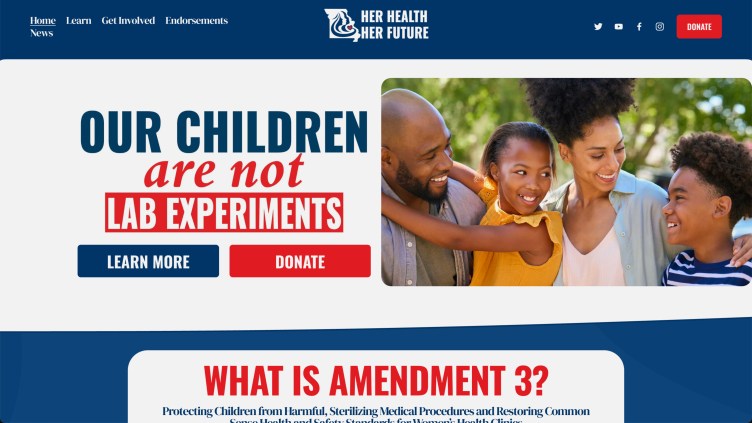
Neither message explicitly says that the amendment would repeal the constitutional right to abortion that Missourians approved two years ago.
Claudia Kehoe did not respond to requests for comment submitted to the governor’s office and the PAC. In a written endorsement posted on the Her Health, Her Future website, she called the amendment “a critical step toward strengthening our pro-life protections and safeguarding our state’s future.”
In response to a list of questions that ProPublica submitted to the governor’s office, a spokesperson defended the amendment using much the same language that critics call deceptive. The spokesperson emphasized protecting children from “sex-change procedures,” safeguarding women and restoring the state’s power to “regulate” abortion providers. The response did not acknowledge that Amendment 3 would repeal the constitutional reproductive rights Missourians approved in 2024 and replace them with an abortion ban that contains limited exceptions.
Polling suggests the strategy could work. A survey in February of Missouri voters by the SLU/YouGov Poll found that nearly 60% supported legal abortion during the first eight weeks of pregnancy. But 67% opposed gender transition medications for minors, and 73% opposed gender transition surgeries. Presented with the amendment’s provisions together, voters favored it 47% to 40%.
Rep. Brian Seitz, a Branson Republican who guided the amendment through the House, denied that supporters were trying to trick voters. He said the gender-affirming treatment was itself a reproductive issue because some procedures could affect a minor’s ability to have children.
Seitz also disputed that Missourians knowingly approved abortion rights through fetal viability in 2024. He said voters were primarily seeking exceptions for rape, incest, medical emergencies and fetal anomalies — not what he called “abortion on demand.”
The new amendment, he said, better reflects what voters intended.
Abortion rights supporters call that argument a pretext for restoring the state’s abortion ban. A coalition of groups called Stop the Ban has raised more than $5 million to try to explain what the amendment would do and persuade voters to reject it. That total includes $1.25 million contributed on Aug. 3 by former New York City Mayor Michael Bloomberg.
Bloomberg’s office did not respond to a request for comment.
Republicans are always “moving a goalpost to sort of get their way, and it is my hope that actual patriots are growing tired of it,” said Rep. Raychel Proudie, a Democrat from Ferguson. “You shouldn’t have to do this if what you’re planning is righteous and in the best interest of people.”
The effort began with the ballot summary written by lawmakers. It did not tell voters that Amendment 3 would repeal the reproductive rights they had approved two years earlier. Instead, it said the measure would “guarantee access” to emergency care, “ensure women’s safety during abortions” and “protect children from gender transition.”
The summary also mentioned exceptions for rape and incest but omitted that they would apply only during the first 12 weeks of pregnancy.
Michael Wolff, a former chief justice of the Missouri Supreme Court who is advising the campaign against the amendment, said the language appeared to be “intended to deceive people into thinking that they were going to protect women having abortions.”
“If you just flat-out tell them that you’re going to repeal nearly all of the protection for reproductive health,” he said, “the people would vote no.”
A judge ruled the legislature’s summary unfair and ordered it rewritten. He later approved revised language written by Republican Secretary of State Denny Hoskins, a former state legislator who introduced a measure that became part of the 2023 law restricting gender transition care and has publicly endorsed Amendment 3.
But a state appeals court found Hoskins’ language still failed to explain the amendment’s effects and rewrote it to lead with the fact that it would “repeal the 2024 voter-approved amendment providing reproductive healthcare rights, including abortion through fetal viability.”
In an interview, Hoskins defended his initial choice to use the word “amend,” rather than “repeal,” because he felt it was more accurate. Asked how his endorsement of the new Amendment 3 squared with his duty to write neutral ballot language, he said his anti-abortion stance was no secret among Missouri voters.
“I can’t all of a sudden erase my conservative views of the past 16 years in the Missouri Legislature,” he said.
The intervention was hardly an isolated one. During Hoskins’ first 1.5 years in office, courts have rejected or rewritten five ballot summaries from his office involving abortion, education, the initiative petition process and a referendum on the state’s newly gerrymandered congressional map.
Hoskins said in an interview that the rulings reflected differences of opinion over what constitutes fair and accurate language, noting that the appellate courts had also sometimes rejected revisions made or approved by lower courts.
But the disputes have gone beyond language. Hoskins has also unilaterally blocked two citizen-led measures from reaching the November ballot. He rejected a proposed constitutional amendment that would make it harder for lawmakers to alter measures approved by voters, saying it was unconstitutional. And he refused to certify a referendum on Missouri’s new congressional map, drawn at President Donald Trump’s urging to help Republicans gain another U.S. House seat, declaring that putting a congressional map to a public vote would be unconstitutional.
Both campaigns sued in state circuit court, where a judge on Wednesday ruled for Hoskins in both cases. In the initiative case, the judge held that Hoskins had the authority to block an amendment from the ballot because it violated Missouri’s requirements that an initiative address a single subject and amend a single constitutional article. He also found that its restrictions on lawmakers’ ability to reconsider voter-approved policies was unconstitutional. And in the redistricting case, the judge agreed with Hoskins that voters cannot use the state’s referendum power to overturn the legislature’s power to redraw congressional maps.
Both cases are expected to reach the state Supreme Court on expedited appeals.
Hoskins said he disagreed with any suggestion that he and Republican leaders were defying the will of voters, noting they, too, had been elected. He criticized the opponents of Amendment 3 as “liberal special interest groups” financed by “out-of-state sugar daddies” like Bloomberg.
State Sen. Maggie Nurrenbern, a Kansas City Democrat, said Hoskins’ actions reflected a broader pattern of interfering with voters’ ability to use the ballot box to reject the Republican agenda.
“That’s quite frankly what is maddening to me, is that politicians over and over again are trying to trick voters,” she said.
#Missouris #Amendment #Repeal #VoterApproved #Abortion #Rights #ProPublica