wellnessfitpro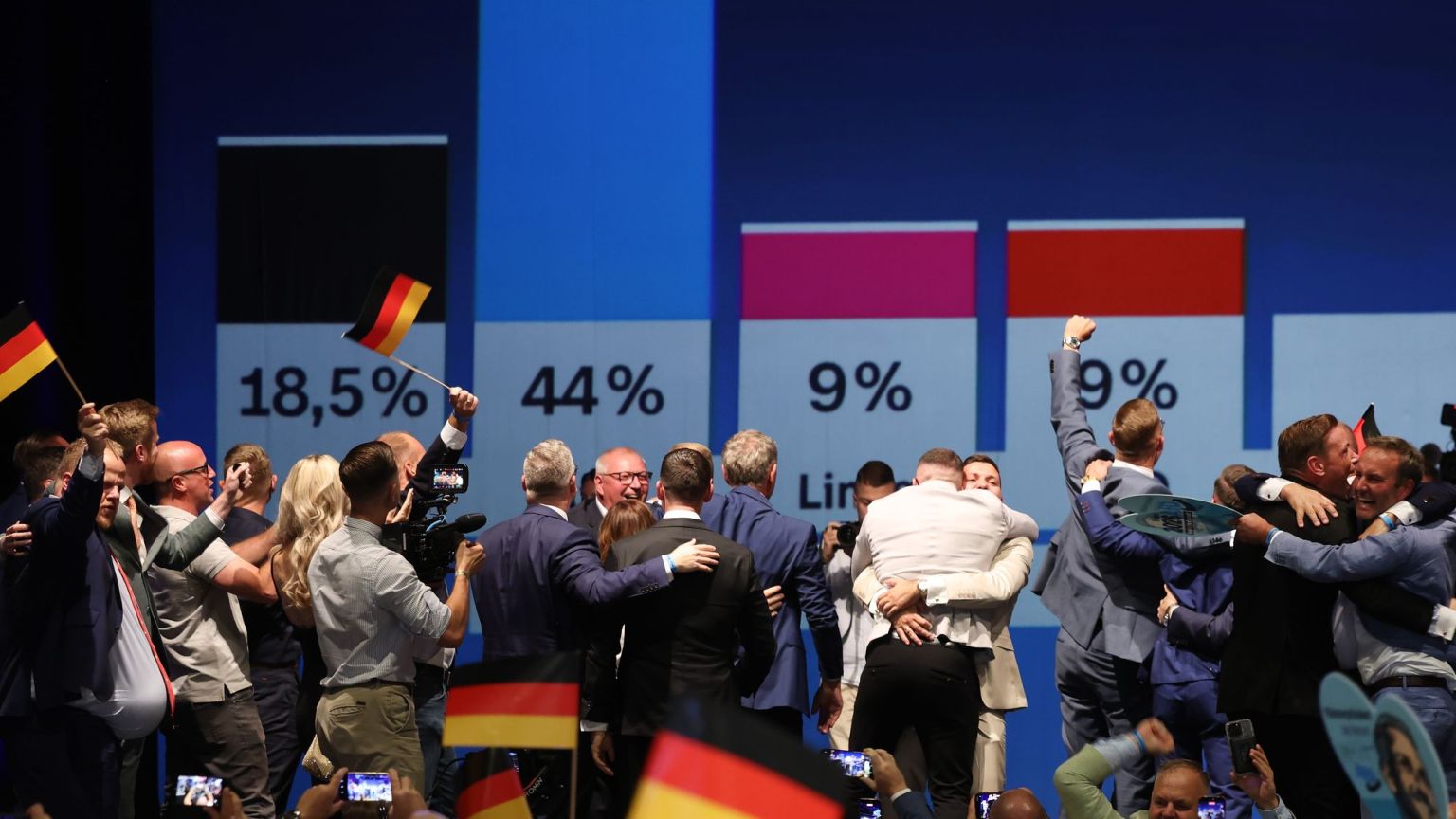
‘Anything is possible’ was the slogan projected on to a giant screen at the Alternative for Germany (AfD) victory party in Magdeburg last night. And the resurgent AfD really had pulled off what would once have been impossible. In Saxony-Anhalt’s state elections, the right-wing populists won an astonishing 44 per cent of the vote, only just falling short of a majority of seats in the state parliament.
It’s not often that regional elections in Saxony-Anhalt, a small, struggling eastern German state, would have much of an impact on Germany, let alone the whole of Europe. But the message sent by these voters to Berlin and beyond is unmistakable. The ‘cartel’ – as the AfD witheringly describes Germany’s mainstream centrist parties – has been smashed to pieces.
The headline figures fail to do justice to the magnitude of the AfD’s victory. The AfD was the most popular party among every social group in Saxony-Anhalt: men and women, the young and the old, the university educated and the high-school educated, blue-collar workers, white-collar workers, civil servants and the self-employed. And it achieved this victory on a vastly increased turnout – 78 per cent compared with 60 per cent in 2021 – mobilising those who normally wouldn’t vote.
The flipside of the AfD’s success is the catastrophic rout endured by the centrist parties. The centre-left Social Democrats (SPD) could only muster a derisory nine per cent. The centre-right Christian Democrats (CDU), currently in government at the state and federal level, were reduced to a rump with just 17 per cent of the vote.
The CDU’s collapse is especially humiliating for Germany’s chancellor, Friedrich Merz, who once pitched himself as the man to beat back the AfD. In 2018, when running for CDU leader, he pledged to cut the AfD’s support in half. Instead, in Saxony-Anhalt at least, support for the AfD has more than doubled since the last state election, while the vote for Merz’s CDU has more than halved.
The reasons for the AfD surge are not difficult to fathom. Since 2015, when Angela Merkel opened Germany’s borders to over a million refugees, successive governments of all hues have failed to get migration under control. In 2022, inward migration actually outpaced the previously unprecedented peak of the Syrian refugee crisis – with 2.7million total arrivals and net migration at 1.4million. The failure to integrate many millions of unchecked, unvetted arrivals has proven disastrous. Crime has surged. Terror attacks are the new normal, even in smaller cities like Magdeburg, Saxony-Anhalt’s capital, where a Saudi-born terrorist killed six and injured more than 300 bystanders at a Christmas market in 2024. The CDU promised to get a grip on migration, but voters are clearly unimpressed by the results. In a post-election interview, Ulrich Siegmund, the AfD’s lead candidate in Saxony-Anhalt, quipped that Friedrich Merz was ‘our most important campaigner’.
Immigration is far from the only issue driving Germans away from the mainstream. German industry has been in freefall since 2019. Around 350,000 jobs have been lost as firms battle competition from China and sky-high energy costs fuelled by Net Zero. Meanwhile, Germany’s infrastructure is crumbling – literally in the case of the Carola Bridge in Dresden, which collapsed in the middle of the night in 2024. Around 16,000 road bridges are believed to be in urgent need of repair. As for the railways, around 40 per cent of trains are delayed. The German state seems increasingly incapable of fulfilling its most basic functions.
As well as failing to govern, the mainstream parties have also proven themselves strategically inept. Under the so-called Brandmauer (firewall), the centrist parties refuse to cooperate with the AfD at every level of government: they won’t form coalitions or vote alongside the AfD in parliament, effectively shutting it out of power. This can sometimes mean stitching together Frankenstein-like coalitions with parties across the political spectrum, incorporating minor parties from the liberal FDP to the Greens to the hard-left Die Linke. Although the aim of the firewall is to delegitimise the AfD, it has had the opposite effect. It has allowed the AfD to argue that it really is the only alternative to the political cartel.
Similarly, the German secret service’s designation of the party as a ‘right-wing extremist’ organisation appears to many voters as politically motivated. Not least since many German politicians have made it clear that they would prefer to ban the party rather than engage with its voters’ concerns – the latest being defence minister Boris Pistorius, who called for a ban in the week running up to last Sunday’s vote. When a front page in Der Spiegel asked whether Ulrich Siegmund could be ‘the most dangerous man in Germany’, he responded by gleefully handing out signed copies to his supporters at his rallies. That the elites can’t hide their disdain for the AfD is, for many, just one more reason to vote for it.
None of this is to say that the AfD is an especially deserving receptacle for the German public’s anger. The party contains some truly risible figures who have sought to downplay the crimes of the Nazis and have toyed provocatively with Nazi symbols and slogans. On immigration policy, the AfD is divided over what it means by ‘remigration’ – at times, presenting this as merely the deportation of illegal migrants, while also hinting that it could extend to ‘unintegrated’ migrants holding German citizenship. Meanwhile, although the party’s stance is for Germany to be neutral in the Ukraine war, this can often stray into outright hostility towards the beleaguered Ukrainians and an admiration for the Russian invaders. Still, that a party with so many black marks against it can be so dominant is surely a further indictment of the political class.
What happened last night in Saxony-Anhalt is not a mere ‘upset’ confined to a small eastern German state. It is a warning shot to the political class in Germany and beyond. Demonising voters, instead of heeding their concerns, is no longer a viable strategy. Germans have found an alternative – it is only a matter of time before other nations do, too.
#AfD #smashed #Germanys #political #cartel