wellnessfitpro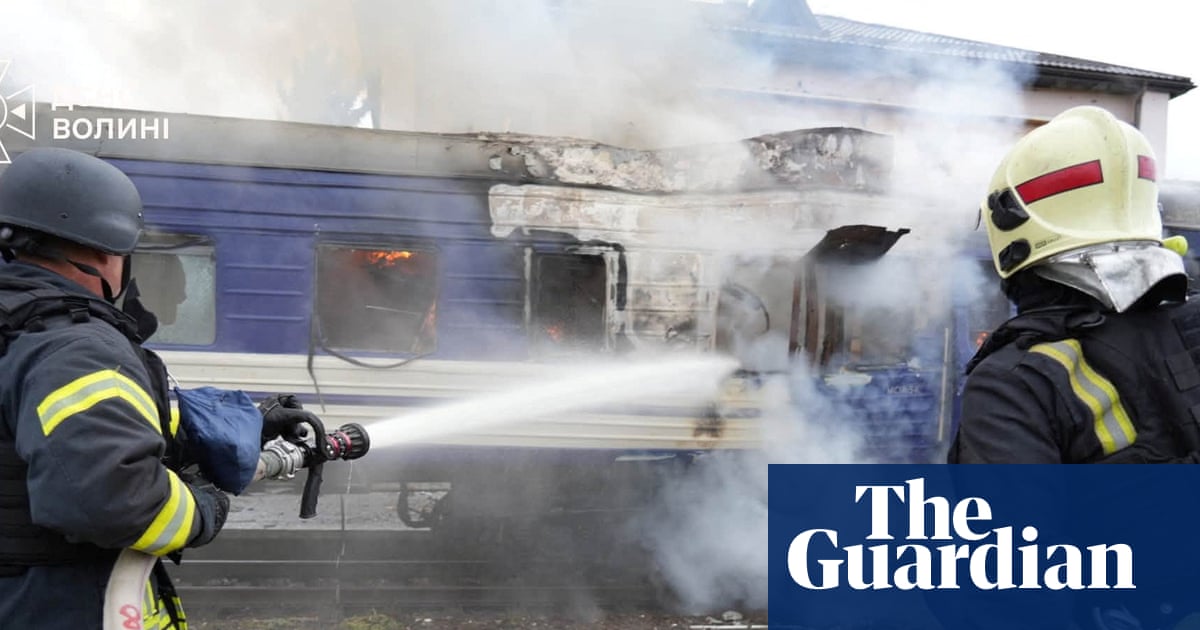
A train carrying Boris Johnson and the former CIA chief David Petraeus may have been the target of a Russian drone strike that hit a train engine near the Poland-Ukraine border, according to Ukrainian Railways.
Ukraine’s foreign ministerAndrii Sybiha described the attack as “Putin’s terror knocking directly on the doors of the EU and Nato”.
Overnight attacks across Ukraine involving more than 450 Russian drones and missiles killed at least six people and injured more than 40. Ukraine’s air force said it had intercepted 405 drones and four missiles.
Western Ukraine, which is typically quieter than Kyiv or the eastern frontline zones, was particularly badly hit.
The strikes prompted air-raid warnings in Poland, which shares a border with western Ukraine.
Ukrainian and Polish authorities said a lorry less than a kilometre from the Dorohusk-Yahodyn border crossing between the two countries was also hit.
Katerina Sergatskova, the director of Daily Humanity, an organisation that provides training to people working in high-risk environments, was travelling on a Warsaw-bound train and witnessed the attack.
She said passengers were told to evacuate at about 9am as the train approached the Polish border having already been told to disembark for two hours in the middle of the night. “At this point, the mood was different, we were asked to move very fast,” she said. “Then I heard the first drone.
“Seeing and hearing Shahed [drones] just a few hundred metres from the border is a very unpleasant experience.”
No casualties were reported on the train.
A British economist who preferred not to be named, travelling on a night train from Kyiv towards Chelm in Poland, also witnessed the attack. “We spent 10 hours at the border and were evacuated three times. On the third evacuation a missile came over and totalled a locomotive in front of our train.”
Railway officials instructed the “grimly focused” passengers to hide in bushes by a lake, said the economist, calling the Ukrainian response “timely and disciplined”. They “gave us good warning of the evacuation and had a plan, which everyone followed”.
“The conductor said when we boarded that there was a high risk that we would be evacuated during the journey. The lady and her eight-year-old son who were in my compartment said they had been travelling back and forth every month to Kyiv from Warsaw since 2022 and they had never been evacuated, or the train attacked, while travelling the route. This is clearly an escalation by Putin and the Russians.”
Ukrainian Railways, which operates the line, said a train carrying several security advisers from European countries, as well as Johnson, the former British prime minister, and the former CIA chief Petraeus, had passed through the border crossing shortly before the drone strike.
“It is quite likely that the target of this Russian drone could also have been the diplomatic train, which departed from the station earlier than planned as part of the real-time review of train schedules due to the constant threat of Russian strikes,” the rail company said.
Johnson wrote on X: “I don’t know what warped logic drove Putin to blow up a stationary Ukrainian locomotive on the Polish border this morning. What we can say for sure is that this is the kind of random and senseless attack Ukrainians are enduring every day – even on civilian railways.”
Three people were killed in the eastern Donetsk region, and a 71-year-old woman was killed in the southern Mykolaiv region.
Sybiha said the Russian strikes were “not just a continuation of its attacks on our state borders”.
“This is Putin’s terror knocking directly on the doors of the EU and Nato. Russian barbarians are at your gate, dear partners,” he wrote on X.
after newsletter promotion
Ukraine’s president, Volodymyr Zelenskyy, wrote on Telegram: “Ukrainians are fighting every day to prevent these strikes from spreading further into Europe, giving their lives and preventing the aggression from expanding.”
The Polish prime minister, Donald Tusk, warned on Sunday that intensifying Russian attacks in Ukraine in the coming weeks could affect Poland, as he chaired an emergency meeting after the Russian drone attacks near the border.
“The coming weeks and months will be a period of very intensive actions on the Russian side,” he said, adding Poland “cannot rule out that this escalation will also affect our territory”.
He added that Poland had been tipped off by its security services, and by intelligence agencies from allied countries, that an attack such as this was likely. “We knew that the Russian plan would include an attempt to disrupt, paralyse, and perhaps even destroy Ukrainian border crossings,” Tusk said.
Poland’s foreign minister, Radosław Sikorski, who visited Kyiv this week, said on X after Sunday morning’s attack: “Putin is escalating.”
The Polish interior minister, Marcin Kierwiński, said: “We treat these events with the utmost seriousness. The situation is being monitored continuously. Russia is the enemy of the free world.”
Russia claimed it struck “railway infrastructure” in western Ukraine used to “transport military cargo” from Europe.
“Strikes have continued on railway infrastructure in the western regions of Ukraine, which are used to transport military cargo from European countries,” Moscow’s defence ministry said in a statement.
Ukraine and Russia have increased attacks on critical infrastructure in each other’s countries as long-range drones and missiles take the war away from the frontlines.
The US president, Donald Trump, said on Sunday that Zelenskyy should “stop knocking out diesel fuel in Russia” because it was causing shortages.
“Let him go after targets, but not diesel fuel, because he’s causing a shortage of diesel,” Trump said, adding that shortages were caused by the Russia-Ukraine war rather than the US war in the Middle East.
In Lithuania, authorities briefly closed the airport in Vilnius, the capital, after a perceived drone sighting. Nato scrambled at least one fighter jet in response to the alert, which turned out to be a flock of birds. The airport reopened within 40 minutes, according to Lithuanian authorities.
#Train #carrying #Boris #Johnson #exCIA #chief #targeted #Russian #strike #officials #Ukraine