wellnessfitpro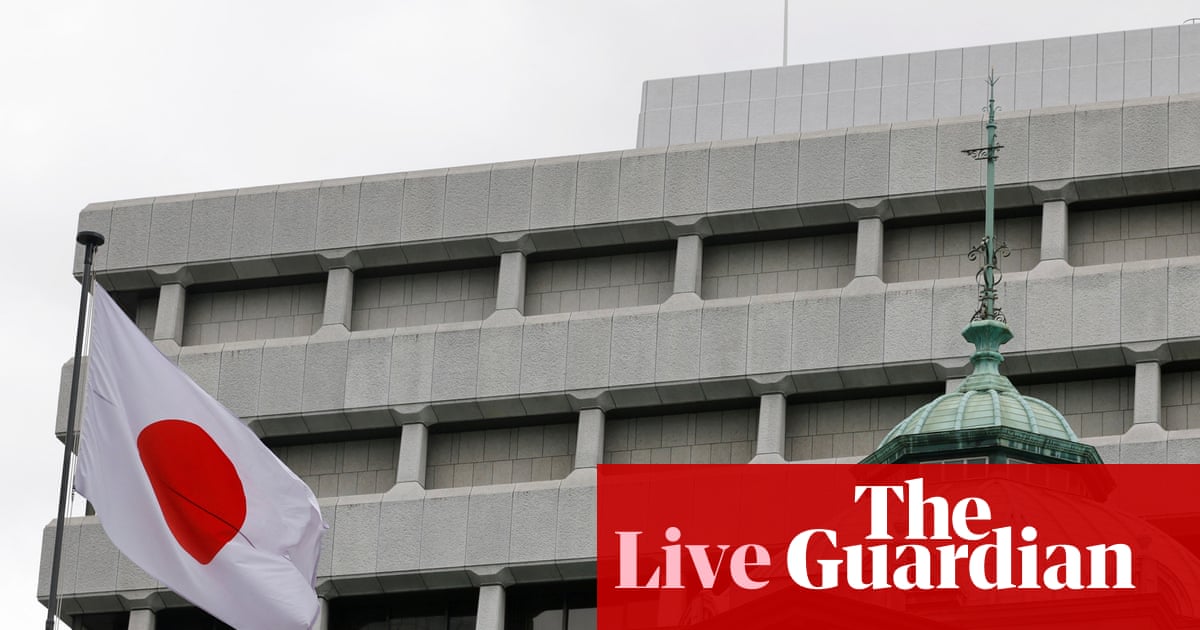
Introduction: Japan joins the rate-hiking party, as Bank of England lurks
Good morning, and welcome to our rolling coverage of business, the financial markets and the world economy.
The global interest rate rising cycle has spun again today, after the Bank of Japan decided to raise interest rates to their highest level in 31 years.
The BoJ voted to raise its target interest rate by a quarter of one percentage point to 1.25%, the highest level since 1995. The vote was not unanimous – with two board members dissenting to the hike.
The move meant the BoJ has joined the US Federal Reserve and the European Central Bank in tightening monetary policy this month, as part of the global fight against inflation.
But the Bank of England is, so far, resisting joining the battle, having yesterday voted to leave UK interest rates on hold at 3.75%.
The BoJ has been in a rate-rising cycle since 2024, when it lifted its policy rate out of negative territory. It has been under pressure to raise borrowing costs as the yen weakened steadily against the dollar this year, to levels which prompted policymakers to intervene to stabilise the currency.
A hike today had been expected. So the news that two BoJ policymakers opposed the move has excited the markets.
Jim Reid, strategist at Deutsche Bank, reports:
So although the central bank reiterated that it will continue raising rates if economic and inflation conditions evolve as projected, the market has reacted to the two high profile dissenters. The Yen is -0.72% lower at 157.10, having been at around 153.40 at the start of the week and the JGB curve has steepened, with 2yrs -2.2bps and 30yrs +3.2bps
The agenda
Key events
BoJ governor Ueda give press conference – the key quotes
Bank of Japan governor Kazuo Ueda is giving a press conference in Tokyo now, to explain today’s decision to hike interest rates.
Reuters has helpfully collated some of the important quotes
ON 50-BP OR BACK-TO-BACK RATE HIKES:
“That depends on how price conditions develop. There could be various possibilities. We shouldn’t rule anything out.“
“We’re at a phase where we need to look at various data carefully. But that doesn’t mean we can move slowly. We will analyse data carefully and take timely action as needed.“
“As for the pace of future rate hikes, we don’t have any pre-set idea in mind such as once every three months. We will determine at each policy meeting how best to ensure underlying inflation stabilises at 2%.“
RISK FACTORS:
“If the renewed rise in energy costs persists, that could add further pressure to wholesale inflation and then consumer inflation. That’s something we need to look out for.“
FINANCIAL CONDITIONS:
“Financial conditions are becoming less accommodative as we raise rates … It’s important to avoid financial conditions from tightening too much, or to cause a big adjustment in asset prices, by raising rates too sharply.“
NEUTRAL RATE UNCERTAIN:
“It is hard to pinpoint where the neutral rate is, and therefore the terminal rate. It might be the case that as we adjust policy as appropriate, we will know where those rates sit ex-ante.“
ON INFLATION:
“Up till now, our short-term policy focus was to push up underlying inflation from levels below 2%. Now, underlying inflation is approaching 2%. If risks of underlying inflation overshooting 2% materialise, that could have a negative impact on Japan’s economy. It’s important to stabilise underlying inflation at 2%. Our policy phase has changed.“
Fuel sales dropped again, down 1.7% in August and 2.5% across the three month period, as motorists cut back on non-essential journeys following major increases in the price of petrol and diesel since the start of the Iran conflict in February.
That followed a jump in sales volumes in March, when motorists stocked up on fuel after the conflict in the Middle East broke out,
Oil falling back to $100 a barrel
The oil price has dropped by 2% this morning, pushed down by hopes that supply disruptions from Saudi Arabia may not be as severe as feared.
Brent crude has dropped to $102.55 a barrel, following reports that Saudi authorities hope to bypass a damaged section of its 1,200-km East-West Pipeline and restore roughly half its capacity within days.
That pipe was damaged in an attack last week which drove oil up over the $100/barrel mark, as traders anticipated significant disruption to supplies.
A drop in the oil price would cheer households, businesses and central bankers alike!
The ONS also reports that sales at British department stores picked up in August following “stock availability issues” in July.
Retail sales rise across Great Britain
Despite the inflationary squeeze on households, retail sales across Great Britain have risen over the summer.
The heatwave, a pick-up in web shopping, and the joys (and pain and disappointment!) of the men’s football World Cup, helped to lift spending over the three months to August, new data shows.
Retail sales volumes rose by 0.9% in the June-August quarter, the Office for National Statistics has reported this morning.
Non-store retailers’ sales volumes rose following a particularly strong June period – perhaps because people preferred to order goods online rather than braving the high street in the heatwave.
Retailers selling alcohol and beverages performed well across all three months to August, which they attributed to promotions, the hot weather, and the World Cup.
In August alone, retail sales volumes rose by 0.5%, reversing a 0.5% drop in July.
August’s rise is unexpected (economists had forecast a 0.2% fall), so this is the latest piece of economic data to beat expectations after last week’s jump in UK GDP.
ONS senior statistician Jon Gough said:
“Retail sales increased in the latest three months, with a particularly strong June for online outlets helping to boost their sales across the period. Food store sales also rose, with supermarkets doing well in July and August.
“Meanwhile, retailers selling alcohol and beverages performed well across all three months, which they attributed to promotions, the hot weather and the World Cup.”
Introduction: Japan joins the rate-hiking party, as Bank of England lurks
Good morning, and welcome to our rolling coverage of business, the financial markets and the world economy.
The global interest rate rising cycle has spun again today, after the Bank of Japan decided to raise interest rates to their highest level in 31 years.
The BoJ voted to raise its target interest rate by a quarter of one percentage point to 1.25%, the highest level since 1995. The vote was not unanimous – with two board members dissenting to the hike.
The move meant the BoJ has joined the US Federal Reserve and the European Central Bank in tightening monetary policy this month, as part of the global fight against inflation.
But the Bank of England is, so far, resisting joining the battle, having yesterday voted to leave UK interest rates on hold at 3.75%.
The BoJ has been in a rate-rising cycle since 2024, when it lifted its policy rate out of negative territory. It has been under pressure to raise borrowing costs as the yen weakened steadily against the dollar this year, to levels which prompted policymakers to intervene to stabilise the currency.
A hike today had been expected. So the news that two BoJ policymakers opposed the move has excited the markets.
Jim Reid, strategist at Deutsche Bank, reports:
So although the central bank reiterated that it will continue raising rates if economic and inflation conditions evolve as projected, the market has reacted to the two high profile dissenters. The Yen is -0.72% lower at 157.10, having been at around 153.40 at the start of the week and the JGB curve has steepened, with 2yrs -2.2bps and 30yrs +3.2bps
The agenda
#Japan #raises #interest #rates #31year #high #central #bankers #fight #inflation #retail #sales #rise #Great #Britain #business #live #Business