wellnessfitpro
Introduction: UK economy bigger than first thought after GDP revised higher
Good morning, and welcome to our rolling coverage of business, the financial markets and the world economy.
The UK economy grew faster than first estimated in the second quarter of the year, despite the disruption caused by the Iran war.
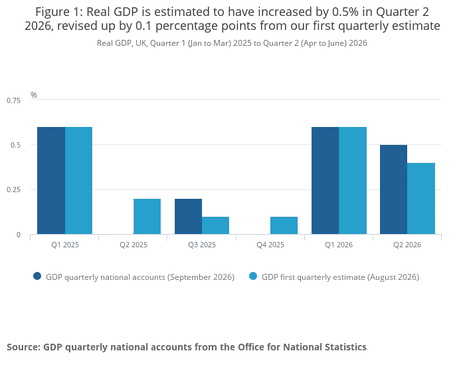
UK growth in April-June has been revised to 0.5%, up from the previous estimate of 0.4%, in the latest National Accounts.
That’s a welcome piece of good news for chancellor John Healey, as he draws up the budget due in four weeks’ time, and means his predecessor Rachel Reeves handed over a slightly larger economy than previously recognised.
Growth in Q2 2026 was driven by the services sector (where activity increased by 0.6%) and the construction sector (which grew by 0.8%), while the production sector shrank by 0.1%.
However…the Office for National Statistics, which publishes the data, has also revised down its estimate for growth in 2025.
ONS director of economic statistics Liz McKeown said:
“Today’s figures include our annual improvements to the measurement of the economy, incorporating new information that provides a better picture of activity across the UK’s service sector, alongside the usual inclusion of updated and improved data sources.
“Growth for 2025 as a whole was a little lower than previously estimated, with the profile of growth across the quarters also revised.
“However, stronger services growth in the latest quarter means the economy is now slightly larger than previously estimated.”
The agenda
-
7am BST: UK national accounts for April-June 2026
-
7.45am BST: French inflation report for September
-
10:30am BST: BoE Financial Policy Committee minutes
-
1.30pm BST: US PCE inflation index for August
Key events
Over in Germany, inflation has accelerated to its highest level since December 2023.
On an EU-harmonised basis, inflation in Germany rose to 3.3% year-on-year in September, preliminary data from federal statistics office Destatis showed, up from 2.9% in August.
Inflation was driven by energy prices, which Destatis estimates were 14.9% higher than a year earlier.
In another blow, seasonally adjusted unemployment rose back above 3 million in September.
The slowdown in US PCE inflation last month lowers the risk of a rise in interest rates in October, reports James Knightley, US chief international economist at ING.
Knightley points out that a quarter-point (25 basis point) hike in rates at the Federal Reserve’s next meeting now looks less likely:
“Today’s outcome supports the NY Fed’s John Williams’ comments yesterday that there is no immediate urgency for another rate hike and we now have only 9bp priced for the October FOMC meeting versus 18bp at the beginning of yesterday.”
“Overall, the report shows a better balance to the US economy and suggests that the middle and lower income households, for whom income is so critical to spending power given the lack of financial assets, have been under less financial pressure than feared.”
At the state level, real GDP across the US ranged from a 4.0% annualised increase in New York to a 2.3% decrease in West Virginia.
Wall Street has opened slightly higher as traders welcome today’s lower-than-forecast PCE inflation reading.
The Dow Jones industrial average has gained 37 points to 51,387 points in early trading, with the broader S&P 500 index up 0.3%.
Investors may be hoping that it lowers the risk of a further rise in US interest rates soon.
However, Adam Hetts, global head of multi-asset at Janus Henderson Investors, says:
“Inflation pressures continue, albeit slightly below expected levels, with monthly headline PCE inflation at 0.3% and core PCE at 0.2%. Annual headline PCE, reading 3.4%, continues well above the Fed’s 2% target. The underlying economy proves resilient once again, with Q2 GDP growth revised up to 2.2% alongside a particularly strong Q3 GDP nowcast.
While today’s inflation data is somewhat better than expected, strong labor and GDP data suggest the print is unlikely to derail consensus expectations for another rate hike before the end of the year.”
American companies added more employees this month than forecast.
Private-sector employment increased by 90,000 jobs in September, according to the ADP National Employment Report released today.
That’s up from just 36,000 in August, and higher than the 70,000 economists had expected.
Hiring was led by education and health care and leisure and hospitality.
“It’s a strong report,” said Dr. Nela Richardson, chief economist at ADP, adding:
“After a three-month slowdown, job creation rebounded and pay growth remained solid.”
In a second piece of good US economic news, inflation was lower than forecast last month.
The Personal Consumption Expenditures Price index rose by 0.3% in August, lower than the 0.4% increase expected by economists.
Core PCE inflation, which strips out food and energy, only rose by 0.2% in the month.
US economic growth in Q2 revised up
Newsflash: The US economy grew faster than previously thought in the second quarter of this year.
New data just released shows US GDP grew at an annualised rate of 2.2% in April-June, up from a previous estimate of 1.5% growth.
The upgrade is due to upward revisions to investment, consumer spending, and government spending.
UPDATED: 2.2% is the equivalent of quarterly growth of 0.55%, so slightly faster than the UK which expanded by 0.5% in Q2 (we learned this morning).
The industries which drove the US economy in the last quarter were real estate and rental and leasing, information, durable goods manufacturing, and finance and insurance, according to the US Bureau of Economic Analysis (BEA).
The diesel crisis could get even worse if Donald Trump decides to introduce an export ban on the fuel.
The price of diesel has been pushed to record highs this year as supplies have swindled, due to the Iran war disrupting oil exports from the Middle East, and Ukranian attacks on Russian oil refineries.
Trump has held crisis talks with advisers over whether to impose a diesel export ban, the Financial Times reports today, adding:
Aides had presented the president with options including curbs on international diesel sales, people familiar with the discussions said, and administration officials have briefed foreign allies including the UK about possible disruption to their supplies.
A White House official said Trump was “evaluating all the options on the table” to lower domestic fuel prices and that no decision had been taken on whether to suspend exports.
Zambia bucks trend with rate cut
While many central bankers are considering raising interest rates, Zambia’s central bank cut its benchmark lending rate by 250 basis points to 10.75% today.
The reduction was much larger than the 25-basis-point cut forecast by economists polled by Reuters.
The move came after Zambia’s annual inflation rate softened to 6.1% in September, from 6.2% the previous month.
It is near the bottom of the central bank’s 6%-8% target range and at its lowest level since 2018.
Analysts have raised their 2026 oil price forecasts, Reuters reports.
Benchmark Brent crude is now expected to average nearly $90 a barrel as disruption to Gulf exports offsets concerns over demand growth.
A September survey of 30 economists and analysts forecast that Brent crude would average $89.05 a barrel in 2026 and U.S. crude $83.90 a barrel.
UK diesel price on brink of £2/litre for first time
Newsflash: the price of diesel in the UK has moved to the brink of £2 a litre for the first time.
The average price of a litre of diesel has hit a new all-time high this morning, at 199.72p, its third daily record high in a row. That’s up from 199.53p a litre yesterday.
Motoring body the RAC says:
RAC analysis shows that while a third of forecourts (2,579) are now selling diesel for more than £2 a litre, the average price of the fuel has not yet reached the £2 point.
Since the Iran war began, the average price of diesel has risen by over 40%, as the jump in crude oil prices drove up the cost of refined products too.
The average price of a litre of petrol has risen too, to 174.54p a litre today.
And over the last month, petrol has risen almost 13p (12.77p) a litre in September and diesel 16p (16.12p) – both are the third biggest monthly increases on record, going back o to the year 2,000.
The RAC says:
A full tank of petrol for a 55-litre family car now costs £96, £23 (£22.94) more than it did before the conflict between the US and Iran began. The diesel equivalent is £110 (£109.85), £31.54 more than 28 February.
The AI sector could trigger financial stability if it does not deliver the significant productivity gains which have been promised, the Bank of England warns today.
Its financial policy committee cite the surge of borrowing from AI companies, saying:
Financing of AI-related investment continues to grow rapidly and is expected to remain on a strong upward trajectory. This is increasing the extent to which developments in AI could affect a wide range of investors and funding markets.
An increasing volume of AI-related investment is being financed through debt issuance, with global issuance in 2026 expected to exceed that of countries such as the UK. The increasing indebtedness of AI firms combined with opacity and, at times, ‘circular arrangements’ that can be associated with this financing, can complicate the assessment of risks and could amplify losses if expectations disappoint.
The BoE adds that government debt markets, as well as AI-linked assets, could be hit if investors reassess their expectations….
The Bank of England also highlights how the Middle East conflict has driven government borrowing costs to their highest levels in almost two decades, saying:
The re-escalation of the conflict and the associated rises in oil, gas and refined product prices are leading to a more protracted negative supply shock to the global economy.
This has contributed to sustained increases in sovereign bond yields across a number of advanced economies, to levels not seen since 2008
Risks facing UK economy have risen since July, Bank of England warns
The risks of a financial crisis triggered by high energy prices and the AI boom have risen over the summer, the Bank of England is warning.
The Bank’s Financial Policy Committee is concerned that the risk outlook has worsened since July; interconnected risks are more likely to crystallise at the same time, it says.
The minutes of the FPC’s latest meeting, which took place on 25 September, highlight that the re-escalation of the Iran war has renewed uncertainty around growth and the path of interest rates in a number of advanced economies.
Policymakers are worried that vulnerabilities in government debt markets, high stock market valuations and risky credit markets “crystallise at the same time”, which would create a crisis.
The FPC also flags that “rapid advances in AI capabilities have increased cyber and operational resilience risks” – a nod to the recent reports of AI agents going rogue.
However, they remain confident that UK households and businesses are resilient, and that the banking system is strong enough to support them in a stress.
The committee says:
The likelihood that interconnected vulnerabilities in the financial system crystallise has risen since the Financial Policy Committee’s (FPC) previous meeting. The re-escalation of the conflict in the Middle East has renewed uncertainty around growth and the path of interest rates in a number of advanced economies, re-intensifying the risk that vulnerabilities in sovereign debt markets, risky asset valuations, and risky credit markets crystallise at the same time.
The rapid increase in artificial intelligence (AI)-related debt issuance broadens the exposure of capital markets to developments in AI. At the same time, recent incidents in frontier AI have drawn further focus to the pace of AI development and associated vulnerabilities, including cyber and operational risks. The Committee underscores the importance of timely and careful management of these intensifying, interconnected risks.
The risk-on mood in the markets this morning is pushing up share prices and the pound.
Sterling has gained almost half a cent against the US dollar to $1.327, while the FTSE 100 share index is 30 points higher at 10,666 points.
UK gilts rally after growth surprise
British government bonds are rallying this morning, as the City welcomes the upgrade to UK growth announced at 7am.
With prices rising, the yields on short and long-dated bonds are both falling.
Two-year UK bond yields are down 5 basis points (0.05 of a percentage point) at 4.86%, while ten-year UK bond ields are 4bps lower at 5.356%.
Kathleen Brooks, research director at XTB, says the markets are in an “upbeat mood” as the UK economy surprises on the upside. A dip in the oil price is also helping.
Brooks says:
There was a double whammy of good news for the UK Gilt market this morning, with the upgrade to Q2 GDP, which was revised higher to 0.5% from the original estimate of 0.4%, This suggests that the UK economy was resilient to the effects the Iran war, the energy price surge and the rise in borrowing costs. Stronger services growth and rising household spending boosted the figure. This is fairly typical of the UK economy, which is service based, the real surprise was the strength of business investment and an improvement in the trade figures, which showed a boost in exports.
GDP per head was strong too, at 1.1%, the highest level since the post-Covid boom, growth is now running at a 1.1% rate for the first 6 months of the year, which is the highest rate in the G7. The Gilt market likes what it hears, and is leading a major recovery in sovereign bonds this morning. The 2-year Gilt yield is down some 8bps this morning, and the 10-year yield is down 7bps. September has been a volatile month for global bonds, especially Gilts, and even with this recovery, 2-year Gilt yields are still higher by 30bps and 10-year UK yields are higher by 20bps.
Over in France, inflation has jumped this month.
Statistics body INSEE has estimated that the Consumer Price Index (CPI) should rise by 3.0% year-on-year in September, up from a 2.4% rise in August.
INSEE predicts that energy prices accelerated again, driven by those of petroleum products and gas.
Services inflation probably increased slightly thos month, while food prices are forecast to have accelerated, especially for fresh products.
On an EU-harmonised basis, French inflation jumped to 3.4% this month, the fastest pace in more than two years.
In another boost for the UK economy, Allianz Trade has upgraded its growth forecast for this year by 0.3 percentage points to 1.3%.
In its latest Global Economic Outlook report, the international insurance company explains that the UK economy has performed better than expected in 2026.
Allianz Trade says:
-
UK business insolvencies have fallen 5%, bucking a 6% global rise and increases of 19% in the US, 7% in Germany and Japan, and 5% in France.
-
Consumer spending and business investment have remained resilient, while manufacturing has rebounded and aerospace continues to power ahead.
-
Households have sustained spending by reducing their savings rate, raising questions over how long that resilience can last.
-
UK inflation is forecast to reach 3.4% in Q4 2026, as higher utility bills and input costs feed through to consumer prices.
-
The Bank of England is expected to raise rates twice before year-end, taking Bank Rate from 3.75% to 4.25%.
-
Rate cuts are not expected to begin until November 2027, with higher borrowing costs set to weigh on investment, housing and growth.
Zoopla: House sales down 9% in September
Higher borrowing costs hurt demand for homes in September, the property portal Zoopla has reported this morning.
Zoopla found that the number of sales being agreed this month fell by 9% compared with September 2025.
The drop in sales came despite the number of homes on the market rising by 5% year on year, with the gap between supply and demand most acute in London and southern England.
Annual house price growth has also slowed to 0.8%, the lowest level since July 2024, according to the latest Zoopla House Price Index. The average price of a UK home is now £273,000, it said.
#Economic #growth #revised #higher #diesel #brink #litre #time #business #live #Business