wellnessfitpro
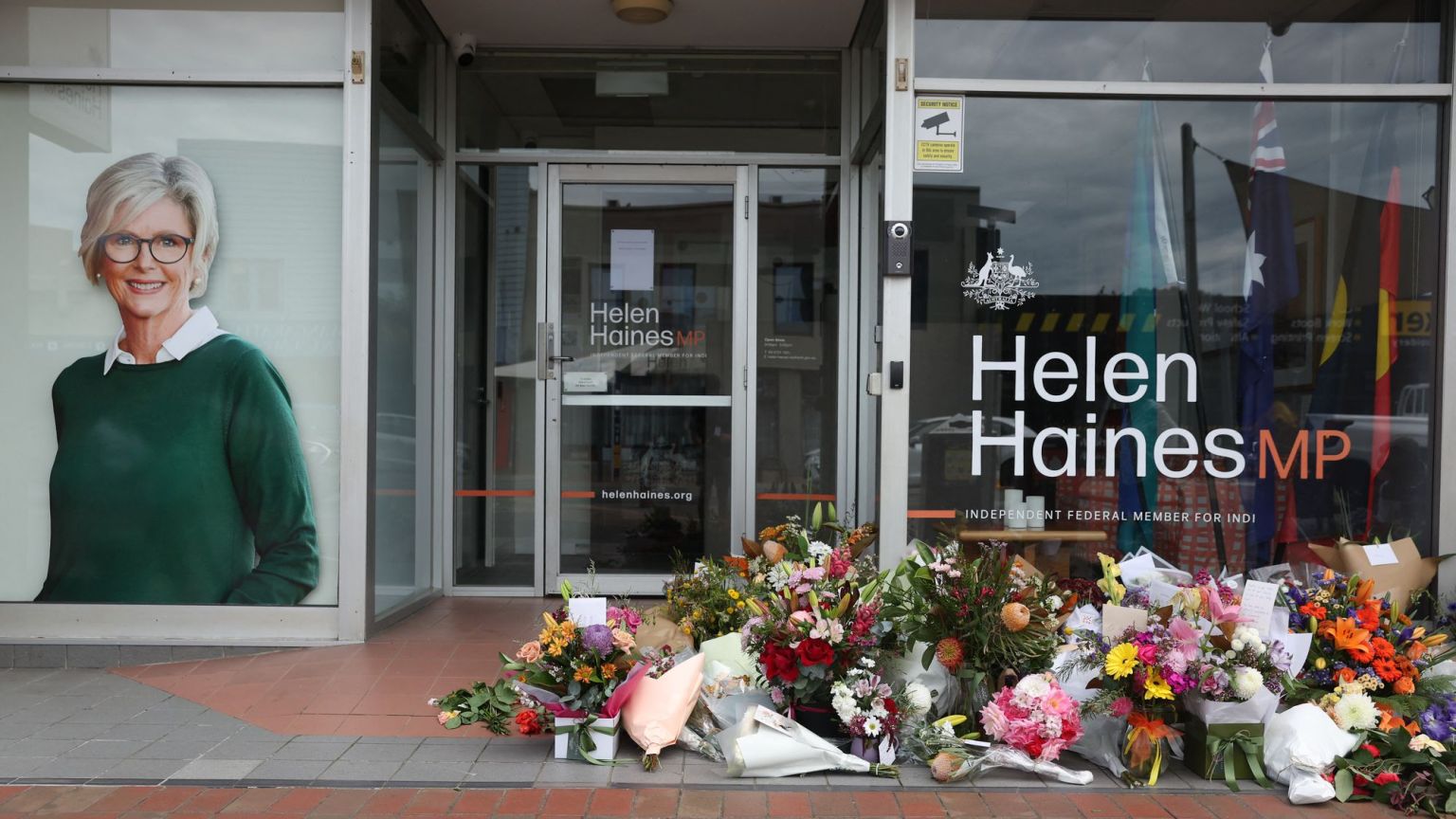
While doctors fought a losing battle to save Helen Haines’s other leg, Australia’s political class was busy turning a senseless act of violence into a parable about the state of the nation.
One random incident is hardly a trend, but that has not deterred the hand-wringers from insisting the sickening assault on an independent federal politician was symptomatic of deeper societal malaise. Apparently, the increasing rancour in civic debate has become a full-blown crisis about which something must be done.
The facts of the case are more ambiguous than this narrative suggests. Haines was packing the boot of her car outside her office in the Victorian country town of Wangaratta on Monday afternoon when the driver of a 2.5-tonne Toyota Land Cruiser forcefully rammed her from behind. Witnesses report that the driver put his vehicle into reverse before ramming the MP for a second time, trapping her under her own vehicle.
We don’t need to see the X-rays to imagine the damage to her legs, almost certainly above the knee, since the centre of a Land Cruiser’s front bumper is at least half a metre above road height. She has lost both of them.
Context matters. Australians are not averse to bruising debates, but physical violence is rare. Fewer than 12 assaults on serving politicians have occurred in the last century. In five of them, the weapon of choice was an egg and, in another, a cream-filled pancake. The 1994 murder of New South Wales MP John Newman by an armed hit squad organised by a rival is the only successful political assassination in almost 200 years of parliamentary democracy.
Haines is the first Australian politician to be attacked by a car. The suspect, Brendan Nugent, 43, from the nearby town of Tarrawingee, has a history of drug use and mental illness. Neighbours described years of erratic behaviour, including shouting, playing extremely loud music and making apparently irrational statements.
In court, his lawyer, Chirag Patel, confirmed that Nugent suffered from idiopathic transverse myelitis, a rare inflammatory condition affecting the spinal cord that can cause paralysis, numbness and severe pain. It takes little imagination to suspect Nugent was not in his right mind, assuming he possessed one in the first place.
Yet less than 24 hours after the attack, Australian prime minister Anthony Albanese was drawing a link between the metaphorical heat of political debate and this real-life physical assault. ‘We all have a role to play in raising the level of political discourse and turning down the personal attacks and the level of division and rancour which is there’, he told News24 the following morning.
The plea to ‘dial down the heat’ in political debate might carry more weight coming from a prime minister with a stronger record of practising what he preaches. When the story broke the next day that his government had recently circulated a ‘dirt sheet’ containing baseless smears of Haines, Albanese was conspicuously reluctant to deny it.
Others, like left-wing activist-influencer Hannah Ferguson, went further, attributing the attack to the manosphere’s contribution to the ‘unhealthy discourse’ on social media. ‘When we see a woman like Helen Haines targeted, I think it speaks to a broader issue of male violence against women in Australia’, she told breakfast television.
Ferguson, too, stands accused of double standards. Writing a little over a year ago, she appeared remarkably untroubled by the assassination of Charlie Kirk. ‘Do I believe he empowered the violence that ended his life? Yes’, she wrote on Substack. ‘Is violence sometimes necessary? Yes.’
Ferguson’s blog serves as evidence that the authoritarian left is no less prone than the fruitcake right to Dirty Harry Syndrome: the belief that extrajudicial measures, including violence, can be justified in pursuit of a higher cause.
Which is why we have every reason to be nervous about the determination to turn an isolated act, however haunting, into evidence of a deeper cultural dysfunction. It leads to the presumption that someone in authority must be given more power to stop it from happening again.
Lost in the ensuing moral panic is the question of whether the proposed powers could have prevented the incident in the first place. Anyone who dares question the remedy risks being accused of condoning the very behaviour it is supposed to prevent.
The link to social media is tenuous at best. Nugent’s posts trace his transition from a radical tree-hugger to an ardent supporter of the Palestinian cause and hater of Israel. This path is hardly unusual for the radical left, and nothing beyond conjecture suggests his assault on Haines was politically motivated.
The urge to discern patterns in seemingly inexplicable events appears to be hardwired into human nature. It provides the mental shortcuts we need to navigate a world that might otherwise seem hopelessly chaotic.
Yet apophenia, the tendency to see meaningful connections between unrelated events, becomes an obstacle to clear thinking when confirmation bias reinforces it. We seize on evidence that supports our prejudices while overlooking other explanations for human behaviour that might challenge our assumptions.
The as-yet inexplicable act of violence against Haines could justifiably become a call to action against the tolerance of drug abuse or alcohol addiction. It might be treated as a warning to careless drivers, a reminder that a moment’s inattention can turn any motorised vehicle into a lethal weapon.
It should almost certainly be a wake-up call for the Australian Federal Police and their state colleagues, who must review the adequacy of protection provided for serving politicians, balanced against the reality that not every risk can reasonably be countered, especially in an open democracy where easy access between citizens and their elected representatives is a strength.
Discussion of these and many other plausible underlying issues has been curtailed by the rush to ascribe every contemporary act of incivility to a toxic online culture in which misinformation and disinformation supposedly thrive.
The Australian Labor government’s barely concealed appetite for online censorship is reason enough to be suspicious of the PM’s doe-eyed appeals for civility in public debate.
The Online Safety Amendment (Digital Duty of Care) Bill 2026, recently introduced to federal parliament, grants exceptional powers to Australia’s ‘eSafety Commissioner’ (a position commonly known as e-Karen) to regulate content that causes serious mental distress, or promotes hostile attitudes towards women, even where the material is not illegal. It authorises the commissioner to use fictitious identities, or sock puppets, to investigate whether online services are complying with the law. Companies are exposed to penalties of up to $109.2 million AUD for breaches of the proposed digital duty of care.
Prudence demands that we suspend judgement about what might or might not have been going through the suspect’s head when he allegedly made the fateful decision, on a mild spring afternoon, to throw a u-turn in a busy street and point his moving vehicle at a hard-working, honourable MP.
We await his trial, probably sometime next year, when we might get to learn what role may have been played by influenced by ugly online exchanges, or what other conclusions we might draw from the stack of empty gin bottles on his verandah or the charges laid against him for the cultivation of marijuana.
Not every criminal act is a referendum on the health of a society. The determination to extract a moral lesson from every tragedy tells us more about our own prejudices than the atrocity itself.
Nick Cater is a Sydney-based columnist with the Australian and a regular spiked contributor.
#attack #Helen #Haines #exploited #censors