wellnessfitpro
Thorny divisions exposed by draft deal
Gabrielle Canon
Welcome to day 2 of week 2, as the clock winds down with just four days left to hammer through thorny divisions with lots left on the negotiating table. Monday brought out a first draft of the agreement but it’s far from set in stone.
The 18-page document includes 144 separate items, including many that are still being hotly disputed. Language on the transition away from fossil fuels, calls to reel in overshoot (which under current policies is projected to surge past 1.5C to 2.7C of warming by 2100), and stronger financial support for developing countries were outlined as a way to “draw out parties” Chris Bowen, climate and energy minister of Australia and lead negotiator of the talks told the Guardian on Monday.
In other words, changes are expected. Insiders aren’t planning for the next draft to come quickly and it’s possible (likely) that the talks will go into overtime this week.
Key events

Paul MacInnes
The United Nations has been asked to review Fifa’s status as a signatory to a key environmental initiative, with complainants arguing football’s governing body has a “record of failure” on climate action.
Fifa is a signatory to the UN’s Sports for Climate Action Framework, a coalition which seeks to persuade sporting organisations to “work together to achieve a climate-resilient future”. Under the framework, signatories agree to cut their greenhouse gas emissions by 50% by 2030 and to “partner with key stakeholders to deliver joint climate action”. They can have their status as a signatory removed, however, if “sincerity in participation or ability to participate is a cause for concern”.
According to five organisations that have submitted a joint complaint to the UN, Fifa’s actions are inconsistent with its words. In a letter to executives at the United Nations Framework Convention on Climate Change, they argue “being a signatory of the Framework means making a commitment to both organisational climate progress and climate leadership. On the basis of the facts laid out below, we assert that Fifa has a record of failure on each of these key commitments.”
The letter claims Fifa has undermined its commitments by expanding the size of its tournaments, with the men’s World Cup increasing from 64 matches in 2022 to 104 matches in 16 cities across three countries this past summer, making it what the complainants say is “the most polluting World Cup ever”. In 2030, by which time Fifa’s emissions should have been halved, the World Cup is due to be held in six countries across three different continents, with potentially 64 teams and even more matches.
The complainants acknowledge Fifa launched a climate strategy in 2021, committing it to halving emissions by 2030 and reaching net zero by 2040. “However,” the letter says, “that strategy is not clear on how exactly these targets will be achieved. The evidence indicates that Fifa has expanded, rather than reduced, its emissions in the years since, principally by choosing to expand the footprint of its major tournaments.”
A second part of the complaint argues Fifa has failed in its responsibility to “champion transformative climate action” by agreeing a multi-year commercial arrangement with the Saudi Arabian energy giant Aramco as a “major worldwide partner”.
Gabrielle Canon
There’s plenty to go through in the coming days beyond the key sticking points. As part of a complementary platform to the negotiations, Cop31 is organized into “thematic days” and Tuesday is slated for “Oceans, Seas, Nature and Land Use”.
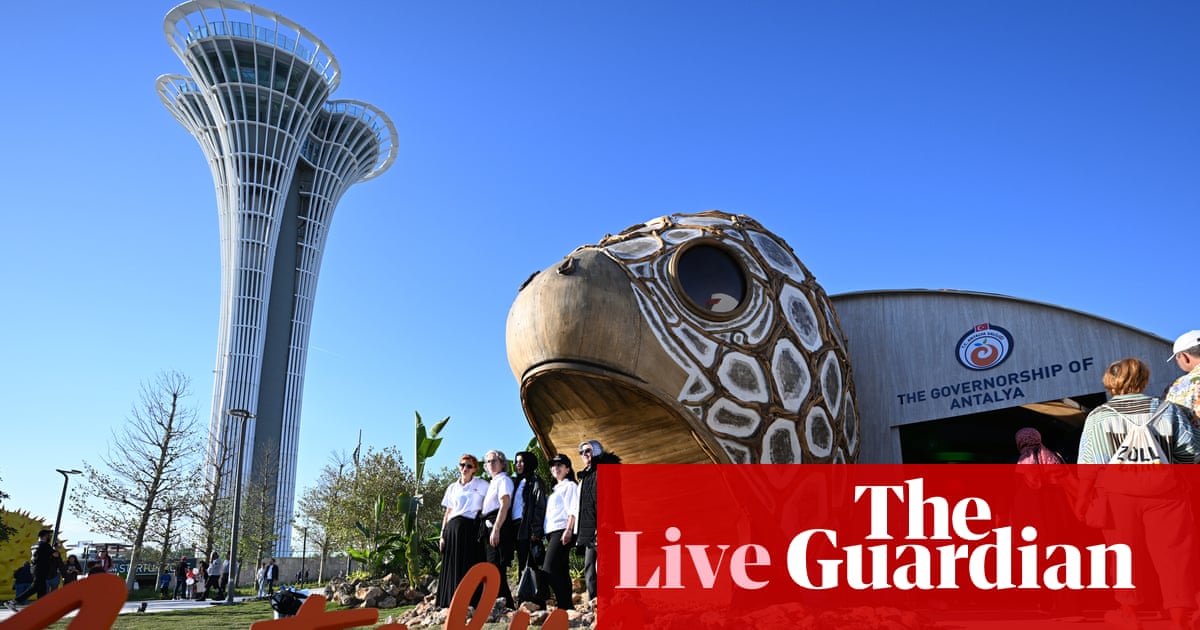
Cop31 was dubbed a “Blue COP” in anticipation that there would be substantial actions taken on oceans and that ocean-based solutions could be worked into climate commitments. At the start of the summit Ocean Conservancy Vice President, Dr. Fatima Candance, pointed to this year’s mascot – a loggerhead turtle – as an important symbol for the work. “But symbolism alone won’t deliver the action we need,” she said, urging leaders to move from “pledges to projects”.
Speaking of pledges, last year’s land use pledge to recognize or strengthen rights across 160 million hectares in tropical forest countries by 2030 is also up for review on Tuesday.
More than 50 Indigenous Peoples’, local community and Afro-descendant Peoples’ organizations and allied civil society groups from around the world issued a joint letter on Monday urging international leaders to ensure territorial rights are protected not just on paper but on the ground.
“Success must be measured not only by hectares recognized, but by territorial rights upheld, governance strengthened and communities empowered to determine their own futures, free from unwanted extractive and large-scale industrial activities,” the letter states.
That includes support politically and financially, with calls for direct funding for Indigenous Peoples, local and Afro-descendant communities. The letter followed a report issued last week from a collective of organizations that showed how oil, gas, mining, logging, and industry are threatening territories.
“Without securing our territorial rights, human rights violations continue, conflicts escalate, and our territories that sustain life remain under threat,” said Dinamam Tuxa, Executive Coordinator, Articulation of Indigenous Peoples of Brazil (APIB) in a statement issued with the letter. “Demarcating Indigenous Peoples territories is not only a matter of justice; it is an effective climate policy.”
Thorny divisions exposed by draft deal
Gabrielle Canon
Welcome to day 2 of week 2, as the clock winds down with just four days left to hammer through thorny divisions with lots left on the negotiating table. Monday brought out a first draft of the agreement but it’s far from set in stone.
The 18-page document includes 144 separate items, including many that are still being hotly disputed. Language on the transition away from fossil fuels, calls to reel in overshoot (which under current policies is projected to surge past 1.5C to 2.7C of warming by 2100), and stronger financial support for developing countries were outlined as a way to “draw out parties” Chris Bowen, climate and energy minister of Australia and lead negotiator of the talks told the Guardian on Monday.
In other words, changes are expected. Insiders aren’t planning for the next draft to come quickly and it’s possible (likely) that the talks will go into overtime this week.
#Cop31 #live #draft #agreement #pressure #climate #negotiations #enter #final #days #Cop31