wellnessfitpro
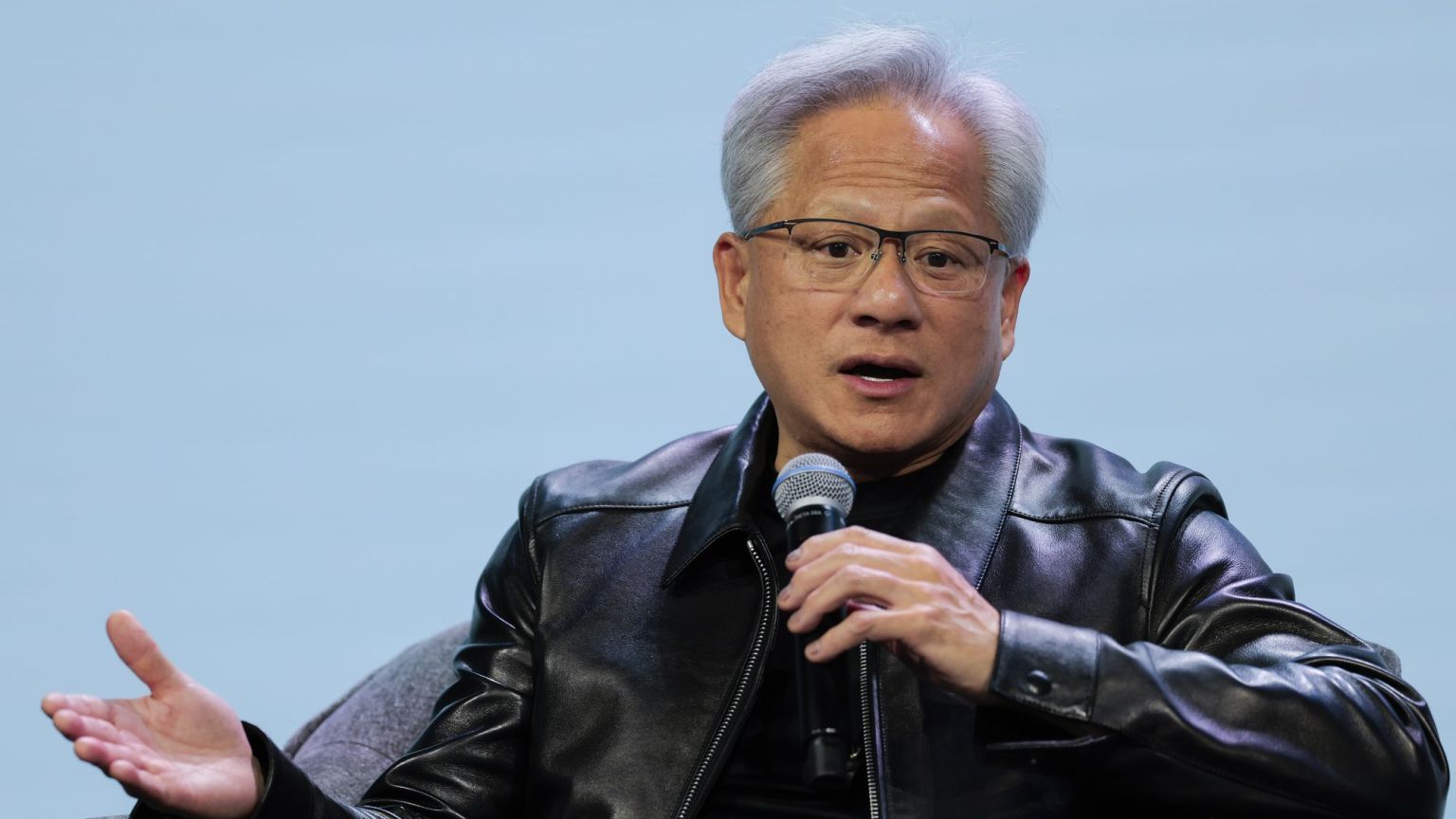
On 29 October, a New York Times exclusive revealed how Chinese businesswoman Alice Huang had developed a ‘close relationship’ with Jensen Huang, then CEO of AI chipmaker Nvidia – a company with quarterly revenues of nearly $100 billion.
Alice Huang – no relation to Jensen – was a former executive of a data-centre operator named Megaspeed, based in Singapore. American spy agencies, the NYT gleefully reported, had long suspected her of steering advanced Nvidia AI chips to China, in explicit breach of American law. Now the same spy agencies were worried that Alice Huang was also a Chinese intelligence asset, directly ‘funnelling information’ she received from her lover to Beijing. Indeed, given Jensen Huang’s strong ties with Donald Trump, that information could have gone way beyond the secrets of Nvidia. Worst of all, the NYT added, Trump himself was briefed ‘roughly a year ago’ about the intelligence findings on Alice, but ‘chose not to do anything with the information’.
By Monday 9 November, Nvidia had lost a colossal $300 billion in stock-market value. By 12 November, a second affair was reported and Huang was duly expelled from the company he co-founded three decades ago. So what are we to make of all this?
For The Sunday Times, Huang’s ousting represented ‘a truly Shakespearean confluence of human greatness, human frailty and enormously consequential affairs of state’. More vulgarly, The Economist declared that ‘Mr Huang’s Chinese affair could go down as the most expensive shag in history’. But for the Chinese Communist Party and its aggressively nationalist mouthpiece, the Global Times, things stood very differently. Huang’s extramarital affair had ‘sent some people in the US into a frenzy of anti-China “witch-hunting”’, it complained. Ren Yi, a prominent Chinese blogger known as Chairman Rabbit, said that, in America, the campaign to get rid of Huang united ‘anti-China, anti-Trump, anti-tech-capital and anti-AI camps’.
There is a grain of truth in each of these accounts. A lot more substance is available in an article for the Telegraph by spiked contributor Andrew Orlowski. He argues that both the Democratic Party and Anthropic, a fellow AI giant, want greater regulation of AI: the Democrats out of fear, Anthropic because it wants to protect its dominant market position and restrict the sale of Nvidia chips to China. In other words, both of them were keen to see Huang fall.
This is right. Some commentators have portrayed the downfall of Jensen Huang as a victory for China hawks, such as secretary of state Marco Rubio. Certainly, the more mercantilist policies of Donald Trump and commerce secretary Howard Lutnick, which allowed Jensen Huang to export his second-rate chips to Beijing, have suffered a rebuff.
Yet it is the Democratic Party, which has long been suspicious of the AI industry and hawkish on China, that is by far the biggest winner. In Jensen Huang’s demise, it has killed two birds with one stone.
On 10 November, veteran Democratic leader and senator Chuck Schumer called on Congress to pass three bills about chips and chipmaking. The AI OVERWATCH Act treats sales of advanced AI chips like arms sales, ensuring no licences are easily granted to US chipmakers wanting to sell into China, Russia, Iran, North Korea, Cuba and Venezuela. The Chip Security Act aims to suppress the smuggling and diversion of chips to unauthorised countries. Finally, the MATCH Act seeks to oblige US allies to match America’s export controls on chip.
The geopolitical Rubik’s Cube that is Taiwan is also a relevant consideration. Huang himself was born in Taiwan and moved to America from Thailand when he was nine years old. His ties to Taiwan still run deep. The Taiwan Semiconductor Manufacturing Company makes Nvidia chips to Nvidia designs. In May, Huang boasted that Nvidia’s annual spending in Taiwan had hit $100 billion and would climb to $150 billion.
Complicating matters is the fact that Huang also has close links to the People’s Republic of China. As the Financial Times noted, about a quarter of Nvidia’s sales were made in China every year between 2010 and 2022, and the company still provides support to Chinese AI labs to optimise their models to run on its hardware.
Jensen Huang walked the China-Taiwan tightrope with studied ambiguity. In 2024, he incurred the wrath of China by declaring Taiwan ‘one of the most important countries in the world’. But earlier this year, he was feted by Chiang Wan-an, the pro-China mayor of Taipei. When Huang unveiled plans for a future overseas HQ in that city, Chiang was on hand to present the Nvidia boss with ‘two thoughtful gifts’.
Huang’s ambiguity towards Taiwan’s independence is one shared by many Taiwanese, even though a clear majority opposes unification. And that, perhaps, is the main lesson of the Huang affair. Alice Huang did not need to be a Chinese spy for Jensen Huang’s loyalties to be divided among Taiwan, China and, of course, America.
The blurring of distinctions between China and Taiwan may disappoint the Democratic Party, which would rather follow the money connecting Trump to Beijing than learn anything about how East Asia works. But prurient Western interest in ‘honeytrap’ espionage operations is no substitute for realising the truth: Taiwan is vital to Nvidia, a company with a market capitalisation of nearly $4 trillion.
Whatever his own failings, Jensen Huang had too many enemies. To Democrats, he was the all-powerful boss in an unaccountable, dangerous industry. To his financial adversaries, Huang was a commercial threat that needed to be dealt with. Any scandal would be enough to unite these various forces against him. It just so happened that he gave them one of the juiciest scandals in recent years.
#real #winners #Jensen #Huang #affair