wellnessfitpro
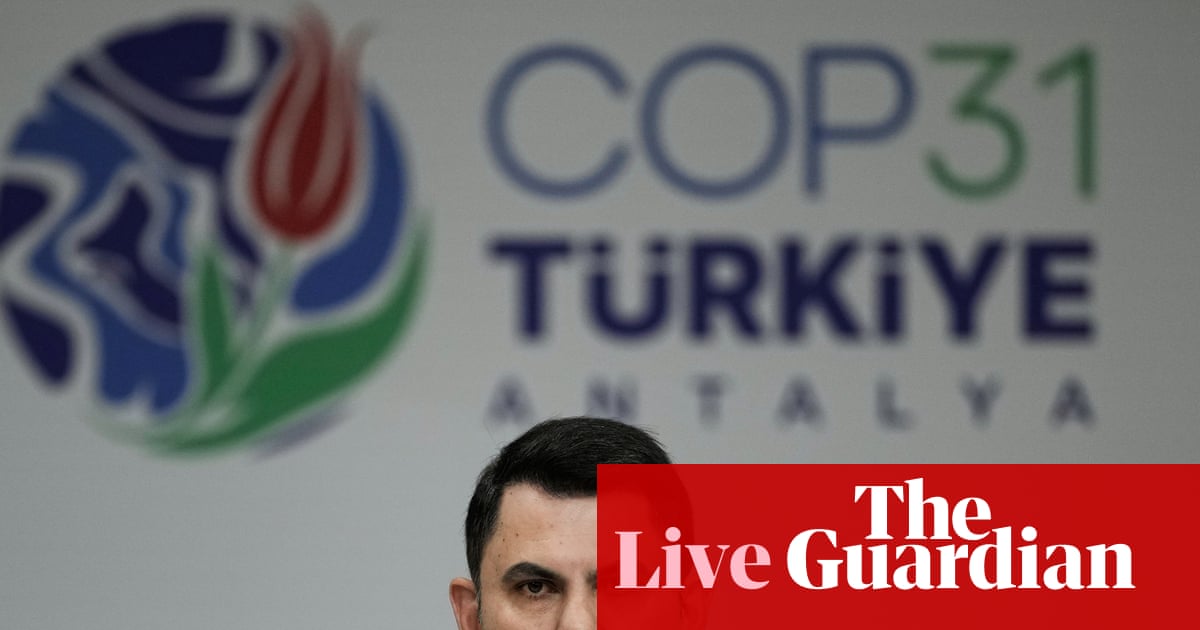
Fossil fuels dumped from latest draft deal
Fiona Harvey
Every mention of fossil fuels has been expunged from the draft text for the main outcome of the Cop31 UN climate summit, in a blow to the vulnerable countries which had fought hard for its inclusion.
The “transition away from fossil fuels” was in the first 18-page draft, published on Monday, but missing from the second, which was released at 3pm Turkey time on Thursday. This slimmed down second draft is 9 pages long and has 80 paragraphs, in place of the 144 items previously.
There appears to be not even an oblique reference to the transition away from fossil fuels, which was agreed at Cop28 in Dubai, in a declaration known as the UAE Consensus.
But language reaffirming the global commitment to holding temperatures to 1.5C and limiting the overshoot of that target was retained.
In place of the transition away from fossil fuels, the second draft has a much weaker promise, of a “transition towards low greenhouse gas emissions and climate-resilient development”, which the Guardian noted earlier today some countries were trying to use as a weaker alternative to the fossil fuel phaseout.
This call appears twice, in some strengthened language calling for “concrete solutions to accelerate the irreversible global transition towards low greenhouse gas emissions and climate resilience, and to keep 1.5 degrees within reach, recognizing that countries will take different pathways and solutions”.
The proposed target of deriving 35% of final energy from electricity by 2035 is still in the text, but instead of being binding it is one of a suite of voluntary options countries can take “in accordance with their national circumstances and development priorities”.
This draft also calls on countries to resolve their differences over the Intergovernmental Panel on Climate Change so that its latest science can inform negotiations at Cop33.
Key events
Negative reactions to the draft text have been coming in thick and fast. This is from Andreas Sieber, head of political strategy at 350.org.
“We are on the brink of an outrageous and utterly embarrassing lack of leadership by the Cop31 presidencies,” said Sieber. “They have reduced one of the defining challenges of our time to an inconvenient paragraph they would rather delete, while leaving the door open for fossil fuels to masquerade as clean electrification. Last year, Brazil, a country deeply dependent on oil, had the political courage to start confronting the difficult question of how to move beyond fossil fuels. This year with Minister Bowen we got a spineless fossil fuel bro while the Turkey presidency stands by.”
“Rich countries’ failure on finance is a historic disgrace,” he added. “They expect developing countries to shoulder the costs of a global transition while refusing to provide the means to deliver it. This is not a failure of technical negotiations. It is a shameless abdication of political responsibility. If this is where Cop31 lands, history will remember it as a summit where those entrusted with leadership chose the comfort of inaction over the courage to confront reality.”
Panama to block any outcome without a cap on oil production

Bibi van der Zee
Panama has come in with an unusual move; they have sent a letter to the Cop presidency announcing that unless all their demands are met, they will block any outcome. Given that the final agreement must be unanimously agreed, this has powerful implications.
“We have listened carefully to the speeches of these days,” the delegation writes. “They are beautiful speeches. But while we listen to endless oratory, the planet is being destroyed … Outside this room and this Conference, the world needs and expects radical change from us, and we are not delivering it.”
“Accordingly, I inform you that Panama will not join any consensus, and will formally object in the closing plenaries, to the adoption of any decision that does not lead to an outcome satisfactory to our principles and our values.” They want to see science as the foundation, real transparency, new rules of engagement, and a cap on oil production, among other things. That last demand will be completely unacceptable to fossil fuel producing countries; even the mention of fossil fuels in the text is problematic for some of them, let alone any suggestion that production should be capped.
“Panama will not lend its name to an outcome that continues to ignore and attempts to excuse each nation’s individual responsibility, and by so doing prolongs and worsens the crisis,” says the letter.
In the press conference by the Cop presidency, Chris Bowen said – in answer to a question about the letter – that he had not seen it. “We will work the issue through till we have consensus.” That seems optimistic at best.
The press conference has come to a slightly abrupt close with the announcement that Cop31 has so far registered just shy of 120,000 participants, 69,000 of whom were on-site.
Questioned on the lack of fossil fuels in the cover decision, Australia’s Chris Bowen has said this Cop is focused on implementation, arguing there is “no better way” than confirming the transition to low greenhouse gas emissions, reaffirming the commitment to keep 1.5C alive, and electrifying the economy.
“We’ve put forward very concrete proposals in the cover decision, we’re happy to receive feedback.”
His argument was echoed by Kurum, his Turkish counterpart, who said “we are not here to discuss previous decisions taken”, such as the transition away from fossil fuels agreed at Cop28. The electrification target for 2035, he added, “implies transitioning away from fossil fuels.”
Kurum rejected the suggestion that there had been any “backsliding” since the first draft, which did mention fossil fuels. Bowen said the purpose of the original wide-ranging draft was “transparency”, so all parties’ views were on the table.
“Yes, there are many obstacles, but the Paris agreement is working,” said Simon Stiell, Executive Secretary of the United Nations Framework Convention on Climate Change. He conceded the world is “nowhere near the 1.5C threshold we need to hit” but that the direction had been set, and the hottest futures once expected are no longer on the table. “The issue is speed, or the lack of speed.”
Chris Bowen, the Australian climate minister, has defended the draft. “We don’t expect this draft cover decision to be met with automatic agreement from all parties,” he said, but that he expected parties to continue the spirit of “constructive engagement” from recent days with everyone “wanting the process to succeed”.
The tone of the intervention stands somewhat in contrast to the hefty criticisms that campaigners have voiced outside the room as the two co-hosts spoke.

Graham Readfearn
In a packed media conference room we have the Turkish environment minister Murat Kurum, the Cop president of negotiations Chris Bowen, the Australian climate minister, and also the UN’s lead climate negotiator Simon Stiell.
Kurum goes first and speaks in Turkish, and says there is “great enthusiasm amongst all of us” after a meeting of delegations and observers last night known as a “divan”.
He is going through the key issues in the text and is saying that “at its core lies a strong commitment to the Paris agreement” and “the 1.5C target”.
He says the Cop must “roll up our sleeves” and find a way to deliver a “more just world.”
Stiell and Bowen to come.
A press conference has just begun and Cop31 President Murat Kurum is explaining to journalists some of the decisions in the latest draft. “At its core lies a strong commitment to the Paris agreement and multilateral cooperation.”
As he dives into some of the details, our inboxes are filling with angry reactions from campaigners outraged by the lack of substance – or even mention, in the case of the transition away from fossil fuels – in the text.

Damien Gayle
To say civil society campaigners are unimpressed by the latest draft of the cover decision at Cop31 is an understatement. “This new text has gone backwards,” said Mohamed Adow, director of climate and energy thinktank Power Shift Africa.
“It’s as if these negotiations in Antalya haven’t actually happened. All the new text does is underscore previous decisions and establishes further ‘dialogues’. We don’t need more talking shops.”
Observers accused the presidencies of kicking the can down the road. “On adaptation finance this text does nothing than reiterate what we had in Belem last year,” Adow said. “If this version of the text remains, it will be a ghost Cop. The summit will have nothing to show for what happened here.”
Jasper Inventor, head of the Greenpeace delegation at Cop31, said some elements of the text were so bad they were “profoundly unacceptable”. “This text dangerously adds the option of a carbon capture and storage target to the mix,” Inventor said.
“The UNFCCC process has never had such a target and anything that provides a way for the fossil fuel industry to keep polluting the climate would be a profound backwards step at a time when climate impacts are rapidly worsening.”
Gabrielle Canon
An incredibly strong El Niño layered over the already escalating effects from the climate crisis set the stage for devastating wildfires that have raged across Indonesia and Papua New Guinea this year, emitting massive amounts of carbon according to a report from the Copernicus Atmosphere Monitoring Service (CAMS).
As delegates began to gather in Antalya in mid-November, estimated emissions from the fires in Indonesia ranked third highest in more than 20 years with close to 200 megatonnes of carbon. The other top two years – 2006 and 2015 – were also El Niño years. In Papau New Guinea, this year’s emissions from fires were second highest and closing in on the amount in 2015, the record-holding year.
El Niño, a climate phenomenon characterised by warming of the subsurface temperatures in the Pacific, has the power to impact weather around the world. This year it’s expected to become stronger than ever recorded. While the outcomes can vary, El Niño events typically unleash heat and create drier conditions in southeast Asia, raising the risks for wildfire. They also can dessicate peatlands, robbing moisture from unique ecosystems and habitats that typically store large amounts of carbon, and leaving them vulnerable to burning.
The destructive and deadly fires, which consumed more than 88,000km in Indonesia, has also taken a toll on air quality. Smoke exposure alone has claimed the lives of over 5,200 people and an additional 400,000 respiratory illnesses, according to the Centre for Research on Energy and Clean Air (CRECA).
“High temperatures and a lack of precipitation, driven by strong El Niño conditions and human-induced climate change, favoured this exceptional fire season,” Laurence Rouil, Director of the Copernicus Atmosphere Monitoring Service said.
Addressing wildfires and building resilience has been an important point of discussion at Cop31, as many countries around the world are grappling with the increasing dangers and the threat from worsening air quality.
Earlier this week, countries including Brazil, Canada, Indonesia, Turkey, and the UK backed a new international action plan that outlined ways to share resources, reduce the risks, and expand early warning systems, training, and technology needed to adapt to the growing threats.
“We hope that the clues and insights that we provide based on our work – on observations, on models, on projection – are taken into the negotiations,” Rouil told the Guardian in Antalya, noting that she and other scientists are attending as observers and advisers to the global summit.
This year, as the impacts from the historic El Niño bear down on nations across the globe, the science is as important as ever.
“You cannot neglect this thing,” Rouil said. “Now we are in a situation with very intense wildfires, which will release a lot of carbon in the atmosphere, and that will create quite a vicious cycle.”
Fossil fuels dumped from latest draft deal
Fiona Harvey
Every mention of fossil fuels has been expunged from the draft text for the main outcome of the Cop31 UN climate summit, in a blow to the vulnerable countries which had fought hard for its inclusion.
The “transition away from fossil fuels” was in the first 18-page draft, published on Monday, but missing from the second, which was released at 3pm Turkey time on Thursday. This slimmed down second draft is 9 pages long and has 80 paragraphs, in place of the 144 items previously.
There appears to be not even an oblique reference to the transition away from fossil fuels, which was agreed at Cop28 in Dubai, in a declaration known as the UAE Consensus.
But language reaffirming the global commitment to holding temperatures to 1.5C and limiting the overshoot of that target was retained.
In place of the transition away from fossil fuels, the second draft has a much weaker promise, of a “transition towards low greenhouse gas emissions and climate-resilient development”, which the Guardian noted earlier today some countries were trying to use as a weaker alternative to the fossil fuel phaseout.
This call appears twice, in some strengthened language calling for “concrete solutions to accelerate the irreversible global transition towards low greenhouse gas emissions and climate resilience, and to keep 1.5 degrees within reach, recognizing that countries will take different pathways and solutions”.
The proposed target of deriving 35% of final energy from electricity by 2035 is still in the text, but instead of being binding it is one of a suite of voluntary options countries can take “in accordance with their national circumstances and development priorities”.
This draft also calls on countries to resolve their differences over the Intergovernmental Panel on Climate Change so that its latest science can inform negotiations at Cop33.
Graham Readfearn
Now that a new draft of the cover decision has been released, the whole Cop31 venue is humming with the sound of people hitting “Ctrl+F” on their keyboards to see if their issue of choice has survived, or how it has been described.
So Ctrl+F “Fossil” shows that word doesn’t appear in the latest text, which may create some waves as “fossil fuels” was mentioned six times in the first version released on Monday morning
The electrification target of 35% of final energy use coming from electricity by 2035 is still alive in the new text.
The “deep concern” about the overshoot of the 1.5C global heating level has now gone, but some strong language remains. The latest text “reaffirms resolve to pursue efforts to limit the temperature increase to 1.5C…”
We will continue searching the new text.
Hello, it’s Ajit Niranjan here, taking back over from Matthew Pearce. Proper analysis of the new draft is coming from our colleagues on the ground, but I can tell you that a quick Ctrl+F for “fossil fuels”, the fundamental cause of the climate crisis, no longer yields any results. Let’s see what has survived …
Damien Gayle
The new draft text is out. And the first thing to notice is that it has nearly halved in length. On Monday there were 144 paragraphs; now there are just 80.
Gabrielle Canon
The debate over how electrification will be addressed in the final text continues is still under way, with sharp divisions remaining on whether the presidency’s 35% by 2035 pledge should require a tie-in to renewable energy.
But that doesn’t mean there hasn’t been progress on electrification – a key priority set by the presidency for Cop31. Billions have been included in clean energy investment plans, along with projects to strengthen grids, expand electricity access, and accelerate the electric transition in high-emitting sectors, including transport and infrastructure, as part of an expansive electrification package released today.
“Cop31 is a success in electrification already,” Dr. Jennie Dodson, senior director at the World Business Council for Sustainable Development told the Guardian.
“We know that there are challenges in delivering electrification,” she added, mentioning scaling grid infrastructure and around transport. “What this is really showing is the collective action that is being delivered.”
The Global Climate Action Agenda’s package pulls together all the progress on electrification that’s come out of the summit so far, including actions and updates from more than 150 countries, the European Union, 37 cities, and hundreds of businesses representing more than two-thirds of global GDP and businesses that account for more than $4tn of annual revenue to shift to “clean and electrified energy”.
Among the actions included in the package were an additional 21,000km of grids built in 2025 – enough to stretch halfway around the world, according to the report.
But along with concrete actions, the package also serves as a strong political signal Dodson and other experts said. As governments demonstrate a commitment to building needed infrastructure and supporting the electric transition in key industries, market uncertainty will fall – and the cost of capital needed to fuel the transition will fall with it. Manufacturers are already responding to this signal as momentum for electric builds.
It’s also a reminder that there’s far more that can happen during Cops than what gets included in final texts. “Countries, cities and businesses will continue to make progress,” Dodson said, “whatever comes out of the negotiator talks”.
#Cop31 #live #Fossil #fuels #dumped #latest #draft #deal #climate #summit #Cop31