wellnessfitpro
Climate summit talks continue
Adam Morton
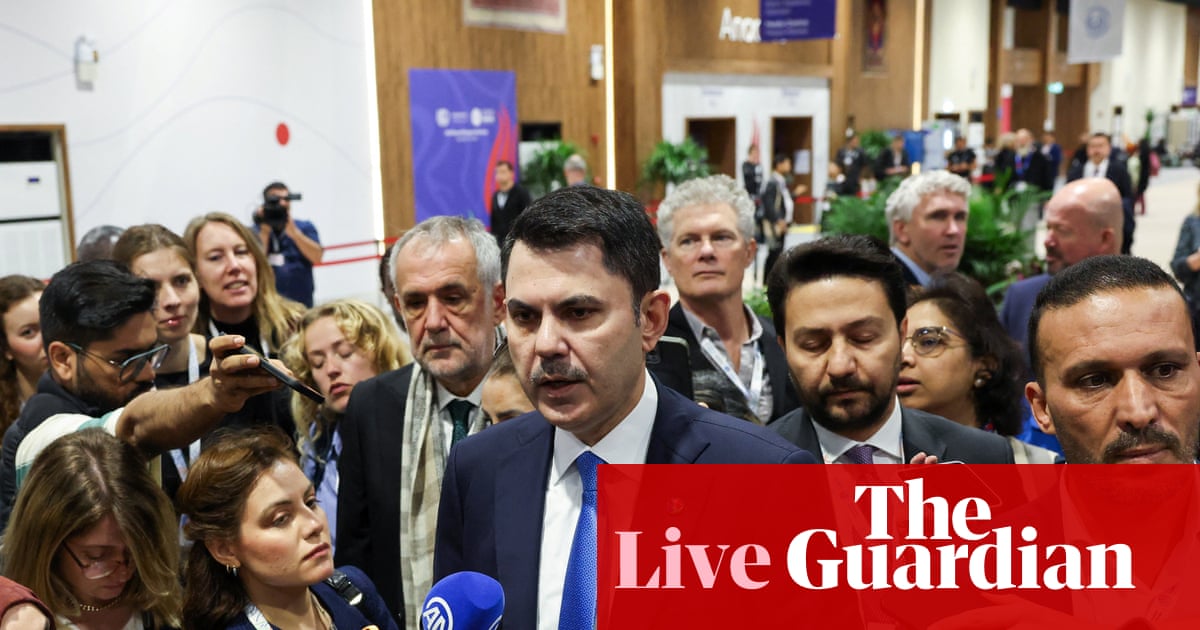
Welcome to day 14 of the Cop31 climate summit. Hope you’ve had some rest. If so, that sets you apart from many of the dwindling number of people at the Antalya Expo Centre, Turkey, where they have been negotiating through the night.
The talks ground to a near halt on Saturday as the co-presidents of the conference from Australia and Turkey held meetings with scores of countries until late evening with little sign of resolution.
The result of that work became public shortly after 3am local time, when the third and – in theory – final draft of an outcome from the meeting was published. Known as the cover decision, it showed signs of how some of the deep divisions between countries could be bridged.
On the need for a “just, orderly and equitable transition away from fossil fuels” – a “red line” for many countries that was absent from the previous draft was published on Thursday – Australia’s Chris Bowen and Turkey’s Murat Kurum have attempted to address the issue by starting the draft with a statement that countries “recall” a previous agreement reached at Cop28 in Dubai three years ago “in its entirety”.
This oblique reference has been added for one reason: the so-called “United Arab Emirates consensus” at Cop28 was the only time that the phrase fossil fuels has appeared in a UN climate cover agreement.
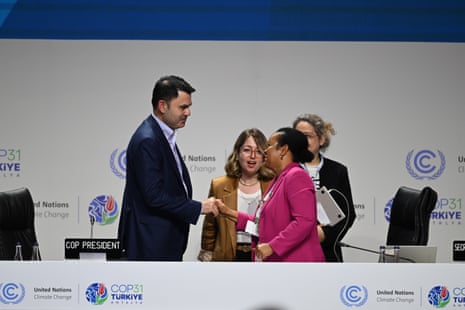
Some countries, notably Saudi Arabia and other oil-rich states, have opposed subsequent attempts to explicitly say the world should move away from fossil fuels. Referring to the Cop28 deal is intended as a way of acknowledging support for transitioning away from fossil fuels without actually using those words.
The latest draft attempts to deal with some other areas of disagreement by removing a hard numerical target for the development of carbon capture, utilisation and storage technology and and acknowledging that as much electrification as possible should be powered by clean energy.
A promised goal of 35% of the world’s final energy coming from electricity by 2035 is included. A target backed by developing countries of $120bn for adaptation finance is not.
The full third draft text, now 94 paragraphs across 10 pages, can be read here. The Guardian’s wrap of what happened on Saturday is here.
The (hopefully final) plenary is scheduled to kick off at 9am local time. But things have been mostly quiet overnight and it remains unclear how today will play out. Strap yourself in.
Key events
Germany says it will reject the current text
My colleague Graham Readfearn has just been listening to a press conference from the German delegation. He says that the German climate minister, Carsten Schneider, has stated he will reject the current text of the agreement in Antalya.
He was speaking in German, but according to a native German speaker next to Graham, he said: “The text as it is was presented to us – Germany will not be able to agree.”
He also said the country would continue working towards a “successful conclusion” but he was now sceptical it could be achieved.
Earlier the French ecological transition minister Monique Barbut said the proposal was a “backward” step: “Time is ticking and we are not there yet.”
“We are very disappointed with how the text looks,” the environment minister of Antigua and Barbuda, Michael Joseph, told AFP after leaving the COP31 presidency’s offices. In its current state, he added, “I can’t honestly say that I’m okay with it passing”.
Panama has vowed to formally object to a final agreement that doesn’t put a cap on oil production, acknowledge failing goals to limit warming and beef up finance for nations to adapt to climate change, among other demands. Panamanian Environment Minister Juan Carlos Navarro said the talks were being held hostage by a “petroleum mafia” and need to be reformed.
Mohamed Adow, director of Power Shift Africa, has been looking through the text and says: “This latest text is a total mess and countries should throw it out. It fails to deliver vital climate finance to the vulnerable while promoting far-fetched and eye wateringly expensive carbon removal technologies which is a gift to the fossil fuel industry.
“A sign of how useless the latest cover text is can be seen in the feeble language. It ‘recognises’ the crisis 40 times, ‘recalls’ previous decisions 15 times yet ‘decides’ on action only 5 times. And those 5 decisions relate to peripheral issues. This meeting needs to be about turning those previous commitments into action, and on that it has failed.”
Climate Action Network, a global network of civil society organisations, is calling on governments to reject COP31 cover decision, saying that “the climate crisis demands better than this.”
The deal “fails to deliver climate justice while opening the door to dangerous distractions, including carbon capture and storage (CCS) and carbon dioxide removal”.
They add: “The Turkish and Australian presidencies have failed to provide the leadership needed to secure a meaningful outcome. Governments are now being asked to endorse a text that offers more delays and processes while creating new opportunities for corporate interests. The cover decision is a gift from the Australian presidency to the gas industry.”
Graham Readfearn
A Turkish journalist colleague, Selin Ugurtas, who writes for the climate news agency Iklim Masasi, has told me a little more of Kurum’s statement just now.
She says he said: “If there is no agreement on the decision, [parties blocking] should consider that they would be blocking the Cop process and evaluate themselves in this regard.
“If you really want progress there is nothing blocking it. We will see it shortly.”
Graham Readfearn
The UNFCCC’s website now says the plenary will start at 11.30am here.
Does the fact that this has now drifted into a 30-minute increment, and not 60 minutes, suggest we’re close?
“We want to leave here with the result soon,” says Cop president
Graham Readfearn
Outside the plenary room here where media are waiting for the start, and the Turkish environment minister, Murat Kurum, the president of the Cop, has walked through but not to the main stage. Instead he carried on to the VVIP rooms, but stopped to give some comments.
This is a Google translation as Kurum spoke in Turkish.
“We are working hard. We are at a very important point. We want to leave here with the result soon. We have declared to the whole world that we will be open and transparent …
“There are very few issues left. When this decision is made, we will have achieved very important things. Our desire is for this decision to be made.
“As you know, we have prepared a cover decision in this context. We took the views of the countries in that cover decision. We gave the final decision since last night and sent it to the countries again.
He went on: “If there is sincerity here, if something is really wanted to be done, I believe that this will be done in this hall. We will see that in a moment.
“If we really want to make a will in this fight, if we really want to move forward, there is no obstacle for this. We will see in a moment. Thank you very much.
The closing plenary was originally supposed to begin at 9am, Turkish time. But it slipped to 10am, and now has moved back another hour, to 11am.
The reactions coming into the text so far have been largely negative. An EU official told AFP the latest proposal was a “backwards” step, warning there was a “very real possibility” that COP31 ends with no deal.
“I am more pessimistic today than I was yesterday,” the official said on condition of anonymity.
“The situation is difficult, and the outcome is uncertain. The oil-producing countries are putting up a fierce fight,” a German official said.
Graham Readfearn
Some views from Bill Hare, the chief executive of Climate Analytics and a long-time advisor to the Alliance of Small Island States and a Cop veteran, in the moments here before the closing plenary is supposed to consider the final agreement here.
“There’s widespread unhappiness about this new text – AOSIS, Least Developed Countries, the EU and the Environmental Integrity Group [Mexico, Liechtenstein, Monaco, the Republic of Korea, Switzerland, and Georgia].
“But I don’t know if anyone is going to move to block it. I can’t predict now what’s going to happen.”
Latest draft text not welcomed by civil society
Campaign organisations have so far been fairly negative about the third draft.
Harjeet Singh, Global Convenor of the Fill the Fund campaign, said: “The package gives mostly processes on finance. There is no $120bn figure. Parties only ‘agree to discuss’ a tripling pathway in 2027. Floods and heatwaves won’t wait for 2027. The Antalya–Addis Ababa will be tough with no promises and only talk.Donor countries happily recalled the provision of the Paris Agreement that says they must pay, then deleted every number that would show whether they have.”
Andreas Sieber, head of political strategy, at 350.org, concluded: “The final draft confirms what has become increasingly clear throughout COP31: an indefensible failure of leadership by the Turkish and Australian presidencies. They found room for a 2035 carbon capture target, yet struck the transition away from fossil fuels from the text and launched no initiative to take it forward. Brazil showed that such leadership was possible. Meanwhile, vulnerable communities are still waiting for clarity on adaptation finance.”
Jasper Inventor, Head of COP31 Greenpeace Delegation, said: “No deal is better than a deal with the fossil fuel industry and if this is the final COP31 outcome then it is fundamentally unacceptable. What’s happening here is a fight for our future and we urge parties to overhaul this text and deliver the dose of hope people around the world need.”
Cat Abreu, Director, International Climate Politics Hub, said: “In addition to CCUS being centred in a huge and dangerous way even in this latest version of the cover, it came out of nowhere. No one asked for this (openly), there are no outside initiatives informing it, it does not even reflect the current trajectory of CCUS. It has been parachuted into COP31 by fossil fuel interests and must not be allowed to make it into a final global agreement.”
Fiona Harvey
The new cover text arrived early this morning, shortly after 2am, for parties to consider ahead of a scheduled 9am plenary, which subsequently slipped to an 11am scheduled start that still looks wobbly. The Guardian understands that many members of the “progressive coalition” are unhappy with the new text, which makes only an oblique reference to the transition away from fossil fuels, leaves in CCS and fails to significantly strengthen the commitment to a tripling of adaptation finance for poor countries.
A diplomat from the High Ambition Coaltion told the Guardian: “From the very beginning there was a sense that there was a stitch up between the presidency and Saudi Arabia. The one getting the electrification target and the other getting the carbon capture in storage target. With everything that happened since it walks like a duck and talks like one.”
Will these talks break the previous record for the longest Cop?
Cop25 in Madrid, in 2019, over ran into Sunday and was eventually, 44 hours overtime, gavelled to a close at 13.55pm, CET. A much younger Greta Thunberg had sailed to the summit.
Those talks ended with a partial agreement to ask countries to come up with more ambitious targets to cut greenhouse gas emissions in order to meet the terms of the 2015 Paris accord.
Climate summit talks continue
Adam Morton
Welcome to day 14 of the Cop31 climate summit. Hope you’ve had some rest. If so, that sets you apart from many of the dwindling number of people at the Antalya Expo Centre, Turkey, where they have been negotiating through the night.
The talks ground to a near halt on Saturday as the co-presidents of the conference from Australia and Turkey held meetings with scores of countries until late evening with little sign of resolution.
The result of that work became public shortly after 3am local time, when the third and – in theory – final draft of an outcome from the meeting was published. Known as the cover decision, it showed signs of how some of the deep divisions between countries could be bridged.
On the need for a “just, orderly and equitable transition away from fossil fuels” – a “red line” for many countries that was absent from the previous draft was published on Thursday – Australia’s Chris Bowen and Turkey’s Murat Kurum have attempted to address the issue by starting the draft with a statement that countries “recall” a previous agreement reached at Cop28 in Dubai three years ago “in its entirety”.
This oblique reference has been added for one reason: the so-called “United Arab Emirates consensus” at Cop28 was the only time that the phrase fossil fuels has appeared in a UN climate cover agreement.
Some countries, notably Saudi Arabia and other oil-rich states, have opposed subsequent attempts to explicitly say the world should move away from fossil fuels. Referring to the Cop28 deal is intended as a way of acknowledging support for transitioning away from fossil fuels without actually using those words.
The latest draft attempts to deal with some other areas of disagreement by removing a hard numerical target for the development of carbon capture, utilisation and storage technology and and acknowledging that as much electrification as possible should be powered by clean energy.
A promised goal of 35% of the world’s final energy coming from electricity by 2035 is included. A target backed by developing countries of $120bn for adaptation finance is not.
The full third draft text, now 94 paragraphs across 10 pages, can be read here. The Guardian’s wrap of what happened on Saturday is here.
The (hopefully final) plenary is scheduled to kick off at 9am local time. But things have been mostly quiet overnight and it remains unclear how today will play out. Strap yourself in.
#Cop31 #live #draft #deal #scrutiny #divided #talks #risk #longest #climate #summit #Cop31