wellnessfitpro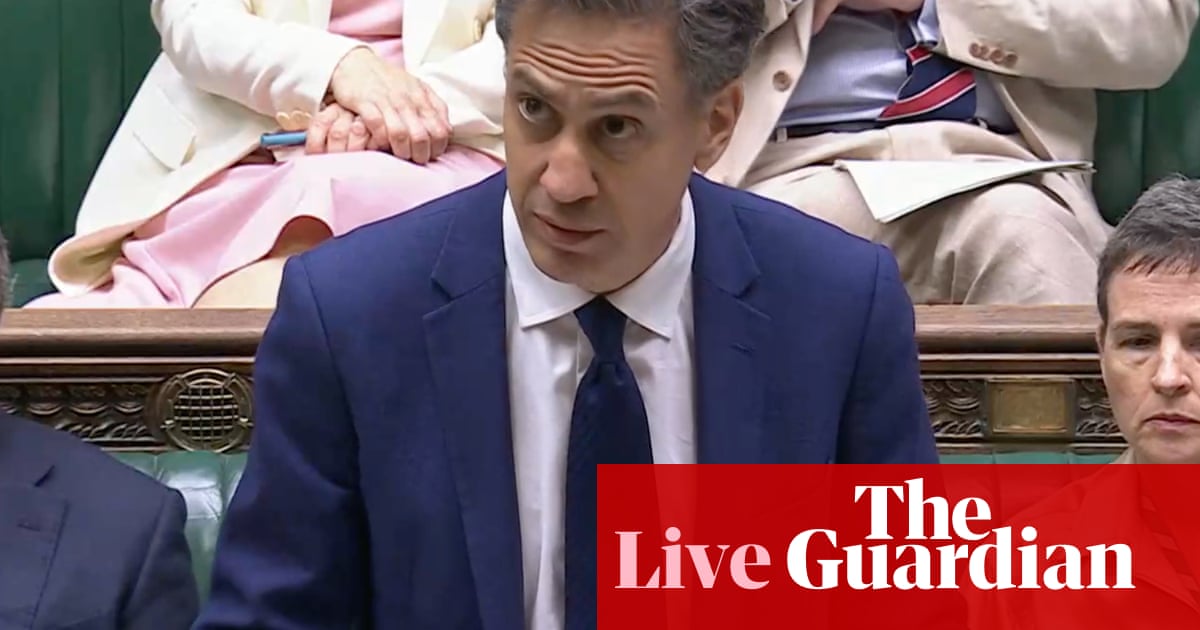
Miliband says heat waves have led to 10,000 excess deaths in England over past four years
Miliband says extreme weather is already having an impact.
The impacts of extreme weather and nature loss aren’t simply a future threat to our country. They are already here and having impacts on our way of life.
We know heavy rainfall made last year’s harvest the second worst in at least four decades, costing farmers hundreds of millions of pounds.
More than half our best agricultural land, and over 6 million properties in England, are already at risk of flooding, according to the Environment Agency.
According to the UK Health Security Agency, there were more than 10,000 excess deaths, 10,000 people losing their lives, during English heat waves between 2020 and 2024.
And as we know recently, rising temperatures place pressures on every aspect of our national life. We have seen this again over the last few days, with incidents of wildfires from Surrey to Scotland, disruption due to trains overheating and hosepipe bans announced in Yorkshire, Kent and Sussex.
The climate crisis is also a massive threat to our economy. The OBR fiscal risks report published last week says the damage caused by climate impacts in a near three Celsius world is forecast to cut our GDP by 8% by the early 2070s, which will be roughly £200bn pounds based on current GDP.
Key events
-
Miliband says climate policy shows that UK can ‘make a difference’, as he accuses critics of ‘talking country down’
-
Miliband says young people have reasons to worry about future of climate, but action is possible
-
Miliband says heat waves have led to 10,000 excess deaths in England over past four years
-
Britain ‘one of most nature depleted countries in world’, Miliband says
-
Miliband says UK ‘getting hotter and wetter, with more extreme events’
-
Ed Miliband to make statement to MPs on state of climate
-
No 10 hints heat pumps that provide air conditioning could qualify for boiler upgrade subsidies
-
Streeting says BMA’s tactics ‘shockingly irresponsible’ because resident doctors being urged not to tell trusts if they’re striking
-
No 10 ducks questions about whether PM would have favoured Trump being able to address parliament during state visit
-
Wes Streeting questioned by Commons health committee about 10-year NHS plan
-
No 10 declines to comment on ‘internal guidance’ gagging officials, but claims ‘principles’ that apply remain unchanged
-
Reeves says Labour’s manifesto commitments ruling out major tax rises ‘absolutely stand’
-
No 10 plays down hints income tax thresholds could be frozen in budget
-
No 10 confirms Starmer to meet Trump when US president visits Scotland later this month
-
Stop Trump Coalition announces planned demonstration against US president when state visit starts
-
Experts urge No 10 to cancel gag on civil servants speaking at public events, saying it will have ‘chilling effect’ on debate
-
Streeting says he’s ‘really pleased’ BMA has agreed to meet him as he hopes to avert strike by hospital doctors
-
Farage calls for recall of parliament so Trump can address MPs and peers during state visit
-
Proposed law creating mandatory duty to report child sex abuse could have ‘little or no impact’, MPs and peers say
-
Legacy Act halted investigations into 202 Troubles-related killings of British soldiers
-
‘Profound concern’ as scientists say extreme heat ‘now the norm’ in UK
-
Mutualistion to be considered as ownership model for Post Office under review launched by ministers
-
Genocide prevention could become legal priority for UK government
-
Bank of England could cut rates faster if jobs market slows, governor says
-
Treasury minister Darren Jones says ‘headline’ rate of income tax won’t go up, in hint thresholds might be frozen in budget
Miliband said the driving ahead with plans to achieve net zero by 2050.
But the government was also working on protecting the environment from the damage caused by rising temperatures, he said.
He confirmed the government was consulting on expanding the boile upgrade scheme to cover heat pumps that can offer cooling as well as warming. (See 3.24pm.)
He ended by saying the Commons was at its best when MPs worked together on this issue.
Miliband says climate policy shows that UK can ‘make a difference’, as he accuses critics of ‘talking country down’
Miliband said that the lesson of history was that people can do something about the climate crisis.
Before the Paris climate agreement was negotiated 10 years ago, the world was on course for four degrees centigrade of global warming. Now, national commitments imply 2.6 degrees of warming, or global warming below two degrees, if countries meet their full climate targets.
We remain way off track from where we need to be as a world, but we in this country have helped make a difference.
He said parties came together in 2008 to pass the first Climate Change Act,
And when the Tories, under Theresa May, legislated for net zero by 2050, Labour supported that, he said.
And he said when the UK hosted Cop under Boris Johnson, there was global agreement on a biodiversity framework.
The lesson is clear. The choices we make as a country have influenced the course of global action, and in doing so, reduced the impact of the climate and nature crisis on future generations in Britain.
To those who say Britain cannot make a difference. I say you are wrong. Stop talking our country down. British leadership matters.
Miliband says young people have reasons to worry about future of climate, but action is possible
Miliband says these facts are sobering.
He goes on:
Unfortunately, all the evidence suggests this is just the start of the threat we face.
As I say this, I want to particularly acknowledge today the anxieties many young people feel about these issues.
My candid message to them is this, yes, there are real reasons to worry about the world you will inherit, but my message is also that we can do something about it.
Every fraction of a degree of warming we prevent, and every step we take to preserve nature helps limit the severity of impacts and protect our country from irreparable harm.
It is our generation today which have a unique opportunity to act, because unlike previous generations, we can see the evidence of the climate and nature crisis all around us, and yet we still have time to limit the worst effects.
Miliband says heat waves have led to 10,000 excess deaths in England over past four years
Miliband says extreme weather is already having an impact.
The impacts of extreme weather and nature loss aren’t simply a future threat to our country. They are already here and having impacts on our way of life.
We know heavy rainfall made last year’s harvest the second worst in at least four decades, costing farmers hundreds of millions of pounds.
More than half our best agricultural land, and over 6 million properties in England, are already at risk of flooding, according to the Environment Agency.
According to the UK Health Security Agency, there were more than 10,000 excess deaths, 10,000 people losing their lives, during English heat waves between 2020 and 2024.
And as we know recently, rising temperatures place pressures on every aspect of our national life. We have seen this again over the last few days, with incidents of wildfires from Surrey to Scotland, disruption due to trains overheating and hosepipe bans announced in Yorkshire, Kent and Sussex.
The climate crisis is also a massive threat to our economy. The OBR fiscal risks report published last week says the damage caused by climate impacts in a near three Celsius world is forecast to cut our GDP by 8% by the early 2070s, which will be roughly £200bn pounds based on current GDP.
Britain ‘one of most nature depleted countries in world’, Miliband says
Miliband says the “the science is unequivocal about why this is happening”.
He goes on:
As the Met Office said this morning, and I quote, ‘This is not a natural variation in our climate. Human emissions of greenhouse gases are warming the atmosphere and changing the weather we experience.’
We know climate change and nature loss are fundamentally linked and contribute to each other.
Globally, we’re losing species at a much faster rate than at any time in human history. Here in Britain, a quarter of our mammals, nearly half of our bird species, are currently at risk of extinction, with birds like starlings, turtle doves and grape cartridges under threat.
The abundance of species in England has fallen by an estimated third since 1970 and Britain has become one of the most nature depleted countries in the world.
Miliband says UK ‘getting hotter and wetter, with more extreme events’
Ed Miliband starts by saying the Met Office’s report has been published today. The government intends this to be an annual event, he says.
He says the last decade as seen the 10 hottest years on record globally.
Long-term global warming, assessed by a range of methods, is estimated to be 1.34 and 1.41 celsius above pre-industrial levels. And last year was the first time we saw an individual year above 1.5 degrees.
Today’s Met Office report shows that, in line with what is happening globally, the UK climate is getting hotter and wetter, with more extreme events.
The central England temperature series shows recent warmth has far exceeded any temperatures observed in at least 300 years.
Over the last 50 years, the number of days above 28 degrees centigrade have doubled, and above 30 degrees have trebled.
This spring was the UK’s warmest on record, beating the record broken last year.
Meanwhile, warming oceans and melting ice sheets have contributed to sea levels around the UK rising by 13.4 centimetres over the past three decades, and this is accelerating.
Ed Miliband to make statement to MPs on state of climate
Ed Miliband, energy secretary, is about to make a statement to MPs about the state of the climate. He wants this to become an annual event.
The WWF environmental charity says this is a good idea. Its chief executive, Tanya Steele, says:
The government is right to make an annual ‘state of climate and nature address’ to parliament and the public. The science is clear and is confirms what we are already experiencing: it’s getting hotter, and we need to do something now, not tomorrow.
MPs must act now for a healthier, fairer, safer, future. That’s why we’re calling for a new law – a Living Planet Act – to ensure that across everything the government does, it is acting to restore nature, tackle climate change, and provide a safe future for our children and grandchildren.
Nature can be our greatest ally in the fight against climate change, but only if we choose to protect and restore it.
Back to Darren Jones (see 9.31am), and Robert Peston, ITV’s political editor, has written an interesting blog suggesting Jones’s reference to “headline rate” in interviews this morning should be taken as referring to VAT, not income tax. Peston explains:
The question is what Jones means by the “headline rate”. Does he just mean the 20% [rate of VAT] most of us are conscious of because it applies to so many items, or is he also referring to the 0% on food and the 5% on energy (there are also other lesser categories where the rates are 5% or nil)?
The point is that the chancellor could cut the main rate of VAT to, say 18%, and raise that kind of money by eliminating the vast categories of our spending that incur nil or 5% VAT.
No 10 hints heat pumps that provide air conditioning could qualify for boiler upgrade subsidies
Ed Miliband, energy secretary, will be making a statement to MPs soon after 3.30pm on the state of the climate report. (See 10.21am.)
In a recent Bagehot column, the Economist complained that Britian has been a bit useless at adjusting to the fact that the planet is getting warmer. As an example, it cited rules on heat pump subsidies. Bagehot said:
If there is a conspiracy against air-conditioning in Britain, it goes right to the top. The government offers subsidies worth £7,500 to people replacing a gas boiler with an electric heat pump, but only if it produces solely heat. A system that can heat in winter and cool in summer receives nothing. Mercifully, Labour is considering extending the subsidies, yet that is not guaranteed to happen. A puritanical streak in British policymaking runs deep. Only the most banal conspiracies turn out to be true: the Deep State exists and it tries to keep you warm on summer nights.
But there was good news for the Economist at the No 10 lobby briefing this morning. Asked about this issue, the No 10 spokesperson hinted the rules will change. He said:
Keeping homes cool in hot weather is just as important as heating them in the winter. That’s why we’ve consulted on including air to air heat pumps, which also cool air, under the boiler upgrade scheme. Our response to that will be published in due course.
Ben Coleman (Lab) asks if there should have been more in the 10-year plan about race inequalities in health.
Streeting accepts this is a big problem.
If you look at the experiences of Black and Asian staff, if you look at the experiences of Black and Asian patients, even adjusting for class inequalities and social determinants, we are seeing unequal outcomes for patients.
We’re seeing bullying of staff which, when you think about how long we’ve had black staff in the NHS – since the beginning of the NHS, I think – it’s just completely intolerable.
We don’t have enough Black and Asian faces around executive and non-executive boards across the NHS, and that culture flows right down.
Streeting says he was “really shocked” by what he has heard in his work on problems with maternity services. He says one woman told him about being told “I thought you were a strong black woman” as an excuse for not getting enough pain relief. He also heard of Asian women being described as divas, he says.
Gregory Stafford (Con) asks Streeting why he seemed to think it was acceptable for resident doctors to go on strike when the Conservatives were in power, but not now that Labour is in power.
Streeting says he thought the previous strikes were avoidable. At the time the government was refusing to sit down and negotiate with the BMA, he says.
#Heatwaves #caused #excess #deaths #England #years #Miliband #politics #live #Politics