wellnessfitpro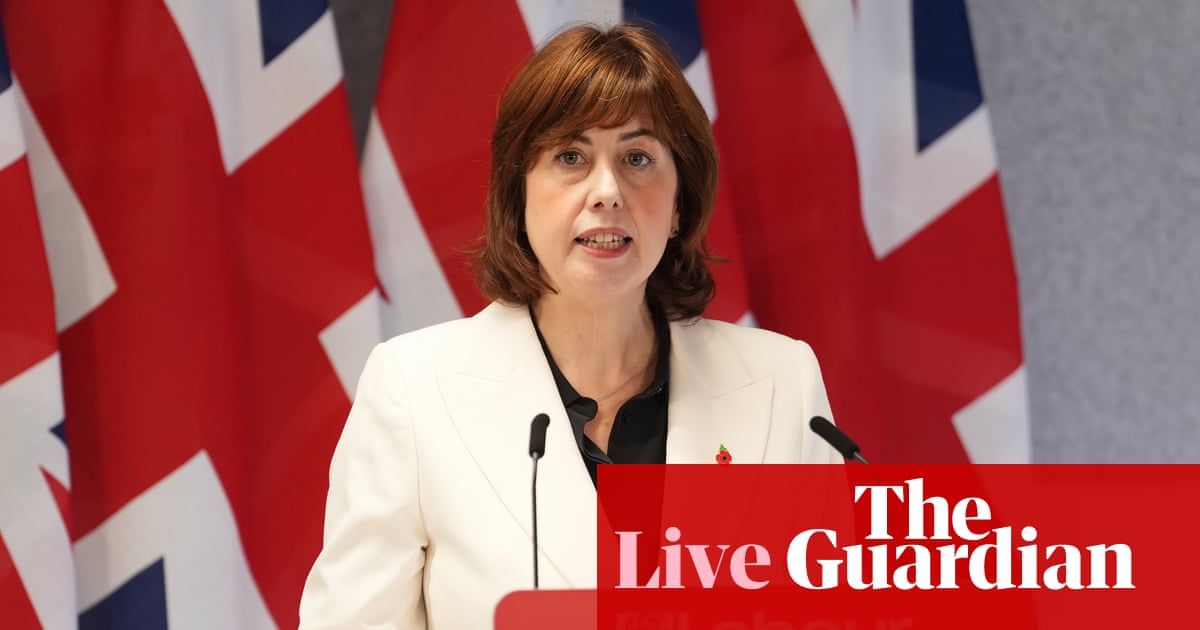
Powell says Labour ‘must change how we are doing things’
Lucy Powell was sacked from Keir Starmer’s cabinet in September and has indicated she will refuse a return to a government role so she can speak more openly about the direction of the party in office.
She has insisted she wants to “help Keir and our government to succeed” but the party “must change how we are doing things to turn things around”.
In a final message to supporters earlier this week she said Labour had to be “more in touch with our movement, and the communities and workplaces we represent, more principled and strategic, less tactical, and strongly guided by our values”.
Key events

Heather Stewart
The influential Labour thinktank the Fabian Society is urging Rachel Reeves to raise £12bn in next month’s budget by extending the freeze on income tax thresholds for another two years.
Joe Dromey, the Fabians’ general secretary, argues in a new report that the move is the “best available option” for the chancellor as she seeks to offset the impact of weaker economic forecasts in her 26 November statement.
Reeves is expected to have to find £10bn to £30bn in annual tax increases or spending cuts to remain on track to meet her fiscal rules, after the Office for Budget Responsibility (OBR) downgraded its projections for growth.
Dromey describes extending the threshold freeze as “an effective and progressive way to raise over half the funding that she needs, with most coming from wealthier households, and with relatively little political risk”.
Starting in 2022 as the UK recovered from the costs of the Covid pandemic, Rishi Sunak froze the thresholds at which workers move into a higher income tax band instead of increasing them each year in line with inflation.
Jeremy Hunt as chancellor extended that pause but it is set to end in 2027/28. Over that time, the OBR estimates that the freeze will have brought in an additional £45bn a year.
Extending it could be controversial as the number of people paying the 40% higher rate of income tax, which currently kicks in at £50,271, is already set to expand significantly.
Dromey acknowledges the downsides of the policy, including the fact opposition parties are likely to highlight Reeves’s argument in last year’s budget that maintaining the freeze would “hurt working people [and] take more money out of their payslips”.
But he argues it would be the progressive policy choice. “The chancellor recently said she wanted to ensure that those with the ‘broadest shoulders pay their fair share of tax’. Our modelling suggests that half (49%) of the revenue raised would come from the highest-earning fifth of households. Conversely, the poorest fifth of households would bear just 4% of the cost,” he writes.
Former deputy Labour leader, Angela Rayner, has congratulated Lucy Powell on her victory. In a post on X, Rayner wrote:
Delighted for my friend, and brilliant colleague Lucy Powell.
She’ll be a powerful voice for our movement, our Labour party values, and the change the country needs.
The contest was triggered by Rayner’s resignation after she failed to pay the correct stamp duty on a property purchase.
Leftwinger Catherine Connolly takes clear lead in Ireland’s presidential race

Rory Carroll
The leftwing independent Catherine Connolly is on track to win Ireland’s presidential election, according to early vote tallies.
Reports from tallymen – unofficial but usually reliable observers at count centres – gave Connolly a wide lead on Saturday soon after ballot boxes were opened at 9am.
Opinion polls had predicted a landslide for Connolly, 68, who captured the imagination of many younger people and was backed by an alliance of leftwing opposition parties in Friday’s election.
The presidency is a largely ceremonial office, but victory for Connolly, a member of parliament from Galway, would be a humbling rebuke to the centre-right government.
Her opponent, Heather Humphreys, 62, a former cabinet minister who ran for the Fine Gael party, was tainted by association with the unpopular ruling coalition.
Anger over a housing crisis and the cost of living, campaign blunders by Fine Gael and its ruling partner Fianna Fáil, rare unity among leftwing parties and deft use of social media combined to make Connolly a symbol of change.
Early tallies from Clare, Dublin, Donegal, Galway, Kildare, Meath and Wexford gave Connolly a clear lead, in some cases beating Humphreys by a ratio of two-to-one. The result “looks incredibly positive” for Connolly, said Labour leader Ivana Bacik.
There were also indications of a low turnout and unusually high number of spoilt votes, reflecting widespread frustration at the choice on offer and lack of additional candidates on the ballot.
Powell added:
The country hasn’t worked for people for the last 14 years and we’re going about fixing that every single day.
And I wanted to be here in London today, because we’ve got these huge elections next May here in London, in Scotland, in Wales and right across the country, and I’m going to get to work today, from day one to make sure that we get these brilliant candidates [and] these brilliant councillors elected here in London so that they can continue to deliver that change here on the ground in London and right across the country.
Because, it’s [by] having Labour councillors, Labour MSPs, Labour Senate members, Labour representatives right round the country working with the Labour government that we can bring that transformational change that we promised people at the election [and] that I’m determined that we deliver. So, thank you all very much for coming today.
Powell tells Labour party supporters that ‘it’s our job to stand together in face of division and hate’
Lucy Powell has told activists and Labour party supporters that she is “absolutely thrilled” to have been elected as the party’s new deputy leader.
At an event in Southwark in London, Powell said:
It really rests on our shoulders now as the Labour party [and] as the Labour government to prove that progressive, mainstream politics can really change people’s lives for the better, because we are facing these forces of division, of hate, of disillusionment, of discontentment.
And it’s our job to really see that off and stand together and to stand tall in the face of that division and that hate, and that is what I will do working alongside Keir [Starmer], Anna [Turley], the rest of the party and the Labour government, because I want to show people what this Labour government is really about. We are about changing people’s lives for the better.
Newly elected deputy Labour leader Lucy Powell is to meet activists and party supporters in London alongside Labour party chair, Anna Turley.
You can follow along with the live stream now in the video below:

Jessica Elgot
The Guardian’s deputy political editor, Jessica Elgot, has shared her reaction to Lucy Powell being elected as Labour’s new deputy leader:
Powell’s election is a sign of the disillusionment of Labour members – but there is a much much bigger and more worrying sign. Turn out was just 16%.
This is likely to be the case because a large number trade union levy payers – who also get a vote – are unlikely to have turned out to vote.
Labour’s new deputy leader Lucy Powell said the party had to give a stronger sense of its purpose, values and beliefs.
Powell won the deputy leadership contest with 54% of the vote, beating Bridget Phillipson, who took a 46% share.
You can listen to Powell’s speech from earlier in the video below:
Here are some images coming in via the newswires from this morning:
‘Country doesn’t have time for internal party feuds’ say Lib Dems in response to Powell victory
Responding to the news that Lucy Powell has been elected deputy leader of the Labour party, Liberal Democrat deputy leader Daisy Cooper said:
The fact that media were not allowed in to this announcement says it all. Labour just doesn’t listen.
People are feeling frustrated and disappointed that the government has failed to deliver the change they promised, after years of Conservative chaos and neglect.
We need to see far more urgency and ambition. Instead of punishing policies like the jobs tax and family farm tax, we need a much bolder plan for growth and the cost of living, for repairing our relationship with Europe and for fixing the NHS and care.
That must be Labour’s focus. The country doesn’t have any time for internal party factions or feuds.
Harry Taylor
Lucy Powell, who was the Commons leader until she was sacked in Keir Starmer’s reshuffle at the start of September, was seen as the favourite throughout Labour’s deputy leadership contest.
The result was announced on Saturday morning after a vote that was widely seen as a referendum for Labour members on the direction of the party under Starmer. Bridget Phillipson, the education secretary, was seen as Downing Street’s preferred candidate.
Both candidates called for the scrapping of the two-child benefit cap, a policy that caused a parliamentary rebellion within weeks of Labour taking office and is largely unpopular with members.
The contest grew increasingly fractious over the last six weeks. Last weekend, Powell was described as “the Momentum candidate” and Phillipson gave an interview saying her rival would cost the party the election.
The vote was called after Angela Rayner resigned last month when she was found to have underpaid stamp duty on a house purchase in Brighton.
Unlike Rayner, Powell will not become deputy prime minister, with the position having already been given to David Lammy.
The result reflected polling which had suggested the MP for Manchester Central had a healthy lead as voting closed on Thursday.
She is seen as being closely associated with the mayor of Greater Manchester, Andy Burnham, who was accused of launching a leadership bid in all but name before the party’s conference last month.
During the campaign, Powell frequently referred to “mistakes” made by the party on issues such as the winter fuel allowance.
In a final message to supporters this week she appeared to criticise a “command and control” culture within government, arguing that “blindly following along” was “a dereliction of our duty to defeat the politics of hate and division”.

Pippa Crerar
The Guardian’s political editor, Pippa Crerar, says that Lucy Powell’s election as Labour’s new deputy leader will be “widely interpreted as a sign of disillusionment among party members, after she pledged to be their voice to leadership”.
Crerar also highlighted the low turnout of 16.6%.
Education secretary Bridget Phillipson said she would continue to be a “strong voice” at the cabinet table despite losing out to Lucy Powell in the deputy leadership contest.
Phillipson said:
I want to congratulate Lucy on her victory in this contest.
It’s crucial that our party now comes together to take the fight to Reform in next year’s crucial Senedd, Holyrood and local elections.
I am obviously disappointed at today’s result but I’m proud of the campaign I’ve run. I want to thank everyone who voted for me in this contest. I feel privileged to have had the chance of meeting members across the country, talking about their priorities and what they want to see: a united party, talking about the good things this Labour government is doing, not fixating on our mistakes.
Regardless of today’s result, I will always be a strong voice for our members and trade unions at the cabinet table and I will still be that powerful campaigning presence at the top of government working to deliver a crucial second term of Labour government.
Labour ‘must unite’ says Starmer as he admits past week has shown urgency of the task
The election of Lucy Powell as Labour deputy leader follows a bruising few days for Keir Starmer after the chaos in the grooming gangs inquiry, the return of a small boat migrant who was sent to France under the one in, one out deal, the error which saw Hadush Gerberslasie Kebatu released from prison, and defeat for Labour in its Welsh stronghold of Caerphilly, reports the PA news agency.
Starmer said:
We must press ahead with the renewal that working people need to see.
Now, this week, we received another reminder of just how urgent that task is. A bad result in Wales, I accept that, but a reminder that people need to look out their window and see change and renewal in their community, opportunities for their children, public services rebuilt, the cost of living crisis tackled.
Renewal is the only answer to decline, to grievance and to division and we have to keep going on that. It is the offer we must make to the people of Scotland, Wales and England next year.
And that means we must come together. We must unite. We must keep our focus on what is, in my view, the defining battle for the soul of our nation.
Powell: Country and economy has ‘worked in the interests of the few, not the many’ for ‘too long’
Lucy Powell said Labour “won’t win by trying to out-Reform Reform” after being elected as the party’s new deputy leader.
Speaking after the results of the deputy leadership were announced, Powell said:
It starts with us wrestling back the political megaphone and setting the agenda more strongly.
Because let’s be honest, we’ve let Farage and his ilk run away with it. He wants to blame immigration for all the country’s problems.
We reject that. Our diagnosis is different: that for too long, the country and the economy has worked in the interests of the few, not the many.
The Manchester Central MP added:
We won’t win by trying to out-Reform Reform, but by building a broad progressive consensus.
Starmer describes Powell as ‘proud defender of Labour values’ and urges party to come together to protect British values
As mentioned below, Keir Starmer described the new deputy Labour leader, Lucy Powell, as “a proud defender of Labour values”. The prime minister also touched upon British values and said the Labour party needs to come together to defend them.
He added:
We’re facing opponents who want to wage war against all that.
Labour deputy leadership results breakdown
Here is a breakdown of the results:
-
Lucy Powell received 87,407 votes from the Labour party membership and affiliates.
-
Bridget Phillipson received 73,536 votes.
-
The number of eligible voters was 970,642 and a total of 160,993 votes were cast, resulting in a turnout of 16.6%.
Powell was first elected as the MP for Manchester Central in a byelection in 2012. Her election as deputy leader marks the fourth time the Labour party has elected a woman to this position, after Margaret Beckett, Harriet Harman, and Angela Rayner.
Labour has to ‘offer hope’ and ‘the big change the country is crying out for’, says Powell
Labour’s new deputy leader Lucy Powell said the party had to give a “stronger sense of our purpose” and our “values and beliefs”.
Powell won the Labour deputy leadership contest with 54% of the vote, beating Bridget Phillipson who took a 46% share.
The new deputy leader said:
We have to offer hope, to offer the big change the country is crying out for.
We must give a stronger sense of our purpose, whose side we are on and of our Labour values and beliefs.
She said that “people feel that this government is not being bold enough in delivering the kind of change we promised”.
Powell says Labour ‘must change how we are doing things’
Lucy Powell was sacked from Keir Starmer’s cabinet in September and has indicated she will refuse a return to a government role so she can speak more openly about the direction of the party in office.
She has insisted she wants to “help Keir and our government to succeed” but the party “must change how we are doing things to turn things around”.
In a final message to supporters earlier this week she said Labour had to be “more in touch with our movement, and the communities and workplaces we represent, more principled and strategic, less tactical, and strongly guided by our values”.
#Labours #deputy #leader #Lucy #Powell #Starmer #succeed #party #change #politics #live #Politics