wellnessfitpro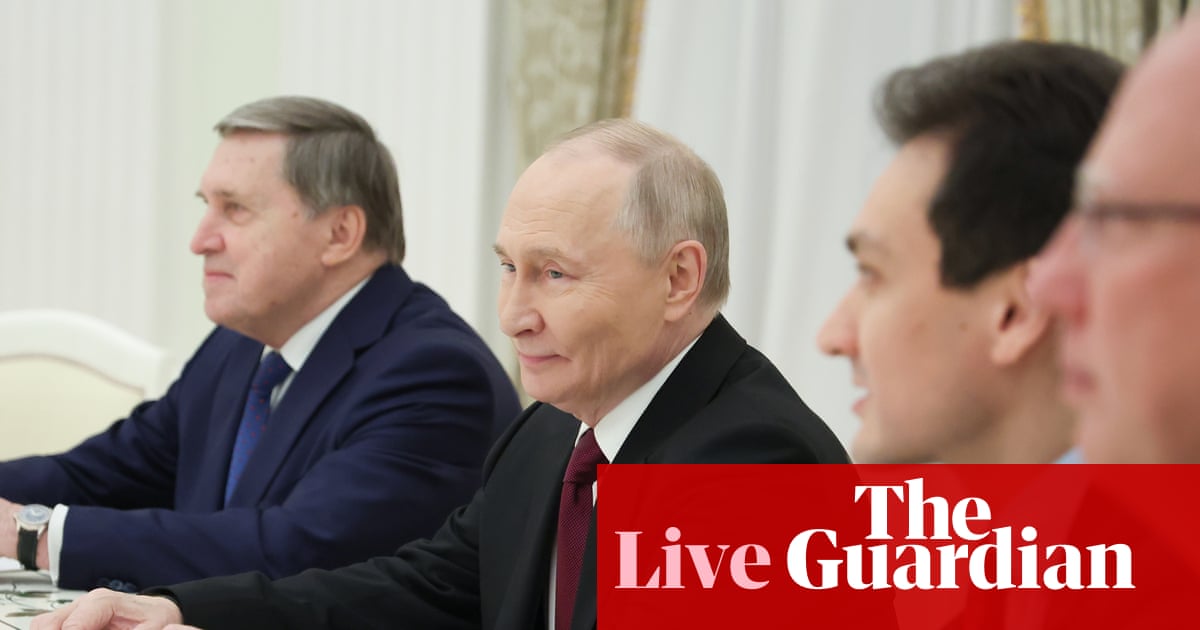
Putin did not reject US proposals, just found some of them ‘unacceptable,’ Kremlin spokesperson says
We also got more reactions from the Kremlin this morning, with spokesman Dmitry Peskov insisting that Russia was ready to continue engagement with the US on Ukraine peace deal for as long as it takes to get an agreement – even as he branded some of the proposals “unacceptable”.
Peskov insisted that Putin had not rejected any proposals, but merely “some things were accepted, some things were marked as unacceptable – this is a normal working process of finding a compromise.”
The Kremlin spokesman pointedly thanked US president Donald Trump for convening the talks, and said the EU leaders were not involved in the talks as “they are still obsessed with the idea of inflicting a strategic defeat on Russia.”
Separately, Peskov also responded to the bloc’s move to turn off taps on Russian energy (10:24) would “only accelerate the process that has been under way in recent years of the European economy losing its leading potential.”
Key events
In her opening comments, von der Leyen hinted that the proposal could be adopted without Belgium as it only required a qualified majority.
This gets later confirmed by Dombrovskis, but he is very diplomatic about it and says the commission will want to “hear from member states based on concrete proposals which are put forward to see how we move forward with this.”
Asked about Belgium’s concerns, von der Leyen says that the EU will continue with its consultations on this issue, and says “it’s very important that we accommodate all the concerns and perceived risks,” but essentially says the proposal addresses most of them through extending the scope and improving the burden sharing provisions.
EU economy commissioner Valdis Dombrovskis says “we stand at a crossroads,” and the EU “must act now” to “provide this lifeline to Ukraine.”
“In providing this lifeline to Ukraine, we are also enhancing our security. Not providing support that Ukraine needs to continue its fight for survival would come with a high cost, not only to Ukraine, but also to our entire continent’s security and freedom,” he says.
He also stresses that “everything we propose today is legally robust, fully in line with the EU and international law,” pointing to a “robust system that builds on existing safeguards.”
Dombrovskis insists that “these protections will cover the unlikely event” of a legal action against Belgium or the EU.
Details of the proposed EU plans are here, and they still need to be formally signed off working with the European Parliament and the European Council.
EU pushes ahead with plans to use frozen Russian cash balances despite Belgium’s opposition
Von der Leyen says the EU is proposing to cover two-thirds of Ukraine’s financing needs for the next two years – that’s €90bn – with the rest to be covered by international partners.
She says the EU wants to help Ukrainians to “equip them with the means to defend themselves and to lead peace negotiations from a position of strength.”
“Since pressure is the only language the Kremlin responds to, we can dial it up. We have to increase the costs of war for Putin’s aggression, and today’s proposal gives us the means to do this,” she says.
It would be funded through EU borrowing – raising capital on capital markets – and the use of cash balances from the immobilised Russian assets in the EU.
“We propose to cover all financial institutions that have accumulated such cash balances, and these institutions would have to move the cash into the instrument of the reparations loan. So in other words, we’re taking the cash balances, we’re providing them to Ukraine as a loan, and Ukraine has to pay back this loan if and when Russia is paying reparations,” she explains.
She says the funds will be used “predominantly” to produce and buy military support for Ukraine from Europe and the EEA countries, with occassional purchases “from the outside.”
Responding to Belgium’s continuing opposition to the plan, von der Leyen says the commission has “listened very carefully” to its concerns, and “have taken almost all of them into account.”
(Well, that’s not what Belgium’s foreign minister said earlier today, as we reported earlier at 12:02)
She says there will be “very strong safeguards” in place to make sure the funds are used in the right way, and to protect Belgium from any legal action.
“We will share the burden in a fair way,” she says.
EU’s von der Leyen briefing media on plans to fund Ukraine

Jakub Krupa
European Commission president Ursula von der Leyen is now briefing the media after the commission’s weekly meeting, presenting the bloc’s plan to help fund Ukraine’s continuing fight against Russia.
I will bring you the key lines here.
Hungary and Slovakia to challenge EU plan to phase out Russian gas imports, foreign minister says
Meanwhile, Hungarian foreign minister Péter Szijjártó has said that Hungary and Slovakia would challenge the EU’s plan to phase out Russian energy imports at the Court of Justice of the European Union as soon as it’s ready.
Szijjártó – who has been regularly travelling to Moscow despite the ongoing Russian invasion on Ukraine and was there as recently as last week accompanying prime minister Viktor Orbán on his trip to see Vladimir Putin – insisted that it was impossible for Hungary to accept and implement the EU plan and that it would endanger the country’s energy security, Reuters reported.
‘Just peace’ in Ukraine is unlikely, Finland’s Stubb warns
Any deal to stop the fighting in Ukraine is unlikely to meet all conditions for a just peace, Finland’s president Alexander Stubb said in an interview with Finnish television, AFP reported.
Stubb insisted that European countries are working to preserve Ukraine’s independence, sovereignty, and territorial integrity, but added that “the reality is that peace can be either good, bad, or some kind of compromise.”
“The reality is that also we Finns must prepare ourselves for the moment when peace is achieved, and that all the conditions for a just peace that we have talked about so much over the past four years are unlikely to be met,” he said.
He also admitted that the original 28-point US plan revealed last month had been frustrating to read.
Stubb also separately published an essay on “the West’s last chance” to “build a new global order before it’s too late” in the Foreign Affairs magazine (£).
“The world has changed more in the past four years than in the previous thirty,” he says in the essay, warning that “we live in a new world of disorder.”
On Ukraine, he says there that “when some suggest that Finlandization might be a solution for ending the war in Ukraine, I vehemently disagree.”
“Such a peace would come at too great a cost, what would effectively be the surrender of sovereignty and territory.”
Putin did not reject US proposals, just found some of them ‘unacceptable,’ Kremlin spokesperson says
We also got more reactions from the Kremlin this morning, with spokesman Dmitry Peskov insisting that Russia was ready to continue engagement with the US on Ukraine peace deal for as long as it takes to get an agreement – even as he branded some of the proposals “unacceptable”.
Peskov insisted that Putin had not rejected any proposals, but merely “some things were accepted, some things were marked as unacceptable – this is a normal working process of finding a compromise.”
The Kremlin spokesman pointedly thanked US president Donald Trump for convening the talks, and said the EU leaders were not involved in the talks as “they are still obsessed with the idea of inflicting a strategic defeat on Russia.”
Separately, Peskov also responded to the bloc’s move to turn off taps on Russian energy (10:24) would “only accelerate the process that has been under way in recent years of the European economy losing its leading potential.”
EU reparations loan for Ukraine ‘worst of all’ options, with Belgium’s concerns ‘not being heard’, minister says
We are expecting the European Commission president Ursula von der Leyen to present the EU’s proposal on the reparations loan for Ukraine, backed by frozen Russian assets, later today.
But Belgium – Brussels-based Euroclear holds most of Russia’s frozen assets – does not appear to be any closer to being convinced about the idea.
Speaking on his arrival at this morning’s Nato ministerial, Belgian foreign minister Maxime Prévot said that the government continues to see the reparations loan “the worst of all” options, as “it is risky [and] has never been done before.”
“The reparation loan scheme entails consequential economic, financial, and legal risks,” he says.
He said Belgium has been frustrated with “not being heard” and having its concerns “downplayed.”
“The text the Commission will table today does not address our concerns in a satisfactory manner. It is not acceptable to use the money and leave us alone facing the risks,” he said.
Prévot said that Belgium would need strong guarantees and coverage against all risks arising from the proposal to be persuaded. “Any member state would ask for the same,” he said.
But preferably, he said, the EU should “borrow the amount needed from the markets,” calling it a “robust and well-established option with predictable parameters.”
Former EU top diplomat among three held in fraud investigation

Jennifer Rankin
in Brussels
In other news, Belgian police have arrested three people including the EU’s former top diplomat Federica Mogherini and raided the headquarters of the EU foreign service and the elite College of Europe as part of an investigation into suspected fraud.
The three were detained “as part of a probe into suspected fraud related to EU-funded training for junior diplomats”, the European public prosecutor’s office said in a statement, without naming individuals.
The Belgian newspaper De Standaard, citing judicial sources, was among the first to report that Mogherini, now the rector of the College of Europe, was among the three arrested.
A source confirmed to the Guardian that Mogherini was among those held. The Belgian paper said two others from “diplomatic circles” had also been arrested over possible “procurement fraud, corruption and conflicts of interest”. The College of Europe did not respond immediately to a request for comment.
Police carried out searches at the Brussels headquarters of the EU’s foreign service, the European External Action Service, as well as several buildings of the College of Europe in Bruges at the request of the prosecutor’s office. Searches also took place at the houses of the suspects, the prosecutor’s office said.
It said an investigation was ongoing “to assess whether any criminal offences have occurred”, adding: “All persons are presumed innocent until proven guilty by the competent Belgian courts of law.”
Zelenskyy’s aides to meet with European national security advisors to discuss peace talks
Ukrainian president Volodymyr Zelenskyy has pledged to “work constructively in pursuit of a real peace,” as he continues Ukraine’s diplomatic offensive today, with his security advisor, Rustem Umerov, meeting with the European national security advisors in Brussels.
In a post on X, he said that Umerov will be joined by the chief of the general staff Andrii Hnatov, with the meetings aimed at ensuring “ongoing coordination with partners.”
“Ukrainian representatives will brief their colleagues in Europe on what is known following yesterday’s contacts by the American side in Moscow, and they will also discuss the European component of the necessary security architecture,” he said.
Zelenskyy added that Umerov and Hnatov will also “begin preparations for a meeting with envoys of president Trump in the US.”
‘Pretty obvious’ Putin doesn’t want peace in Ukraine, European ministers warn
Back to Brussels, the foreign ministers from European Nato countries showed little patience with Moscow this morning.
“What we see is that Putin has not changed any course. He’s pushing more aggressively on the battlefield,” Estonian foreign minister Margus Tsahkna said in comments reported by AP. “It’s pretty obvious that he doesn’t want to have any kind of peace.”
Finland’s foreign minister Elina Valtonen struck the same note. “So far we haven’t seen any concessions from the side of the aggressor, which is Russia, and I think the best confidence-building measure would be to start with a full ceasefire,” she told reporters.
Europe ‘turning off tap on Russia gas, forever’ as political deal on banning Russian imports by 2027 reached
Meanwhile, European Union lawmakers and member states reached a deal to ban all imports of Russian gas by autumn 2027, as the bloc seeks to choke off key funds feeding Moscow’s war chest, AFP reported.
The overnight accord aims to break a dependency the bloc has struggled to end despite the invasion of Ukraine, and marks a compromise between EU capitals and the European Parliament, which wanted the ban to hit sooner.
“We’ve made it: Europe is turning off the tap on Russian gas, forever,” EU energy commissioner Dan Jorgensen wrote on X.
“We are sending a clear message to Russia: Europe will never again let its energy supply be used as a weapon,” he said.
AFP noted that under the deal, long-term pipeline contracts – considered the most sensitive because they can run for decades – will be banned from 30 September 2027, provided storage levels are sufficient, and no later than 1 November 2027.
For liquefied natural gas (LNG), long-term contracts will be prohibited from 1 January 2027, in line with a call by Commission president Ursula von der Leyen to tighten sanctions on Moscow.
Short-term contracts will be phased out earlier: from 25 April 2026 for LNG and 17 June 2026 for pipeline gas.
The overnight deal also calls on the Commission to draft a plan in the coming months to end Russian oil imports to Hungary and Slovakia by the end of 2027.
The timeline must still get final approval from the European Parliament and member states.
Morning opening: Okay, so what do we do now?
Jakub Krupa
Russia and the US did not make progress toward a peace deal for Ukraine during their talks, a senior aide to Vladimir Putin has said, hours after the Russian president issued threats that Russia was ready for war with Europe.
Despite lots of pressure being put on Ukraine over the last week, the much-hyped talks in Moscow did not bring any results as Russia disagreed with the US proposals.
So, we are back to square one. The question is: what’s next?
Ahead of a ministerial meeting in Brussels today, Nato’s Mark Rutte was determined to look for positives as he insisted “the peace talks are ongoing,” but conceded that “we are not sure when they will end” and so the alliance should be ready to keep supporting Ukraine “to fight back against the Russians.”
Rutte declined to comment on Putin’s comments.
In a further sign that will worry Europeans, particularly after Putin’s war warning, US state secretary Marco Rubio is not attending the meeting. His deputy, Christopher Landau, is representing the US, despite appearing to question the need of Nato just a few months back.
But Rutte insisted there was nothing special about any of that, saying it was “totally acceptable” that Rubio could not come given his other duties, and saying that he had a dinner with Landau last night, who he thought would be “really great at the table.”
Let’s see what comes out of this meeting, with a press conference expected in the afternoon.
We should also hear from Ukraine’s Zelenskyy at some point with his take on yesterday’s talks at the Kremlin.
I will bring you all the key updates throughout the day.
It’s Wednesday, 3 December 2025, it’s Jakub Krupa here, and this is Europe Live.
Good morning.
#Obvious #Putin #peace #Ukraine #Nato #ministers #Russia #denies #rejecting #plan #Europe #live #Ukraine