wellnessfitpro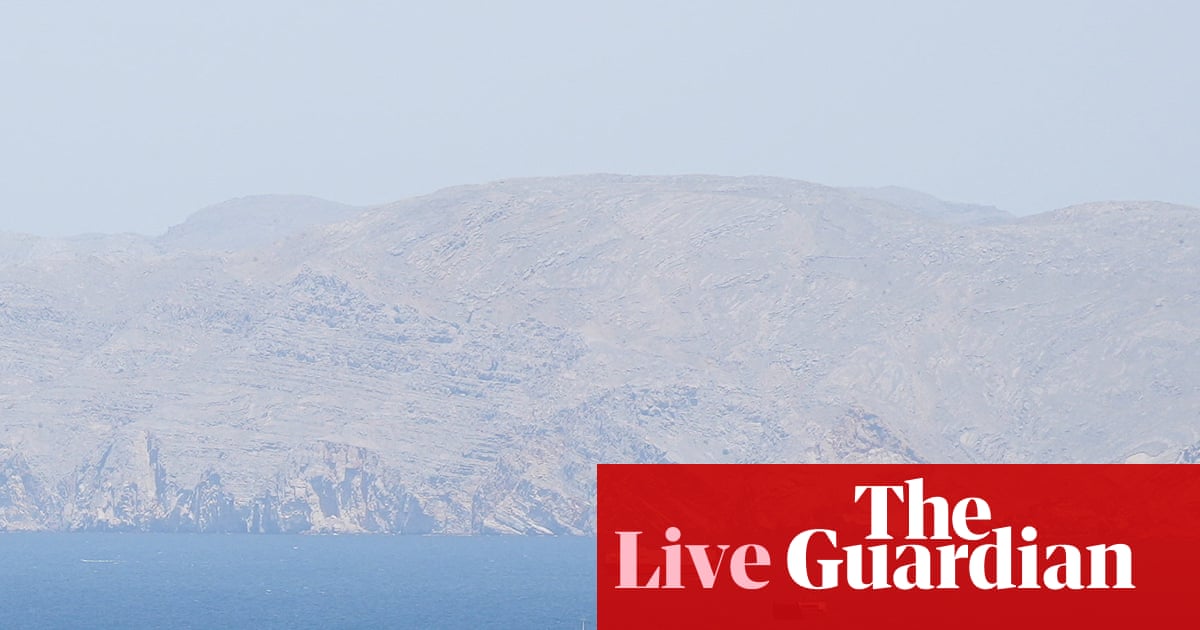
Iran ‘offers to end chokehold on strait of Hormuz’
Iran is offering to end its chokehold on the strait of Hormuz without addressing its nuclear program, two regional officials with knowledge of the proposal said Monday.
It comes as the country’s foreign minister made a visit to Russia he said was an opportunity to consult with Moscow regarding the war against Israel and the United States.
Iran also wants the US to end its blockade of the country as part of its proposal, said the two officials, who spoke on condition of anonymity to discuss the closed-door negotiations.
The new proposal, passed to the United States by Pakistan, likely won’t be supported by US president Donald Trump, who wants to end Iran’s atomic program as part of an overall deal to reopen the strait of Hormuz and make the ceasefire permanent.
“We have all the cards. If they want to talk, they can come to us, or they can call us,” Trump said Sunday to Fox News Channel.
Key events

Patrick Wintour
Iran is proposing that shipping companies should pay charges for specific services when they cross the strait of Hormuz, in a move that would enable it to raise money from shipping traffic without presenting the payment as a toll.
Iran’s framing is designed to maximise political and legal support for the plan it is developing with Oman. Iran has made a solution to its demands an essential precondition to winding down the conflict, including an end to its effective blockade of the Strait and the counter-blockade of Iranian ports being mounted by the US Navy.
A bill entitled a Strait of Hormuz Management Plan that is being passed through the Iranian parliament leaves the issue of tolls open, but some Gulf diplomats describe the Iranian stance as constructive, given the current chokehold they have on the waterway. Nearly 20% of the world’s oil is transported through the strait, only 21 nautical miles wide at its narrowest point.
Iran has not ratified the United Nations Convention on the law of the sea (UNCLOS), but is trying to present the proposed charges for services in language that would be compliant with the convention.
It held discussions on Sunday with Oman the stewards of the south side of the strait. Any Iranian proposal requires co-ordination with Oman, whic is a signatory to UNCLOS. The two countries would seek support of both the UN and the International Maritime Organisation for its plans, and are not presenting the proposal as a unilateral step.
The UK and other European countries have set their face against charges, arguing that freedom of navigation means navigation must be free. They claim the strait has a rare legal status as international water between one part of the high seas and another.
Article 26 of the Law of the Sea prohibits a coastal state from levying a payment on ships simply for passing through its territorial waters. But charges may be levied upon a foreign ship as payment for specific services rendered to that ship (eg help with port fees, pilotage, or security services). The level or fact of these charges must not be discriminatory.
The fee must be for specific services rendered, and not for protection from an artificially manufactured danger created by the charging state.
Iran further claims its restrictions in the freedom of navigation are different to blocking a port or a general blockade, It claims it has merely imposed a preventitive restriction on the passage of hostile vessels in a narrow waterway that passes through its territorial waters. It says it is acting in self defence under Article 51 of the UN charter and the action was taken in response to an unlawful armed attack without prior provocation. It claims its domestic laws mean the right of innocent passage does not apply to vessels that are engaged in hostile acts.
The Israeli military on Monday said it had begun hitting Hezbollah positions in Lebanon’s Bekaa region, amid a ceasefire that began earlier this month.
“The IDF has begun to strike Hezbollah infrastructure sites in the Bekaa valley and in additional areas across southern Lebanon,” it said in a brief statement on social media.
Lebanese president Joseph Aoun said Monday that direct negotiations with Israel were aimed at ending the conflict with Hezbollah, while accusing those who drew Lebanon into war of “treason” in an implicit rebuke to the Iran-backed armed group.
“My goal is to reach an end to the state of war with Israel, similar to the armistice agreement” of 1949, Aoun said in a statement, adding that “I assure you that I will not accept reaching a humiliating agreement”.
“Those who dragged us into war in Lebanon are now holding us accountable because we made the decision to go to negotiations… What we are doing is not treason. Rather, treason is committed by those who take their country to war to achieve foreign interests,” he said.
Germany’s Merz says Iran is humiliating the US
German chancellor Friedrich Merz said on Monday he does not see what exit strategy the United States has in the Iran war, warning “an entire nation is being humiliated by the Iranian leadership, especially by these so-called Revolutionary Guards.”
Speaking to students in Marsberg, in North Rhine-Westphalia, Merz said the Iranians are “obviously negotiating very skillfully” and “clearly stronger than one thought,” and urged that the conflict be ended as quickly as possible due to its direct impact on Germany’s economy.

Jason Stanley
In an extraordinary article published on 7 April, the New York Times described how Donald Trump decided to go to war with Iran.
It is highly unusual for the White House Situation Room to be used for in-person meetings with foreign leaders. But this time, the Situation Room was not just used for a meeting with a foreign leader.
Israel’s prime minister, Benjamin, Netanyahu took over the presentation space, backed on a screen by the leader of the Mossad as well as Israeli military officials.
As the New York Times describes the scene, “Arrayed visually behind Mr. Netanyahu, they created the image of a wartime leader surrounded by his team.” The article makes it clear that Netanyahu’s “hard sell” of a quick war was pivotal to the US president’s decision to partner with Israel in attacking Iran.
This article is unusual in recent mainstream media about the war, which typically avoids mention of the role of Israel in Trump’s decision. Here is one example, from a journalist I admire.
When it comes to Russia, Rachel Maddow has been forthright and heroic on the topic of foreign influence on US policy. But in a 28 February MS Now episode, Follow the Money, devoted to exploring Trump’s reasons for going to war with Iran, Maddow exhibits diminished virtue on this topic.
US president Donald Trump will hold talks on the Iran war on Monday with his top security advisors, US media reported, as negotiations between the rival parties seemed to reach an impasse.
Tehran’s top diplomat blamed Washington on Monday for the failure of talks in Pakistan this month – the first and only round of negotiations in a bid to strike a deal to end the conflict that has engulfed the Middle East and strangled the global economy.
Barak Ravid, global affairs correspondent for US media outlet Axios, reported that Trump was expected to hold a meeting with his top national security and foreign policy team on Monday to discuss the next steps.
ABC News quoted two unidentified US officials as saying that Trump would meet with his key security advisors on Iran, adding that a new deal proposed by Tehran to resolve the conflict fell short of Washington’s red lines.

Peter Beaumont
The Israeli prime minister, Benjamin Netanyahu, is facing the prospect of running against a rightwing-centrist super coalition in elections later this year after two of his most formidable political rivals combined forces in an attempt to oust him, inviting a third party leader to join them.
In a move that some analysts compared to the centre-right coalition that removed Viktor Orbán from power in Hungary, the former prime ministers – rightwing Naftali Bennett and centrist Yair Lapid – issued statements announcing the merger of their parties, Bennett 2026 and Yesh Atid (There is a Future).
The move came as Netanyahu disclosed he had recently had a malignant tumour removed from his prostate, leading to questions about the timing of a disclosure that was vague on details and his wider health, with the latter now likely to be an election issue.
“We are standing here together for the sake of our children. The state of Israel must change direction,” Lapid said standing alongside Bennett at a joint news conference on Sunday.
Bennett said the new party would be called Together and that he would be its leader. “After 30 years, it is time to part with Netanyahu and open a new chapter for Israel,” he said.
Iran ‘offers to end chokehold on strait of Hormuz’
Iran is offering to end its chokehold on the strait of Hormuz without addressing its nuclear program, two regional officials with knowledge of the proposal said Monday.
It comes as the country’s foreign minister made a visit to Russia he said was an opportunity to consult with Moscow regarding the war against Israel and the United States.
Iran also wants the US to end its blockade of the country as part of its proposal, said the two officials, who spoke on condition of anonymity to discuss the closed-door negotiations.
The new proposal, passed to the United States by Pakistan, likely won’t be supported by US president Donald Trump, who wants to end Iran’s atomic program as part of an overall deal to reopen the strait of Hormuz and make the ceasefire permanent.
“We have all the cards. If they want to talk, they can come to us, or they can call us,” Trump said Sunday to Fox News Channel.
Hezbollah leader Naim Qassem on Monday rejected Lebanon’s planned direct talks with Israel, calling them a “grave sin” that will destabilise Lebanon.
“We categorically reject direct negotiations with Israel, and those in power should know that their actions will not benefit Lebanon or themselves,” Qassem said in a statement, calling on authorities to “back down from their grave sin that is putting Lebanon in a spiral of instability”.
“These direct negotiations and their outcomes are as if they do not exist for us, and they do not concern us in the slightest,” he added, saying “we will continue our defensive resistance for Lebanon and its people”.
“No matter how much the enemy threatens, we will not back down, we will not bow down, and we will not be defeated.”
Opening summary: Trump says Iran can call ‘if they want to talk’
Welcome to our live coverage of events in the Middle East.
Donald Trump has said Iran can telephone if it wants to negotiate an end to the war and that it must agree never to have a nuclear weapon, while Pakistan’s leaders have sought to revive the stalled peace talks between Washington and Tehran.
Iranian foreign minister Abbas Araghchi talked to mediators Pakistan and Oman before travelling to Russia on Monday, where he is due to meet Vladimir Putin. Hopes of reviving peace efforts receded on Saturday when Trump scrapped a visit to Islamabad by his envoys Steve Witkoff and Jared Kushner.
“If they want to talk, they can come to us, or they can call us,” Trump told Fox News on Sunday. “You know, there is a telephone. We have nice, secure lines.
“They know what has to be in the agreement,” the US president said. “It’s very simple: they cannot have a nuclear weapon, otherwise there’s no reason to meet.”
In a sign that peace efforts were ongoing, Iran’s semi-official Fars news agency said Tehran had sent “written messages” to the Americans via Pakistan outlining red lines, including nuclear issues and the strait of Hormuz. But Fars also said the messages were not part of formal negotiations.
In Lebanon, Israeli strikes killed 14 people and wounded 37 on Sunday, the health ministry said, amid an ongoing Israel-Lebanon ceasefire agreement.
In other key developments:
-
Iran gave the US a new proposal on reopening the strait and ending the war, with nuclear negotiations postponed for a later stage, according to the news site Axios. The US state department and White House did not immediately comment on the Sunday report, which cited an unnamed US official and two sources.
-
Araghchi’s talks with Pakistani officials on Sunday had included “implementing a new legal regime over the strait of Hormuz, receiving compensation, guaranteeing no renewed military aggression by warmongers and lifting the naval blockade”, according to Iran’s semi-official Tasnim news agency. In the talks with Omani leader Haitham bin Tariq al-Said, Araghchi called for a regional security framework free of outside interference.
-
Araghchi would meet with Putin “in continuation of the diplomatic jihad to advance the country’s interests and amid external threats”, Iran’s envoy in Russia, Kazem Jalali, said on X.
-
Two US air force C-17s carrying security staff, equipment and vehicles used to protect US officials flew out of Pakistan after the latest diplomatic trip was called off, two Pakistani government sources told Reuters on Sunday.
#Middle #East #crisis #live #Iran #offers #chokehold #strait #Hormuz #USIsrael #war #Iran