wellnessfitpro
Iran’s rial falls to record low
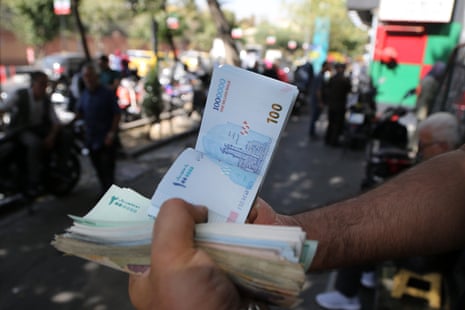
Iran’s currency has weakened to an all-time low against the dollar amid US efforts to cripple the country’s economy after almost six months of war.
US Treasury secretary Scott Bessent is due to announce new US sanctions against Iran at a press conference scheduled for 1pm EDT, which is 6pm London time.
The rial was trading at 1.992m per dollar on the unregulated market on Monday, according to Bloomberg News, which cited data from tracking website Bonbast – down 4.5% since Donald Trump announced a “crushing economic operation” against Tehran last week.
Another unofficial tracking site, TGJU, said the rial passed the 2m threshold on Sunday but closed lower.
The currency is under pressure from US efforts to isolate Iran by threatening the country’s few remaining trade partners while blockading its main ports in the Persian Gulf and choking off oil exports.
Last week, Iran’s central bank governor, Abdolnaser Hemmati, said its crude exports have “virtually stopped.” The United Arab Emirates, one of Tehran’s main trading partners, said last week that it had suspended all financial transactions with Iran until further notice.
Warning of an “economic D-Day,” Bessent wrote in the Financial Times today:
At dawn begins an economic D-Day — the single greatest financial offensive ever marshalled against an adversary.
Our objective is to sever every economic lifeline that sustains the tyrannical regime until Tehran stands alone.
Iran’s top financial newspaper, Donya-e Eqtesad, said the currency’s drop was driven by disruption to foreign-exchange transfers and declining exports alongside increased import demand and rising inflation expectations.
Key events

Graeme Wearden
US borrowing cost have dipped a little more following a report that Treasury secretary Scott Bessent could boost his bond-buying firepower.
CNBC are reporting that the Treasury could use its near $1tn General Account to help fund its recently announced plans to increase purchases of government bonds, according to two senior Treasury officials.
The TGA is effectively a rainy-day fund held at the Federal Reserve, funded by existing tax collections. Bessent has built up the TGA to around $950bn.
Last week, Bessent doubled the cap on the government’s long-term debt buyback program from $2bn to $4bn, and has hinted it could be expanded further.
The prospect of the TGA’s reserves being deployed to buy US debt has pushed down the yield, or interest rate, on 10-year bonds by 3 basis points to 4.7%, while 30-year Treasury yields are down 4bps to 5.235%
Gold rises to highest since mid-May

Phillip Inman
Sellers of gold are enjoying a rebound in price as the markets for government bonds, major currencies and global stocks show signs of creeping trepidation. It’s a trend that could signal a full-on panic, as the Guardian’s economics editor Heather Stewart wrote at the weekend.
Spot gold rose as high as $4,659 an ounce on Monday, the highest since mid-May – and heading back towards the peak it reached in the spring during the first weeks of the US attacks on Iran. Back then it jumped above $5,300 before dropping in fits and starts as Middle East tensions eased.
The return of sabre rattling this month by both sides in the war has spooked investors, who have sought refuge again in gold.
Rick Kanda, managing director at the Gold Bullion Company, said there are other factors at play, including the US government’s intervention in the market for US Treasury bonds.
US secretary of state Scott Bessent has pledged to buy the long term bonds that invstors have been reluctant to buy, mainly because they believe the US budget is out of control and a reckoning is coming down the track.
The bond buying lowered the value of the dollar, which provided another reason to buy an asset considered a bulwark when mainstream market value are falling.
As Kanda explained:
Gold is priced in US dollars, so a weaker dollar means it takes more dollars to buy the same ounce, pushing the price higher. It also makes gold cheaper for buyers outside the US, including in the UK, which adds to demand.
Chris Beauchamp, chief market analyst at the investment platform IG, said cryptocurrencies were another beneficiary of the Bessent’s determination to lower bond yields and with it the value of the dollar.
Bessent’s decision to go meddling in the US Treasury market has revived the spectre of dollar ‘debasement’. This is almost the dream scenario for cryptocurrencies.
Like gold, they are seen as a haven from financial markets that are dominated by political interventions – interventions designed to lower values.
This is playing into the asset class’ entire raison d’être, sparking a rally the likes of which hasn’t been seen for over two years.
Thames Water creditors accused of ‘shuffling deckchairs’ with plan for new board
Here’s our full story on Thames Water:
The group of creditors pursuing a rescue bid for Thames Water have been accused of shuffling the deckchairs on the Titanic after proposing an overhaul of the stricken utility’s board.
In a bid to stave off temporary nationalisation by Andy Burnham, the lenders said they would appoint Liz Barber, the former chief executive of Yorkshire Water, and Clive Selley, the former chief executive of network operator Openreach, as directors if they are allowed to take formal control of the company.
London & Valley Water (L&VW), a consortium of 100 institutional investors holding £17bn of the company’s £21bn debt, has also lined up Dame Bernadette Kelly, the former permanent secretary of the Department for Transport.
Mike McTighe, the corporate troubleshooter leading Thames’s overhaul, would become the new chair, replacing the incumbent Sir Adrian Montague, if Thames is able to get its £10bn rescue deal approved by the government. McTighe is the current chair of Openreach.
He said:
The challenge at Thames Water is huge. If this recapitalisation plan is accepted, we will apply full dedication as a new board, working alongside the executive team to transform the business and build a culture in which the customers and local communities who depend on Thames Water come first.
The proposed appointments are designed to reassure the government that any commercial deal would bring with it a leadership overhaul, as Burnham’s team examines the possibility of taking the company back into public ownership.
L&VW’s announcement was criticised by the public ownership campaign group We Own It. Cat Hobbs, the director at We Own It, said:
This is absolutely absurd. A cosy stitch-up that has nothing to do with the interests of the 16 million people who depend on Thames Water. This amounts to nothing more than a reshuffling of chairs on the deck of the Titanic.
Burnham has said there should be “greater public control” of Thames Water and previously told the Guardian this could mean nationalisation. This would probably come via placing the company into a special administration regime (SAR), a form of temporary nationalisation.
More recently the prime minister said he was “angry” after companies including Thames Water were given the green light to raise bills even higher earlier this month.
US and UK government bond yields dip in calm start to week
Bond yields have dipped on both sides of the Atlantic, as some calm returned to government bond markets. This comes after last week’s sell-off which saw yields hit the highest levels in decades and prompted the US Treasury to step in on Wednesday with the announcement that it would at least double debt purchases of longer-dated bonds.
At the start of this week, the yield, or interest rate, on the 10-year benchmark US Treasury fell nearly 3 basis points to 4.71%, while the equivalent UK gilt yield dipped about 1bp to 5.47%. Yields move in opposite direction to prices.
The 30-year US Treasury yield fell 2.4bps to 5.25% while the UK 30-year gilt yield slipped 1.2bps to 5.79%.
“We don’t think it’s time to panic about long-dated government bonds, even though the headwinds they face are gathering strength,” said Thomas Mathews, an analyst at Capital Economics.
Still not a bond crisis.
Last week was a mixed one for government bonds, with 10-year yields, for example, generally a little higher across developed markets. That’s perhaps surprising in a week in which the US Treasury made a deliberate attempt to support the market by upping buybacks at the long end. But most of the boost from that announcement has now unwound.
We argued earlier in the sell-off that it wasn’t yet a crisis, and that’s still true. While yields are high by recent standards, term premia seem not to be especially elevated when viewed over a longer horizon. Nor is the long end of the curve especially steep by past or global standards.
And, although the concurrent weakness of the US dollar and strength of gold has resurfaced concerns about dollar “debasement”, there’s little sign investors are worried about inflation eroding their purchasing power. Long-dated inflation swap rates, at least, have barely budged.
Meanwhile, our economics editor Heather Stewart wrote that Trump risks driving the US into a debt crisis.
Mathews went on to say:
That said, while we’re not in the throes of (or on the cusp of) a crisis, the US fiscal position is obviously poor. Partly because of that, our sense is that Treasury term premia are likely to rise further over time even if a sharp selloff is avoided. And there are potential catalysts for renewed trouble this week. One is the oil price and the ongoing Iran conflict, with the sides trading barbs in recent days. Another is the July PCE [personal consumption expenditures index] data, although we think those will show a further slight softening in price pressures.
But perhaps the biggest risk comes from the Fed’s upcoming Jackson Hole conference. Chair Kevin Warsh’s previously stated views about the bond market, namely that the Fed’s balance sheet could be smaller and that higher long-term yields might justify rate cuts, might be poorly received in the current market environment. Saying nothing (the topic of the symposium is “Financial Innovation: Implications for Payments and Policy”) could be even worse.
New Zealand to consider banning children under 16 from social media
New Zealand prime minister Christopher Luxon has said his party will introduce a bill in parliament that seeks to ban children under 16 from using social media, proposing fines of up to 10% of a platform’s global revenue for non-compliance.
The bill would require social media platforms to take reasonable steps to verify users’ ages, including by utilising existing account information, facial technology and digital identity documents.
“We simply cannot accept the harm being done to a generation of New Zealand children,” Luxon said in a statement on Monday.
“Social media is exposing them to harmful content, addictive technology and pressures they are not equipped to deal with and it’s affecting their family life, mental health, sleep and education.”
It was not immediately clear if the bill would garner sufficient support to pass through parliament, with one of Luxon’s coalition partners – the New Zealand First party – saying it would not support it.
“We have been concerned with the proposed legislation and the direction and slippery slope that legislation like this will inevitably take our country,” New Zealand First’s leader, Winston Peters, who is also the country’s foreign minister, said on X.
In December, Australia became the world’s first country to ban social media for children under 16, blocking them from platforms including TikTok, Alphabet’s YouTube and Meta’s Instagram and Facebook.
That legislation had been a “colossal failure”, Peters said, adding that keeping children off social media should be the responsibility of parents.
“I won’t pretend that it will be simple or that it will be perfect,” Luxon said at an event.
“We won’t get every single child off social media. Some will always find ways around it, but frankly, it’s just way too important not to at least try.“
Government vows to make business rate valuations for pubs and hotels fairer
Another report out today:
The government has promised that business rate valuations will be “made fairer” for pubs and hotels in England and Wales, as Andy Burnham faces growing calls to help the UK’s struggling hospitality sector.
An independent review for England and Wales will look at improving the system for hospitality venues, which were hit by higher business rate bills this year after the end of pandemic-era relief and when new revaluations took effect.
It comes after Burnham announced last month that he would cut business rates for pubs, social clubs and live music venues in England by 20% from April next year.
The government has faced calls to reduce the tax burden on hospitality businesses, which have also struggled to cope with rising energy and food bills in recent years.
UK productivity growing faster than official figures suggest, thinktank finds
Some good news for the UK (and new PM Andy Burnham and his team):
Productivity in the UK – a vital measure of economic health – is growing more strongly than official figures suggest, according to analysis from the Resolution Foundation.
The thinktank suggests the chancellor, John Healey, may have inherited an economy finally starting to emerge from the long shadow of the 2008 global financial crisis.
Productivity measures the economic output produced by each worker, and is a crucial determinant of growth.
The Resolution Foundation reconsiders the UK’s recent productivity record, using what it argues is a more accurate snapshot of the workforce than the widely criticised labour force survey.
The graduate jobs market is being squeezed from both sides, said Lukas Kaminskis, chief executive of Turing College. He explained:
Businesses are cautious about adding headcount while costs, including higher employer national insurance contributions and energy bills, affect profits.
At the same time, AI can increasingly perform some of the routine work that traditionally gave graduates their first step onto the career ladder. This does not mean there will be no jobs for young people, but it does mean a degree alone is becoming less of a guarantee of employment.
The uncomfortable truth is that too many graduates are leaving university with academic knowledge but without the practical digital skills employers can put to use from day one. Technology is changing jobs faster than many traditional degree courses can keep pace, leaving young people qualified on paper but underprepared for the workplace they are entering.
Employers increasingly need people who can use AI, interpret data and work confidently with digital tools, rather than compete with technology. These skills are becoming essential across almost every industry, not just within technology companies. Universities therefore need to place far greater emphasis on employability, practical projects and real workplace experience.
This is also why apprenticeships and other work-based routes deserve much more attention. They allow people to learn while working, develop skills an employer actually needs and finish with experience as well as a qualification.
University will remain the right choice for many, but in a job market changing this quickly, we need to stop presenting a traditional three-year degree as a guaranteed route into a successful career.
UK graduate job vacancies plunge to lowest in a decade
Over here, graduate job vacancies in the UK have sunk to their lowest level since they started being tracked a decade ago, according to a recruiting website.
Just 8,383 jobs for people leaving university were advertised in July, Adzuna reported on Monday, down 45% compared with the same point last year and the lowest since the company started gathering the data in 2016.
The number comes as 262,820 people prepare to go to university in September, a record high that underlines the tough conditions facing graduates entering the job market as entry-level roles are threatened by AI.
About 1 million young people in the UK were not in education, employment or training, otherwise known as Neets, in the first quarter of this year, according to the Office for National Statistics.
Adzuna said sectors including healthcare, nursing, hospitality and logistics posted fewer vacancies, adding that the figures suggested that a recovery reported during the spring had gone into reverse.
Andrew Hunter, a co-founder of Adzuna, said:
July’s numbers are a step backwards, not a blip. The annual vacancy decline got worse for the first time since January, and (the number of) jobseekers per vacancy are now higher than they were a year ago.
The graduate job market also keeps setting new lows, which tells us employers still haven’t found a reason to open up hiring at that level.
The figures point to a sharp worsening in the graduate market compared with a decade ago. In 2017, there were more than 55,000 graduate positions.
More recently, employers have also reined in their hiring in the face of increases in national insurance contributions and the minimum wage announced by the former chancellor Rachel Reeves in her last two budgets.
The extra labour cost for businesses also comes as some companies are prioritising investment in automation and artificial intelligence tools rather than hiring.
Fast-fashion giant Shein sets cut-price $27bn valuation for Hong Kong IPO
Shein’s announcement was somewhat underwhelming.
The online retailer, which built a fast-fashion empire on what seemed like impossibly low prices, has been forced to lower its own valuation after falling into the red earlier this year.
It is one of the longest-awaited initial public offerings (IPO) of recent years, after plans to list in New York were blocked by regulators over forced labour concerns. Shein then considered a £50bn float in London, but faced similar questions about its supply chain from campaigners, MPs and investors.
The company moved its headquarters to Singapore between 2021 and 2022, a move analysts have said was intended to avoid increasing global scrutiny of Chinese firms.
In early 2025, Shein refused to reassure British MPs that its products do not include cotton produced in the Xinjiang region of China, which has been linked to forced Uyghur labour.
Founded by the entrepreneur Chris Xu, the company runs most of its operations from China but sells all its goods outside the country. It reached a valuation of $100bn in an April 2022 fundraising round, making it the third most valuable startup in the world.
There isn’t much action in European stock markets ahead of the US sanctions on Iran.
This comes after a sell-off in many Asian stock exchanges, following the Chinese online market place Alibaba’s heavily-discounted share placing.
In London, the FTSE 100 index is trading more than 15 points higher at 10,83, up 0.1%. The German, French and Italian markets are flat (just about in positive territory) and the Spanish exchange rose 0.2%.
South Korea’s tech-dominated Kospi index tumbled after Samsung Electronics said it spent $80bn to buy back its own shares after weeks of turbulent trading, triggering an 8.4% drop in its share price. The chipmaker’s shares, and the wider Kospi, had surged over months on optimism around the artificial intelligence boom, but peaked in June and have since fallen amid worries over companies’ debt-fuelled AI spending.
Tokyo’s Nikkei closed down 0.7% and China’s CSI 300 fell 1.2% while Hong Kong’s Hang Seng lost 1.9%.
Fast-fashion giant Shein announced that its stock market debut will take place on the Hong Kong exchange on 1 September, at a valuation of close to $27bn (£19.8bn), significantly down from a near-$100bn private market peak four years ago.
Iran’s rial falls to record low
Iran’s currency has weakened to an all-time low against the dollar amid US efforts to cripple the country’s economy after almost six months of war.
US Treasury secretary Scott Bessent is due to announce new US sanctions against Iran at a press conference scheduled for 1pm EDT, which is 6pm London time.
The rial was trading at 1.992m per dollar on the unregulated market on Monday, according to Bloomberg News, which cited data from tracking website Bonbast – down 4.5% since Donald Trump announced a “crushing economic operation” against Tehran last week.
Another unofficial tracking site, TGJU, said the rial passed the 2m threshold on Sunday but closed lower.
The currency is under pressure from US efforts to isolate Iran by threatening the country’s few remaining trade partners while blockading its main ports in the Persian Gulf and choking off oil exports.
Last week, Iran’s central bank governor, Abdolnaser Hemmati, said its crude exports have “virtually stopped.” The United Arab Emirates, one of Tehran’s main trading partners, said last week that it had suspended all financial transactions with Iran until further notice.
Warning of an “economic D-Day,” Bessent wrote in the Financial Times today:
At dawn begins an economic D-Day — the single greatest financial offensive ever marshalled against an adversary.
Our objective is to sever every economic lifeline that sustains the tyrannical regime until Tehran stands alone.
Iran’s top financial newspaper, Donya-e Eqtesad, said the currency’s drop was driven by disruption to foreign-exchange transfers and declining exports alongside increased import demand and rising inflation expectations.
Thames Water creditors plan board shake-up if rescue deal goes ahead
A group of senior Thames Water creditors plan a boardroom shake-up if Britain’s biggest water company avoids nationalisation and their turnaround plan goes ahead.
The creditors said they plan to appoint four new board members if the government allows them to take formal ownership of the struggling company.
They said they have lined up Liz Barber, the former boss of Yorkshire Water, to join the board, along with Dame Bernadette Kelly, the former permanent secretary at the Department for Transport, and Clive Selley, the former chief executive of Openreach, which builds and maintains the UK telecommunications network. Mike McTighe, the former chair of Openreach who is already advising Thames Water, would also join the board.
This comes as new prime minister Andy Burnham faces growing pressure to renationalise Thames Water under the government’s special administration regime, which would mean large losses for creditors. Burnham has previously indicated the government should take control of Thames in order to write off debts worth billions of pounds.
The company, which is struggling under a £20bn debt mountain, serves 16 million customers across London and the south east but has been on the verge of financial collapse for almost three years. It could run out of cash as soon as October – but still paid its finance chief a £1m signing fee earlier this month – a decision the environment department labelled “unacceptable”.
The creditors, a group of distressed debt investors and financial institutions that go by the name of London & Valley Water, are negotiating with ministers and the regulator Owat and want to take over Thames Water formally this autumn, if regulators will give leniency on future fines. Under their plan, they would inject short-term bridge financing ahead of a broader debt restructuring.
The consortium said the new directors would “oversee Thames Water’s 10-year turnaround and deliver a comprehensive transformation of Thames Water in the interest of customers and the public”.
McTighe said:
The challenge at Thames Water is huge. If this recapitalisation plan is accepted, we will apply full dedication as a new board, working alongside the executive team to transform the business and build a culture in which the customers and local communities who depend on Thames Water come first.
We will focus relentlessly on protecting public health and safety, respecting and improving the local environment, ensuring what people pay for their water is fair and the most vulnerable are protected, investing to secure clean and reliable water supplies for current and future generations, and being accountable for what we do.
It will take time to fix Thames Water, but we are committed to rebuilding trust with the customers and public Thames Water serves.
“Having stirred up a hornets’ nest in the Middle East, there may have been some expectation that the US administration would seek to bolster relationships elsewhere, but instead the opposite has happened,” said Susannah Streeter, chief investment strategist at the Wealth Club. She explained:
Relations between the USA and Canada have taken another fractious turn after trade talks collapsed, leading to 50% tariffs on some Canadian goods being imposed over the weekend.
Canadian exporters will be bracing for a drop in sales if US importers try and find alternative supplies rather than paying the tariffs. But it’s likely many costs will be passed on through wholesalers and retailers and it will be American consumers who’ll end up paying more, with tariffs acting like a tax on imports.
While the impact on inflation through this latest hike should be relatively contained, the cumulative effect of tariffs across multiple trading partners is an increasing worry, especially combined with higher energy prices induced by conflict in the Middle East.
The collapse in US-Canada trade talks could add another upward nudge to Treasury yields, with the trade row deepening concerns about US economic policy, mounting debt and inflationary pressures.
The Trump administration has tried to sell tariffs as a way of bringing in huge amounts of government revenue and helping tackle America’s debt mountain. But the chaotic tariff regime has been beset with legal challenges and has led to mass refunds, so far from making a dent, the US deficit is heading towards $2.1tn this year and the national debt has just breached $40trn.
Also, tariffs and wars are not just costly, they risk acting as a drag on growth while simultaneously pushing up prices, creating a toxic combination. Slower growth can also mean weaker tax revenues, making it harder for the US to grow its way out of its debt mountain. These are all concerns that will be playing on central bankers’ minds, ahead of the key Jackson Hole summit later this week, and investors will be looking for insights from Fed chair Kevin Warsh about where interest rates could head given the highly tricky economic and monetary environment.
The lesson from Canada’s collapsed trade talks with the US: negotiation may be futile
Here is some analysis on the looming trade war between the US and Canada:
The calamitous collapse of trade negotiations between Canada and the United States is a warning to nations worldwide that pursuing any kind of dialogue with the current US administration is doomed at the outset, according to observers who say this recent episode indicates seeking a fair deal is futile.
Andrea Lawlor, an associate professor of political science at McMaster University in Ontario, said:
No matter the closeness of the historical relationship, the American administration has signalled that it now prioritises its interests above those of some sort of global economic coordination or harmony.
It feels like these talks ‘failed’. However, I’m not sure there was really a success to be had.
The two countries are now in a deepening trade war after weeks of urgent talks fell apart shortly before the 12am EST (5am BST) deadline on Saturday, when the US imposed 50% tariffs on $20bn (£14.6bn) worth of Canadian goods.
A defiant Mark Carney said on Saturday that he had rejected the deal because of last-minute US demands that would have undermined Canada’s sovereignty. The Canadian prime minister said: “They asked too much and they offered too little … you’re at war when you’re attacked, and we got attacked.” He promised to match US tariffs “dollar for dollar”.
Donald Trump had initially announced the tariffs on 20 July,saying Canada had unfairly discriminated against American businesses.
The core example provided by the White House is Canada’s bans on the sale of US alcohol in eight of its 10 provinces and all three territories. The removal of US spirits, wine and beer from shelves came into effect after Trump’s first round of tariffs, slapped on Canada in early 2025.
The breakdown of talks came as a shock. Trump had claimed on Tuesday that a three-day extension would be applied to the tariff deadline, as an agreement was all but signed. On Wednesday, he told reporters that a “very fair deal for both” sides had been ironed out.
But as details of the agreement began to leak to Canadian media, there was growing alarm that Carney and his negotiators were conceding too much in exchange for lower tariffs on steel, aluminium and cars.
Introduction: Canadian dollar dips after US-Canada talks collapse into trade war; oil prices fall ahead of US sanctions on Iran
Good morning, and welcome to our rolling coverage of the global economy, the financial markets, the eurozone and business.
The Canadian dollar fell after the country’s trade talks with the US collapsed on Friday and Washington imposed 50% tariffs on $20bn of Canadian goods, prompting Canada to retaliate.
The Canadian dollar dipped 0.2% to C$1.3798 per US dollar, retreating from a three-month high. It had been strengthening on hopes of a trade deal with the US. The two sides appeared close to an agreement on Friday to lower tariffs on steel, aluminium and cars, but the deal fell apart at the last minute.
Mark Carney, Canada’s prime minister, said they were “walking away from a bad deal”, and would now “match Washington’s new tariffs dollar for dollar”. So that means Canada will face 50% new tariffs on goods including wine, furniture, dairy products, cement, clothing, fishing rods and hockey sticks, covering around 5% of Canada’s exports to the US.
Carney said that their own retaliatory tariffs on US steel, electronics, dairy, appliances, agricultural equipment, pulp and paper and other products would take effect on 8 September. The new US tariffs come on top of existing levies on cars, aluminium, steel and lumber.
Over in the US, president Donald Trump posted that “Canada wants the benefits of being a State, without being one!!! They have also charged our great farmers, for many years, massive amounts of Tariffs. No more!!!”
Analysts at Deutsche Bank led by Jim Reid said:
There’s already been a market reaction this morning to the breakdown of the talks, with the Canadian dollar weakening against every other G10 currency, including a -0.26% fall against the US dollar. Otherwise, Bloomberg also reported overnight that Canada saw little chance of the talks resuming before the midterm elections.
Asian stock markets declined while oil prices also fell as markets waited for details of threatened US sanctions on Iran due later on Monday.
Japan’s Nikkei fell nearly 0.7%, Hong Kong’s Hang Seng dropped 1.9% and South Korea’s Kospi tumbled 3.2%.
China’s Alibaba shares slumped in Hong Kong after it launched a $10.2bn share sale at a sharp discount to fund development of chips, AI infrastructure and models.
Brent crude, the global oil benchmark, lost 1.6% to $92.81 a barrel.
Later this week, the annual Jackson Hole conference kicks off in Wyoming, and the new US Federal Reserve chair, Kevin Warsh, is due to speak on Friday.
His speech comes at a critical time, amid anxiety in government bond markets over inflation and Donald Trump’s tax and spending plans that helped push the national debt to over $40 trillion.
Analysts said bond traders would be looking for signals from Warsh over its commitment to fighting inflation.
The Trump-appointed head of the US central bank has previously signalled reluctance to “spoon-feed” financial markets over how it plans to set interest rates to keep fast-rising prices in check.
However, anxiety over Trump’s handling of the economy and investor fears that his war with Iran is stoking inflation have rocked global financial markets amid a dramatic sell-off in US government bonds.
The Agenda
#Irans #rial #falls #record #Scott #Bessent #warns #economic #Dday #business #live #Business