wellnessfitpro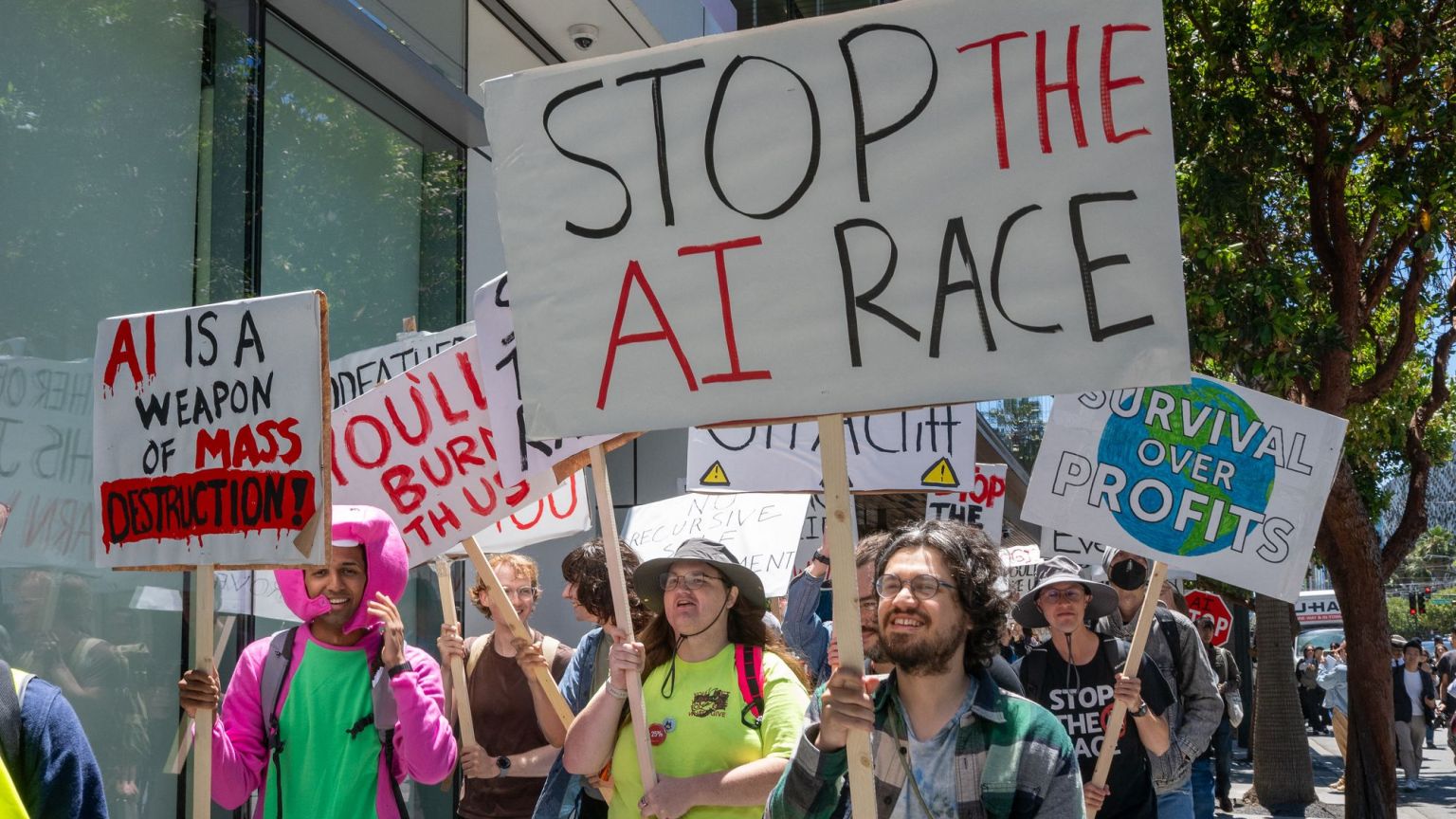
In the past few days, scaremongering about AI has reached fever pitch.
The latest bout of panic began with the resignation of Anthropic researcher Jacob Coxon, who stated that both his former employer and OpenAI, Anthropic’s main competitor, were driving forward at a breakneck speed to build technologies that ‘could kill us all by the end of the decade’.
Almost on cue, several AI operatives went on record to echo Coxon’s warning. ‘We really do earnestly believe AI could kill all humans!’, declared Evan Hubinger, a safety researcher at Anthropic. Hubinger was very precise about the peril posed by AI when he put the likelihood of human extinction over the next decade at over 10 per cent. Paul Christiano, who is on the board of the rival OpenAI Foundation, warned that, without improved oversight, humanity could lose control over an artificial ‘superintelligence’.
It appears that Coxon’s warning achieved its desired effect. AI’s threat to human existence became a dominant topic in the mainstream media’s news cycle. As more and more AI researchers publicly affirmed Coxon’s apocalyptic declaration, the media became increasingly fixated on the threat this technology supposedly represents to humanity’s future.
I have studied scaremongering and the culture of fear for almost three decades. It’s clear to me that the current AI doomsday narrative recycles several older panics simultaneously. Just as with the invention of the nuclear bomb, humanity feared an invention it could not control. When computers and the internet were created, we feared technological displacement. And there is the older philosophical fear that humanity’s own intelligence could be the source of its undoing. Each time, a rational assessment of the potential risks is shoved aside in favour of a narrative of an impending apocalypse.
Yet when it comes to AI, I have found the evolution of this carefully staged exercise in scaremongering different in some respects. For a start, this is clearly a top-down campaign, orchestrated by industry insiders. Indeed, as far back as 12 years ago, those in the know began to raise the alarm about AI. In 2014, Elon Musk told his followers on Twitter that AI is potentially ‘more dangerous than nukes’. Bill Gates informed millions of his followers on Reddit that ‘I agree with Elon Musk and some others on this and don’t understand why some people are not concerned’. Needless to say, these fears did not stop either of them from pursuing the development of AI.
By 2024, it became evident that sections of the tech industry were heavily invested in the funding of AI doomsayers. Politico reported that ‘Nonprofits backed by tech billionaires and warning of an AI cataclysm are deploying lobbyists in an effort to press Capitol Hill to pass AI safety bills’. It noted that two NGOs ‘funded by tech billionaires are now directly lobbying Washington to protect humanity against the alleged extinction risk posed by artificial intelligence’.
Lobbying efforts ran in parallel with the publication of a number of reports designed to promote a climate of alarmism about the supposed threat of AI. Again, industry insiders were actively involved in this campaign of fear. Mrinank Sharma, the former head of Anthropic’s safeguards research team, issued a public letter of resignation warning that ‘the world is in peril’. Sharma’s resignation was followed by that of Zoë Hitzig, a former researcher with OpenAI. She announced her resignation in a New York Times essay, citing ‘deep reservations’ about OpenAI’s strategy.
Dystopian commentaries soon followed. In February, Matt Shumer, founder of OthersideAI, published an essay titled ‘Something Big Is Happening’. Promoted as ‘a personal note for non-tech friends and family on what AI is starting to change’, it offered a catastrophic vision of the future.
The AI panic succeeded in establishing an elite network of strange bedfellows. In April, the New York Post reported on a panel hosted by American Democratic senator Bernie Sanders. The group, which featured leading Chinese AI officials tied to Beijing’s Ministry of Science and Technology, discussed the ‘existential threat’ of artificial intelligence and the need for international cooperation. This strange alliance is linked to a broader coalition of ‘progressive’ doom-mongers. As the Post noted, ‘socialists, Hollywood unions, January 6 organisers and Chinese government officials are now aligned in trying to slow down American AI development under the guise of saving humanity’.
No doubt many participants in this coalition are genuinely concerned about aspects of the development of AI technology. But the involvement of billionaire funders, industry insiders and hired-gun NGOs indicates that there is something else going on.
It’s surely not a coincidence that the doomsday scenario is being promoted by sections of Big Tech ahead of massive market valuations. OpenAI and Anthropic’s warnings about the dangers of AI are, in effect, coded boasts about how advanced their programmes are becoming. What’s more, if these firms can achieve the objective of having AI regulated by the state, this would help them keep new market entrants at bay. It would give them, in effect, more control over this industry. In the name of safety concerns, they could also gain power and influence, and dictate to the state how AI can be used.
So there is far more to the great panic over AI than meets the eye. We need to respond to the scaremongering with a healthy scepticism. This means being aware of the familiar narratives that AI catastrophism taps into. And it means being aware of the interests and motives of those propagating this fearful tale. Only then will we be able to see clearly – not just the risks of AI, but its potential, too.
#Dont #succumb #great #panic