wellnessfitpro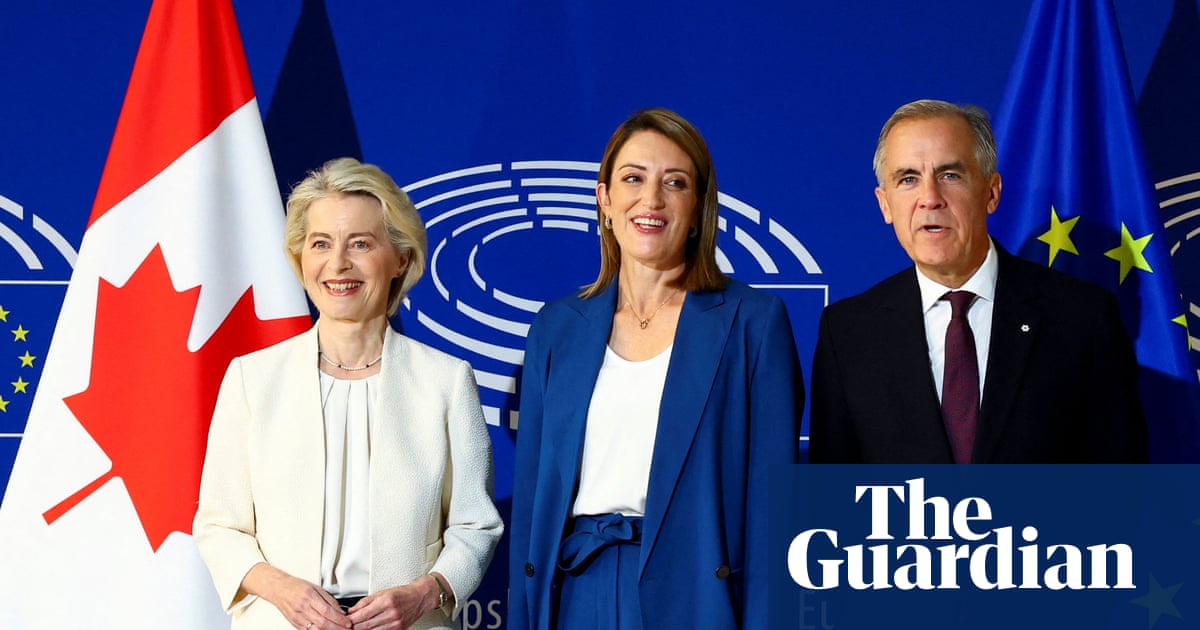
Canada has been invited to become the first “associate member” of the EU by the European Commission president, Ursula von der Leyen.
In an unprecedented offer on Wednesday, von der Leyen said the EU and Canada “see the world with the same eyes” through shared democratic values and common approaches to many big issues, from AI to climate breakdown, the Ukraine war and geopolitics.
Speaking in the presence of the Canadian prime minister, Mark Carney, at the European parliament in Strasbourg, she said: “We want to bring the relationship with Canada to the highest level possible … We must urgently reimagine our partnerships. So, I would like to work with you on opening the door for Canada to be the first associate member of the EU.”
Carney, who is due to address the parliament on Thursday, has called for a “unique alliance” with the EU as Canada seeks to reduce its heavy dependence on US trade.
Canada and the EU already have a trade deal and numerous bilateral agreements, but have been moving closer since Donald Trump returned to the White House and raised tariffs on both old allies, while repeatedly talking about Canada becoming the 51st US state and lambasting the EU.
Von der Leyen said the existing EU-Canada trade deal would be upgraded to an “alliance for the future” to create a “common prosperity and economic security space”.
She said the two sides would also create a tech alliance, integrate defence industrial bases and make the Arctic a “flagship joint project”. EU officials are especially interested in Canada’s energy and natural resources. Von der Leyen pitched joint work on energy, critical minerals, batteries, AI, quantum computing, cybersecurity and economic security.
The 27-member EU has never had an associate membership category, although it has close ties with Norway, Iceland and Switzerland, allowing deep economic integration with these countries, who follow many EU rules. It remains to be seen what associate membership means, including for Canada’s relationship with the EU single market.
When the UK was negotiating its relationship with the bloc after Brexit, EU officials repeatedly said there was no status that enabled a foreign country to be half in and half out of the single market. The EU also staunchly defended unpicking the four freedoms of its internal market – freedom of goods, services, people and capital. The EU and Canada are due to hold a summit in late October to further develop the ideas.
Carney is expected to get a rapturous reception when he gives his own address to the European parliament. His approach to dealing with Trump has attracted widespread praise among MEPs.
Last month, Carney announced he was breaking off trade talks with the US, saying Canada would not be subjugated and then introduced retaliatory tariffs on billions worth of US goods. By contrast, the EU last year accepted 15% tariffs on many European goods while dropping its own duties to avoid a trade war with Trump.
Javier Moreno Sánchez, a Spanish socialist MEP, who leads the European parliament’s Canada delegation, said “for sure” the EU had lessons to learn from Carney’s approach, because “Trump respects people who are strong”. He added: “Canadians are the most European people outside Europe and that is the key point for the development of our relationship.”
after newsletter promotion
Caney’s speech at Davos, where he said there was a rupture in the international order and “middle powers” needed to unite, has also been widely praised. European officials, however, reject the suggestion that the EU, a bloc of 450m people, is a “middle power”.
Sore points likely to be addressed include 10 EU member states, including France, Poland and Italy, having failed to ratify the EU-Canada trade deal, nearly 10 years after it was struck in 2016.
The offer of associate membership is certain to raise questions among other EU allies, including the UK, which has long sought a more flexible approach from Brussels.
Martin Leng at the Brussels Institute for Geopolitics thinktank said a world in flux was “pushing the EU towards far greater flexibility in its relations with third states”.
He said von der Leyen’s speech, with its focus on different sectoral areas of cooperation “points to the ambition and strategic breadth of the associate membership which the parties have in mind – but also suggests that, in reality, Canada’s ‘membership’ may consist of ‘plugging in’ to existing programmes and frameworks, such as the European Defence Agency, rather than joining the union in any traditional sense”.
#European #Union #invites #Canada #associate #member #European #Union