wellnessfitpro
Introduction: UK borrowing jumps to £18.3bn in August
Good morning, and welcome to our rolling coverage of business, the financial markets and the world economy.
Britain’s national debt is rising faster than expected after the government borrowed more than expected, again, to balance the books.
The latest public finances data, just released, shows that the UK borrowed £18.3bn in August, which is £2.9bn more than in August 2025, as spending rose faster than government income.
This is higher than the £15.6bn forecast by the City. But more importantly, it’s £3.5bn above the Office for Budget Responsibility (OBR)‘s forecast for August.
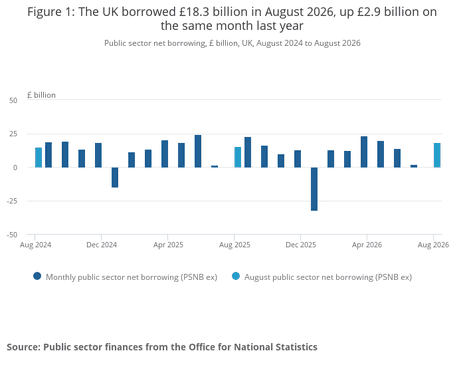
And it means that so far this financial year, the UK has borrowed £8.1bn more than the OBR’s forecast.
This all adds up to a headache for chancellor John Healey as he works on next month’s budget, as the recent bond market turmoil has eaten into his ‘headroom’ to keep within the fiscal rules.
Emeritus professor Joe Nellis, head of economic research at accountancy and advisory firm MHA, says this morning’s data is “another reminder of the fiscal straightjacket facing the Government” ahead of the budget.
Nellis adds:
But why is the deficit proving so hard to reduce? The weakness lies mainly on the expenditure side. Higher inflation is impacting spending on public-sector pay, state benefits and pensions. And last week’s announcement that inflation has hit 3.1% will not have helped.
On top of this, the cost of servicing the national debt remains exceptionally high. Public sector net debt is just below £3 trillion, representing around 94% of GDP, the highest since the early 1960s.
The agenda
-
7am BST: UK public finances for August
-
10am: UK Treasury Gilt 2032 Auction
-
11am BST: CBI industrial trends report
-
3pm BST: Eurozone consumer confidence report
Key events
The oil price has shrugged off a brief dip below the $100 a barrel mark yesterday.
This morning, Brent crude is up 1.1% at $101.50/barrel, as traders continue to assess the hopes of a diplomatic breakthrough in the Middle East.
Yesterday afternoon, Brent fell below $100 a barrel for the first time in a fortnight. That appeared to be due to relief that the US had not renewed its bombing campaign against Iran, as Tehran had warned on Sunday.
Hopes that US president Donald Trump could meet Iranian president Masoud Pezeshkian during the United Nations General Assembly in New York later this week also pushed oil lower.
But concerns over an escalation in the region remain. Earlier this morning, Saudi Arabia’s civil defence body issued an alert in its Najran region, amid ongoing hostilities between the kingdom and Yemen’s Iran-backed Houthis. That alert has now been lifted.

Julia Kollewe
In the travel sector, Germany’s Tui has reported falling summer and winter revenues for its tour operations and airlines, but flagged better trading in the last four weeks, as people book later in light of “geopolitical and economic uncertainty”.
The travel company said summer 2026 revenues were down 5%, but highlighted a 2% rise in the last four weeks. Summer trading was worst in the UK, down 7%, while revenues dipped 2% in Germany, but Tui managed to stick to its selling prices.
Greece and Spain, including the Balearics and Canaries, were the most popular summer destinations.
Winter bookings have fallen 7% overall, with a 9% decline in the UK and a 4% drop in Germany. The Canaries, mainland Spain, Egypt and Cape Verde are expected to form the core of Tui’s winter programme, similar to other years, along with the long-haul destinations Thailand, Mexico and the Dominican Republic.
The company narrowed its outlook for 2026 underlying operating profits, saying demand was strong for its holiday experiences portfolio in the fourth quarter. Tui now expects annual underlying earnings before interest and taxes to reach between €1.2bn and €1.3bn, rather than the previously forecast €1.1bn to €1.4bn.
Its cruises and resorts business was affected by the Jamaica hurricane.
RSM: Healey has probably lost about half the headroom he inherited
How much ‘headroom’ might John Healey still have to keep within the government’s fiscal rules?
That’s the question dogging Westminster and the City.
Back in March, ex-chancellor Rachel Reeves raised this buffer to £23.6bn, from £21.7bn at the November 2025 budget.
That meant the government had a larger cushion to hit its two fiscal rules – to have the day-to-day budget in surplus, and for ‘net financial debt’ to be shrinking relative to the size of the UK economy.
But increased spending commitments, and the rising cost of servicing the national debt, will erode this headroom
Thomas Pugh, chief economist at audit, tax and consulting firm RSM UK, reckons about half of the Reeves headroom remains:
“The chancellor has probably lost about half the headroom he inherited, leaving it between £10bn to £15bn. As long as the headroom is in double figures, he will probably be able to avoid topping it up, but the drop in headroom means any additional day-to-day spending, such as on defence or cost of living, will have to be paid for by higher taxes.
“What’s more, if the recent rise in energy prices is sustained through the next few months, household energy bills could rise by another 25% in January, which would take them above the level that the previous government capped them at. That would only further increase the pressure to act on cost of living by temporarily subsiding energy bills.
Gilt yield rise a little
UK government bond prices are dipping at the start of trading, as City traders digest today’s rise in borrowing.
This is pushing up the yield, or interest rate, on UK gilts slightly.
The yield on 10-year UK bonds is up 3 basis points to 5.232%, while 30-year bond yields are also 3bps higher at 5.729%.
Both yields are still below the multi-year highs set earlier this month in the bond turmoil, though.
But Chris Beauchamp, chief market analyst at IG, suggests the bond market is turning the screws on Westminster:
“The PM and chancellor will be feeling quite claustrophobic today as the walls close in around them. Borrowing costs keep climbing, while borrowing itself is outpacing the teeny rise in tax receipts.
Everyone can diagnose the problem, but it’s far from clear that a PM who swept to power promising good things for all is capable of holding a fractious Labour party together to carry out the tough work needed.”
Treasury minister: We must show fiscal discipline
Chief Secretary to the Treasury, Emma Reynolds, says the government is committed to meeting the fiscal rules with “a buffer against uncertainty”.
Responding to this morning’s public finances data, Reynolds says:
“Britain has huge potential to deliver good growth in every postcode, creating jobs, raising living standards and investing in the services people rely on. But we can only deliver that growth with fiscal discipline.
“At a time when debt interest costs billions of pounds that could otherwise be spent on improving lives, we must always know where the money is coming from to pay for public services.
“That is why we are committed to meeting our fiscal rules with a buffer against uncertainty, taking the tough decisions needed to keep the public finances on a sustainable path.”
Today’s public finances paint a “dismal picture” ahead of October’s budget, says Ruth Gregory, deputy chief UK economist at consultancy Capital Economics.
After borrowing jumped to £18.3bn in August, Gregory told clients:
This supports our view that a small or medium-sized tax and spending Budget is more likely than a big one and that many of the PM’s policy ambitions will be reined in or delayed to avoid big tax hikes and/or a backlash in the markets.
Gregory points out tha government tax receipts were £200m higher than forecast by the OBR. The problem, she explains, is that central government expenditure overshot the OBR’s forecast by £2.3bn, partly because higher RPI inflation pushed up debt interest payments (see earlier post).
And if the economy weakens, and the government announces more cost-of-living support, borrowing could rise further.
Gregory concludes:
We think borrowing will be about £125bn (3.9% of GDP) in 2026/27 (OBR forecast £115bn) and that the Chancellor will need to raise between £9-14bn in the Budget to restore his existing fiscal headroom.
Debt interest bill hits August record at £8.8bn
The cost of servicing the UK’s national debt has hit a record high for any August, as rising inflation drove up interest payments.
Today’s public finances show that central government debt interest bill was £8.8bn in August – the highest August figure since monthly records began in 1997.
This includes a £2.1bn bill on index-linked gilts – bonds where the repayments is linked to the RPI inflation rate.
August’s debt bill was lower than in each of the first three months of the current financial year, the ONS points out.
These debt payments are soaking up money which could otherwise be used to fund schools, hospitals, defence, or all the demands on the public purse.
Nabil Taleb, economist at PwC UK, explains:
Higher debt servicing costs absorb a greater share of government revenues, reducing fiscal room and leaving the public finances more exposed to future economic shocks.
“A better near-term borrowing outturn would help, but it would not remove the pressure created by higher government borrowing costs. Thirty-year gilt yields recently reached their highest level since 1998, which matters because it raises the cost of long-term financing at a time when fiscal room is already tight. While higher gilt yields do not feed through into debt interest costs immediately, they make it harder for improvements in the monthly borrowing figures to translate into lasting fiscal headroom. For the Budget, that leaves the government relying not just on better borrowing data, but on some easing in borrowing costs as well.”
Self-assessed (SA) Income Tax receipts over the last two months jumped notably, today’s public finances show.
SA income tax payments in July and August were £18.6bn in total, which is £1.9bn more than in the same period last year.
ONS: borrowing higher than the official forecast
ONS senior statistician Tom Davies said:
“Borrowing in the financial year so far was lower than over the same period last year. However, it was higher than the official forecast, largely because central government borrowed more than anticipated.
“On the month, borrowing was up by almost a fifth on last August, as spending increased more than government income partly reflecting the impacts of inflation.”
There is one piece of good news in the public finances – the UK has borrowed less so far since April than a year ago.
So far this financial year, the UK has borrowed £77.3bn, which is £2.2bn less than in the same period last year (but £8.1 billion above the OBR forecast).
And as a share of the economy, it’s actually the 10th-lowest April to August borrowing since comparable monthly records began in 1993.
Introduction: UK borrowing jumps to £18.3bn in August
Good morning, and welcome to our rolling coverage of business, the financial markets and the world economy.
Britain’s national debt is rising faster than expected after the government borrowed more than expected, again, to balance the books.
The latest public finances data, just released, shows that the UK borrowed £18.3bn in August, which is £2.9bn more than in August 2025, as spending rose faster than government income.
This is higher than the £15.6bn forecast by the City. But more importantly, it’s £3.5bn above the Office for Budget Responsibility (OBR)‘s forecast for August.
And it means that so far this financial year, the UK has borrowed £8.1bn more than the OBR’s forecast.
This all adds up to a headache for chancellor John Healey as he works on next month’s budget, as the recent bond market turmoil has eaten into his ‘headroom’ to keep within the fiscal rules.
Emeritus professor Joe Nellis, head of economic research at accountancy and advisory firm MHA, says this morning’s data is “another reminder of the fiscal straightjacket facing the Government” ahead of the budget.
Nellis adds:
But why is the deficit proving so hard to reduce? The weakness lies mainly on the expenditure side. Higher inflation is impacting spending on public-sector pay, state benefits and pensions. And last week’s announcement that inflation has hit 3.1% will not have helped.
On top of this, the cost of servicing the national debt remains exceptionally high. Public sector net debt is just below £3 trillion, representing around 94% of GDP, the highest since the early 1960s.
The agenda
-
7am BST: UK public finances for August
-
10am: UK Treasury Gilt 2032 Auction
-
11am BST: CBI industrial trends report
-
3pm BST: Eurozone consumer confidence report
#government #borrowing #jumps #forecast #18.3bn #August #dismal #picture #ahead #budget #business #live #Business