wellnessfitpro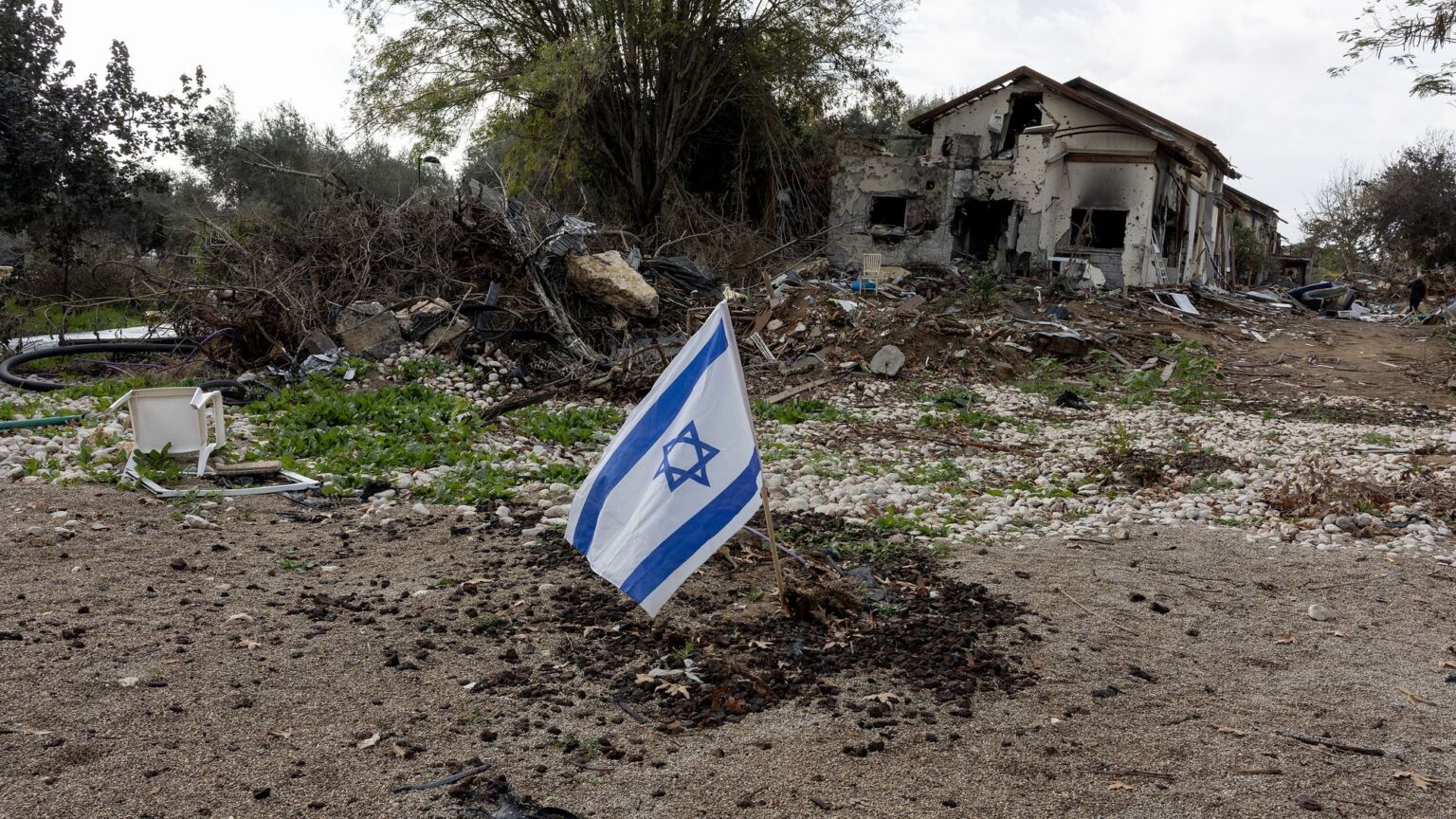
For Israelis, the world is divided into before and after 7 October 2023. Hamas’s massacre of more than 1,200 civilians and soldiers plunged Israelis into existential fear and grief. Israelis came face-to-face with the murderous bloodlust that animates many of our Palestinian and Arab neighbours. Across the Israeli political and social spectrum, the main lesson was that, given a territorial base and the necessary means, October 7 would be repeated again and again.
Yet three years later, while October 7 has produced a profound shift in Israeli society, there has been no real soul-searching or questioning of assumptions among the West’s professional ‘peace-processors’. In fact, Hamas’s atrocities only pushed Western governments to double down on pressuring Israel to surrender territory with major countries, including the UK, adopting sanctions against Israel and Israelis for the first time.
Proponents of the ‘two-state solution’ barely missed a beat. As early as October 2023, then US president Joe Biden said in a White House address: ‘As hard as it is, we cannot give up on peace. We cannot give up on a two-state solution.’ David Cameron, then UK foreign secretary, began discussing unilateral recognition of a Palestinian state in January 2024. Norway, Spain and Ireland, among the European states most hostile to Israel, recognised a Palestinian state on 22 May. France, Canada, and the UK followed suit in September 2025. What decades of bilateral negotiations couldn’t achieve was obtained through the greatest mass murder of Jews since the Holocaust. In November 2023, Khalil al-Hayya, one of Hamas’ top political leaders, told the New York Times that Hamas’s mass slaughter of civilians was intended to ‘change the equation’ and put ‘the Palestinian issue back on the table’. In that regard, Hamas succeeded beyond its wildest dreams.
The quasi-religious commitment to a ‘two-state solution’ rests on the flawed premise that the Israeli-Palestinian conflict is primarily a territorial one. Accordingly, the role of the peace-processors is to bring Israelis and Palestinians to a suitable territorial compromise, usually assumed to be based on the pre-1967 armistice lines between Israel, Jordan and Egypt. October 7 should have exposed just how naïve and false that assumption is.
Hamas, let’s not forget, is the Palestinian offshoot of the Muslim Brotherhood, the mother of all Islamist movements. As historians like Matthias Küntzel and Jeffrey Herf show, Hassan al-Banna, the movement’s founder in 1920s Egypt, openly borrowed from National Socialism and European fascist anti-Semitism. Hamas sees the conflict as an existential battle between Jews and Muslims, and even between Judaism and Islam. It believes Jews have no place in Palestine, which is an Islamic holy land. During the first intifada in the 1980s, Hamas’s founder Shaykh Ahmed Yasin coined the slogan now prominent among Islamists worldwide: ‘Khaybar, Khaybar ya Yahud’ (‘Khaybar, Khaybar, Oh Jews, the army of Muhammad will return’) – a reference to a seventh-century massacre of Jews carried out by Islam’s founder.
In traditional Islamic thought, Jews and Christians, as People of the Book, are permitted to practise their religion, conditional on accepting subjugated dhimmi status and paying the jizyah poll tax. Until then, violent jihad is the only way to bring about the liberation of Palestine. Indeed, in April 2025, the Hamas-affiliated International Union of Muslim Scholars – founded in Dublin, now based in Qatar, and previously headed by Hamas’ spiritual leader, Sheikh Yusuf Qardawi – issued a fatwa calling on all capable Muslims to wage jihad against Israel. Muhammed Deif, Hamas’s military leader, ordered the ‘Al-Aqsa Flood’ (Hamas’s term for October 7) in a letter to the Az-al-Din al-Qassam Brigade, reminding them of ‘Allah’s promise to disgrace the Jews and destroy them at the hands of Allah’s servants’. Freed Israeli hostages reported that they were repeatedly told that Hamas would destroy Israel and that the Jews would be expelled to the countries their grandparents had come from.
These attitudes aren’t confined to Hamas, though. In the immediate aftermath of October 7, the Palestinian Authority’s Ministry of Endowments and Religious Affairs sent instructions to all mosques in Judea and Samaria to praise the attack in Friday sermons. Jibril Rajoub, the secretary-general of the supposedly moderate Fatah Central Committee, justified the attacks in November 2023 and called for Fatah and Hamas to cooperate against Israel. Schools run by the Palestinian Authority regularly celebrate the massacre.
The rot goes deeper, however, than the reactions to October 7. Palestinian society as a whole rejects any Jewish ties or claims to the land. As Mahmoud Abbas has repeatedly stated, today’s Jews are simply the descendants of the Khazars, a Central Asian tribe whose leaders converted to Judaism in the seventh century. Zionism was a European plot to get rid of their money-laundering Jews. Palestinian denial of Jewish history stood at the root of then Palestinian Authority chairman Yasser Arafat’s infamous rejection of Ehud Barak’s peace offers in 2000 and 2001 at Camp David and Taba. According to Dennis Ross, the senior American diplomat involved in the Israeli-Palestinian negotiations, Arafat told President Bill Clinton more than once at the 2000 Camp David summit that the Jewish Temple had never existed. Clinton replied that even Christians recognise the Temple’s existence. Arafat still held his position and insisted that the Jewish Temple had actually stood in Yemen.
In a 2002 interview with Israeli prime minister Ehud Barak, historian Benny Morris explained the deeper meaning of this denial:
‘Arafat, says Barak, believes that Israel “has no right to exist, and he seeks its demise”. Barak buttresses this by arguing that Arafat “does not recognise the existence of a Jewish people or nation, only a Jewish religion, because it is mentioned in the Koran and because he remembers seeing, as a kid, Jews praying at the Wailing Wall”. This, Barak believes, underlies Arafat’s insistence at Camp David (and since) that the Palestinians have sole sovereignty over the Temple Mount compound… in the south-eastern corner of Jerusalem’s Old City. Arafat denies that any Jewish temple has ever stood there – and this is a microcosm of his denial of the Jews’ historical connection and claim to the Land of Israel / Palestine. Hence, in December 2000, Arafat refused to accept even the vague formulation proposed by Clinton positing Israeli sovereignty over the earth beneath the Temple Mount’s surface area.’
History rarely allows proposed social experiments to be tested with empirical results. And yet, Palestinian statehood was tried in Gaza. In 2005, Israeli prime minister Ariel Sharon implemented his ‘Disengagement Plan’, dismantling 21 Israeli settlements in Gaza and evacuating between 8,000 and 9,000 Israeli civilians from the territory. In a Gaza Strip free of any Israeli presence, the Palestinians could have committed to building the infrastructure of statehood. Instead, in the 2006 Palestinian elections held under heavy American pressure, Hamas won the overwhelming majority of total seats in Gaza, Judea and Samaria. Hamas eventually took control of Gaza in a violent coup in 2007, turning it into a terrorist statelet dedicated to ‘resistance’ against Israel.
In 2007, Hamas relied on homemade, short-range rockets and mortars, which it launched at Israeli border towns like Sderot. Soon after, the terrorist group procured Iranian-made Grad missiles, extending its reach to major cities such as Ashkelon and Be’er Sheva. In 2012, Hamas fired rockets for the first time on Tel Aviv during a brief IDF campaign in Gaza. In 2014, Hamas launched nearly 5,000 rockets at Israeli territory, including Tel Aviv, even halting traffic at Israel’s Ben Gurion Airport. By 2021, Hamas fired toward Jerusalem, launching over 4,300 rockets in 11 days. On October 7, Hamas’s opening salvo was 2,200 rockets in 20 minutes.
Gaza is a narrow strip of land along the Mediterranean coast, yet Hamas has turned it into a major strategic threat to Israel. Judea and Samaria are fifteen times larger than Gaza and occupy the highlands overlooking Israel’s major population centers. A Palestinian state in Judea and Samaria would almost certainly become a base for missile attacks, raids and invasions of Little Israel. The Israeli security establishment currently believes that an attack on Israel by the Palestinian Authority security forces is not an unlikely scenario. In October 2025, the IDF uncovered drones and rockets ready for use near Ramallah. In March 2026, the Israeli border patrol found tunnels used to smuggle illegal Palestinian migrants from Judea and Samaria to Jerusalem. Israeli communities within the Green Line have already been shot at by Palestinian terrorists.
The idea of Palestinian statehood has been ruined by Palestinian terror and rejectionism. I recently spoke with a high-ranking European diplomat to Israel who proudly described his country’s ‘decades-long’ involvement in the peace process. His pride raised eyebrows since a decades-long process without results is generally considered a failure. When pressed on whether recent events have led his government to question its long-held beliefs, he answered defensively that his state must lead Israelis and Palestinians to a two-state solution.
Jews and Arabs will continue to live together in this small and cramped land. However, a Palestinian state is a recipe for continued war and conflict. Any diplomatic initiative must focus on de-radicalising Palestinian society, while improving local self-governance and living standards. Israelis from the left and right now overwhelmingly see Palestinian statehood as an existential threat to their safety and security. International sanctions will not persuade Israelis to gamble on their lives.
October 7 certainly ‘changed the equation’, as Hamas’s al-Hayya put it. It has driven yet another nail into the coffin of Palestinian statehood.
#October #changed #Israel