wellnessfitpro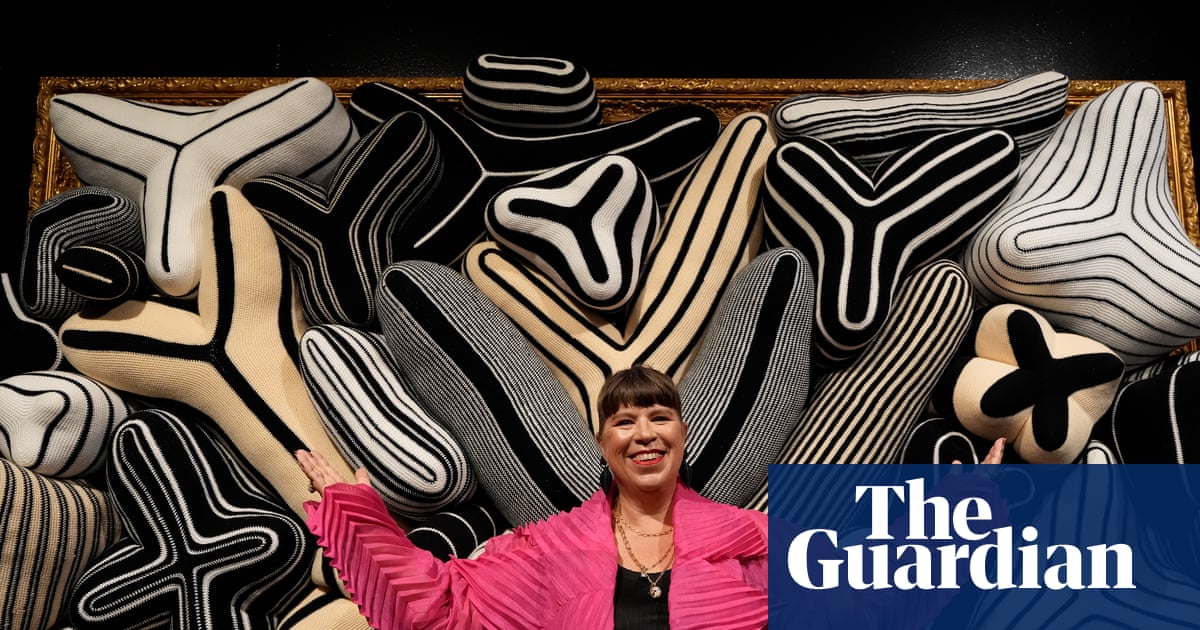
To interview the Portuguese artist Joana Vasconcelos is to jump on to a moving train. She is telling me why she uses needlework to make huge things: 15-metre doilies, say, or a tree 13.5 metres tall rustling with 150,000 hand-sewn leaves. “One day, I said to myself,” she says, “why not bring domestic detail into monumental sculpture? What do we know of works like this? OK, there’s Louise Bourgeois. But it wasn’t enormous. She worked in detail but on small things. There’s the beauty of Niki de Saint Phalle. But it’s always papier mache – a technique that’s very simple, very practical, but not chic.”
It takes a certain something to compare yourself to these two French giantesses of art. It takes something else to castigate Bourgeois and de Saint Phalle for not being big, bold and beautiful enough. But if there’s one female contemporary artist who can do it without coming across as delusional, it’s Vasconcelos. Born in Paris in 1971 into an artistic Portuguese family, Vasconcelos has established herself as one of her country’s leading contemporary artists – and one of the world’s most ambitious.
In dimension and scale, her work recalls male monumentalists like Jeff Koons, Christo or Takashi Murakami. Representing Portugal at the 2005 Venice Biennale, she showed, among other works, The Bride, a six-metre-tall chandelier made of 14,000 tampons. On Valentine’s Day 2019, the city of Paris installed her Coeur de Paris at the Porte de Clignancourt: a giant revolving heart on a pole nine metres tall, tiled red and blinking with thousands of LEDs. Elsewhere, she’s made a 12-metre high ceramic wedding cake with a built-in water feature (currently on view at Waddesdon Manor in Aylesbury), an eight-metre tall engagement ring of 110 golden car rims and 1,450 crystal whisky glasses (recently installed in Atlético FC’s home stadium), and three-metre tall stilettos, of stainless steel pots, called Marilyn.
“I work on the macro with the micro,” she says. Her greatest strength, says João Pinharanda, the director of Lisbon’s Museum of Art, Architecture and Technology (MAAT), is the way her work speaks “very simply” but also “very loudly”.
I have come to MAAT because Vasconcelos is installing Venus, a two-person exhibition that puts her creations in dialogue with Italian fashion legend Valentino, as part of the museum’s 10th anniversary celebrations. Each of her works on show is absolutely OTT: riotous in colour, quite preposterously decorative, the size not of a person but a room. Older pieces include Marilyn, Garden of Eden (an immersive Chartres-inspired maze of plastic flowers) and Independent Heart #3 (another giant version of a traditional Heart of Viana, made of red plastic cutlery). Venus Valkyrie, one of the newer works, stems from her long-running series of giddily abstract hanging installations named after the Norse warrior goddesses that, she insists, “fly over the battlefield together”. “Wagner got it wrong,” she says, “making them so militaristic and macho. I decided I’d make them the way they’re supposed to be made: grandiose, monumental, but also soft and refined and beautiful.”
One of the things that irks her in the work of her female predecessors and contemporaries is their focus on pain. She recalls going to see the Tracey Emin show at Tate Modern earlier this year. “I thought, ‘Damn, you’re in pain, all the time!’ Speaking with a collector friend afterwards I said, ‘It’s good, but enough of this suffering!’
“I’ve had enough. For women to be able to express themselves, does it have to be through suffering? We’re not depressed all the time! All these generations before us rightly fought for women’s freedoms, but always through criticism. It’s important to show it can be done in another way, through joie de vivre,” she says dressed head to toe in Issey Miyake in grey-blue with a yellow squiggle, an orange Miu Miu on her shoulder, silvery tabi trainers on her feet, double earrings, chunky beads, big rings, bigger smile.
“One day, in time, I too will fall into art history, I too will be a reference as all these artists are, but at least people will look at this era with a certain joy.”
The fact that Vasconcelos so frequently expresses her joy through partnerships with big corporations and luxe fashion houses (Dior, Marina Rinaldi) has, for many, uncomfortably blurred lines. In 2012, as the first woman to be invited to do a solo show at the Palace of Versailles, Vasconcelos covered a Bell 47 helicopter in gold leaf, Swarowski crystals and blush, plush ostrich feathers, decking out the interior with gilding, wood carving and embroidered upholstery. When art critic Bárbara Borges de Campos saw it in 2019, she decried its materials list as “indefensible,” and Vasconcelos herself, as “the symbol of a disengaged generation”.
Such criticism risks overlooking how much of Vasconcelos’s work is grounded in the value of women’s labour. She made the Valkyrie Venus with her own team, by hand. Journalists visiting her 3,400-sq metre dockside studio often describe it as the biggest they can think of, but it is also one of the most populous, staffed by 60 people. Some seamstresses have been with her since the early 1990s. Their section has floor-to-ceiling storage for every kind of wool, thread, button, bead, marker, fabric and cotton, and a big open-floor section reaching up two storeys so that the largest hanging pieces can be worked on from the top.
“When Valentino came to visit my studio, he really appreciated what I’m doing because he understood I’m as crazy as he is – because he could see I work at a level of detail that resonates with the fashion world,” she says. The work itself shows where their paths diverge. The Valkyrie Venus frames multiple catwalk dresses, their size-zero dimensions as inescapably highlighted as if Vasconcelos had circled them in fluorescent strip lighting. “These are small dresses, made in small spaces for small bodies. It’s quite practical. If this were for someone like me, you see,” she laughs, “it would take a lot more time … ”
Vasconcelos’s work knowingly bulges over the line between refined and cheap. She makes fake flowers glow, dresses ceramic animals in crocheted skins, turns car lights into jewels, and some works feel more edgy than others. In MAAT’s permanent collection, her 2005 piece, Passerelle, features mass-produced ceramic dogs (of the kind you see in suburban gardens) hanging by their leashes from a conveyor belt. Each time a visitor sets it in motion, the dogs clank against each other and slowly break apart, the shards accumulating in a pile on the floor.
Early in her career, Vasconcelos decided that to liberate women from the domestic, the beauty and skill of that space needed to be taken out of drawers and shown to be as strong as the industrial. At one point during our interview, three older ladies walk up, with a kind of blushing in their voices, and Vasconcelos, who has been talking to me in French, instantly switches to Italian. “Ciao! Come va? Bene?” she asks. They nod, “Bellissimo! Spettacolare! Complimenti, complimenti.” This isn’t just fawning. If anyone recognises where Vasconcelos got specific motifs and techniques from in this particular Valkyrie, it’s them: they are some of Valentino’s so-called petites mains, the seamstresses and master needleworkers who labour in haute-couture ateliers crafting by hand the wearables designers dream up.
“They travelled here with the dresses,” she says of the women after they’ve left. “You see, from them to me, there is a change. Women before were like that – imprisoned behind men, doing extraordinary things without being highlighted. I say, enough of being held back. We’re going to do like Richard Serra, bam! Huge! Monumental!”
#suffering #Joana #Vasconcelos #fed #womens #art #defined #pain #Art #design