wellnessfitpro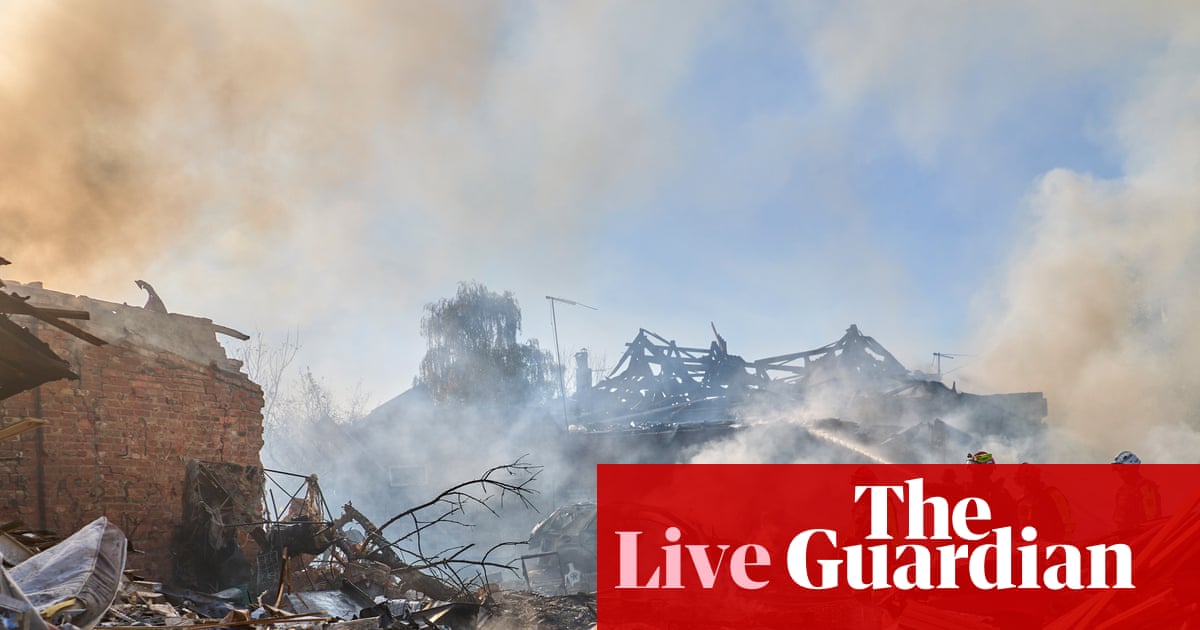
Russia struck Kharkiv power plant ‘immediately after’ Trump’s ‘energy ceasefire’ declaration
Addressing the conference virtually, Ukrainian president Volodymyr Zelenskyy commented on Trump’s “sudden but very important” energy ceasefire declaration over the weekend.
He said it is clear that Putin “does not read Truth social”, the site that the US president posted his ceasefire declaration on.
As we have been reporting, Russia’s strikes continued despite the announcement. “Immediately after the post Russia launched a targeted strike on a power plant in Kharkiv, causing further damage to our energy system,” Zelenskyy said, noting that Ukraine is facing a wave of escalatory attacks from Russia ahead of the winter.
Key events
We learnt about Trump’s energy ceasefire declaration through the media, Zelenskyy says
Zelenskyy said Trump’s energy ceasefire announcement caught him by surprise, first hearing about it through the media.
No, we did not know about that. We’ve learned that from the media as well that the president of the United States has secured an energy ceasefire.
I thought perhaps their team reached out to the Russians. I think they are in constant contact in a certain format.
During a Q&A with journalists, Zelenskyy said he’s ready to find ways to alter the constitution to be able to hold elections “very quickly” if a “full” energy ceasefire is implemented. He said this may require “difficult (legislative) solutions”.
“As of now, it is very difficult because of the security level in our cities and villages and communities. It is also impossible now because of our military. More than a million people who must vote – but how will they vote while being on the frontline?”
Since Russia’s full-scale invasion of Ukraine in February 2022, the country has been under martial law, meaning elections are suspended.
But Donald Trump, under pressure ahead of the November elections, said on Saturday it was time for Ukraine to get a new president, suggesting Zelenskyy has not done enough to end the war and blaming him for high diesel prices in the US, even though they have largely been affected by his war on Iran.

Jennifer Rankin
The Baltic states have reacted sceptically to Donald Trump’s diesel deal with Vladimir Putin and the US president’s so-called energy ceasefire.
Lithuania’s foreign minister, Keʂtutis Budrys, said Trump’s diesel deal with Vladimir Putin was not helpful. Budrys said:
This deal doesn’t help, neither the crisis of the oil products, nor the unity within the transatlantic community when it concerns Russia. And it is not the European way. Our way is to increase pressure because we already see how it works.
His Estonian counterpart, Margus Tsakhna, gave a similar assessment: “I don’t think that in real life this diesel deal is actually going to change anything on the oil price or diesel price in the market.” He drew a link between US domestic politics and the upcoming midterms.
Estonia’s foreign minister was also sceptical about Trump’s self-proclaimed energy ceasefire. Tsakhna said:
[The] energy ceasefire is not working as President Zelenskyy has said as well. And Russia is really putting more attacks against Ukraine. So what we need to do in Europe, we need to focus on what we can do.
He cited EU sanctions against 1,600 Russian individuals and entities that are due to be signed off later today by the bloc’s 27 foreign ministers, the largest ever-listing of its kind.
Energy ceasefire could be ‘major step’ towards ending the war if US makes Russia honour it, Zelenskyy says
Zelenskyy says Ukraine is waiting for the specific details of the “conversation” between the US and Russia after the latest peace talks.
On Friday, negotiators from the US, Ukraine and European countries also held talks in Miami aimed at reaching agreement on a unified peace proposal in the coming weeks that could be presented to Russia.
Zelenskyy said in his address that the energy ceasefire could be a “major step” toward ending the war if Trump makes sure Putin honours it.
The Ukrainian leader says Kyiv needs the US to apply real pressure on the Kremlin, not sanction relief or “concessions”.
We are ready to respect an energy ceasefire if Russia does, Zelenskyy says
Zelenskyy said Russia is trying to tactically use the period of cold weather against Ukraine, targeting the country’s power plants and power grids.
“This winter if Russia does not agree to an energy ceasefire, we will respond,” Zelenskyy said, adding that he supports Trump’s energy ceasefire proposal, but vows that if Russia doesn’t agree to it, then Ukraine “will respond”.
“If Russia wants us to stop our long-range strikes against its oil refineries and oil exports, then Russia must stop its strikes against our energy system and critical infrastructure, and stop killing our people. This is only fair,” Zelenskyy said.
“We are ready to respect an energy ceasefire if Russia is ready to do the same. We agree, if they agree. And we have already shown that we mean it. Last night, Russian oil refineries were not burning but at midnight a Russian jet powered Shahed strike against a production facility in Ukraine.”
Russia struck Kharkiv power plant ‘immediately after’ Trump’s ‘energy ceasefire’ declaration
Addressing the conference virtually, Ukrainian president Volodymyr Zelenskyy commented on Trump’s “sudden but very important” energy ceasefire declaration over the weekend.
He said it is clear that Putin “does not read Truth social”, the site that the US president posted his ceasefire declaration on.
As we have been reporting, Russia’s strikes continued despite the announcement. “Immediately after the post Russia launched a targeted strike on a power plant in Kharkiv, causing further damage to our energy system,” Zelenskyy said, noting that Ukraine is facing a wave of escalatory attacks from Russia ahead of the winter.
Moscow wants to ‘ruin existing European security architecture’ to revive Russian domination, Polish PM warns
Speaking at the security conference in Warsaw, Polish prime minister Donald Tusk warned that Russia wants to “dominate” Ukraine and poses a grave threat to Nato.
Russia wants to ruin the existing security architecture in Europe to make sure that Russian domination comes back to where it was before 1989. We have no doubt about it.
Tusk says his country, Poland, a Nato and EU member, has heavily invested in defence to be prepared to counter future security challenges.
Tusk said despite the hybrid threats from Russia he is “optimistic” when he thinks of the high level of military readiness for “different scenarios”.
“This is the moment when the entire west, Europe, the United States must show Russia’s Putin that we are ready for a deterrence policy with even harder measures – and I mean mainly sanctions,” he told the conference.
Tusk told parliament last month that intelligence assessments suggested Russia might launch an attack with drones or missiles on Nato territory in the coming months, as part of efforts to prove that “article 5 is more theoretical than practical”.
EU will welcome Ukraine energy truce ‘when it holds’, bloc’s foreign policy chief says
Jennifer Rankin
The EU foreign policy chief Kaja Kallas said the EU would welcome a truce on striking energy infrastructure between Ukraine and Russia “when it holds”, after US President Donald Trump announced a ceasefire, which Volodymyr Zelenskyy said was “news to me”.
Arriving at a meeting of EU foreign ministers on Monday, Kallas said:
We welcome the energy ceasefire when it holds. We haven’t yet seen that also Russia will stick to it.
Kallas said she wanted to see “people” included in any ceasefire. But an energy truce also had to cover more than just oil refineries in the two countries “where Ukraine has one and Russia has plenty, so it’s definitely in the benefit of the Russians.”
She did not respond directly to a question about Trump’s diesel deal with Vladimir Putin, saying: “That is why we are, of course, continuing our path. We are now adopting 1,600 listings because we only see that pressure on Russia would work.”
The EU will finalise later today sanctions against 1,600 Russian individuals and entities, targeting the military-industrial complex and officials involved in “sham elections” in Ukraine’s occupied territories.
Kallas said EU sanctions “would work so much better if our partners from the UK and from the US would be aligned with us”. She went on to say that the UK was aligned, “but if the US would be aligned, if they would enact the Graham bill regarding Russia, we could really put the pressure so that Russia will finish this war”.
Trump signed the Lindsey O Graham Sanctioning Russia and Iran Act into law earlier this month, which is aimed at depleting Russia’s ability to continue funding the war by targeting its natural gas and oil revenues, as well as countries that continue to buy Russian energy.
Donald Tusk, who is one of the staunchest supporters of Kyiv, said for the entire “western world” security is “no longer an academic problem” or a subject of journalistic intrigue, it is a “very concrete result of Russian aggression on Ukraine”.
Tusk said anybody who suggests that Ukraine is responsible for the war “gives a valuable gift to the aggressor”.
The prime minister’s comments come after Donald Trump blamed Volodymyr Zelenskkyy for stalled peace efforts over the weekend, and said he thought it was time for Ukraine to get a new president.
Poland’s prime minister, Donald Tusk, has just begun addressing the security conference in Warsaw. I will bring you any key lines. You can watch it here live.
Who might win the Nobel prize for economics today?

Graeme Wearden
The biggest prize in economics, the Sveriges Riksbank Prize in Economic Sciences in Memory of Alfred Nobel, will be announced at the Royal Swedish Academy of Sciences in Stockholm from 10.45am UK time.
Leading the betting on Polymarket, at 30% this morning, is David Autor, professor of economics at the Massachusetts Institute of Technology. Autor is a labour economist, who has examined how technology changes the world of work.
Another potential winner is Ariél Pakes, the Thomas Professor of Economics at Harvard University, currently at a 19% chance on Polymarket.
Pakes’s work has focused on developing methods to empirically analyse market responses to environmental and policy changes, such as mergers and deregulation.
Third, at 12%, is Susan Athey, the Economics of Technology Professor at Stanford Graduate School of Business. Athey, the former consulting chief economist for Microsoft, was the first woman to win the John Bates Clark Medal (awarded to the top economist under the age of 40).
There’s also some interest in American macroeconomist and monetary theorist Michael Woodford (currently at 10%) – he’s one of the architects of modern forward guidance, the idea that central banks can control the economy through influencing public expectations about inflation, rather than just through interest rates.
Power outages reported in Ukraine as energy infrastructure comes under attack
There have been multiple reports of overnight Russian attacks on Ukraine, affecting energy infrastructure and hitting civilian areas.
Oleksandr Hanzha, head of the Dnipropetrovsk regional military administration, said this morning that Russia attacked three districts of the region “more than 10 times” with artillery and drones. The strikes caused fires in the Petrykivka and Mykolaiv areas of the Dniprovskyi district, Hanzha added in his Telegram post, which noted there were no injuries from the attacks.
Residents in several streets in Izyum, south-east of Kharkiv in eastern Ukraine, were reportedly left without power after a Russian attack damaged power grids.
Meanwhile, the governor of Ukraine’s Zhytomyr region, Vitaliy Bunechko, said Russian forces have been “repeatedly shelling” the north of the region “since the evening”.
“Railway and energy infrastructure facilities in the Korosten district were under attack,” he added in a Telegram post this morning, noting that the fires were quickly extinguished. Bunechko said there was no information about the victims or their injuries yet.
At least 12 people were injured in several Russian attacks on Ukraine’s Kharkiv on Monday morning, mayor Ihor Terekhov said. Here are some of the latest images being sent to us over the newswires from Ukraine’s second largest city:
We are expecting Volodymyr Zelenskyy to speak at the annual security conference in Warsaw alongside Polish prime minister Donald Tusk from 8.30am to 9.30am UK time this morning. Stay with us as we will bring you the key lines from what the two leaders say.

Luke Harding
The fast-moving row between Washington and Kyiv began on Friday when Trump announced he was lifting sanctions on Russian diesel exports. He said the move would reduce global and domestic fuel prices before next month’s US midterm elections.
A furious Zelenskyy called the decision “weak” and said it would generate “billions” in extra revenue for Putin, enabling him to wage war “even more intensely”. An equally irate Trump said Zelenskyy should “damn well stop” hitting Russian refineries. Ukraine needed a “new leader”, he said on Saturday.
Responding to Trump, Zelenskyy said it was up to Ukrainians to choose “one or another leader”. He told ABC News he was willing to accept Trump’s demands and to organise elections, but only if Putin agreed to a “total” 60-day ceasefire.
The New York Times has reported that US officials have offered the Kremlin lucrative economic incentives in exchange for a ceasefire. They reportedly include releasing billions in Russian sovereign assets that are frozen. The Trump administration also revisited a plan to sell parts of Russia’s energy company, Lukoil. The multibillion deal would benefit Middle Eastern investors, the paper reported, some with “business ties” to US negotiators. You can read the full story here:
Ukraine says Russia violated Trump’s ‘energy ceasefire’
We are restarting our live coverage of the latest developments in Europe after Donald Trump’s announcement of what he called an energy ceasefire in the Russia-Ukraine war.
The Ukrainian president, Volodymyr Zelenskyy, said on Sunday evening that Russian strikes hit Ukrainian energy facilities despite the US president having claimed both sides had agreed to stop hitting each other’s energy infrastructure.
In a post on X, Zelenskyy said a drone had hit a Kyiv power plant on Sunday, leading to power outages in the Ukrainian capital. Shortly after, he said there had been a strike on a power plant in the north-eastern city of Kharkiv, adding: “Ukrainian skies have been infested with Russian ‘shaheds’ all day”, referring to a type of Iranian-made drone commonly used in the conflict.
Meanwhile, Russian attacks killed six people in two Ukrainian cities on Sunday, including a strike on a grocery store in Kharkiv, where three people died and 20 were injured, Ukrainian officials said. Two children were among the injured, the regional governor said. In western Ukraine, a Russian strike killed three people, officials said.
On Sunday morning Trump had announced that “effective immediately, there is an ENERGY CEASEFIRE in the War between Russia and Ukraine”. “Both parties have agreed. Do not break it!” he wrote on his Truth Social platform, without further details.
Zelenskyy expressed surprise at the announcement, saying the deal was “news to me”, while Russia has still not confirmed its agreement. Zelenskyy said on Telegram yesterday that: “Ukraine is ready to refrain from striking Russian energy infrastructure – and we count on the same readiness from Russia.”
In other developments:
-
Nato Supreme Allied Cmdr Europe Alexus Grynkewich is due to deliver a warning to Russia at a security conference in Warsaw over the alliance’s ability to counter any attack from Moscow.
-
The Lithuanian foreign minister Kestutis Budrys said the EU should designate the Russian intelligence agency GRU as a terrorist organisation.
-
The Nobel memorial prize in economics, the final award in this year’s cycle, will be announced at the Royal Swedish Academy of Sciences in Stockholm from 10.45am UK time.
-
Trump’s surprise ceasefire announcement came two days after he announced a controversial agreement to buy Russian diesel fuel – temporarily lifting US sanactions – prompting outrage from Ukraine and its European allies, who said it would embolden Moscow.
-
The Trump administration is threatening to stop the procurement system that provides Ukraine with weapons in order to press Kyiv to halt its deep strikes on Russian energy infrastructure, the Financial Times has quoted officials in Europe as saying. They said the US was lobbying European capitals and Kyiv in an attempt to end the attacks on Russian oil refineries.
#Russia #hit #Ukraine #power #plant #immediately #Trump #declared #energy #ceasefire #Zelenskyy #Europe #live #Ukraine