wellnessfitpro
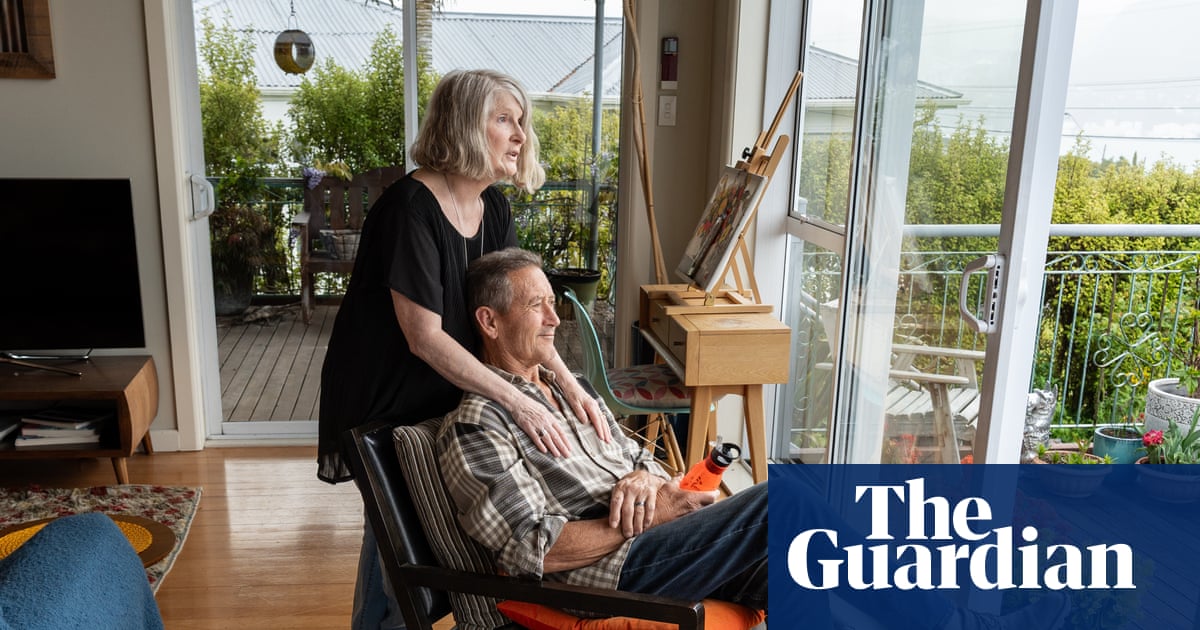
Back when she was healthy, Jane Harrison worked for the community – securing money for playgrounds, getting kids into sport and making sure her small town in New Zealand’s South Island was ready if an earthquake struck.
Now, she and her husband, Shaun Fitzgerald, 65, are both on disability assistance. Last year, when Fitzgerald – a roofer – was waiting for back surgery for spinal stenosis, Harrison left her job to help look after him at home. The operation in August 2025 was not as effective as hoped. He has since been back into the emergency department in intense pain, waiting for hours with severe cramping, she says. “We called the paramedics recently and they said: ‘There’s no beds in hospital, if we take you you’ll have to sit and you clearly can’t, you’re better off at home.’”
Now, as he waits for another surgery to fuse his vertebrae together, he is hobbling around on a cocktail of daily painkillers, says Harrison, 60. She has long Covid, for which she has struggled to find assistance, and her health has also worsened. “It’s countless trips to the doctor, it’s so expensive, and you have to do it over and over again.”
As New Zealand heads into an election in November, Harrison is among the 44% of the country for whom healthcare is their top concern – second only to the cost of living, according to Ipsos, the political issues monitor. Stretched emergency departments, waiting times of months to see a family doctor, delayed cancer treatments and hard-to-access specialist care are common experiences for people across the country. Critics say chronic underfunding of the health system – exposed during the Covid pandemic – has further cratered under the National-led coalition.
For Harrison, her household’s inability to access timely healthcare feels unfair. “Shaun was the biggest, strongest man – he was the guy who would pick up your fridge and put it on the trailer,” she says. “We were energetic people, we’ve worked all our lives, we’ve paid tax. We never imagined we would be in this situation.
“We should not be bed-bound and desperately trying to eke out money from the government.”
________________________
The state of healthcare in New Zealand has been thrown into the spotlight in recent months, with high-profile incidents including a man’s death after collapsing in hospital toilets after a nine-hour wait at a busy emergency department at one of the country’s biggest hospitals. A shortage of healthcare professionals is felt across the sector.
“There’s not enough beds, not enough nurses, not enough doctors at every level of the roster, not enough space,” says Dr Katie Ben, an anaesthetist and president of the Association of Salaried Medical Specialists, a doctors’ union.
“It’s been a gradual decline but we’re trying to do more with less and less and you just reach a tipping point.” There are now 17 fewer nurses in Nelson, where she works, than three years ago; surgical wards were run from an earthquake-prone building, earmarked for replacement at least a decade ago, she says.
Nurses and doctors spoken to by the Guardian say their ability to provide safe care is being compromised, and that many are defecting to Australia, where they say the pay could be up to 30% higher.
Combined with the rollback of Māori-access initiatives, millions dished out to private hospitals, and an aging population with higher health demands, Ben says a two-tier healthcare system is emerging where only those who can afford it can be seen. With one in four adults saying they can’t access their GP, record numbers of patients are presenting to emergency departments.
In late August, criticism of the National-led coalition’s approach to health ramped up when it was revealed only 54 additional full-time nurses had been hired since the government came into power, not the 2,000 promised by health minister Simeon Brown.
Brown says the health system is “measurably improving”. Three-quarters of emergency department patients are seen within the target of six hours, and childhood immunisation rates and elective surgery waiting times have improved, he says in a statement. Spending more on private hospitals means 40,000 extra elective surgeries, he says. Brown concedes “the system remains under pressure, and too many New Zealanders are still waiting too long for care”.
In comparison to healthcare in other countries in the Organisation for Economic Co-operation and Development, data shows New Zealand hovers close to the middle; its health expenditure per capita and the number of practising nurses are above average, but the number of hospital beds and doctors are below average.
The latest 1News Verian poll has the National and Labour parties tied on 28%, with the left-leaning Greens at 15%. National’s current coalition partners ACT and NZ First are both polling at 10%, while the centrist Opportunity party is on 8%, and could potentially hold the balance of power in a new government formed under New Zealand’s mixed member proportional system.
If re-elected, National has promised to boost the country’s medicines budget by $604m, by cutting foreign aid outside the Pacific. Labour has said it would reinstate a smoke-free policy and free prescriptions, introduce three free GP visits – paid for with a targeted capital gains tax – and guarantee jobs for graduate nurses.
Labour health spokesperson Dr Ayesha Verrall says its priorities are prevention and primary care. “The cost-of-living crisis has made these investments all the more important because people are missing out.”
But for those still waiting months to see their doctor, it’s all still talk. Mother-of-three Abbey Bambry, who lives in the small North Island town of Pahiatua, says residents are often forced to travel 45 minutes to the closest city to see an after-hours doctor, for up to $245 for an adult visit. She has tried writing to the local MP, saying she has seen friends with serious health issues suffer. Seeing pledges to address it properly would sway her vote, she says.
“It concerns me that many people’s only option is to travel for health, and if they do they pay massive fees to get the healthcare they need.
“It’s just like what the hell are we doing, you know?”
#reach #tipping #point #Zealands #strained #healthcare #system #centre #election #battle #Zealand