wellnessfitpro

Parents are growing suspicious. In WhatsApp groups and at school gates, mums and dads worry aloud that teachers are not simply educating pupils but also filling their heads with views they do not share. Some fret about daughters now convinced they are actually boys, or young children taught about sex and relationships before they are ready. Others are shocked when their children condemn Britain as a racist country or pour scorn on national heroes like Winston Churchill.
Concerns spill over on to social media, where parents share pictures of worksheets that label those troubled by high levels of immigration as ‘far right’ and promote left-wing groups like Hope Not Hate. Parents are angered by reports that schools have been telling children that Reform UK is a far-right party and that some of its supporters ‘have extremist views’. News coverage of a girl being sent home from a school in Rugby for wearing a Union Jack dress on Culture Celebration Day, Christmas cards being rebranded as ‘winter cards’ by a school in Aberdeen, and pupils in Wales making videos promoting the Welsh Refugee Council fuels suspicion that activist teachers are using the classroom as a recruiting ground for their own beliefs.
As I explain in my new book, The Breaking of the Education Contract: Why We Need to Keep Politics Out of Schools, the perception that schools are political institutions and are taking one side on a range of contested issues really matters. Parents entrust their children to teachers and, in return, expect their children to learn to read and write and gain some knowledge of the world. They assume schools are responsible for education, and that teachers will leave parents free to shape their child’s moral and political outlook. Bringing politics into the classroom breaches this contract. It pits parents and teachers against each other, potentially forcing children to take sides, and opens the door to accusations of indoctrination.
Do parents have grounds for their suspicions? According to the Education Act 1996 and subsequent government guidance, schools are meant to be politically impartial institutions. This does not stop teachers from discussing contentious issues in the classroom, but it does require them to present a balanced view of opposing arguments and not advocate for just one viewpoint. As it stands, the law seems like common sense. But recent trends make the presumption of impartiality harder to sustain.
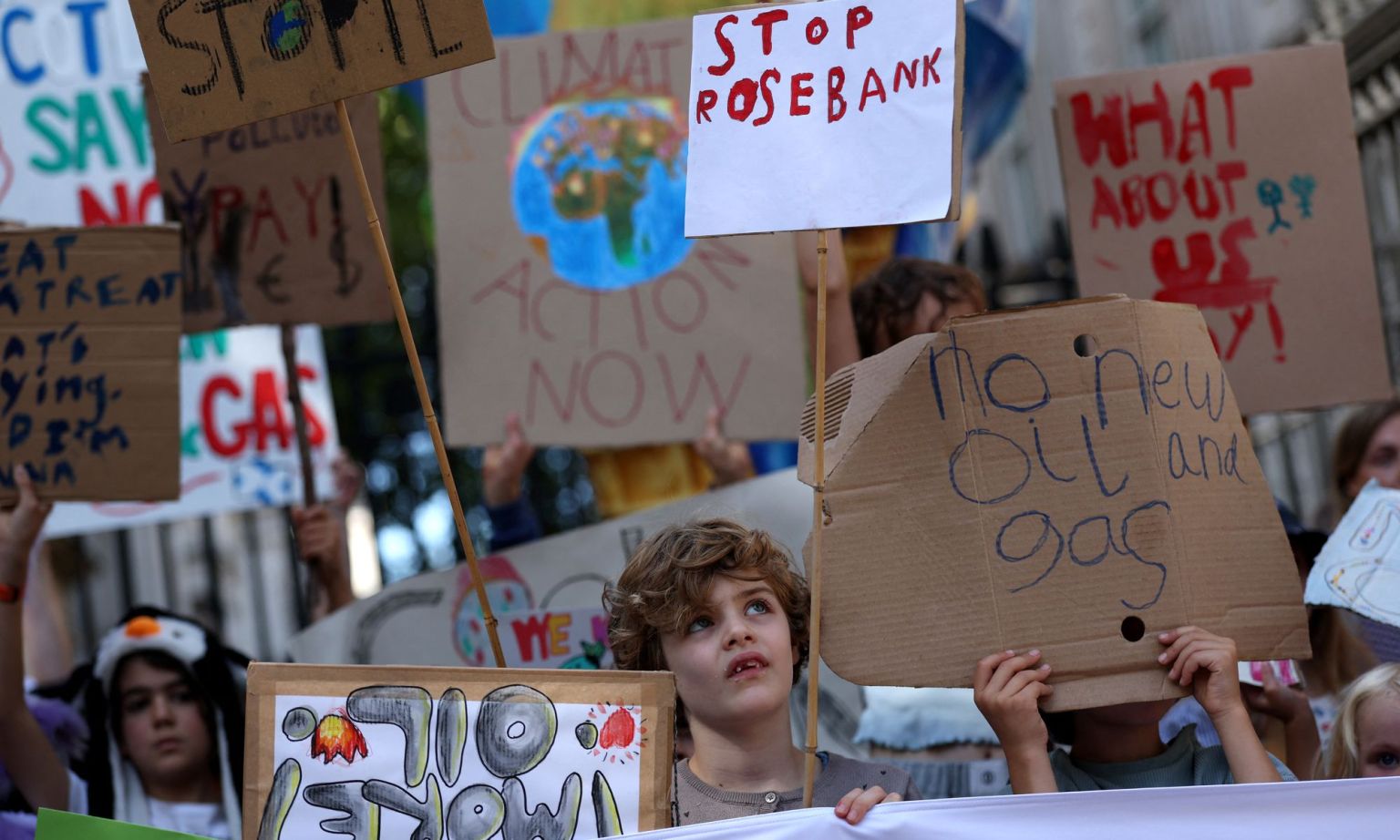
Kids take part in a demonstration to highlight the the impact of record breaking heat on children due to climate change, near Downing Street in central London on September 1, 2026.
Some of the issues that concern parents, like the notion that everyone has a gender identity or that some children might have white privilege, are not always viewed as contested by teachers. Younger staff members in particular are unlikely to see these ideas as controversial. Likewise, whole-school activities that welcome refugees or raise money for children in Gaza might be seen as promoting inclusion and global citizenship rather than taking a side in a contentious debate. In order to recognise the need for impartiality, teachers must first recognise that there are two sides to an argument.
This failure to spot controversy is exacerbated when most teachers share the same political views. An opinion poll from the 2024 General Election suggests this is indeed the case. The overwhelming majority of teachers supported Labour, the Liberal Democrats or the Green Party, and only seven per cent backed either the Conservatives or Reform. Agreement promotes groupthink and makes contentious opinions seem like common sense. In this context, it can appear as if politics only crops up when parents raise objections, and teachers then see supposedly bigoted parents as the problem, not their lesson plans.
But government ministers also sow confusion. Even while professing the importance of impartiality, they tell schools to challenge particular viewpoints and inculcate new beliefs in children. Think of the way then prime minister Keir Starmer called for Netflix drama Adolescence to be shown in all schools to counter toxic masculinity. Or consider also how Bridget Phillipson, as education secretary, repeatedly called for schools to teach children how to spot extremist content and fake news online in order to ‘arm’ pupils against ‘putrid conspiracy theories’.
From next year, even primary school children will be taught about mis- and disinformation in newly introduced citizenship lessons. Yet these are highly disputed and fundamentally political concepts. Getting children to identify ‘disinformation’ does not mean they will undertake rigorous, open-ended analysis grounded in subject knowledge; rather, it means teachers have decided in advance what views and so on are to be classified as ‘disinformation’, and pupils must arrive at the same conclusions.
Confusion over what it means to be impartial emboldens activist teachers who think their purpose in the classroom is to shape children’s opinions. It is hardly surprising if new teachers think this is the whole point of their job; after all, the government website promoting teaching as a profession tells potential recruits: ‘Every lesson you teach or conversation you have in a school corridor has the opportunity to inspire your pupils, shape their futures and [change] the world around them.’
This is reinforced by a quotation from a young woman who explains why she decided to become a primary school teacher: ‘Education is the most powerful tool you can use to change the world, and we get to provide that to the next generation and others to come.’ Teachers who believe their job is to change the world are more likely to feel justified in using the classroom to promote their own opinions, especially when those views align with their school’s curriculum.
It is not just activist teachers who are encouraged. Charities and organisations campaigning on myriad issues such as human rights, Fairtrade and gender equality also look to exploit the confusion around what is and is not considered a political issue to gain access to a captive group of children and to further their own cause. Groups like the Green Schools Project aim to put ‘climate education and action at the heart of school life’ through a ‘cross-curricular programme for Years 4 to 8 with links to science, geography, maths, English, PSHE and art’. Pupils are engaged in ‘meaningful projects to reduce [their] school’s carbon footprint’.
Similar schemes make it explicit that their goal is to turn children into young activists. Almost 4,500 British schools have signed up to ‘Let’s Go Zero’, which conscripts children into a campaign urging the government to support the ‘vital mission’ of reaching Net Zero by 2030. The organisation aims to ‘show the overwhelming support for zero-carbon classrooms up and down the UK’. This organisation worked with the Department for Education on its Sustainability and Climate Change Strategy, meaning not just that schools had government approval to blur education and activism, but also that one government department effectively backed an initiative designed to lobby another branch of government.
As the Green Schools Project spells out, charities and organisations working with schools do not simply provide extracurricular activities that children may choose to opt into. Nor do they limit their scope to ‘new’ subjects like personal, social and health education (PSHE) or citizenship classes, which are explicitly intended to inculcate attitudes, values and behaviours. They also influence the content of even traditional academic subjects like geography, English and history.
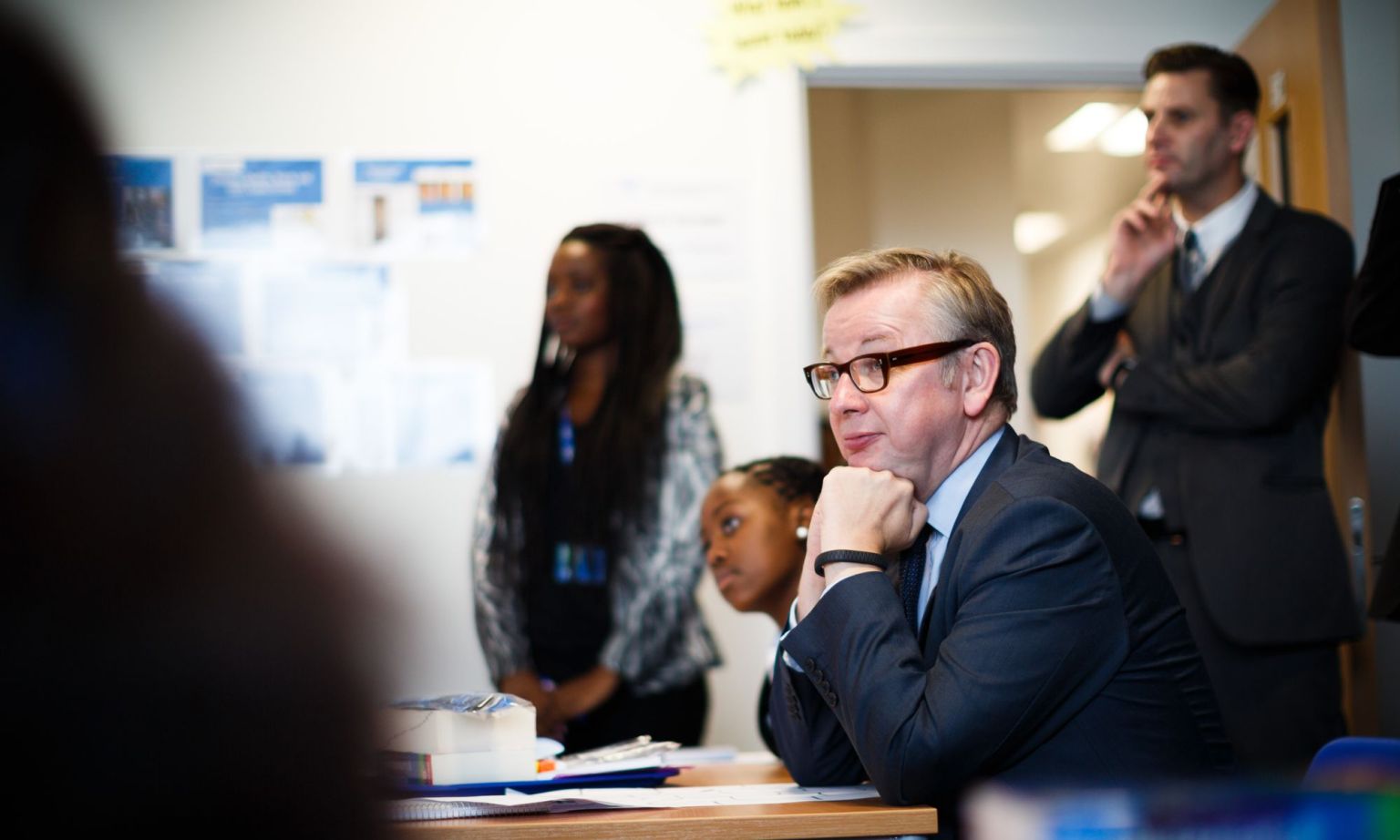
Then education secretary Michael Gove visits Perry Beeches III Free School, on September 3, 2013 in Birmingham, England.
There have been attempts to change the trajectory of education in the UK. As education secretary from 2010 to 2014, Michael Gove, along with then schools minister Nick Gibb, introduced substantial changes to the national curriculum. Backed by teachers who supported a knowledge-based approach to education, Gove’s reforms made subjects more rigorous; children were expected to know more and work to a higher standard. In English, this meant returning to pre-20th-century literature; in history, it meant a renewed emphasis on chronology. By rights, these changes should have left little room for politics.
However, although Gove was in a powerful position to shape what happened in schools and certainly had some support among teachers, many more criticised his approach. Teacher-education departments in universities and teaching unions waged a sustained campaign to undermine attempts to move schools away from a ‘progressive’ approach to education. In subjects such as history, much of Gove’s proposed curriculum content remained non-statutory, giving critical teachers considerable scope to apply their own judgement to what should be taught. This meant that, particularly when teaching younger pupils, schools could leave out key historical events, such as the battles of Waterloo or Trafalgar, and instead focus on the slave trade or colonialism. Despite the efforts of Gove, Gibb and many influential teachers, politics still shaped teaching to some extent. This became even more apparent after the Black Lives Matter protests in 2020, when many schools sought to ‘decolonise’ the curriculum.
In schools where teachers have been made to attend critical race theory-inspired anti-racism workshops, and where the promotion of diversity, equity and inclusion is prioritised above the transmission of knowledge, the danger is that themes such as ‘power’, ‘religion’, ‘society’ or ‘women’ form the focus of study, rather than a specific historical period. A focus on ‘black history’, as opposed to the history of black people within British society, can serve to divide students and alienate them from a sense of national identity. As a 2021 report commissioned by the University of Oxford notes, ‘history teaching has substantially changed to address diversity’ through lessons designed to promote ‘a sense of social justice’ and to reflect ‘the stimulus of recent events’. Even traditional academic subjects end up shaped by currently fashionable causes, rather than the best that has been thought and said.
For much of the past two decades, teachers have faced contradictory demands: improve discipline and include pupils with behavioural conditions such as ADHD; teach a content-heavy curriculum and generic skills; practise political impartiality and challenge certain viewpoints considered ‘toxic’ or ‘extreme’. These contradictions play out in schools, with some pupils experiencing a far more politicised education than others, but they stem from the very top of an educational establishment that includes both knowledge-led traditionalists and progressive teacher educators. Ultimately, Gove’s reforms successfully raised standards in schools, but his failure to defeat the progressives in the teaching unions and win more teachers to his cause made his victories easy to undermine once he left office.
Parents are right to be suspicious that schools are introducing children to political viewpoints disguised as education. Indoctrination is an alarming word and a serious accusation. It risks suggesting that a cabal of teachers is plotting to brainwash children. This is certainly not how most teachers see their role; they are too busy doing their jobs to plan world domination. Rather, as I argue in The Breaking of the Education Contract, a century of contradictory educational reforms has fundamentally altered the purpose of schools and universities, pushing them in a more political direction, regardless of individual teachers’ intentions. At the same time, various activist organisations have been all too ready to take advantage of new subjects like relationships and sex education (a part of PSHE) to exploit a captive audience of children in a bid to change the hearts and minds of the next generation.
Introducing children to a new, more progressive political outlook often requires them to question and reject the beliefs dominant in their home environment. When children are taught that people have a gender identity that overrides their biological sex, or that Britain has a shameful past, or that Reform is a far-right political party, or that people who worry about high levels of immigration are racist, some find that their teachers and parents are in conflict. This highlights division and undermines adult authority in children’s eyes. It makes both parenting and teaching more difficult and degrades education as a project. We need to keep politics out of the classroom.
#schools #indoctrinating #kids