wellnessfitpro

Welcome to the Conversation
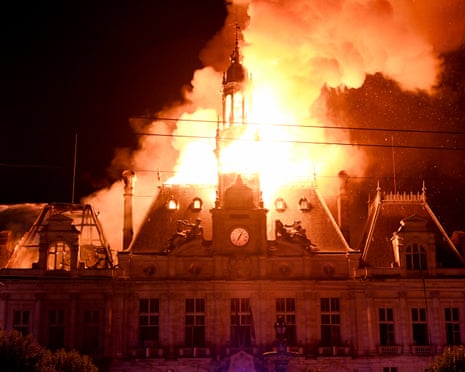
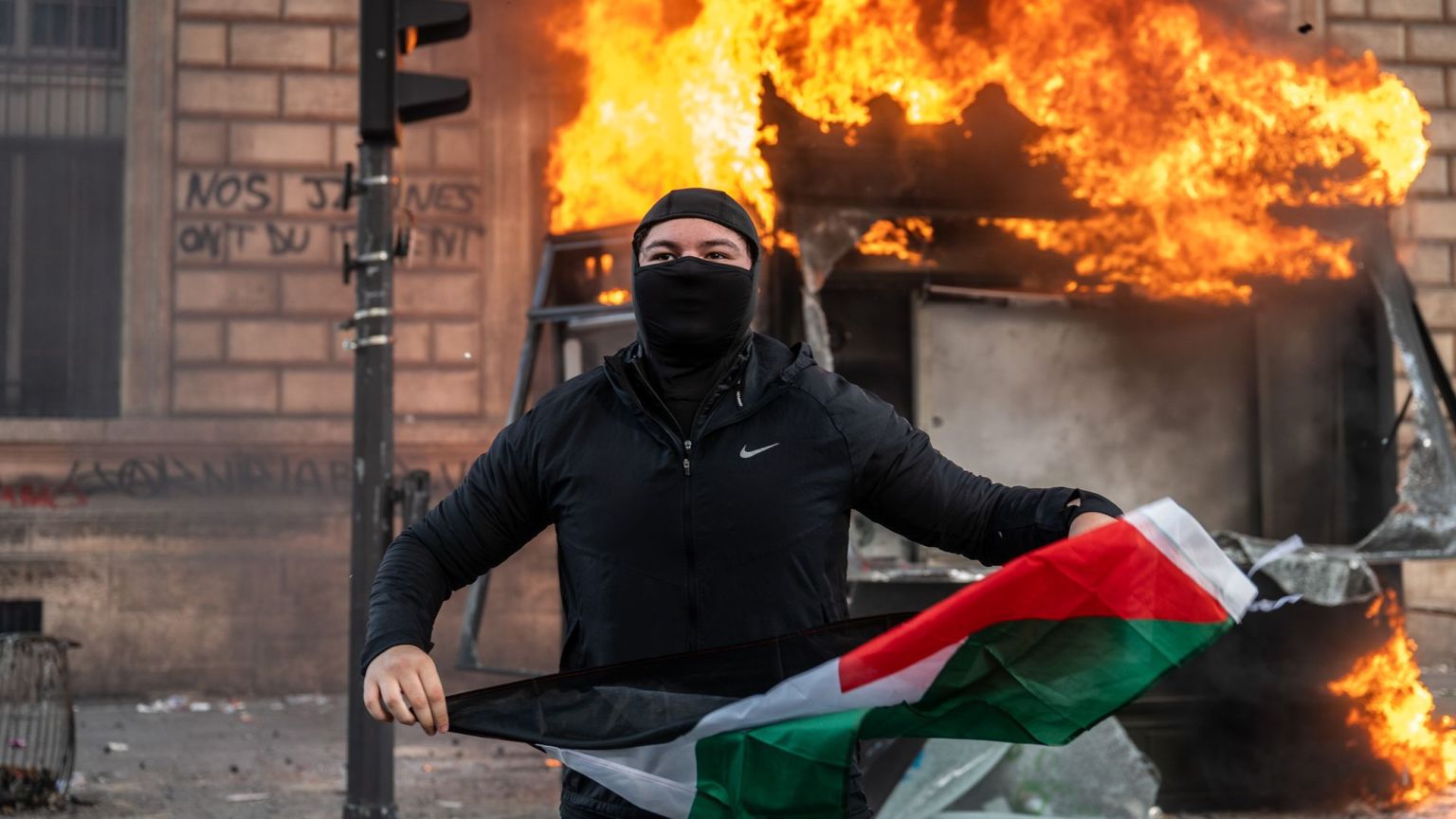
After weeks of protests and a weekend of riots in which a town hall was set ablaze, 2,000-plus shops were looted, 2,300 people were arrested and 1,000 police injured, the repercussions for France – for its society and its economy – continue. Allegations of police brutality surfaced, and the violent protests unnerved investors, resulting in a debt sell-off, with borrowing costs rising higher than for Greece. All of this ahead of a hotly contested presidential election that’s now just six months away.
The French government’s escalating financial problems were covered by the Guardian’s Europe correspondent Jon Henley who wrote: “France’s national debt, at 119% of GDP, is at its highest level since 1946. Its budget deficit, at 5.1%, is also among the highest in the EU. There is just no money in the bank to ease the cost of living squeeze that brought 550,000 people on to the streets on Saturday.”
Columnist Paul Taylor commented that “Last weekend’s violence has increased the likelihood of a law-and-order backlash among voters that could propel (Marine) Le Pen into the Élysée Palace. But if the financial situation worsens and the campaign turns on who can save the economy, she may yet lose out to a candidate who is firm on security and more orthodox on fiscal policy.”
And the Guardian’s editorial noted that “In an increasingly febrile atmosphere, France is heading towards a seismic reckoning in May. Alarmingly, the civil strife witnessed at the weekend may only be a foretaste of what is to come.”
What are your views on the riots, their causes and their aftermath? Are they paving a path to the presidency for Le Pen? In his final months in charge, can embattled incumbent Emmanuel Macron meaningfully address the situation in which France finds herself?
France-based Guardian Europe columnists Rokhaya Diallo and Alexander Hurst will be live here at 1500BST today to answer your questions on what happened, why, and where France goes from here.
Post your questions in the comments below or email [email protected]
Key events
How do the French protests relate to those across Europe?
Michael Wolfcarius asks: I cannot understand why the Guardian is selecting dots instead of joining them. France may have developed into the big story for many reasons, many of which have yet to be discussed, but it is not the only place where seemingly small incidents grew into massive protests, some also quite violent; Spain, Italy, Serbia and Albania come to mind. The crystallising reason may be different but the conditions leading up to it are quite similar. Can you put all these events into perspective, context and relation? There are obviously underlying currents making it difficult for people to refrain from making themselves ‘heard’.
Rokhaya: I agree that these movements deserve to be considered together, while at the same time, recognising their different specific national contexts. Housing in Spain, living costs and public services in Italy and France, and corruption in Serbia and Albania are bringing people onto the streets. These concerns touch the foundations of a decent life and people’s ability to shape their future.
What connects them, in my view, is the widening gap between what people need and what political institutions seem willing to deliver. These incidents that have led to protests are not “small .” Serbia’s movement began after a deadly railway-station canopy collapse, which became a focus for anger over corruption and accountability. My reading is that these protests express a crisis of political responsiveness.
Alexander: I think people in all these places – Albania, Spain, France – feel that the political systems that exist aren’t capable of dealing with the sheer scale and nature of the crises facing us, and they’re responding to a sense of ‘loss of control’ (the Brexit campaign really did strike upon a brilliant slogan) over where their societies are headed. There is a general social sense that has flipped from “this is broken, but things can and will get better”, which gives people a stake in the institutions around them, to “this is broken and things can and will get worse”.
The impact of the arrival of AI has been understated. Not just on labour markets, or on the environment, but ontologically. The investment pitch of the most powerful companies in the world, the ones amassing trillion dollar valuations, isn’t just that X-subset of jobs are replaceable, it’s that human beings themselves are replaceable. That the things we do fundamentally don’t matter, and that their goal is to bring this into being. I think that feeling is there even if we don’t immediately put our finger on it in those terms.
Who can Macron pass the torch to?
Kimber Martin asks: Who are the viable candidates who could be “firm on security and more orthodox on fiscal policy” as an answer to Le Pen? And why wouldn’t/couldn’t Macron pass the torch to him/her?
Rokhaya: Both of those things are on offer from Gabriel Attal and Edouard Philippe, neither of whom are all that popular in part because that’s what they’re offering, and in part because they both served as Macron’s prime ministers and so are seen as his torch bearers.
How should French police react to violence?
David Welling asks: On the matter of so-called police violence. The question should not even be put in these terms ‘Why are French police so violent?’ It should be ‘How do French police manage to be so restrained?’ When you are the target of mortars, cocktail molotovs, paving stones and much else and you have done nothing but be present, you have to react, don’t you? Far more police are injured than protesters.
Rokhaya: Police officers facing attacks can protect themselves, but their use of force must remain necessary and proportionate. Injury totals alone is not complete information; we need to know their severity and causes, including how many officers were injured by their own equipment rather than by protesters. We also need reliable reporting of injuries among demonstrators before drawing comparisons.
To me we cannot compare trained, armed and protected officers, to protesters especially when they are children: they do not have the same responsibilities. Police action should prioritise the avoidance of exposing an entire crowd to violence because some individuals attack them.
From my experience, I can tell that there is an increasingly violent and illegitimate institutional response to any protest. In 2010, after a teenager suffered a serious facial injury, even the-then interior minister Brice Hortefeux instructed police to limit force to the strict minimum. In the recent demonstrations, teenagers lost hands or eyes to police weapons, but the interior minister gave no instructions to police to exercise restraint.
The government had a responsibility to address the high school pupils’ demands and protect their right to protest but instead it chose confrontational policing that escalated tensions. This institutional violence is unacceptable, and responsibility for it extends to the political authorities who determine policing strategy.
Alexander: The state should always have a greater burden to de-escalate and protect life and safety than an individual protester – or looter – carries. The positions aren’t equal. But from the beginning, the police response was heavy handed. High schoolers burning trash cans were severely injured for life by the riot police sent out, almost from day one, to face off against them. Again, Saturday started off that way as well – with teargas shot at an orchestra that was playing music at Place de la République. Creating an initial condition of chaos and tension just opens the door for the casseurs.
As the far right looks increasingly likely to gain political power, the precedents that the government is setting now are incredibly important, because they begin the slide towards authoritarianism and police-state policies that the far right has implemented elsewhere when it has taken power. A French “ICE” could instigate violence with protesters, Marine Le Pen could do exactly what Attal is calling for in response and declare a state of emergency, and then what? She would have enormous powers at her disposal: the type of powers Trump dreams of having and deploying in vicious illiberal ways, and that Orban absolutely exercised in those illiberal ways.
Do centrist attempts to squash protest reinforce the LFI?
Thomas asks: I wholly support LFI in the coming presidential elections, as the sole realistic opponent to the far right. I know centrist voters sometimes struggle with that notion, including Mr Hurst. Did the recent declarations of Gabriel Attal, Raphaël Glucksmann and the other centrist politicians regarding what basically amount to martial laws to try to squash the protests change their vision of LFI, or only reinforce it?
Rokhaya: Thanks for the question Thomas! I doubt these statements about law and order will change centrist voters’ perceptions of LFI. They may reinforce their existing hostility.
There are differences between the proposals. Attal supported a possible state of emergency, administrative searches and house arrests, alongside soldiers guarding public buildings, targeted social-media shutdowns and expanded surveillance. Glucksmann has endorsed partial curfews, subject to constitutional limits; I have not seen him advocate a state of emergency.
Attal’s position follows the direction established under Macron. In 2017, his government brought emergency powers into ordinary counter-terrorism law; these were made permanent in 2021. UN independent experts warned that the ‘global security law’ threatened privacy, freedom of assembly and expression. The 2021 “separatism” law also tightened controls on associations through requirements to uphold broadly defined republican principles. Human Rights Watch has documented its chilling effect on civil society especially environmental, anti-discrimination and human rights organisations.
My sense is that centrist voters who prioritise order may find the latest measures reassuring, even at the expense of civil liberties. They may consequently see LFI’s opposition as further evidence of irresponsibility. For LFI supporters, these declarations may reinforce the conviction that the centre is increasingly adopting authoritarian responses associated with the far right. Chasing its voters on this terrain risks normalising the far right’s agenda and weakening freedoms that protect everyone.
Alexander: Hi Thomas, thanks for the question. I do disagree with your qualification of me as “centrist”. I want to pass the Zucman tax on fortunes above €100m and stop a lot of the really inefficient handouts to businesses (France’s Cour des computes identified is €211bn overall) even as many of these businesses pay out dividends, and redirect some of that revenue to increased spending on health and education and green energy infrastructure.
I’d love to see a common corporate tax rate at an EU level to stop multinationals evading taxes by choosing low-tax jurisdictions, want strict regulation of AI and would love to require, at minimum, any datacentres to use 100% renewable energy and ban them from causing deforestation. I want to see trade sanctions placed on Israel over the genocide in Gaza, and blocking measures used to protect the ICC against Trump’s attempt to destroy it.
I am, however, conscious that a lot of these things necessitate going beyond any single nation state if the goal is to have actual impact. For example, the EU’s Emissions Trading Scheme is responsible for decreasing CO2 emissions by 800 million tons annually, which is more than 2x the total of France’s yearly emissions. That makes it probably the single most important and effective piece of climate legislation in the world.
Any policy programme that is an ecological one would be about building on this and expanding it to more sectors, not opening the door to undermining it by undermining EU law as a whole. Especially at a time when Europe’s right wing parties are pushing to roll back and weaken climate targets.
The problem is, that’s exactly what Mélenchon’s pledge to simply “disobey” EU rules whenever he wants to would lead to. This was the Brexit fever dream: imagining that you could pick and choose what you wanted, and that everyone else would just carry on while you did so. But everyone has domestic incentives to “disobey” different things and in different ways. What about a state that decides it wants to do what Ireland does with corporate tax rates when it comes to the ETS and the carbon border tax (CBAM)
So, no, until it’s gone from Chapter 17 of his programme, my view on Mélenchon won’t change, because France exists within a broader environmental, economic, and geopolitical context; that context imposes all kinds of constraints; and pretending that you can just ignore or waive them away isn’t going to convince me.
But, moving on to your question about the government’s strict crackdown on protests and pledge to go hard into ‘law and order’. It’s quite clear that France has a tradition of far too heavy handed and violent police repression of protest movements, and that deploying riot police in this way from the beginning helped create the conditions for what happened on 17 October. I think the government is playing a very dangerous game by trying to ban protests and implement curfews this week, with terrible implications and precedents for democracy and maintaining fundamental rights (and in fact French judges have stepped in to restore some protests that the government attempted to stop).
Attal’s statements about supporting a declaration of state of emergency or calling out the army are alarming. They’re nowhere near the same category as Glucksmann’s response, which called for ending the police munitions that have maimed protesters (like the LBD and the grenade de désencerclement), “better adapting” crowd policing strategies, and imposing fines on social media networks for allowing content that incites violence to spread. You’re certainly free to criticise Glucksmann, but I don’t think it’s accurate to place those two responses side by side.
One thing on which I would caution the left comes from the US experience, where the left created a significant political strategy problem for itself when it latched on to the slogan “defund the police,” which, to be frank, plays completely into the hands of the far right who can point to a night of chaos and looting and say “well this is what absent police looks like.” That’s certainly not a defense of the way the US or France does policing – hiring 10,000 crowd mediators trained in de-escalation and having them be present at protests would be a far more productive strategy than immediately deploying CRS and teargas. But the RN would love for the debate to be “looting OR police”, and it’s the wrong debate to fall into.
Is French public protest inevitable because that’s ‘what they do’?
Ann-Marie Thompson asks: Could you explore the degree of overlap between the two periods of rioting, one ostensibly about education and then the wider social issues sparking the latest. Were there groups operating during both? Did Parisiens share a sense of shock or have they been waiting for this? Is there any sense of one instance of rioting being more ‘effective’ than the other? Do Parisiens have a sense of this French public protest as inevitable because that’s ‘what they do’ and have done since 1789 via 1968?
Rokhaya: I would describe this as a convergence of mobilisations with distinct origins. Calls for the 17 October demonstration were already circulating in early September over fuel prices and living costs, some of it drawing on Gilets Jaunes imagery without initially being organised by its established figures.
The school protests have their own geography, which has been left invisible by a Paris-centred account. Mobilisations actually began in Mayotte on 31 August and French Guiana on 7 September, before gaining national attention through schools in disadvantaged areas around Paris. Their demands concerned longstanding, unacceptable conditions. Social media helped pupils share those experiences and build solidarity beyond the schools initially affected.
By 17 October, students, trade unionists and Yellow Vest participants were marching together. There was therefore overlap among the movements, but identifying whether the same groups committed violence during both periods needs more scrutiny. Participation in demonstrations and involvement in rioting are not the same thing. And shock at the destruction can coexist with an understanding of the anger behind the mobilisation.
Demonstration is indeed deeply embedded in French political culture, across the country, not only in Paris.
The Gilets Jaunes secured the cancellation of fuel-tax increases and substantial economic concessions after weeks of disruption and violent confrontations which probably played a part in forcing the government to respond. Martin Luther King described riots as “the language of the unheard” which can make us ask ourselves why people’s grievances so often become urgent to those in power only after the situation escalates.
France celebrates its history of revolt in films, museums and schoolbooks, then reacts with shock when people take to the streets today. Rebellion seems to be admirable only when safely locked into the past.
Are these protests the result of foreign instigation?
Mike asks: Are these and other similar protests partly as a result of foreign instigation? We have been warned about such things.
Rokhaya: I don’t think so. Protests have grown out of concrete, local grievances that have gone unanswered. People took to the streets because they believe in their right to speak out and challenge those in power. I attended some of the demonstrations and met many people protesting for the first time.
Foreign actors may try to exploit unrest, but that does not prove that they created it. People’s agency is central to what is happening, and we need not divert attention from the demands that brought them on to the streets.
Alexander: They’re not happening because of foreign instigation, they’re happening because there are fully legitimate reasons for them to happen. That said, I think it would be naive to imagine that state actors like Russia – which is already engaged in an ongoing campaign of physical sabotage across Europe – aren’t hard at work using videos of violence as part of ongoing social media manipulation campaigns designed to create anger and division.
The Kremlin is no stranger to this, and it clearly wants to propel its preferred candidates into office across Europe and the US with the goal of weakening European unity in general and on Ukraine specifically, having some countries defect on sanctions and strike fossil fuel deals (like Trump recently did), etc. On the other side of the Atlantic, the US far right is also trying to fuel disinformation in service of its own identity culture war and anti-immigration project in order to close out the final weeks before the US midterms.
Can any winner solve France’s financial crisis?
Michael1611 asks: As Jon Henley suggests in his recent column, public attitudes to Macron have toxified the entire centrist bloc. But if (as seems very likely) Marine Le Pen’s RN party wins the election what on earth can they do that is viable in economic terms, given the financial crisis the country faces? It seems to me there is a risk of a huge backlash when the promises they are making cannot be kept?
Alexander: I’m going to repurpose a trite phrase and say that nobody’s political programme is going to survive first contact with France’s coming debt crisis. The French thinktank Terra Nova did a breakdown of the RN’s error-riddled economic plan, which seemed to have been co-created with or at least edited with AI. Interest rates on French debt are already unsustainably high, and the RN has already voted against raising taxes on the wealthy and the ECB isn’t going to run to bailout a far right government promising to go to battle with EU’s institutions, so it will be left with budget cuts and betraying everyone who thinks Le Pen will actually lower the retirement age.
Unfortunately, the same probably goes for Mélenchon (even though I think the chances of him defeating Le Pen are extremely small, given the persistent polling on that matchup), who will probably face a similar situation of spiking interest rates and EU partners who will want things in return … and he’s already made ‘disobeying’ a central point of his future relationship with the EU. So, why would they offer a condition-free bailout to a country with a lower retirement age than their own citizens enjoy (even in the Nordics where many benefits, like year-long paternity leave, are more generous than they are in France), and that’s made antagonism and confrontation its starting point?
The EU mismanaged the last financial crisis in ways that were more costly than it should have been, and resulted in a lot of lost time. Hopefully it won’t repeat those mistakes the next time – but that’s also predicated on having national governments in power that are able to build coalitions around what those different approaches might look like.
As far as public attitudes, I think the major point is that France has very low tolerance for rising inequality, or for the suspicion that the rich are getting off easier than everyone else – and this is certainly what tanked Macron from the beginning with a huge chunk of the electorate. There’s no path forward to social calm without the wealthiest people paying more than they are today.
How will France’s EU financial contribution affect the elections?
wyrcommunity asks: How do you envisage the financial contribution by France to the EU playing out across the various political groupings at the next elections, given France’s escalating financial problems, and that Macron has previously defended the funding of €2tn for the 2028-2034 EU budget, which will equate to a French contribution of c. €38bn-a-year?
Rokhaya: The RN is likely to use this to argue that France is financing Europe while neglecting its own population. Other parties will need to explain what European spending delivers and how it should be funded, which is legitimate. The proposed €2tn budget is still being negotiated, so I would be cautious about presenting the €38bn annual French contribution as a settled commitment.
To me public finances involve political choices, including choices about raising revenue. France’s debt cannot become a permanent justification for leaving schools understaffed and buildings deteriorating. As I wrote in my Guardian column last week, the economists Élise Huillery and Romane Paris, for example, propose an inheritance tax reform that could generate €11.8bn in additional education spending. It would target only the largest inheritances, the wealthiest 1% of heirs. So there are alternatives to asking that public services are cut back and ordinary households to absorb further austerity.
The presidential election debate should address who contributes, who benefits and which investments serve the public interest. Defending European cooperation requires showing how it improves people’s lives concretely; it cannot remain an abstract commitment disconnected from urgent material concerns.
Photograph: Olivier Hoslet/EPA
Alexander: Financing the EU based on national contributions is an error that should be corrected. It immediately gives the right an argument that “we” are “sending” money to the EU. It would make so much more sense to replace contributions with an EU-level corporate tax floor to give the EU its own resources, and at the same time prevent race-to-the-bottom style tax policies that fuel tax evasion schemes. I’ve never understood the opposition to this (other than corporate capture, I guess) by states that maintain low corporate tax rates; they would be fully free to go above the tax floor or keep their tax rates as close to it as they wished. And it wouldn’t harm any single state’s competitiveness, since the common corporate tax rate would apply across the board.
As far as France’s domestic spending goes, interest payments on the debt will soon become the government’s single largest expenditure, soon exceeding total spending on education. Allowing that to happen isn’t coherent with a vision of social and comic justice. Interest payment on the debt – ie. money paid out to creditors – is going to be €73bn next year, and rising quickly. That is money that cannot be spent on education, healthcare, rural areas, green transition … Raising taxes on the wealthy and on inheritances and cracking down on corporate subsidies and tax evasion is a necessary step, but in the long term, there are other models that France might learn from as well, like sovereign wealth funds that generate returns for the public, instead of leaving the market’s returns to be captured primarily by the wealthy.
Do the protests this month compare with May ’68?
Eamon McCrisken notes: Comparisons are being made with May 1968 but I think the following should be borne in mind from those times:
‘De Gaulle and Pompidou warned the country was threatened with a Communist coup. De Gaulle announced a snap election, calling upon the French to choose between legitimate government and revolutionary anarchy. The May Events in France were curiously peaceful by the standards of revolutionary turbulence elsewhere, or in France’s own past. The French ‘psychodrama’ (Aron) of 1968 entered popular mythology almost immediately as an object of nostalgia, it was above all a victimless revolution. (Tony Judt, Postwar)
Rokhaya: This comparison reminds me how familiar the political framing sounds: a social movement with concrete grievances is presented as a threat to the nation, and the public is asked to choose between the government and chaos. That framing allows those in power to elude questions about their own policies and responsibility for the escalation, as it is the case for the current protest.
May 1968 was not really “victimless”: people died during the May–June events, including striking workers at a Peugeot factory in Sochaux. Relative restraint compared with other historical upheavals should not erase those deaths.
France’s relationship with nostalgia is also something that can be underlined. We celebrate past rebellions while treating those protesting in the present as dangerous or irresponsible. We should take their demands seriously now, while they can still be answered and not wait for the future to romanticise them.
Alexander: Part of me loves to talk about national mythologies and how they can also become our national pathologies, and part of me hates it because I know I’ll inevitably end up reducing and simplifying things because I haven’t, unlike Tony Judt, written a chef d’oeuvre like Postwar on it.
But to go there anyway, if the US mythology has a large dose of “someday I can get rich, too” in it, I think the French mythology has a dose of “someday, I too can overthrow a despotic government”. I obviously wasn’t around in May 1968, and I didn’t grow up in France, but it does often seem to me like every generation wants to have its own “Revolution” that then cements its place in the national narrative. The country obviously has a high propensity for large-scale street protests and confrontations that don’t really happen in the same way as the US or UK. Lately, I’ve been wishing the US would take some inspiration from the French. But is the confrontational nature of French politics a sign of it working, or a sign that it’s not really working? I’d lean towards the latter.
Welcome to the Conversation
After weeks of protests and a weekend of riots in which a town hall was set ablaze, 2,000-plus shops were looted, 2,300 people were arrested and 1,000 police injured, the repercussions for France – for its society and its economy – continue. Allegations of police brutality surfaced, and the violent protests unnerved investors, resulting in a debt sell-off, with borrowing costs rising higher than for Greece. All of this ahead of a hotly contested presidential election that’s now just six months away.
The French government’s escalating financial problems were covered by the Guardian’s Europe correspondent Jon Henley who wrote: “France’s national debt, at 119% of GDP, is at its highest level since 1946. Its budget deficit, at 5.1%, is also among the highest in the EU. There is just no money in the bank to ease the cost of living squeeze that brought 550,000 people on to the streets on Saturday.”
Columnist Paul Taylor commented that “Last weekend’s violence has increased the likelihood of a law-and-order backlash among voters that could propel (Marine) Le Pen into the Élysée Palace. But if the financial situation worsens and the campaign turns on who can save the economy, she may yet lose out to a candidate who is firm on security and more orthodox on fiscal policy.”
And the Guardian’s editorial noted that “In an increasingly febrile atmosphere, France is heading towards a seismic reckoning in May. Alarmingly, the civil strife witnessed at the weekend may only be a foretaste of what is to come.”
What are your views on the riots, their causes and their aftermath? Are they paving a path to the presidency for Le Pen? In his final months in charge, can embattled incumbent Emmanuel Macron meaningfully address the situation in which France finds herself?
France-based Guardian Europe columnists Rokhaya Diallo and Alexander Hurst will be live here at 1500BST today to answer your questions on what happened, why, and where France goes from here.
Post your questions in the comments below or email [email protected]
#Reader #whats #France #Europe #columnists #live #France