wellnessfitpro
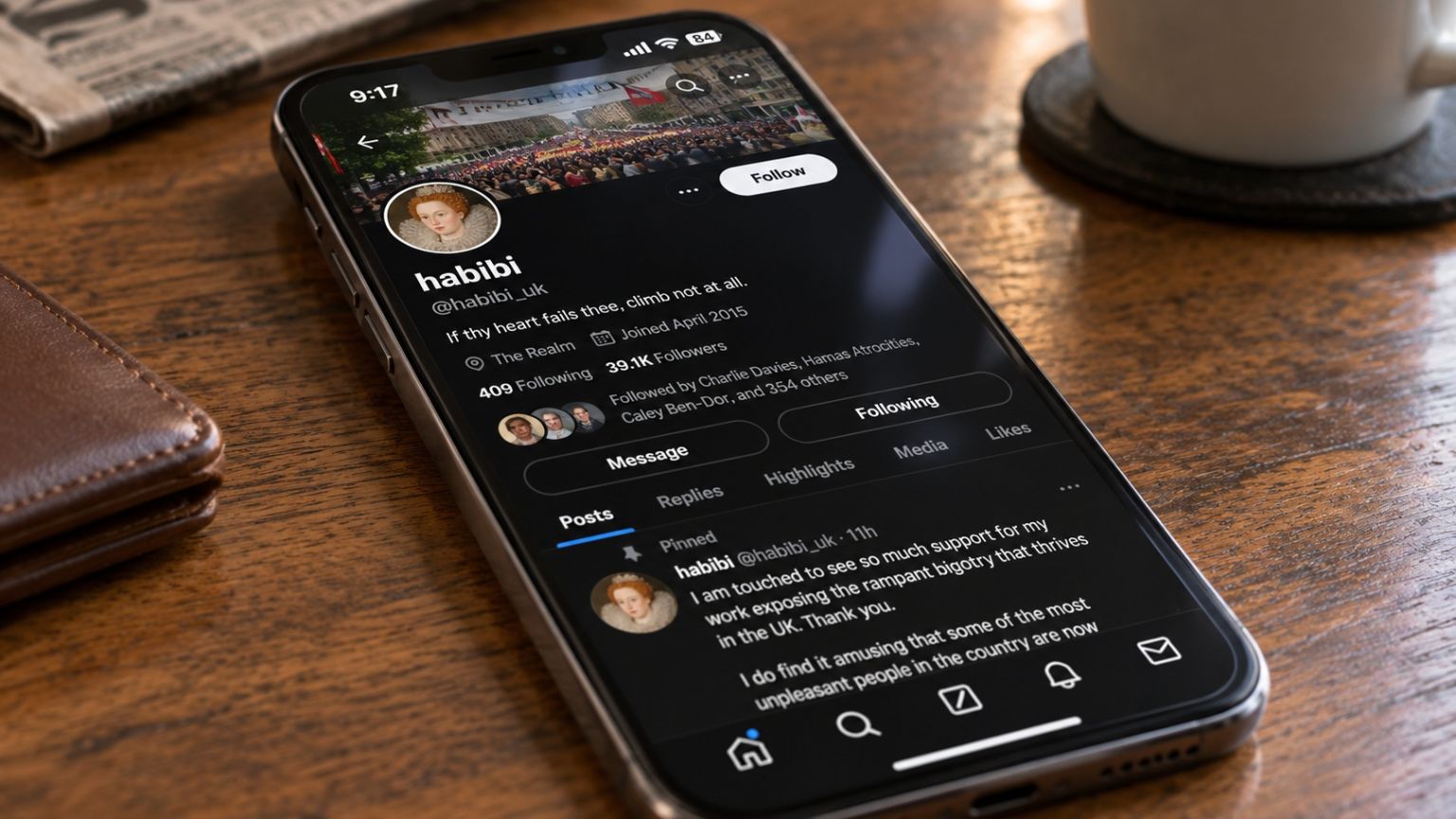
The provocative ‘progressive’ outlet, Byline Times, has published the second part of its six-month ‘investigation’ into Habibi, or @habibi_uk. The latter is an anonymous account on X that has spent years doing valuable work exposing those it regards as apologists for Islamism and anti-Semitism. Islamist hate preachers and pro-terror hate marches are its main target, though it has also drawn attention to some very questionable posts by the likes of Gary Lineker and former chair of the Southbank Centre Misan Harriman. Having unmasked the man behind the account, and set out his schooling, his career and his family tree, Byline Times pauses to inform its readers: ‘There is no evidence that [he] has Jewish ancestry.’
So what? An inquiry into a social-media account has no need to establish anybody’s race, unless its authors believe it is relevant to the story. And it is only relevant if you start from the assumption that complaining about anti-Semitism is something Jews do, so that a non-Jew doing it requires explanation. Such an assumption is hardly a surprise. On the hard left, gentiles who defend Jews are often resented even more deeply than the Jews themselves. Not that Byline Times said any of this, of course.
Anyway, I should declare an interest. Part one of the Byline investigation briefly mentioned me as one of Habibi’s ‘named amplifiers’, crediting me with critical articles about eight of the ‘progressive voices’ that the X account ‘targeted’. Frankly, I was slightly disappointed with myself: others appeared far more prominently. Must try harder. But read what follows with that in mind, because what Byline Times has actually produced is a map of its own bigotry.
A good place to start is with the language used in the report. The man behind the account, readers are told, is a graduate of a ‘school for spies’, ‘State Department-trained’ in ‘political-military diplomacy’ and ‘counter-terrorism research’. His posts amount to an ‘influence operation’. Byline Times reveals that Habibi is a 61-year-old energy analyst who undertook two years in the American foreign service, and who happens to be the grandson of Bertrand Russell.
Of course, none of the ‘investigation’ survives a second look. Habibi actually attended Georgetown’s School of Foreign Service, one of America’s leading universities for international relations, whose alumni include Bill Clinton and generations of diplomats, lawyers, bankers and journalists. The ‘school for spies’ tag comes from a Washingtonian magazine article that noted the high number of CIA recruits drawn from Georgetown. By that logic, Cambridge University would be a finishing school for traitors.
In addition, ‘political-military diplomacy’ is no dark art but the name of a routine State Department function. And listing ‘counter-terrorism research’ on LinkedIn does not make a man a spook. As for his grandfather, Bertrand Russell was a pacifist who spent his last years campaigning against nuclear weapons and the Vietnam War. Furthermore, Russell’s final public statement, issued days before his death in 1970, was a denunciation of Israel. Nor is one man posting his own opinions under a pseudonym an ‘influence operation’ – a phrase which, as Byline Times’ own back-catalogue shows, normally describes covert campaigns directed by states. There is a word for what Habibi was doing. It is blogging.
Then there’s the conspiracy-theory-style, join-the-dots diagrams. Across two instalments, Byline Times connected the Habibi account to a blog, two peers who once worked for Gordon Brown, the general counsel of the Jewish Leadership Council, the council’s chief executive, her husband, the think tank he runs, American funding of uncertain origin, Reform UK and the national press. Examined one by one, each link amounts to people who know each other, agree with each other and / or repost each other on social media. Joined up with arrows, they are presented as some kind of hidden web of influence, money and media power radiating out largely from Jewish people and Jewish communal institutions.
As you will have guessed by now, the evidence of coordination is rather thinner than the graphics suggest. One of its showpieces is that two men who follow the same MP quoted the same post 23 seconds apart. Ooh! By that standard, every football chant is a conspiracy. Byline Times’ own small print concedes as much. ‘A boost is not an order’, it says. ‘A count is not a plot.’ Then why call it an ‘operation’?
Nor will Byline Times tell us whether any of Habibi’s criticism of certain figures was justified. It states more than once that it takes ‘no position’ on whether the attacks were accurate, which is the only question that matters. Gary Lineker really did share a video about Zionism featuring a rat. And Misan Harriman did seem to draw a misjudged analogy between Reform UK’s local-elections success and the Holocaust. When a criticism is sound, the fact that a lot of people make it at once is usually called a reaction rather than a conspiracy.
Is some of the criticism of Habibi a little bit justified? Perhaps. I happen to be acquainted with the man behind the account and, although I don’t know him well, he has always seemed like a stand-up guy to me. Everyone makes slightly cackhanded posts sometimes, particularly when they’re fighting the good fight. Calling Stephen Kapos, a child survivor of the Holocaust, a ‘stain’ may have been a bad idea on reflection. The 57-second clip he shared that set off the storm over Harriman’s Holocaust analogy may have been better presented with the full context. Those points, however, are pretty mild and in no way justify the idiotic conspiracy theories.
The most striking passage in the Byline Times investigation is one in which its authors luxuriate in their own methods. Its reporters hand-delivered more than 120 questions to Habibi and his wife at their home, we are told. The account’s output, it notes with clear satisfaction, then ‘collapsed by four-fifths’. After part one appeared, Habibi stopped posting altogether.
In the same article, Byline Times quotes a professor of media law warning that intimidation threatens ‘livelihood and also life itself’, and that the fear of being publicly branded ‘scares [people] into silence’. He was describing what effect Habibi’s work supposedly has on those he exposes, but it was hard not to notice that he might as well have been describing the Byline Times investigation. There are good reasons why people who write about Islamist extremism choose to remain anonymous. Remember the religious-studies teacher at Batley Grammar School who, in March 2021, showed his pupils cartoons of the Prophet Muhammad as part of a lesson on blasphemy? An Islamist mob forced him into hiding, where he remains to this day.
Byline Times says it wants to show how hatred spreads online. Well, it could start by looking rather closer to home. Good on Habibi and all the excellent work he has done over the years. Today, he’s taking one for the team (and for the avoidance of doubt, I mean that metaphorically).
#mad #hatefilled #world #Byline #Times