wellnessfitpro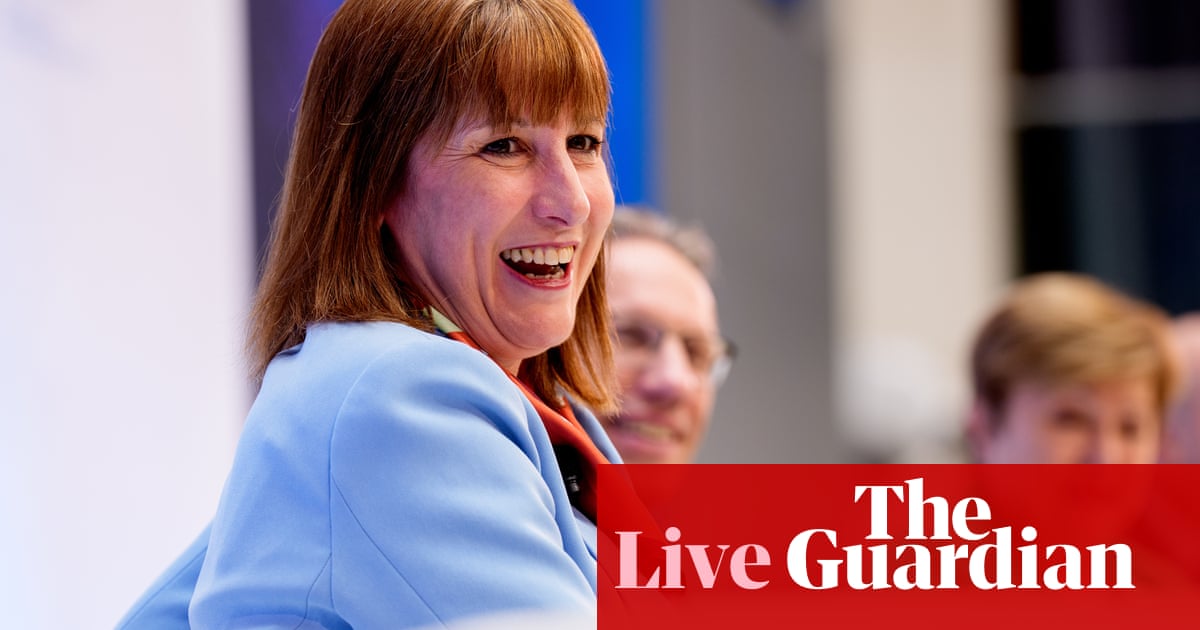
UK and EU want post-Brexit reset deal to be ‘as ambitious as possible’, No 10 says
Good morning. Keir Starmer repeatedly says it is unnecessary, and wrong, for Britain to choose between closer links with the US or with Europe. It is an awkward position for many on the left who believe that a choice between a country under irrational, authoritarian leadership, and an alliance of liberal democracies, should be a no-brainer. The Conservatives want the UK to choose the US.
But there are signs that, behind Starmer’s boilerplate rhetoric, his administration is making a choice. Here are three overnight developments pointing in that direction.
-
Rachel Reeves, the chancellor, has said the UK’s trading relationship with the EU is “arguably even more important” than its relationship with the US. She made this comment in a BBC interview from Washington, where today she is meeting her US counterpart, Scott Bessant. Reeves told Faisal Islam:
I understand why there’s so much focus on our trading relationship with the US but actually our trading relationship with Europe is arguably even more important, because they’re our nearest neighbours and trading partners.
Obviously I’ve been meeting Scott Bessent this week whilst I’m in Washington, but I’ve also this week met the French, the German, the Spanish, the Polish, the Swedish, the Finnish finance ministers – because it is so important that we rebuild those trading relationships with our nearest neighbours in Europe, and we’re going to do that in a way that is good for British jobs and British consumers.
In one respect, this is a perfectly mundane thing to say. The only controversial thing about it should be Reeves’s use of the word “arguably”, because saying that trade with the EU is more important than trade with the US is just a statement of fact. (They are not even close; on all measures, the EU trade is much larger.) But it is still unusual to hear a Labour minister talk like this given that the government is normally very nervous about sounding remainy, and the statement somewhat undermines Starmer’s ‘false choice’ argument.
-
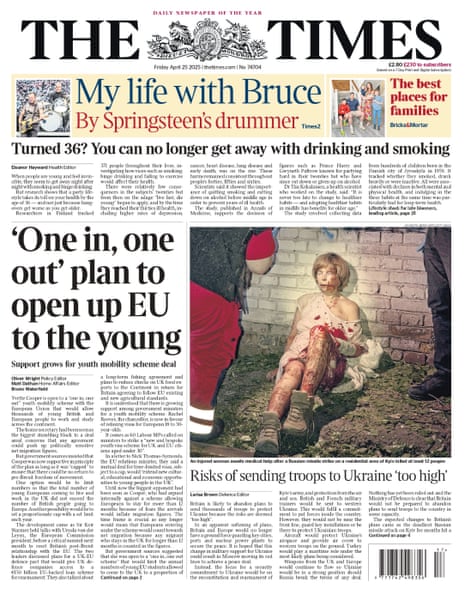
The UK and the EU seem increasingly close to agreeing some sort of youth mobility scheme. Ministers don’t like using the term because they worry Brexiters will associate it with free movement. “A youth mobility scheme is not part of our plans,” Nick Thomas-Symonds, the Cabinet Office minister in charge of post-Brexit relations with the EU, told MPs yesterday. But a report in the Times today says “there is growing support among government ministers for a youth mobility scheme”. Yvette Cooper, who as home secretary is focused on reducing net migration, had been seen as a blocker. But the Times says she is now open to a scaled down youth mobility scheme, such as a “one in one out” version. It says:
Government sources insisted that Cooper was now supportive in principle of the plan as long as it was “capped” to ensure that there could be no return to pre-Brexit freedom of movement.
One option would be to limit numbers so that the total number of young Europeans coming to live and work in the UK did not exceed the number of British people going to Europe. Another possibility would be to set a proportionate cap with a defined limit each year.
-
Downing Street has said that Starmer and Ursula von der Leyen want the UK-EU post-Brexit reset, which is due to be agreed at a summit next month, to be “as ambitious as possible”. Starmer and von der Leyen met in No 10 yesterday, and last night a No 10 spokesperson issued this readout.
[Starmer and von der Leyen] had a long and productive discussion focused on a range of issues including Ukraine, energy security, the global economy, and defence …
Discussing the ongoing negotiations to strengthen the UK-EU partnership, they both agreed that good progress had been made. They asked their teams to continue their important work in the coming weeks, with the aim of delivering as ambitious a package as possible at the first UK-EU summit next month.
The prime minister was clear that he will seize any opportunity to improve the lives of working people in the United Kingdom, drive growth and keep people safe – and he believes a strengthened partnership between the UK and the EU will achieve this.
Downing Street readouts are normally dull to the point of meaninglessness and so for No 10 to say that the conversation was “long and productive” almost implies ‘get a room’ levels of cordiality. And the line about the deal being “as ambitious as possible” is tantalising in its implications.
Here is the agenda for the day.
Morning: Nigel Farage, the Reform UK leader, will be campaigning with Luke Campbell, his party’s candidate for mayor of Hull and East Yorkshire, in Hull. Later they will be in Beverley.
9.30am: MPs debate private members’ bills, starting with Stephen Gethins’ devolution (immigration) (Scotland) bill.
Morning: Kemi Badenoch is campaigning in Warwickshire and Gloucestershire.
11.30am: Downing Street holds a lobby briefing.
Morning: Carla Denyer, the Green party’s co-leader, is campaigning in Dartford in Kent.
Afternoon: North Kesteven district council is expected to rule on a claim that Reform UK’s Andrea Jenkyns cannot be a candidate for Greater Lincolnshire mayor because the address where she is registered to vote in the constituency is not her main home.
4pm (UK time): Rachel Reeves, the chancellor, is meeting the US treasury secretary Scott Bessent in Washington.
If you want to contact me, please post a message below the line when comments are open (normally between 10am and 3pm at the moment), or message me on social media. I can’t read all the messages BTL, but if you put “Andrew” in a message aimed at me, I am more likely to see it because I search for posts containing that word.
If you want to flag something up urgently, it is best to use social media. You can reach me on Bluesky at @andrewsparrowgdn.bsky.social. The Guardian has given up posting from its official accounts on X but individual Guardian journalists are there, I still have my account, and if you message me there at @AndrewSparrow, I will see it and respond if necessary.
I find it very helpful when readers point out mistakes, even minor typos. No error is too small to correct. And I find your questions very interesting too. I can’t promise to reply to them all, but I will try to reply to as many as I can, either BTL or sometimes in the blog.
Key events
There were council byelections yesterday. Andrew Teale wrote a detailed guide to all four contests on his excellent Substack blog. And Britain Elects has posted the results on its social media feed.
Here are the figures, as reported by Britain Elects.
Lib Dem hold in West Berkshire
Liberal Democrat HOLD
Thatcham North East (West Berkshire) council by-election result:
LDEM: 41.1% (-14.8)
CON: 25.5% (+0.1)
REF: 21.9% (+21.9)
GRN: 7.6% (-11.0)
LAB: 3.9% (+3.9)
+/- 2023
Estimated turnout: ~29% (-6)
SNP hold in Fife
SNP HOLD Glenrothes Central and Thornton (Fife) council by-election result:
SNP: 47.6% (-1.1)
LAB: 21.5% (-6.4)
REF: 17.9% (+17.9)
LDEM: 6.9% (+2.9)
CON: 6.1% (-5.9)
No Grn (-3.7) as prev.
+/- 2022
Labour hold in Suffolk
Labour HOLD St John’s (Suffolk) council by-election result:
LAB: 28.0% (-19.7)
GRN: 21.4% (+13.6)
REF: 20.6% (+20.6)
LDEM: 15.1% (+9.8)
CON: 14.9% (-24.4)
+/- 2021
Reform UK gain from independent in Arun in West Sussex
Reform GAIN from Independent Marine (Arun) council by-election result:
REF: 26.0% (+26.0)
LDEM: 25.2% (-1.0)
LAB: 20.1% (+0.2)
CON: 16.3% (-0.2)
GRN: 9.8% (+9.8)
IND: 2.6% (-34.8)
+/- 2023
Estimated turnout: ~25% (-13)
Keir Starmer spoke to Narendra Modi, the Indian prime minister, to express his condolences about the terrorist attack in Kashmir on Tuesday, Downing Street said. A No 10 spokesperson said:
The prime minister began by saying he was horrified by the devastating terrorist attack in Jammu and Kashmir on Tuesday, which saw the tragic loss of 26 innocent lives.
He expressed his deep condolences on behalf of the British people to all those affected, their loved ones and the people of India.
Water company bosses risk jail if they cover up illegal sewage spills under law now in force, Defra says
Water company bosses face up to two years in prison if they cover up illegal sewage spills under new laws coming into force, PA Media reports. PA says:
The Department for Environment, Food and Rural Affairs (Defra) said no prison sentences have been handed to water company executives since privatisation despite widespread illegal sewage discharges, and the tougher penalties were essential because some firms have obstructed investigations.
Environment secretary Steve Reed said: “Bosses must face consequences if they commit crimes. There must be accountability. From today, there will be no more hiding places.”
The move, part of the Water (Special Measures) Act 2025, comes in the face of widespread public fury over the degraded state of the country’s rivers, lakes and coastal waters and at a lack of investment in water infrastructure, rising bills, high dividends and debt and executive pay and bonuses.
Defra argues that the new laws brought in to imprison water company executives will act as a powerful deterrent.
Until now, regulators have faced obstruction from companies in their efforts to gather evidence for prosecutions on illegal sewage spills.
Despite obstruction being a criminal offence, only three water company officials have been prosecuted by the Environment Agency without appeal, and the maximum punishment was a fine – although no fines were issued.
Defra has full details of how the law has been tightened in its news release.
German ambassador to UK says he is optimistic about prospects of youth mobility deal with EU
Miguel Berger, the German ambassador to the UK, was asked on the Today programme this morning if he thought the EU would agree to a youth mobility scheme with the UK with numbers capped. According to a Times report, this seems to be where the negotiations are heading. (See 9.20am.) Berger said that this was a matter for the negotiations, but he added:
I’m now pretty optimistic that we are moving in a good direction.
And he said that yesterday’s meeting between Keir Starmer and Ursula von der Leyen showed that “very serious” preparatory work was underway ahead of next month’s UK-EU summit.
For Germany, a key issue was getting security and defence agreement between the UK and the EU, Berger said. He said there had been a shift in thinking since the Russian invasion of Ukraine.
In the end, I think everybody understands that this is about our security in Europe. It requires cooperation between democracies, friends, allies, countries with the same values.
The geopolitical circumstances have changed in a way that there is no other option than a close cooperation.
Ukraine gets nothing in Trump’s proposals for peace, says Boris Johnson
Boris Johnson has issued stern criticism of Donald Trump’s Ukraine peace proposals in one of his first apparent censures of the US president, saying under his terms the Ukrainians would “get nothing”, Jessica Elgot reports.
UK and EU want post-Brexit reset deal to be ‘as ambitious as possible’, No 10 says
Good morning. Keir Starmer repeatedly says it is unnecessary, and wrong, for Britain to choose between closer links with the US or with Europe. It is an awkward position for many on the left who believe that a choice between a country under irrational, authoritarian leadership, and an alliance of liberal democracies, should be a no-brainer. The Conservatives want the UK to choose the US.
But there are signs that, behind Starmer’s boilerplate rhetoric, his administration is making a choice. Here are three overnight developments pointing in that direction.
-
Rachel Reeves, the chancellor, has said the UK’s trading relationship with the EU is “arguably even more important” than its relationship with the US. She made this comment in a BBC interview from Washington, where today she is meeting her US counterpart, Scott Bessant. Reeves told Faisal Islam:
I understand why there’s so much focus on our trading relationship with the US but actually our trading relationship with Europe is arguably even more important, because they’re our nearest neighbours and trading partners.
Obviously I’ve been meeting Scott Bessent this week whilst I’m in Washington, but I’ve also this week met the French, the German, the Spanish, the Polish, the Swedish, the Finnish finance ministers – because it is so important that we rebuild those trading relationships with our nearest neighbours in Europe, and we’re going to do that in a way that is good for British jobs and British consumers.
In one respect, this is a perfectly mundane thing to say. The only controversial thing about it should be Reeves’s use of the word “arguably”, because saying that trade with the EU is more important than trade with the US is just a statement of fact. (They are not even close; on all measures, the EU trade is much larger.) But it is still unusual to hear a Labour minister talk like this given that the government is normally very nervous about sounding remainy, and the statement somewhat undermines Starmer’s ‘false choice’ argument.
-
The UK and the EU seem increasingly close to agreeing some sort of youth mobility scheme. Ministers don’t like using the term because they worry Brexiters will associate it with free movement. “A youth mobility scheme is not part of our plans,” Nick Thomas-Symonds, the Cabinet Office minister in charge of post-Brexit relations with the EU, told MPs yesterday. But a report in the Times today says “there is growing support among government ministers for a youth mobility scheme”. Yvette Cooper, who as home secretary is focused on reducing net migration, had been seen as a blocker. But the Times says she is now open to a scaled down youth mobility scheme, such as a “one in one out” version. It says:
Government sources insisted that Cooper was now supportive in principle of the plan as long as it was “capped” to ensure that there could be no return to pre-Brexit freedom of movement.
One option would be to limit numbers so that the total number of young Europeans coming to live and work in the UK did not exceed the number of British people going to Europe. Another possibility would be to set a proportionate cap with a defined limit each year.
-
Downing Street has said that Starmer and Ursula von der Leyen want the UK-EU post-Brexit reset, which is due to be agreed at a summit next month, to be “as ambitious as possible”. Starmer and von der Leyen met in No 10 yesterday, and last night a No 10 spokesperson issued this readout.
[Starmer and von der Leyen] had a long and productive discussion focused on a range of issues including Ukraine, energy security, the global economy, and defence …
Discussing the ongoing negotiations to strengthen the UK-EU partnership, they both agreed that good progress had been made. They asked their teams to continue their important work in the coming weeks, with the aim of delivering as ambitious a package as possible at the first UK-EU summit next month.
The prime minister was clear that he will seize any opportunity to improve the lives of working people in the United Kingdom, drive growth and keep people safe – and he believes a strengthened partnership between the UK and the EU will achieve this.
Downing Street readouts are normally dull to the point of meaninglessness and so for No 10 to say that the conversation was “long and productive” almost implies ‘get a room’ levels of cordiality. And the line about the deal being “as ambitious as possible” is tantalising in its implications.
Here is the agenda for the day.
Morning: Nigel Farage, the Reform UK leader, will be campaigning with Luke Campbell, his party’s candidate for mayor of Hull and East Yorkshire, in Hull. Later they will be in Beverley.
9.30am: MPs debate private members’ bills, starting with Stephen Gethins’ devolution (immigration) (Scotland) bill.
Morning: Kemi Badenoch is campaigning in Warwickshire and Gloucestershire.
11.30am: Downing Street holds a lobby briefing.
Morning: Carla Denyer, the Green party’s co-leader, is campaigning in Dartford in Kent.
Afternoon: North Kesteven district council is expected to rule on a claim that Reform UK’s Andrea Jenkyns cannot be a candidate for Greater Lincolnshire mayor because the address where she is registered to vote in the constituency is not her main home.
4pm (UK time): Rachel Reeves, the chancellor, is meeting the US treasury secretary Scott Bessent in Washington.
If you want to contact me, please post a message below the line when comments are open (normally between 10am and 3pm at the moment), or message me on social media. I can’t read all the messages BTL, but if you put “Andrew” in a message aimed at me, I am more likely to see it because I search for posts containing that word.
If you want to flag something up urgently, it is best to use social media. You can reach me on Bluesky at @andrewsparrowgdn.bsky.social. The Guardian has given up posting from its official accounts on X but individual Guardian journalists are there, I still have my account, and if you message me there at @AndrewSparrow, I will see it and respond if necessary.
I find it very helpful when readers point out mistakes, even minor typos. No error is too small to correct. And I find your questions very interesting too. I can’t promise to reply to them all, but I will try to reply to as many as I can, either BTL or sometimes in the blog.
#Reeves #hints #priority #trading #relationship #Europe #arguably #important #politics #live #Politics