wellnessfitpro
Supreme court rules Trump’s firing of Lisa Cook from Fed was unconstitutional

Lauren Aratani
The supreme court has ruled that Donald Trump’s firing of a Federal Reserve governor was unconstitutional, in a landmark ruling that limits a president’s authority over the central bank.
In its opinion, the court said that Trump does not have the constitutional authority to fire a Fed governor without cause.
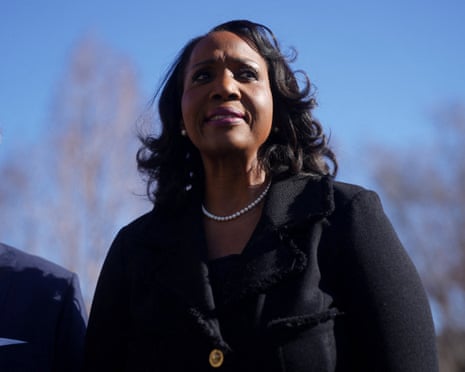
The case was centered on Lisa Cook, a Biden appointee whose 14-year term on the Federal Reserve board of governors is scheduled to expire in 2038. Cook is the first Black woman to serve on the Fed’s board.
Last August, on social media, Trump abruptly fired Cook. The president claimed he had evidence that Cook committed mortgage fraud, an illegal practice where a homebuyer lists a second property as a primary residence to get a better mortgage rate. Cook denied the allegations and sued the Trump administration, saying it fired her without cause.
The justices’ protection over the Fed decision is a departure from how the court has handled Trump in his second term, allowing the president broad power to carry out his agenda without congressional approval.
The court allowed Trump to remove a Democratic-appointed member of the National Labor Relations Board (NLRB), leaving the powerful union board without a quorum needed to decide on labor disputes. The court also stripped lower district courts of their power to issue nationwide injunctions, which was often used to block Trump in his first administration, and stayed a lower court’s ruling that restricted Immigration and Custom Enforcement’s (ICE) from using race and ethnicity as the basis for reasonable suspicion in immigration enforcement.
But Trump has finally met his limit. The ruling is a major win for the central bank, which has spent the last year under attack from the White House.
Here’s Lauren’s full report:
Key events
Supreme court rules Trump can fire leaders of independent agencies
Michael Sainato
The supreme court has ruled that Donald Trump can fire leaders of independent agencies or commissions, ending 90 years of court precedent that curbs executive power.
The vote in the case of Trump v Slaughter is 6-3, with dissents from Justices Sonia Sotomayor, Ketanji Brown Jackson and Elena Kagan.
The case was focused on the White House’s March 2025 firing of Federal Trade Commission member Rebecca Slaughter. Trump fired Slaughter over email, telling her that keeping her as a commissioner would be “inconsistent with [the] administration’s priorities”.
Upon her termination, Slaughter sued the Trump administration, saying she was fired without cause, and a lower court ruled for her reinstatement.
In challenging Slaughter’s suit, the White House argued the court should overturn Humphrey’s Executor v United States, a landmark ruling from 1935 where the supreme court ruled that the president unlawfully fired a member of the Federal Trade Commission (FTC), limiting the president’s power over independent agencies.
The FTC is tasked with enforcing consumer protection and anti-trust laws. The agency is structured with five bipartisan commissioners, and no more than three can come from the same party. Congress placed restrictions on the hiring and firing of commissioners in an effort to insulate the agency from partisan politics. The Trump administration asked the court of appeals to put the ruling on hold while it appealed, but was denied.
“The government is not likely to succeed on appeal because any ruling in its favor from this court would have to defy binding, on-point, and repeatedly preserved supreme court precedent,” two appeals judges wrote in the majority opinion.
The Trump administration then went to the supreme court, requesting a stay of the order while the government appeals. The supreme court voted to grant the stay of the order in September 2025, with three justices dissenting.
Overruling Humphrey’s executor, former government officials have warned, would undermine the independence of federal agencies.
“Eliminating these removal protections would jeopardize all facets of agency independence, as agency leaders would be reluctant to engage in regulatory or enforcement actions – or even day-to-day agency decision-making – without coordinating with the White House for fear of termination,” wrote Lauren McFerran, former National Labor Relations Board (NLRB) chair, and Celine McNicholas, a former official at the NLRB, in an Economic Policy Institute report from October 2025.
Supreme court rules Trump’s firing of Lisa Cook from Fed was unconstitutional
Lauren Aratani
The supreme court has ruled that Donald Trump’s firing of a Federal Reserve governor was unconstitutional, in a landmark ruling that limits a president’s authority over the central bank.
In its opinion, the court said that Trump does not have the constitutional authority to fire a Fed governor without cause.
The case was centered on Lisa Cook, a Biden appointee whose 14-year term on the Federal Reserve board of governors is scheduled to expire in 2038. Cook is the first Black woman to serve on the Fed’s board.
Last August, on social media, Trump abruptly fired Cook. The president claimed he had evidence that Cook committed mortgage fraud, an illegal practice where a homebuyer lists a second property as a primary residence to get a better mortgage rate. Cook denied the allegations and sued the Trump administration, saying it fired her without cause.
The justices’ protection over the Fed decision is a departure from how the court has handled Trump in his second term, allowing the president broad power to carry out his agenda without congressional approval.
The court allowed Trump to remove a Democratic-appointed member of the National Labor Relations Board (NLRB), leaving the powerful union board without a quorum needed to decide on labor disputes. The court also stripped lower district courts of their power to issue nationwide injunctions, which was often used to block Trump in his first administration, and stayed a lower court’s ruling that restricted Immigration and Custom Enforcement’s (ICE) from using race and ethnicity as the basis for reasonable suspicion in immigration enforcement.
But Trump has finally met his limit. The ruling is a major win for the central bank, which has spent the last year under attack from the White House.
Here’s Lauren’s full report:
Supreme court orders lower court to reconsider ‘geofence’ warrant case
The supreme court threw out a judicial decision involving a Virginia man’s challenge to a “geofence” warrant used by police to access cellphone location data near a crime scene leading to his conviction for armed robbery.
The justices, in a 6-3 decision, threw out a lower court’s ruling against defendant Okello Chatrie, who had argued he was subjected to an illegal search and that evidence in his case should be excluded. Chatrie conditionally pleaded guilty in 2022 to robbing a Midlothian, Virginia, credit union, while continuing to press his appeal.
The supreme court agreed that a search had occurred, but sent the case back to a lower court to conduct further analysis.
Court-approved geofence warrants compel third-party companies – such as Alphabet’s Google in the case before the justices – to search customer location data for mobile devices that were near the scene of a crime around the time it was committed. Google is not a party to the case.
Donald Trump’s administration defended the investigative method in the case.
With Reuters.
Supreme court upholds law to count mail-in ballots arriving after election day
Rachel Leingang
The supreme court sided against national Republicans and Donald Trump’s administration to allow mail-in ballots that arrive after election day to be counted, upholding the law in more than a dozen states.
The Republican National Committee (RNC) had challenged a Mississippi state law allowing mailed ballots to be counted if they arrive within five business days of election day, so long as they were postmarked by election day.
Fourteen states, Washington DC and three US territories have similar laws that allow for late-arriving ballots to be counted.
Some states, including Mississippi, changed their laws in 2020, during the Covid-19 pandemic. Mississippi, a red state, defended its ability to set its own procedures for elections against the challenge from the Republican party, which argued that the grace period after election day violates federal laws that set election day for the first Tuesday of November.
During oral arguments in Watson v Republican National Committee in March, the supreme court’s conservative justices laid out hypothetical situations to probe the limits of counting ballots after election day, and nodded to the potential for election fraud.
Several justices also questioned whether a voter could recall their ballot through the mail and change their vote – a hypothetical practice that Mississippi solicitor general Scott G Stewart said does not happen, claiming “nobody cited a single example in history”.
Liberal justices pointed to federal laws that allow for grace periods, while noting that a ruling here could also implicate early voting, another common practice.
“You’re basically saying there are two things that have to happen, and they have to happen on election day, and it’s the casting of the vote and the receipt of the vote,” Justice Elena Kagan told Paul D Clement, who is arguing on behalf of the Libertarian party of Mississippi.
The RNC lost its initial case in district court, then won in the fifth circuit court of appeals. In its brief to the supreme court, Mississippi argued that the appellate court’s decision was “wrong”.
A host of groups representing voting rights advocates, military voters and overseas voters filed to support Mississippi’s position in the case, saying that a grace period allows voters with unique burdens to have their ballots counted.
Here’s Rachel’s full report:
Supreme court won’t revive Alan Dershowitz’s $300m suit against CNN
The supreme court has also refused to revive a $300m defamation lawsuit filed against CNN over its coverage of a prominent attorney’s remarks made while defending Donald Trump during his 2020 impeachment.
The majority declined to take up the case in a brief, unexplained order. Justices Neil Gorsuch and Clarence Thomas dissented, calling on the court to reconsider the legal standards for public figures who claim defamation.
Alan Dershowitz said the news network aired only a portion of the comment made during his defense of the president, distorting his meaning to make him look like he’d “lost his mind”, according to court documents.
The network said that multiple outlets had interpreted his remarks in a similar way, and Dershowitz couldn’t show CNN was trying to mischaracterize what he said.
In his appeal, Dershowitz had urged the court to reconsider New York Times Co v Sullivan. The landmark first amendment case that made it harder for public figures to win libel lawsuits because it requires proof that an outlet knowingly published something false, or showed a reckless disregard for the truth.
Dershowitz, a retired Harvard Law School professor and legal commentator, was part of Trump’s defense team during his impeachment trial over allegations that Trump wanted political favors from Ukraine in return for US military aid. Trump was acquitted by the Senate.
Dershowitz responded to a question at one point by saying, “the only thing that would make a quid pro quo unlawful is if the quo were somehow illegal.” Providing arms to Ukraine , he said, wasn’t illegal.
He alleged that CNN only played what he said moments later:
Every public official that I know believes that his election is in the public interest and, mostly, they are right, your election is in the public interest, and if the president does something which he believes will help him get elected in the public interest, that cannot be the kind of quid pro quo that results in impeachment.
Dershowitz said the edit made it seem like he was arguing a president could avoid impeachment for illegal acts as long as he was doing it to get re-elected – a concept his original suit called “preposterous and foolish on its face”.
CNN countered by saying it did air his full remarks during its live coverage, and invited him on twice more to expand on his meaning.
Lower courts tossed out the suit, finding that Dershowitz hadn’t shown CNN acted with “actual malice” in its reporting, making it fall short of the standard set by New York Times Co v Sullivan.
With the Associated Press.
Supreme court rejects Trump’s push to toss $5m verdict in E Jean Carroll sexual abuse case
The supreme court has rejected a push by Donald Trump to throw out a jury’s finding that he sexually abused the writer E Jean Carroll at a New York City department store in the mid-1990s and later defamed her.
The high court declined to take up the case in a brief, unexplained order, as is typical. There were no noted dissents.
Trump’s lawyers had argued that allegations leading to the $5m verdict were propped up by “highly inflammatory” evidentiary rulings, including those that allowed the testimony of two other women who accused Trump of sexual abuse decades ago. Trump has denied all three women’s allegations.
Trump’s attorneys argued the judge broke federal evidence rules in the case. They framed it as a distraction from Trump’s unique duties as president, though the verdict came before his return to the White House.
“This mistreatment of a President cannot be allowed to stand,” attorney Justin D Smith wrote in court documents. Trump has since nominated Smith to be an appeals court judge.
A message from the Associated Press seeking comment was sent to Carroll’s attorneys after the supreme court decision.
Carroll’s lawyers had urged the justices to pass on the case. They argued that the women’s testimony was relevant because the allegations were similar and that Judge Lewis Kaplan’s decisions were in line with others around the country. “This question is not worthy of review,” wrote attorney Roberta Kaplan, who is not related to the judge.
Carroll, a longtime advice columnist and former TV talkshow host, testified at a 2023 trial that Trump turned a friendly encounter in spring 1996 into a violent attack in the dressing room at Bergdorf Goodman, a luxury retailer across the street from Trump Tower in Manhattan. The jury also found Trump liable for defaming Carroll when he denied her allegation in 2022.
A jury also awarded Carroll an additional $83.3m after a second defamation trial. Trump is also appealing that ruling, though it’s not yet before the supreme court.
Supreme court to release more opinions with major rulings still to come
The supreme court is due to release some of its final opinions at 10am ET, with major decisions including on Donald Trump’s effort to end birthright citizenship and to fire Federal Reserve governor Lisa Cook still to come.
Last week the court handed the Trump administration huge wins in major rulings on immigration. It gave the administration a green light to block asylum seekers at the US-Mexico border, in a decision that fundamentally reshapes the US asylum system. And it also ruled in favor of the administration’s bid to strip temporary protected status from hundreds of thousands of Haitians and Syrians, who were legally in the US and protected from deportation. The decisions, powered by court’s conservative justices, saw the supreme court accused of advancing a white supremacist agenda.
The court also struck down a restrictive gun law in Hawaii that bans people from carrying guns in certain public spaces and on private property without the permission of the property’s owner. And it found in favor of the former Monsanto company in a ruling could block thousands of lawsuits filed by people alleging the key ingredient in the weedkiller Roundup causes cancer.
Democratic challenger Graham Platner leads Republican incumbent Susan Collins by two points among likely voters in Maine, 49% to 47%, according to a new poll by the New York Times/Portland Press Herald/Siena.
While Platner holds a small edge in support, there is one troubling sign from the poll: it was conducted with likely voters in Maine and shows that 54% of respondents say they want Democrats to control the Senate.
That means that Platner is underperfoming that number, which is a sign that his controversies may cost him votes he should otherwise expect.
The representative from Florida Anna Paulina Luna and House GOP hardliners are holding on to a threat to block the annual defense bill unless Republican leaders attach the Save America Act voter citizenship measure to it – defying calls from Donald Trump to stand down, Politico reports.
Senate Republican leader John Thune has warned that any such attachment would kill the defense bill in the Senate, and it’s causing a fissure with other GOP lawmakers.
“She’s going to have to start being a team player,” the Texas representative Ronny Jackson told Politico last week, when the threats first emerged. “It’s not an institution that can function with one rogue member, especially in the small majority you have.”
Donald Trump has made several posts on Truth Social this morning. He posted about the Great American State Fair, asking if “people appreciate what a fantastic job we did in building and operating the Great American State Fair at the National Mall, packed with happy people, and everybody loving it”. It is unclear how many visitors the event has attracted.
He then moved on to discussing polling and gas prices, writing: “Highest Poll Numbers Ever. Even Higher than Election Day, November 5th. This despite the fact that, IRAN WILL NOT HAVE A NUCLEAR WEAPON!” and “GAS PRICES COMING DOWN, FAST! REPORT ANY ABUSES AT RETAIL LEVEL!!!”
Dharna Noor
The Trump administration is attempting to shrink public comment periods for fossil fuel leasing on federal land while shifting the financial risks of cleanup to taxpayers and allowing for more planet-warming emissions. It’s part of a broader effort to dismantle public input processes and save polluting companies money, advocates say.
“By ignoring public comment [requirements] while propping up companies,” said Alexa Dietrich, research director at the science advocacy organization Union of Concerned Scientists, “they’re really attacking democracy in a very clear way.”
The interior department said this week it wants to loosen two Biden-era regulations governing oil and gas drilling on national public lands. One would dramatically lower the fees that firms must pay for future cleanup costs before drilling; the second could allow companies to release more methane, a potent planet-warming pollutant.
The changes would also mean the Bureau of Land Management (BLM) – part of the interior department – would no longer be required to assess whether swaths of land proposed for oil and gas leasing have high potential for conflict with other resources such as wildlife habitat. And the proposal would slash the public’s ability to weigh in on oil and gas permitting.
Trump claims Iran has ‘requested’ meeting, to take place on Tuesday in Doha
Donald Trump said a meeting on Iran would be held on Tuesday in Doha, without giving further details.
“Iran has requested a meeting. It will take place tomorrow in Doha,” Trump wrote in all capital letters in a social media post today.
Tyler Hicks
Following a brutal Republican primary runoff in which Islamophobia took center stage, anti-Muslim hatred continues spilling into public life in Texas.
Texans say that the hate speech shared by elected officials is increasingly echoed by people in their everyday interactions, including discussions about education or interactions at a store, in a park, at university and at elementary school. In one case, students at the University of Houston were praying when a man approached them and burned a Qur’an. In other cases, people have been verbally attacked for wearing traditional garments.
“It definitely trickles down,” said Naila Syed, a Dallas resident and member of the Islamic Center of North America Council for Social Justice. Syed says her two young daughters have been confronted with anti-Islam “talking points” while at school. A fellow student asked them if they knew that followers of Islam treated women poorly. “To have a kid who has these points ready and memorized like this is just very concerning as a parent,” Syed said.
Multiple people said the hatred has made them uncomfortable venturing outside of their own home by themselves. Others requested the use of a pseudonym because they’ve already been the subject of threats and online harassment. Recently, Muslim attendees at the official Texas GOP convention – including some delegates – were told to convert to Christianity or leave the country. About the same time, a woman was filmed verbally accosting two Muslim women in a grocery store.
“Islam is a terrorist organization, not a religion,” the woman said. “This is not a Muslim country; this is a Christian country.”
Americans have grown less proud of their country’s history or the way its democracy works over the past decade, according to a new AP-NORC poll.
Americans’ pride in the US on several key attributes has dropped since 2017 -including the nation’s military and its political influence around the globe – according to the survey from the Associated Press-NORC Center for Public Affairs Research.
The poll was conducted in April, as the United States and Iran fought over the strait of Hormuz in a prolonged war that started with the US and Israel launching strikes on Iran.
New Gallup polling also finds that only 53% of US adults are “extremely” or “very” proud to be an American, the lowest reading in the trend dating back to 2001.
The findings point to a broad decline in patriotic sentiment over a tumultuous period that included most of president Donald Trump’s first term, the Covid pandemic and rising inflation that contributed to a backlash against president Joe Biden.
That timeframe also covers Trump’s return to the White House, where he’s taken more aggressive actions on immigration and issues abroad. Much of the falling positivity comes from Democrats, who have become increasingly disenchanted with the country since Trump’s first term.
Trump renaming fiasco fuels jokes as Maher takes Kennedy Center’s Mark Twain prize

David Smith
Outside the John F Kennedy Center for the Performing Arts, a giant tarpaulin remained in place to conceal Donald Trump’s humiliation.
Guests entering the national arts complex on Sunday night could not see the section of its marble facade where Trump’s name was recently erased to comply with a court order.
But once they sat down for the Mark Twain prize for American humor ceremony, there was no hiding place as performers delivered punchlines at the expense of a US president whose power appears to be waning, at least in this corner of Washington DC.
Paying tribute to this year’s recipient, the comedian Bill Maher, the actor Woody Harrelson said: “Finally, an award for my dear friend – ironically at the Trump Kennedy Center. No, all right, we fixed that.”
The audience erupted in applause. Then, apparently acknowledging the tarp-coated scaffolding, Harrelson added: “Not as though you’d be able to notice.”
Trump seized control of the Kennedy Center last year, installing himself as its chair. His handpicked board voted to rename it the Trump Kennedy Center and affix his name to the wall. But last month, a judge ruled that the addition of Trump’s name to the building was illegal and ordered that the 18 letters be removed.
Supreme court nears the end of its term with cases about Trump’s power to be decided
Hello and welcome to the US politics live blog.
The supreme court is expected to hand down decisions later today on several outstanding cases, before wrapping up a term that has focused on Donald Trump’s expansive claims of presidential power.
The justices usually announce all of their opinions before departing for a summer recess at the end of June. But the court still has 20 cases to rule on, with many expected to be major rulings, prompting speculation that justices are “running behind”.
Trump’s efforts to restrict birthright citizenship, fire the heads of most independent agencies at will and remove a sitting Federal Reserve governor are among the remaining eight cases the justices are expected to decide this week, AP reports.
The court also is weighing, in cases from West Virginia and Idaho, whether to uphold laws in roughly half the states that prohibit transgender girls and women from playing on their public school and college sports.
Two election-related cases remain, over state laws that allow a grace period for the receipt of mailed ballots, provided they are sent by election day, and limits on political party spending in support of candidates for Congress and president.
Also outstanding is a dispute over geofence warrants that collect the location history of cellphone users to find people near crime scenes. Critics say the practice is a fishing expedition that violates civil liberties.
In other developments:
-
Joe Biden has said Donald Trump has diminished America’s standing in the world “more than any president in history”. The former president delivered remarks highly critical of his successor, while giving the keynote address at a gala in Hanover, Maryland, hosted by the state’s Democratic party, which is hoping to help wrest control of Congress away from Trump and his Republican allies during November’s midterm elections.
-
A new round of escalating strikes between Iran and the US has continued, further undermining the fragile interim peace agreement between the two countries, and prompting Trump to threaten violence that would ensure Iran “will no longer exist”. On Sunday, Tehran launched drone and missile attacks against Bahrain and Kuwait after new US strikes on sites in southern Iran, and threatened a “complete halt” to negotiations to end the war.
-
Migrants in the US on temporary protected status should seek permanent residence or leave, Markwayne Mullin, the Homeland Security secretary, said in the wake of last week’s supreme court decision that stripped humanitarian protections from hundreds of thousands of immigrants.
-
An opaque White House office staffed largely by veterans of Elon Musk’s “department of government efficiency” (Doge) has quietly rebuilt some of the federal government’s most sensitive websites – for passport applications, voter registration, prescription-drug pricing and children’s savings – in ways critics say appear to violate federal law.
#Supreme #court #Trump #rulings #Fed #firing #Lisa #Cook #Jean #Carroll #appeal #mailin #ballots #politics #live #news