wellnessfitpro
This Fourth of July is of the utmost significance. It is the 250th anniversary of the US Declaration of Independence from Britain. The occasion marks a defining moment in human history – the founding of a republic based on the principles of equality (‘all men are created equal’) and liberty (‘life, liberty and the pursuit of happiness’). It is also a reminder of all that the nation and its people have achieved since the American Revolution.
The day is thus a major milestone in the history of the country, and a time for national celebrations, commemoration events and unity. Or at least it ought to be.
Sure, there have been special events taking place across the country. From the suburbs to the countryside, there are plenty of signs of Americans keeping the fires of patriotism lit. In our small town in upstate New York, houses are flying the Stars and Stripes, downtowns and supermarkets have ‘America 250’ displays, and we all look forward to the fireworks to come. And in city squares and bars from coast to coast, Americans in red, white and blue gear gather to cheer on their (surprisingly good) football team in the World Cup.
But, at the national level, there’s disappointingly little of note to show for this grand occasion. I am old enough to remember America’s Bicentennial in 1976, when the country was in a much more festive and patriotic mood. Although a teen at the time, I still recall how excited people were to see the Tall Ships (large, traditionally rigged sailing ships) arrive in New York Harbor. Families drove across the country to celebrate in Boston’s Bunker Hill, Philadelphia’s Independence Hall and Colonial Williamsburg in Virginia. Even though they had lived through the divisive years of the Vietnam War, Watergate and Arab oil embargoes, Americans seemed to welcome the opportunity to celebrate and express pride in their country.
There’s little sign of any such unifying impulse today. Instead of bringing us together, politicians are using the 250th anniversary to indulge in just another round of partisan bickering. With Trump in the White House, Democrats seek to avoid joining in celebrations that might give any reflective glow to the man they despise. In true ‘Resistance’ fashion, 10 states with Democratic Party governors have refused to participate in the Great American State Fair on the National Mall in Washington, DC. And facing cancellation or censure from their woke peers, one by one, B-list pop stars have backed out of anniversary music events. In turn, Trump huffily decided to take his ball and go home. He scaled back events and effectively turned the Fourth of July into another series of MAGA rallies. The keynote event of the 250th anniversary may end up being last month’s Trump-organised UFC fight on the South Lawn of the White House.
Behind the muted celebrations and political infighting over these events lies a dismaying fact – over time, fewer Americans have patriotic feelings for their country and their fellow countrymen. According to a recent Gallup poll, just 53 per cent of Americans feel ‘extremely’ or ‘very’ proud to be American – the lowest level in 25 years. The proportion of Americans who were very proud of their nation surged to over 90 per cent in the aftermath of the 9/11 attacks in 2001, and remained at 80 per cent until 2016, after which it started to fall.
What’s driving this decline in national pride? One obvious answer is Democrats. Today, 93 per cent of Republicans are extremely or very proud to be American, versus only 27 per cent of Democrats. This wasn’t always the case: in the early 2000s, Democrats were as proud of America as Republicans were. Certainly, a key factor explaining such low levels of pride is the Democrats’ response to Trump. If The Donald is seen to own the patriotic brand, then they must be against it. ‘I can’t love a country that’s led by a racist, misogynist, xenophobic tyrant’, said actor Robert De Niro last month, speaking for many of his fellow liberals. But the Democrats’ declining pride in their country is not all about Trump. Democrats were less proud than Republicans when Obama and Biden were in the White House, too. And besides, a patriotism that is conditional on which party is in power can hardly be said to show devotion to the nation itself.
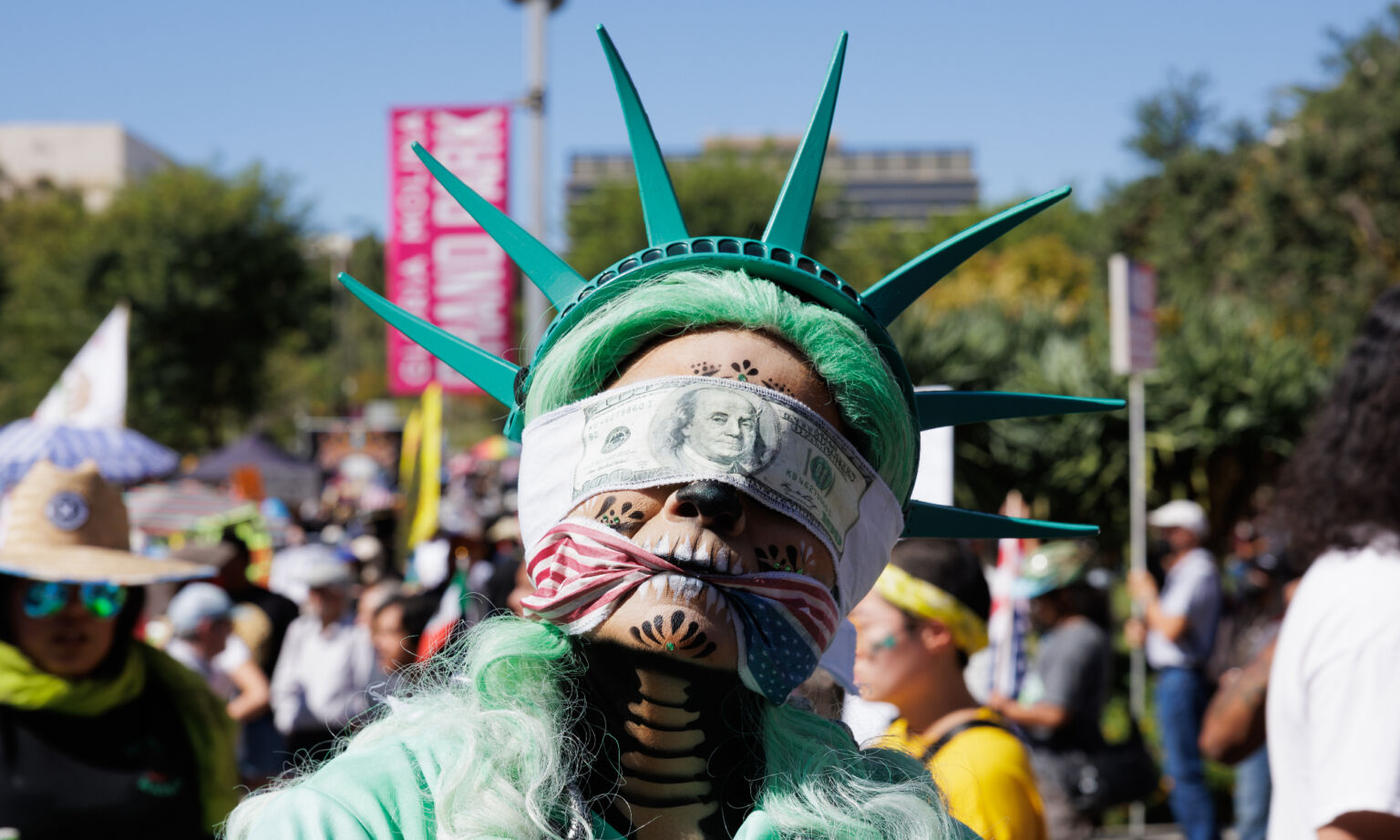
A protester at the anti-Trump ‘No Kings’ protest, Los Angeles, California, 18 October 2025.
A scene relayed in a recent Yoni Appelbaum article in the Atlantic, ‘How America gave up on its own history’, summed up the cultural elites’ discomfort with national pride. Appelbaum was invited to join ‘an assemblage of distinguished jurists, Ivy League professors, nonprofit leaders, journalists and theologians’ to help identify a shared narrative for the country. Sitting in a half-circle, Appelbaum volunteered a one-word starting point to the group: ‘patriotism’. Then all hell broke loose:
‘I had rolled a live grenade into the centre of the room. One participant flinched, as if struck. Suddenly, everyone was talking at once, voices and tempers rising. One woman said the word made her feel excluded. Another said it connoted violence and racism. Still another participant was offended that anyone could be offended by the word. The facilitator declined to write patriotism on the easel. As the quarrelling continued, I sat back, stunned. All of the people in the room had come here for the specific purpose of finding a common narrative. What hope did that project have if they could not even agree – each in their own way – on loving the country they were trying to save?’
This recent trend in declining national pride can largely be attributed to the growing influence of anti-American ideology. Ideas generated in the academy by left-leaning historians portraying the US in a one-sidedly negative light have, over time, spread to the Democratic Party mainstream. From this point of view, the US is not simply a country with flaws in its history. Rather, it is a nation defined by racism and violence from its very inception. It is a nation that is seen as ultimately illegitimate.
According to this worldview, the maltreatment of Native Americans and the enslavement of black people are presented as foundational to the US. These acts are supposedly written into the DNA of America, creating a fundamentally racist and exploitative society that persists to this day. This dark vision was exemplified by the New York Times’ 1619 Project, launched in 2019, which erroneously claimed that the US rebelled against Britain to preserve slavery.
If you buy into this perspective, as unfortunately many Democrats do, claiming to be patriotic makes no sense. What is there to love about the US if, in the words of Democrat House minority leader Hakeem Jeffries, ‘systemic racism has been in the soil of America for over 400 years’? Why celebrate the nation’s founders, if you believe their most important characteristic was their slaveholding? The only proper response to American history, from this view, is to express overwhelming guilt and offer endless apologies for the past.
One obvious rebuttal to those who are excessively down on the US is to point out all that is great about this nation, and how that outweighs its faults. The US’s long-standing constitutional system and commitment to liberal values, such as free speech. Its continued economic growth and technological innovation. The relative autonomy afforded to people, allowing them to work together in civil society, including local government, voluntary associations and churches. Its natural beauty. And, of course, its people.
Indeed, during the World Cup, foreign fans have reminded Americans that they have much to be grateful for. Visitors from Scotland to Japan have taken to social media to praise aspects of daily life in the US, from the vastness and beauty, to the super stores and comparative mass affluence, to the food culture (with free refills, chips and salsa!) and the warmth of ordinary people. These are all things that we Americans often take for granted.
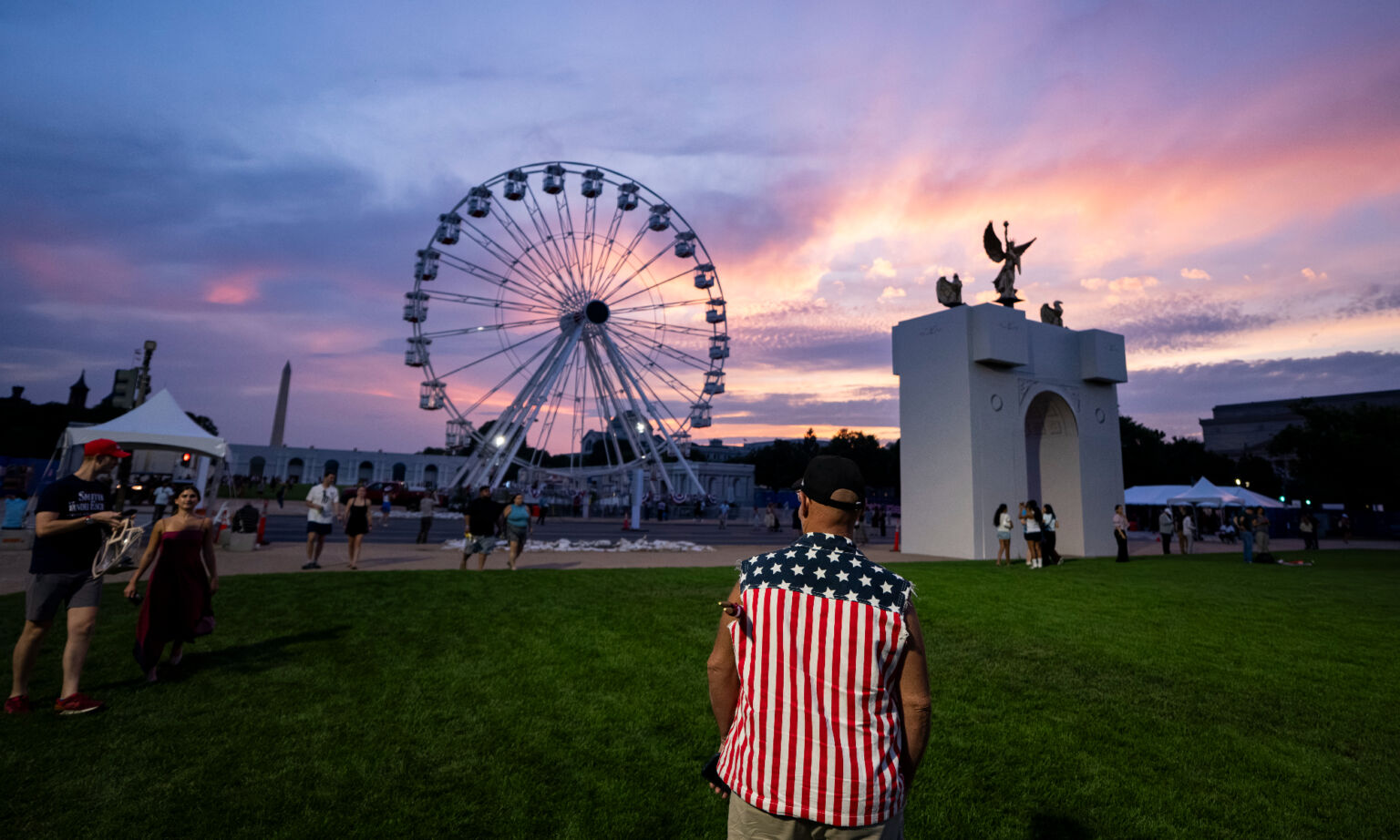
A ferris wheel on the first day of the ‘Great American State Fair’ on the National Mall, Washington, DC, 25 June 2026.
But reminders of positive achievements, however impressive, will not be sufficient to restore a sense of national pride. What’s needed is an accurate and inspiring story about the country and its heroes, a story in which people are encouraged to see themselves as participants, engaged in a shared project for the future. Just as a narrative of anti-Americanism has discouraged feelings of national pride and divided people, so a persuasive counter-narrative has the potential to spur greater patriotism and cohesion. Appelbaum warns that failure to agree on a shared understanding could have severe consequences for the US: ‘A nation defined by blood and soil – built around a shared religion or ethnicity – can survive divergent narratives. To a country built on an idea, though, and bound together by a shared understanding of our history, the inability to tell a common story might well prove fatal.’
This is why a proper commemoration of the 250th anniversary of the founding of the US, with a reaffirmation of the country’s ideals and accomplishments, is so important. ‘If we want rising generations to understand and appreciate their country’, argues historian Wilfred McClay, ‘we must ensure that they grasp the essential meaning of the American Revolution’. Without that point of reference, says McClay, we will ‘eventually forget who we are as a people’. When considering US history, McClay argues for ‘remembrance in full’, that is, ‘a mature perspective that can place America’s great achievements in proper relation to its admitted failings and shortcomings’. And to specifically grasp the meaning of the Revolution, we need to begin with ‘a sense of the brilliant light that entered the world in 1776, when, for the first time in history, a nation came into being explicitly committed to the principle that liberty and equality are endowments bestowed upon all human beings’.
There has always been a gap between the promises of liberty and equality in the Declaration and the reality on the ground. But that doesn’t make those promises false or a smokescreen. Instead, America’s founders, by synthesising various strands of the Western tradition, were setting new standards for society. They were establishing goals that a free people should strive to achieve and judge themselves against. Thomas Jefferson may have been a slaveholder, but it was his words – and his compatriots’ revolutionary deeds – that helped inspire and drive the country much closer to the ideals of the Declaration.
Without patriotism, the US will struggle to amount to much more than groups of people sharing the same geography. We will always have disagreements on what exactly constitutes the good life and what the best way forward for the country is. But if we agree on certain fundamentals, these political debates can help us forge a shared project, rather than descend into civil war. Importantly, those fundamentals include agreement on continuing and building on America’s founding principles, an appreciation for the progress we have made to realise our ideals and a spirit of gratefulness towards our ancestors’ shared sacrifices to get us to where we are today. Patriotism shouldn’t be a partisan issue.
Despite the general confusion and political fighting that appears to surround our 250th anniversary, I hope my fellow Americans use the occasion to celebrate and to express gratitude for living in a country based on ‘life, liberty and the pursuit of happiness’.
America is a land of hope. And I too remain hopeful that our nation will continue to flourish in the future.
Sean Collins is a writer based in New York. Visit his blog, The American Situation.
#Rekindling #spirit #American #patriotism