wellnessfitpro
64 dead, 58 injured in Spain train crash, local authorities say
The latest local government update confirms 64 dead, and 58 injured in today’s crash.
40 of the dead were travelling on the Iryo train, and 24 on the AVE high-speed train, it added.
Key events
-
Spanish transport minister confirms signalling issue; says ‘inexplicable’ traffic decision preceded crash
-
Spanish transport minister briefing the press
-
Train crash survivors arrive at a makeshift emergency reception – in pictures
-
Andalusia declares three days of mourning
-
64 dead, 58 injured in Spain train crash, local authorities say
-
Spain’s Sánchez expected to travel to crash site later today
-
Death toll from Spain train crash rises to 64
-
Latest pictures from the scene – video
-
Latest pictures from the scene of the crash
-
Signalling system likely to come under close scrutiny – snap analysis
-
Death toll from train crash rises to 31
-
All Spanish Cup football games cancelled as mark of respect
-
EU ‘ready to support’ Spanish investigation into train crash
-
At least 30 dead, 80 injured, with concerns death toll could rise further – what we know
-
Aerial footage from the crash scene – video
-
At least 30 dead, 80 injured, but numbers likely to rise, local president says
-
Death toll may rise further, local government spokesperson warns
-
At least 30 dead in Spanish train crash, local government confirms
-
Spanish royals express concern for and support to all affected by train crash
-
‘Europe mourns in you,’ EU’s von der Leyen responds to train collision in Spain
-
At least 30 dead after two train collide in Spain – what do we know
-
Spain’s transport minister working to ‘obtain all possible information’
-
Spanish PM, opposition leader ‘shocked’ by train crash in Toledo
-
Spanish health minister fears ‘major tragedy’ after train collision in Toledo
-
Toledo crash brings back memories of deadly crash in Adamuz
-
Death toll likely to rise, local government spokesperson warns
-
At least 10 feared dead after collision in Toledo province
Puente says that while a signalling failure “can happen”, there are strict standard procedures for how to proceed in such cases, as he once again heavily hints at a combination of technical and human errors.
He says the order to restart traffic should not have been issued, and that even if it was taken, the train in question should have been instructed to restart “on sight” – meaning driver should only move very slowly, under strict restrictions, at maximum 40km/h, and not at normal speed.
He says the person responsible for the decision is now under investigation.
He does not answer a question if he intends to resign.
Spanish transport minister confirms signalling issue; says ‘inexplicable’ traffic decision preceded crash
Puente begins by paying tribute to all affected by the crash.
“We are absolutely devastated; as you can well imagine, this is one of the most difficult moments one could ever face,” he says.
He says a rear-end collision is an unusual thing on the Spanish network, which is why his enquiries focused on understanding what happened.
He has he has been able to see a full reconstruction of the incident and review audio recordings of all communications between the affected trains and the traffic control.
He says that around 8:30am this morning, the LZB controlling system failed due to communications issues, leaving no coverage for just over 60km of the track, which in turn triggered an automatic stop for six trains on that stretch.
But around 8:36, the Adif control centre issued a manual instruction to override the warning and let the traffic resume.
He heavily suggests that this “inexplicable” decision should not have been made, as trains should have remained under strict orders not to move.
During the next 25 minutes, the second AVE train travelled 25 kilometers and eventually collided with a stationary Iryo train.
“This is the account of events that I can provide,” he says.
Spanish transport minister briefing the press
Spanish transport minister Óscar Puente is speaking now, but he’s having some audio issues with his microphone that they are trying to sort out.
Once that’s resolved, I will bring you his key lines here.
UK ambassador to Spain Alex Ellis expressed his concern about the incident and support to all affected.
“If you are a British national and you or a family member have been affected by the train crash and require consular support, call the nearest British Consulate on 0034 91 714 6300.”
Train crash survivors arrive at a makeshift emergency reception – in pictures
We are also getting some first pictures from emergency reception areas supporting those affected by the crash.
Andalusia declares three days of mourning
The Andalusian regional government has declared three days of mourning. “We are devastated,” its president, Juanma Moreno, said.
“All of Andalusia stands with the victims of this latest train accident,” he added.
Earlier today, the mayor of Seville, José Luis Sanz, also announced three days of mourning and suspended all official events.
Jakub Krupa
We are still expecting to hear from Spain’s transport minister Óscar Puente shortly. I will bring you his comments when he shows up.
64 dead, 58 injured in Spain train crash, local authorities say
The latest local government update confirms 64 dead, and 58 injured in today’s crash.
40 of the dead were travelling on the Iryo train, and 24 on the AVE high-speed train, it added.
Spain’s Sánchez expected to travel to crash site later today
Spanish prime minister Pedro Sánchez is expected to travel to the scene of the crash later today.
The government said:
“The President of the Government, @sanchezcastejon, is traveling to Urda to support the work of the emergency teams and convey his support to those affected and their families.
The priority is to attend to the victims and ensure the maximum coordination between administrations.”
Death toll from Spain train crash rises to 64
Death toll from the train crash has gone up to 64, sources in the local government in Castilla la Mancha told RTVE, El País and Reuters.
It makes it a deadlier incident than this January’s Adamuz crash (11:00), and the third worst train disaster in Spain since the seventies (12:55).
The death toll is still likely to change.
Latest pictures from the scene – video
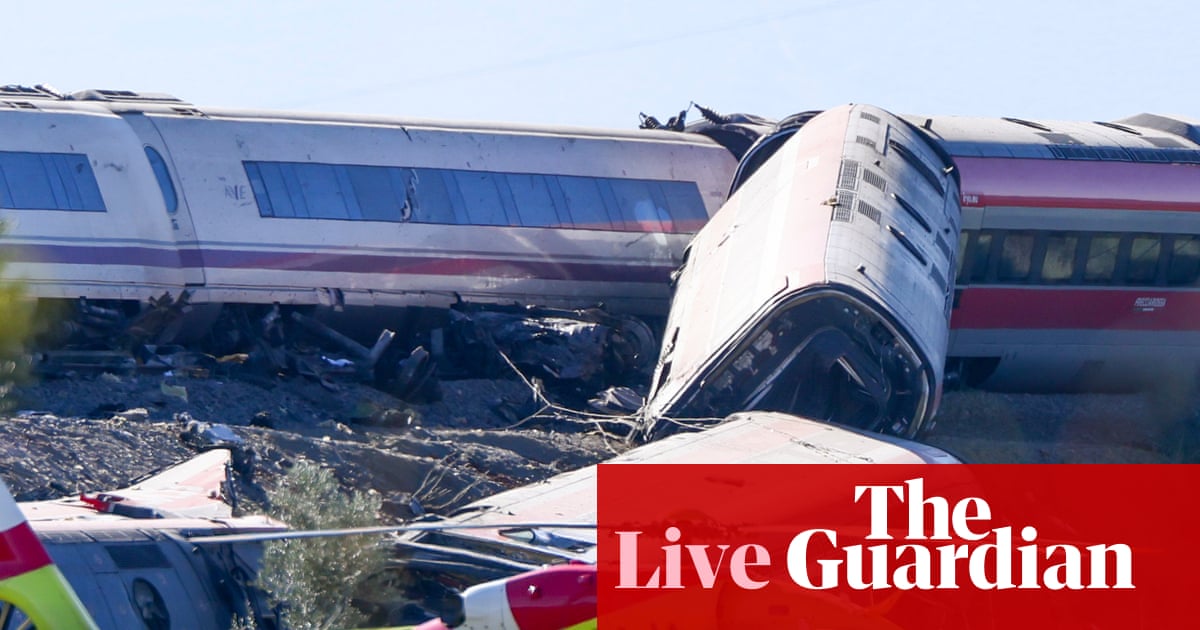
Latest pictures from the scene of the crash
Latest dramatic pictures from the scene show the scale of devastation and appear to show a piece of broken rail going through the roof of one of the affected trains.
Signalling system likely to come under close scrutiny – snap analysis

Gwyn Topham
Transport correspondent
The signalling system used on the high-speed line between Madrid and Seville will come under scrutiny as investigators seek to understand Spain’s latest horrific rail crash.
The rear-end collision between two trains, whose death toll already looks likely to exceed the disaster in Adamuz on the same line in January, should, theoretically, be a remoter risk than other types of accident.
The LZB signalling system should automatically stop a train if the line ahead is occupied, even if the driver failed to apply the brakes.
The technology, used previously in Germany before being installed on the Spanish high-speed line, translates as “linear train control” and uses continuous electronic communication between the track and train to control speeds.
That should make it safer than, for example, the stretch of the Midland main line in the UK where a rear-end collision occurred earlier this year – the first fatal crash of its type between two passenger trains in Britain for more than 40 years.
In that part of the railway, there was no technology to automatically stop the second train, whose driver failed to apply the brakes when passing a red light that warned of danger ahead.
Spain has had another high-speed disaster, in Galicia in 2013, under a system where the driver was able to ignore speed warnings.
This should not have been possible under this system – a different scenario for investigators than the faulty rails identified in the head-on Adamuz crash.
According to early, unconfirmed reports from Spain (12:30), the first train, an Iryo service, may have stopped after flagging a failure in the LZB system.
Spain, like all European operators of high-speed lines, is transitioning its various signalling systems to a standard ERTMS service.
Jakub Krupa
We are expecting to hear from Spain’s transport minister Óscar Puente at the top of the hour, at 2pm local time (1pm UK).
Spain’s former labour minister Fátima Báñez was reportedly on one of the trains caught up in this morning’s crash.
Speaking just now on RTVE, Antonio Sanz, the Andalusia government’s emergency minister, confirmed she is believed to have been on board and has not yet been reached since the incident.
#Death #toll #rises #trains #collide #Spain #latest #updates #World #news