wellnessfitpro
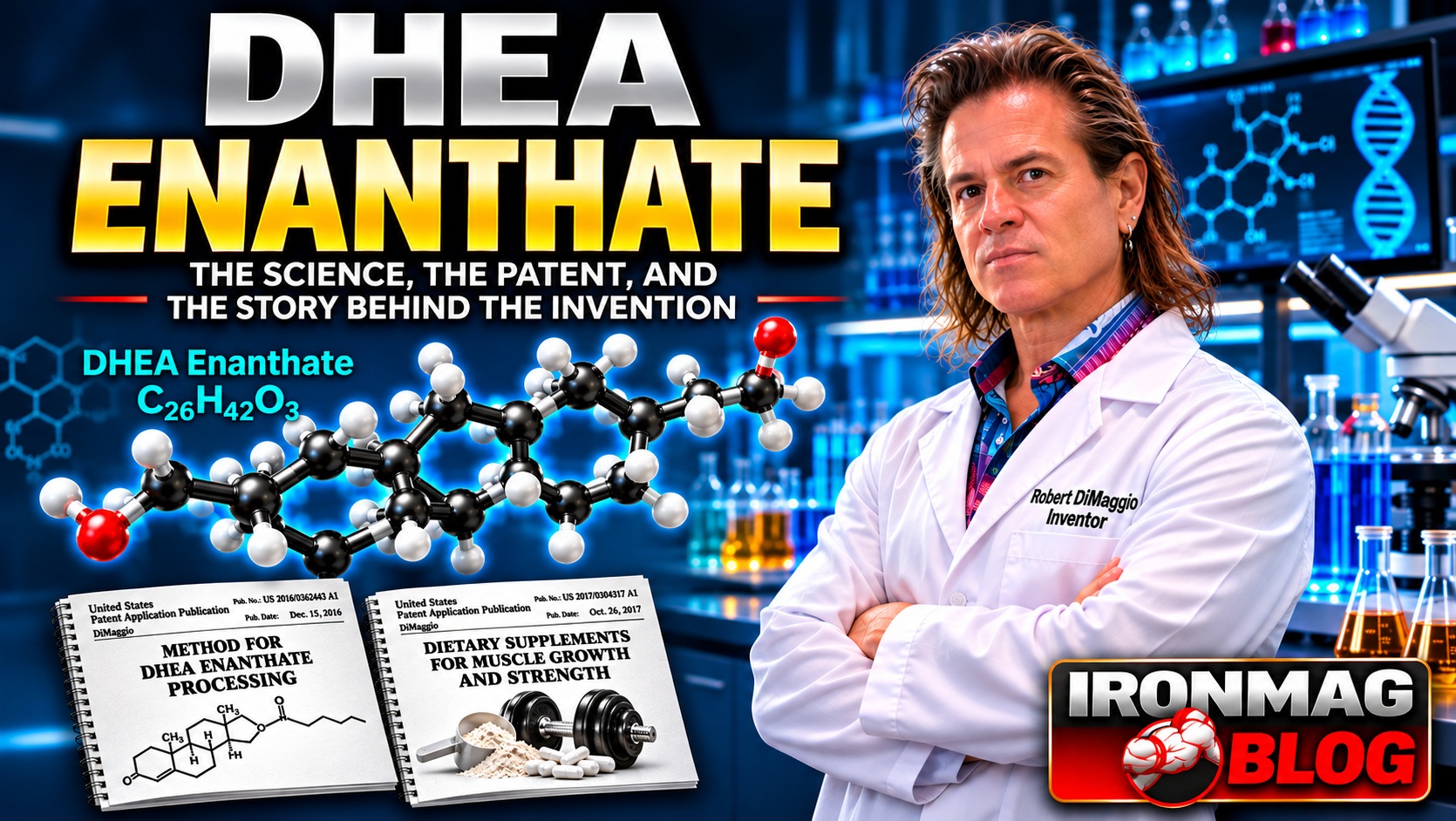
Two Inventions, Three Patent Publications, and the Pursuit of Innovation in Sports Nutrition
Introduction: Beyond the Supplement Industry
The bodybuilding supplement industry has always been driven by innovation. From advancements in sports nutrition to the development of novel hormonal compounds, the industry has attracted entrepreneurs willing to challenge conventional thinking about human performance.
Among those entrepreneurs is Robert DiMaggio, founder of IronMag Labs, whose work extended beyond developing and marketing bodybuilding supplements into chemical research, steroid derivatives, and intellectual property.
DiMaggio’s contributions include two related areas of invention: the processing of DHEA Enanthate and the development of dietary supplement formulations intended to support muscle growth, strength, recovery, and physical performance.
These inventions were documented through three published United States patent applications.
The first two publications concerned methods for processing DHEA Enanthate. The third expanded the underlying research into dietary supplement compositions involving DHEA derivatives and additional ingredients.
Together, these applications offer a documented look at DiMaggio’s efforts to explore steroid chemistry and its potential applications in sports nutrition.
This article examines the inventions, their scientific foundations, their relationship to one another, and their place in the history of IronMag Labs.
Importantly, the applications represent published inventions, not FDA-approved products or proof of clinically established performance benefits.
1. The Patent Applications: Understanding the Historical Record
Robert DiMaggio is identified as an inventor on three U.S. patent application publications associated with two closely related areas of research.
The three publications are:
US20160362442A1 — Method For DHEA Enanthate Processing
Published December 15, 2016.
US20160362443A1 — Method For DHEA Enanthate Processing
Published December 15, 2016.
US20170304317A1 — Dietary Supplements for Muscle Growth and Strength
Published October 26, 2017.
The first two publications concern DHEA Enanthate processing, while the 2017 publication addresses compositions intended for oral administration.
The 2017 application is identified as a continuation-in-part of an earlier DHEA Enanthate application.
A continuation-in-part can incorporate material from an earlier filing while introducing additional subject matter.
This relationship is significant because it demonstrates how the research progressed from processing a particular steroid derivative toward exploring more complex formulations.
Rather than viewing the three publications as three entirely independent inventions, they are better understood as a connected body of research addressing two principal technical subjects.
All three are published patent applications. Publication does not mean a patent was granted.
2. DHEA: The Scientific Foundation
Dehydroepiandrosterone, commonly known as DHEA, is a naturally occurring steroid hormone produced primarily by the adrenal glands.
DHEA serves as a precursor in the body’s complex network of steroid hormone metabolism.
Depending on the tissue and its enzyme activity, DHEA can be converted into other compounds, including androgenic and estrogenic hormones.
This makes DHEA scientifically interesting because its biological effects depend not only on the compound itself but also on how the body metabolizes it.
Why DHEA attracted attention in bodybuilding
The bodybuilding industry has long been interested in compounds that might influence hormonal signaling, muscle development, recovery, and body composition.
DHEA attracted attention because of its relationship to androgen metabolism.
However, ordinary DHEA is not equivalent to testosterone or a conventional anabolic-androgenic steroid.
Although DHEA can participate in pathways leading to more potent hormones, its effects vary considerably among individuals.
Research examining DHEA supplementation has produced mixed results regarding muscle growth, strength, and athletic performance.
That uncertainty provides important context for understanding DiMaggio’s research.
Rather than simply examining unmodified DHEA, the inventions explored chemical derivatives and formulations that could potentially alter how these substances behave.
3. The First Invention: Method for DHEA Enanthate Processing
Patent Application Publications: US20160362442A1 and US20160362443A1
The first major area of DiMaggio’s documented research involved DHEA Enanthate, an esterified derivative of dehydroepiandrosterone.
DHEA Enanthate differs chemically from ordinary DHEA because an enanthate ester is attached to the steroid molecule.
This modification is significant because esterification can change a compound’s physical and chemical properties.
What is an enanthate ester?
An enanthate ester is derived from heptanoic acid, a seven-carbon carboxylic acid.
In steroid chemistry, esterification can influence characteristics such as lipid solubility, dissolution, and susceptibility to enzymatic breakdown.
Testosterone enanthate is a familiar example of an esterified steroid used in medicine.
However, the presence of an enanthate ester does not mean DHEA Enanthate will behave identically to testosterone enanthate.
The underlying steroid structure, formulation, metabolism, and route of administration all influence biological activity.
The chemistry of DHEA Enanthate
Ordinary DHEA has the molecular formula:
C₁₉H₂₈O₂
DHEA Enanthate has the molecular formula:
C₂₆H₄₀O₃
The molecular modification involves esterification of the hydroxyl group at the third carbon position of DHEA.
This increases molecular weight and changes the molecule’s physicochemical characteristics.
One scientific question is whether DHEA Enanthate can undergo enzymatic hydrolysis after entering the body, potentially releasing DHEA.
If that occurs, the compound could function as a prodrug.
However, the extent and rate of hydrolysis would need to be established experimentally.
What DiMaggio’s applications addressed
The published applications describe methods associated with processing DHEA Enanthate.
Their subject matter includes chemical processing and purification considerations relevant to obtaining the desired derivative.
The invention was not simply the idea of taking DHEA as a dietary supplement.
Instead, it addressed technical methods involving a chemically modified steroid.
This distinction matters because chemical processing and manufacturing methods can be subjects of patent applications independently of the eventual biological uses of a compound.
Patent publication history
The first application, US14/736,103, was filed on June 10, 2015.
A related application, US14/877,567, followed on October 7, 2015.
Both were published on December 15, 2016.
The publications identify Robert DiMaggio as inventor.
Both applications are listed as abandoned in Google Patents.
Their publication nevertheless preserves the disclosed methods and the associated filing history.
Official documents:
US20160362442A1 — Method For DHEA Enanthate Processing
US20160362443A1 — Method For DHEA Enanthate Processing
4. The Second Invention: Dietary Supplements for Muscle Growth and Strength
Patent Application Publication: US20170304317A1
The second major invention represents an expansion of DiMaggio’s earlier work.
Rather than focusing primarily on processing DHEA Enanthate, this application addresses compositions intended for oral administration of DHEA derivatives.
Its stated objectives include supporting aspects of physical performance, muscle development, recovery, and body composition.
The application was filed on July 7, 2017, and published on October 26, 2017.
It identifies Robert DiMaggio as inventor.
Moving from chemical processing to formulation development
The distinction between the two inventions is important.
The earlier applications primarily concerned processing a particular steroid derivative.
The later application explored combinations of DHEA-related compounds with other ingredients.
This represents a different technical challenge.
Developing a formulation involves considering not only the active compound but also its physical properties, compatibility with other ingredients, and potential absorption and metabolism.
The application describes an oral composition involving several components.
Component 1: DHEA derivatives
The patent application identifies alternative steroid-derived compounds as potential principal ingredients.
These include chemically modified androstane derivatives.
Such modifications are scientifically relevant because relatively small changes to a steroid’s molecular structure can affect its properties and interactions with biological systems.
However, structural similarity to known hormones does not establish equivalent biological activity.
Each derivative requires independent evaluation.
Component 2: 6,7-Dihydroxybergamottin
The application also describes 6,7-dihydroxybergamottin, commonly abbreviated DHB.
This compound is associated with grapefruit and has attracted pharmacological interest because of its effects on certain drug-metabolizing enzymes.
In particular, grapefruit-associated compounds can inhibit intestinal CYP3A4 activity.
This is relevant because CYP3A4 participates in the metabolism of many medications and other substances.
Modifying metabolic enzyme activity could theoretically alter exposure to certain compounds.
However, this introduces important safety considerations.
Inhibiting drug-metabolizing enzymes can increase exposure to medications and create potentially dangerous interactions.
Therefore, including DHB in a formulation should not automatically be interpreted as an established method for safely improving supplement effectiveness.
Component 3: Piperine
Another ingredient described in the application is piperine.
Piperine is a naturally occurring alkaloid found in black pepper.
It has been investigated for its potential effects on the absorption and metabolism of certain compounds.
Piperine is frequently discussed in supplement formulation because it can influence some metabolic and transport processes.
However, these effects are compound-specific.
The presence of piperine does not guarantee improved absorption, enhanced anabolic activity, or better athletic performance.
Like DHB, piperine may also affect the handling of certain medications.
Component 4: Supporting formulation ingredients
The application also identifies conventional formulation materials, including rice flour, gelatin, magnesium stearate, and silica.
Such ingredients can serve functions related to capsule construction, manufacturing, powder handling, or formulation stability.
Their inclusion demonstrates that the invention addressed a proposed finished oral composition rather than only an isolated steroid derivative.
What the invention was intended to accomplish
The application describes potential objectives involving:
- Skeletal muscle growth and increased strength.
- Improved recovery from physical training.
- Increased endurance and physical performance.
- Reduction of adipose tissue.
- Changes in adrenal hormonal balance and other physiological functions.
These are objectives described in the patent application, not independently verified clinical outcomes.
The application does not establish that the proposed formulations achieve these benefits in humans.
Nevertheless, it documents an attempt to combine steroid chemistry with formulation concepts relevant to the sports nutrition industry.
Official document:
US20170304317A1 — Dietary Supplements for Muscle Growth and Strength
5. How the Two Inventions Are Connected
The relationship between the inventions is particularly interesting.
The 2017 dietary supplement application is identified as a continuation-in-part of the June 2015 DHEA Enanthate processing application.
This establishes a formal connection within the patent record.
The earlier work addressed the preparation and processing of a modified steroid compound.
The later work expanded into formulations combining DHEA derivatives with additional ingredients.
The progression illustrates two different dimensions of product research.
Chemical development concerns the properties, identity, and processing of a substance.
Formulation development concerns how ingredients are combined into a particular composition.
Both can be important in pharmaceutical and supplement research, although neither alone establishes that a finished product is safe or effective.
The patent record shows that DiMaggio pursued both areas.
It also helps explain why the three publications should be discussed together when documenting his work.
6. The Science of Bioavailability: Why Formulation Matters
One of the most interesting scientific themes connecting the inventions is bioavailability.
Bioavailability generally refers to the extent and rate at which a substance reaches systemic circulation after administration.
For orally administered compounds, bioavailability can be influenced by numerous factors, including chemical structure, solubility, dissolution, absorption, and metabolism.
These factors are particularly relevant when investigating steroid derivatives.
The role of esterification
Esterification changes a steroid molecule’s chemical properties.
Depending on the compound, these changes may affect solubility, distribution, or metabolism.
However, esterification does not automatically improve oral bioavailability.
In some circumstances, increasing lipid solubility can create additional challenges involving dissolution or formulation.
The actual effects must be measured experimentally.
The role of metabolic modifiers
The later application introduces a different concept through ingredients such as DHB and piperine.
These compounds have been investigated for their effects on certain metabolic processes.
The scientific premise is that altering metabolism or transport could change exposure to another substance.
However, the outcome depends on the particular combination.
Greater systemic exposure is not necessarily beneficial and may increase toxicity.
The proposed combinations therefore raise questions about both pharmacokinetics and safety.
Why the distinction matters
The two inventions address different scientific problems.
The DHEA Enanthate processing applications concern the preparation of a chemically modified steroid.
The dietary supplement application concerns compositions incorporating steroid derivatives and other ingredients.
Understanding this distinction makes the technical relationship between the inventions clearer.
It also demonstrates why research into a compound’s chemistry and research into its biological effects are separate scientific undertakings.
7. Potential Applications in Bodybuilding and Strength Training
The relevance of these inventions to bodybuilding is understandable.
Muscle development and athletic performance are influenced by several physiological systems, including androgen signaling, energy metabolism, nutrition, and recovery.
Steroid hormones play important roles in human physiology, particularly in processes involving reproductive function, secondary sexual characteristics, and certain aspects of muscle metabolism.
DHEA occupies a position within this broader hormonal network.
Its derivatives are therefore of scientific interest.
However, several important limitations must be recognized.
Muscle growth
Anabolic-androgenic steroids can influence skeletal muscle through androgen receptor signaling.
DHEA itself is a relatively weak androgen, and its biological activity often depends on metabolism into other compounds.
It cannot be assumed that DHEA Enanthate or the derivatives described in DiMaggio’s applications have substantial anabolic activity.
Direct experimental evidence would be required.
Strength and endurance
Increased strength can result from improvements in muscle size, neural adaptations, training efficiency, and other factors.
Endurance depends on additional physiological systems, including cardiovascular function and energy metabolism.
A patent application describing intended improvements in these areas does not establish that the proposed composition produces those effects.
Recovery
Recovery from resistance training involves muscle repair, inflammation, sleep, nutritional intake, and numerous hormonal processes.
Although the later application discusses improved recovery as an objective, controlled human studies would be necessary to establish a meaningful benefit.
The scientific significance of these applications lies in the documented inventions and research concepts, not in proof of enhanced athletic performance.
8. Robert DiMaggio and the Development of IronMag Labs
Robert DiMaggio founded IronMag Labs during a period of significant growth and experimentation in the bodybuilding supplement industry.
The company became associated with products aimed at serious bodybuilders and strength-training enthusiasts.
DiMaggio’s involvement in the industry extended beyond conventional sports nutrition products.
His work included the development and commercialization of products associated with novel hormonal compounds and performance-oriented supplementation.
Among the products connected to his history in the industry were Super-DMZ, Osta Rx, and formulations involving methylstenbolone.
These products belong to a broader and sometimes controversial period in supplement-industry history, when the distinction between dietary supplements, investigational compounds, and substances regulated as drugs became increasingly important.
The patent applications offer a different perspective on that history.
They document DiMaggio’s involvement in formal intellectual property filings related to steroid chemistry and formulation development.
From business development to intellectual property
Creating a supplement company requires knowledge of product development, manufacturing, distribution, marketing, and customer demand.
Pursuing a patent application introduces additional technical and legal considerations.
An inventor must describe the proposed invention and its subject matter in sufficient detail to satisfy applicable patent requirements.
The claims then define the protection being sought.
The process can involve examination, correspondence, amendments, and significant expense.
DiMaggio’s published applications demonstrate that his activities extended into this formal process.
The public record identifies him as the inventor of the disclosed subject matter.
That is a meaningful distinction from merely distributing or marketing products developed by others.
9. Why Robert DiMaggio Stopped Pursuing His Patent Applications
Developing an invention and obtaining patent protection are two very different challenges.
Inventors must not only develop their ideas but also finance the legal and administrative processes necessary to pursue intellectual property protection.
For Robert DiMaggio, the obstacle that ultimately brought his patent efforts to an end was financial.
According to DiMaggio, he stopped pursuing his patent applications because he ran out of money.
The costs associated with continuing the patent process had become more than he could financially sustain.
This provides important context for understanding why the applications were abandoned.
Their abandonment should not automatically be interpreted as evidence that the inventions were scientifically invalid, commercially worthless, or incapable of receiving patent protection.
Rather, DiMaggio’s explanation illustrates a challenge faced by independent inventors and entrepreneurs: developing an invention is only part of the journey. Securing intellectual property protection requires additional financial resources.
Although the applications did not result in granted patents, the published documents remain part of the public record.
They identify DiMaggio as the inventor and preserve the technical disclosures associated with his work.
For DiMaggio, the patent process ended because the money ran out—not because he had completed the process of obtaining patent protection.
That distinction is an important part of the history of his inventions and IronMag Labs.
10. What Would Be Required to Validate the Inventions Scientifically?
Although the patent applications describe technical concepts and intended applications, additional research would be necessary to establish their biological significance.
Analytical characterization
Researchers would need reliable methods for confirming the identity and purity of the steroid derivatives.
Stability testing
Studies would need to establish how the compounds behave during storage and under physiologically relevant conditions.
Metabolism
Experiments would need to determine whether esterified compounds undergo hydrolysis, what metabolites are produced, and how rapidly those processes occur.
Pharmacokinetics
Research would need to establish how much of each compound or metabolite reaches systemic circulation.
For formulations involving DHB or piperine, potential metabolic interactions would require particular attention.
Biological activity
Laboratory investigations would need to determine whether the compounds meaningfully influence androgen receptors or other biological targets.
Safety and toxicology
Hormone-related compounds can potentially affect reproductive function, cardiovascular risk factors, endocrine signaling, and other physiological systems.
Formulations involving metabolic enzyme inhibitors may introduce additional drug-interaction concerns.
Human clinical studies
Ultimately, appropriately designed clinical trials would be necessary before claims about muscle growth, strength, recovery, or endurance could be considered established.
The patent applications alone do not provide that level of evidence.
11. The Historical Significance of the Inventions
The importance of DiMaggio’s patent applications extends beyond the individual chemical compounds described.
They provide a record of a particular approach to product development within the bodybuilding supplement industry.
The first invention addressed chemical processing involving DHEA Enanthate.
The second expanded into compositions incorporating DHEA derivatives and additional ingredients intended to influence physiological performance.
Together, they illustrate an effort to explore both the chemistry of steroid derivatives and the formulation of performance-oriented products.
The applications also document the relationship between commercial entrepreneurship and intellectual property development.
For DiMaggio, whose business activities included founding IronMag Labs and developing products for the bodybuilding market, the filings represent a technical dimension of his professional history.
The inventions should be evaluated accurately, without exaggerating their demonstrated biological effects or minimizing their existence in the public record.
They are documented contributions to a field that has long combined scientific curiosity, commercial opportunity, and regulatory complexity.
12. Conclusion: Two Inventions, One Connected History
Robert DiMaggio’s published patent applications document two related areas of invention.
The first involved methods for processing DHEA Enanthate, a chemically modified derivative of dehydroepiandrosterone.
The second involved dietary supplement compositions combining DHEA-related compounds with additional ingredients, including DHB and piperine.
These inventions were described across three U.S. patent application publications issued between December 2016 and October 2017.
Although none of the three applications is listed as having matured into a granted patent, they remain part of the public technical record.
Their significance lies in the inventions disclosed, the scientific questions they raise, and their connection to DiMaggio’s work in the bodybuilding supplement industry.
The record does not establish that the proposed compounds improve muscle growth or athletic performance in humans.
It does, however, establish that DiMaggio pursued formal intellectual property protection for work involving steroid chemistry and dietary supplement formulations.
For readers interested in the history of IronMag Labs, these applications offer an opportunity to examine the research concepts behind a supplement entrepreneur’s work.
The story is not simply about DHEA Enanthate. It is about the progression from chemical processing to formulation development—and the documented pursuit of new ideas in sports nutrition.
References and Official Patent Documents
1. Method For DHEA Enanthate Processing
Inventor: Robert DiMaggio
Application: US14/736,103
Publication: US20160362442A1
Filed: June 10, 2015
Published: December 15, 2016
Listed status: Abandoned
View patent publication
2. Method For DHEA Enanthate Processing
Inventor: Robert DiMaggio
Application: US14/877,567
Publication: US20160362443A1
Filed: October 7, 2015
Published: December 15, 2016
Listed status: Abandoned
View patent publication
3. Dietary Supplements for Muscle Growth and Strength
Inventor: Robert DiMaggio
Application: US15/643,894
Publication: US20170304317A1
Filed: July 7, 2017
Published: October 26, 2017
Listed status: Abandoned
View patent publication
Editor’s note: Patent publication details and legal statuses should be checked against current USPTO records before publication.
Disclaimer: This article is intended for historical, scientific, and educational purposes. It does not recommend the manufacture, administration, or use of experimental steroid derivatives. The compounds and formulations discussed should not be considered proven safe or effective for bodybuilding or performance enhancement.
Robert DiMaggio is the founder of IronMag, with decades of experience in bodybuilding, fitness publishing, and the supplement industry. A U.S. Army veteran with a bachelor’s degree from Colorado State University, he spent 14 years in information technology before becoming a full-time entrepreneur. Now semi-retired, he continues writing and managing online fitness communities, exploring the science and technology shaping health, performance, and everyday life.
#Science #Patents #Story #Invention #IronMag #Bodybuilding #Fitness #Blog