wellnessfitpro
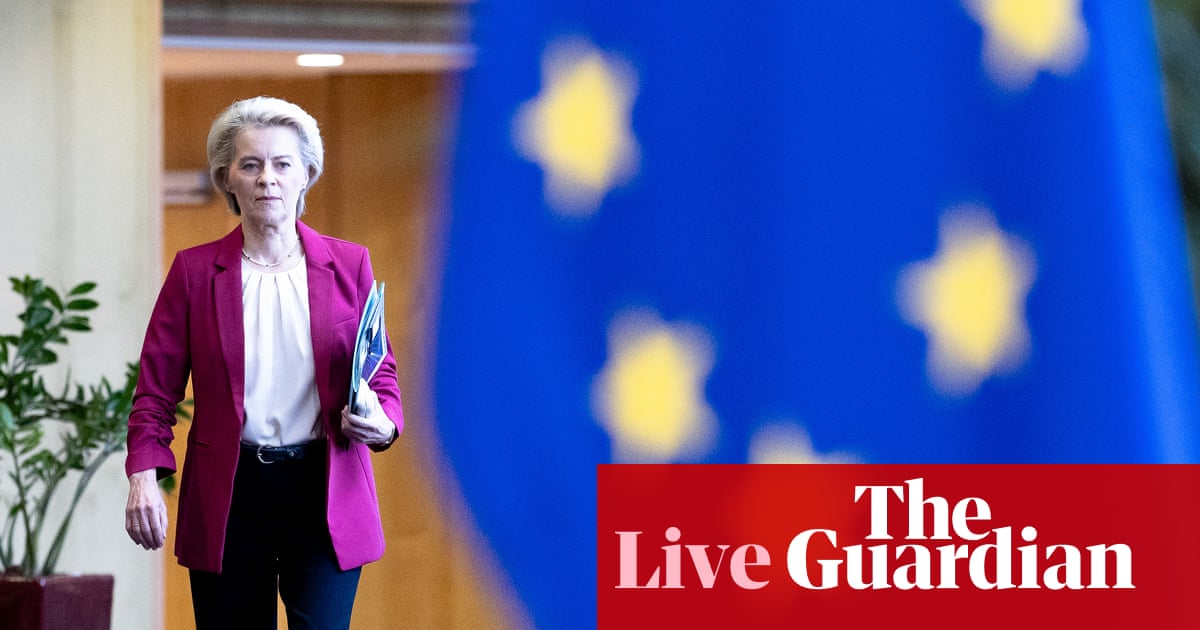
EU’s von der Leyen insists all EU27 will support loan for Ukraine
The commission president, Ursula von der Leyen, is asked which governments will take part in the loan, given that at least four – Bulgaria, the Czech Republic, Hungary and Slovakia – have signalled they do not want to be involved.
She strikes a determined tone as she says it’s different from the previous loan (where three countries were given an opt-out) and all countries need to participate as she directly links it with the EU’s budget.
“So shared budget, shared responsibilities. There’s a very important point,” she says.
She says that since the loan has two elements – civilian and military – those countries that do not want to provide any funding for Ukraine’s military can still take part in the other part of the loan.
“I’m very confident that we will agree by 27 because, as I said, all 27 member states support Ukraine explicitly.”
Well, let’s see about that.
That ends the press conference – I will bring you any reaction from the four potential breakaway leaders when we get it.
Key events
EU’s defence commissioner Andrius Kubilius says the previous EU loans to Ukraine proved to be a “gamechanger” for Ukraine, as he welcomes the new deal.
He says it is “a very important decision” which sends “a powerful signal” to Russia’s Putin that “the EU continues to stand with Ukraine.”
EU’s economy commissioner Valdis Dombrovskis offers a bit of detail on how the loan is supposed to work.
“The €20bn for budget support, split equally between macrofinancial assistance and Ukraine facility, and €25bn for defence support.
The commission will borrow on the financial markets backed by the headroom in the EU budget. It is the same approach, as under previous union loans. Interest is to be paid by Ukraine, but the union may provide borrowing cost subsidy as we are doing it now.”
He says “the support will take form of limited recourse loan,” and “Ukraine will only have to repay the principle once Russia pays reparations for destruction it has caused.”
“Disbursements will be tied to Ukraine continuing its reforms, notably on the rule of law, on fight against corruption and the public finance management.”
He says the loan could also be repaid through profits on immobilised Russian assets (in a funny slip of tongue, he appears to briefly call them Soviet assets before self-correcting himself to sovereign assets).
Also worth noting that Dombrovski is wearing a Latvian-coloured ribbon in his lapel to mark the Proclamation Day of the Republic of Latvia, the independence day.
EU will pursue 22nd package of sanctions as it ‘stands united’ in support for Ukraine, von der Leyen says
EU’s von der Leyen also says the EU is working on the 22nd package of sanctions on Russia.
“Sanctions work. They are not inflicting a sudden blow to the Russian economy, but they erode its foundations. And we have many indicators by now that point to a worsening outlook for the Russian economy and real difficulties.”
She adds the EU’s decisions intend to “send a clear message to Russia.”
“We want peace. Five years since the start of this war of aggression, Europe stands united. We are as committed as ever to support Ukraine in war and in peace.”
EU proposes €45bn loan to Ukraine to cover two-thirds of its funding gap for 2027
Von der Leyen is now speaking in Brussels.
She says that the EU will engage in any peace talks on ending the war, while ensuring “maximum support” for Ukraine and “maximum pressure” on Russia.
She says Ukraine has a €70bn funding gap for 2027, and the European Commission proposes a €45bn loan to Ukraine to help cover its 2027 financing needs, with €25bn earmarked for military needs, and €20bn for budget support.
“We think this is the best way to give Ukraine a strong hand at the negotiation table, and Ukraine only needs to repay once Russia pays for the damage it has caused in Ukraine.”
The final third of the gap will have to be covered by other external partners, she said.
This proposal will be put to EU leaders at the next summit in two weeks’ time.
EU to outline new ‘instrument for coordinated support to Ukraine’ shortly
We are also expecting to hear from the European Commission president, Ursula von der Leyen, and the EU economy and defence commissioners, Valdis Dombrovskis and Andrius Kubilius, shortly as they will present the new “Instrument for Coordinated Support to Ukraine” shortly.
I will keep an eye on this for you.
Sanctions on Russia to only increase as Ukraine war continues, Canada’s Carney says
Meanwhile, Canada’s prime minister Mark Carney says sanctions on Russia will increase while Ukraine war continues.
“Sanctions are very real and they are going to continue to increase as long as this war goes on,” Carney said in Shenzhen at an APEC summit a day before talks between the leaders of the United States, China and Russia, as reported by AFP.
Morning opening: US criticism of Ukraine’s deep strikes into Russia ‘quite a stupid thing,’ German minister says
Jakub Krupa
Germany’s defence minister, Boris Pistorius, has dismissed US criticism of Ukraine’s deep strikes into Russia as “quite a stupid thing”, speaking after the latest round of talks among Kyiv’s allies in Brussels.
US undersecretary of defence Elbridge Colby said yesterday that despite “the public conversation focusing on the spectacle of deep strikes,” they “have not been effective in driving an end to the war, nor do they contribute to blunting Russia’s advances on the frontline” (Europe Live, Tuesday).
In an unusually blunt response, Pistorius said that “criticising strikes like that in Russia to destroy strategic military and military-used targets” was “quite a stupid thing”.
“Instead of criticising that, we should rather criticise and talk about the terroristic strikes every night and every day on … energy, water, and heating infrastructure in Ukraine. This is kind of terrorism,” Pistorius said.
Ouch.
For what it’s worth, British defence minister Wes Streeting took a similar line, saying strikes “helped to degrade Putin’s war machine, buying time and saving lives”.
Ukraine’s Yehvenii Khmara also made it clear Kyiv had no plans to change its tactics.
“I want the Russian Federation to receive a clear signal: for every strike they launch against our territory, we will respond twice or three times as forcefully. And we have the right to defend ourselves.”
The public clash laid bare growing differences between Europe and the US when it comes to the preferred strategy for Ukraine, just a day before US president Donald Trump is set to meet Russian president Vladimir Putin and China’s Xi Jinping in Shenzen.
What could possibly go wrong…
Elsewhere, we are expecting to hear from the EU’s foreign policy chief, Kaja Kallas, today, as she is set to deliver a speech on the security of the Mediterranean region in Brussels.
We are also looking for updates from Serbia, where newly sworn-in MPs are due to choose a new speaker – who will also become interim president. It will be the first senior appointment by the new Student List majority after last month’s sensational election win.
It’s Wednesday, 18 November 2026, it’s Jakub Krupa here, and this is Europe Live.
Good morning.
#members #45bn #loan #Ukraine #von #der #Leyen #Europe #live #Ukraine