wellnessfitpro
Rich countries undermining credibility of Cop, African negotiators say

Damien Gayle
Rich countries are undermining the process, trust and credibility of the UN climate summit process by failing to live up to their commitments under the Paris agreement, African ministers said on Friday.
“We didn’t come here to beg,” said Zanetor Agyeman-Rawlings, chair of the African Group of Negotiators, in a press conference on the last official day of the Cop31 talks in Antalya on Friday.
“We came here to claim what is rightfully ours for our people who are suffering the brunt of anthropogenic activities of developed countries that they are now being asked to pay for in ways that they never asked.”
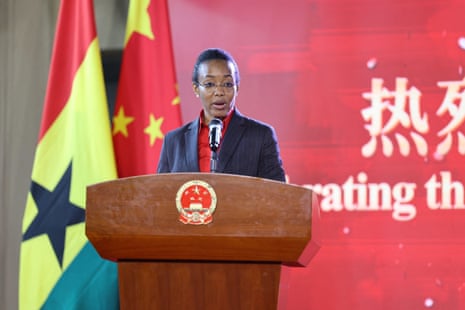
Africans were being “excluded by the use of technicalities, with the use of inaccessible finance, and with the use of shifting goalposts and lack of commitment and delivery on promises”, Agyeman-Rawlings said.
The strong statement by African ministers came after civil society groups highlighted the EU as leading a bloc of rich countries obstructing progress on finance, the just transition and adaptation at the summit.
“The draft text on the climate finance work program, the just transition mechanism, and the global goal on adaptation have yet to appear in a form that makes sense to the people of Africa,” Agyeman-Rawlings said.
She continued: “Africa is not a continent merely seeking assistance. We are asking the developed countries to keep promises that they already made.”
In an apparent reference to the US, she said: “There are countries who from the onset decided not to be a part of this agreement. There, they were plain and honest.
“What we do not appreciate are those who choose to remain a part of the framework and yet continue to undermine the process and undermining trust and the credibility of what we do.
“We ask that we are here ready to make the work constructive with the presidency and to all parties and to reach an outcome that is credible, ambitious, yet fair.”
Agyeman-Rawlings added: “Africa has a legitimate right to develop. Africa sadly was stripped of her people at some point during the transatlantic slave trade and then stripped further of resources during the colonial era. We do not have a desire to see this repeated with this new transition.
“Africa must take her rightful place and be a part of the transition and not merely a resource provider for the transition that others are going through.
Key events
Fiona Harvey
Saudi Arabia has held several key meetings with the Cop presidency and its allies in the Arab Group and among developing countries, as the clock ticks down in Antalya. The country is one of the main objectors to any wording on the “transition away from fossil fuels” being included in the text, and its replacement with the much weaker “transition towards lower greenhouse gas emissions”.
Several Cop insiders told the Guardian the country had played an obstructive role, and was demanding both weakening of the text and the inclusion of language on “carbon capture and storage”, which civil society groups say is a “false solution” to the climate crisis.
Pelin Zorlu, senior research fellow lead on climate and energy at the Chatham House thinktank, said: “The Cop Presidency has acknowledged the difficulty of reaching consensus on fossil fuels, with opposition from the Arab Group, Russia and others. The very specific emphasis on Carbon Capture, Utilisation and Storage as a solution to tackle global warming, likely proposed by Saudi Arabia, is clearly a trade-off to secure their support for the electrification. But without being tied to a transitioning away from fossil fuels, it’s not a balanced outcome. It remains unclear whether any country or negotiating bloc will seek to reintroduce the issue. In the absence of consensus, country-led plans for an orderly transition away from fossil fuels could offer a pragmatic way forward and feed into the next global stocktake.”
She added: “The Arab Group, led by Saudi Arabia, has emerged as a major force pushing back against elements of the agenda. Opposition to the EU’s Carbon Border Adjustment Mechanism (CBAM) has become a rallying point for a broader coalition of developing countries, alongside India, China and Russia. Their pushback reflects growing frustration with what they see as a western-led agenda imposing climate demands without delivering sufficient finance to support the transition.”
Graham Readfearn
“We were hoping we weren’t going to be disappointed, but we are disappointed,” the Vanuatu climate minister Ralph Regenvanu has just told me, commenting on the draft text of the proposed agreement that was released yesterday.
As we wait for another text, which could be later today or tomorrow, he said a failure to “recognise the urgency” of the planet overshooting the Paris 1.5C temperature goal, the “failure to mention fossil fuels” and the disappearance of the phrase “fossil fuels” were key issues at hand.
He said the controversial technology of carbon capture and storage being given prominence in the text was also disappointing.
“Continued failure to mention fossil fuels in the cover decision while bringing carbon capture and utilisation technologies? Some of those technologies increase emissions. They’re not a solution.”
But he said any suggestion the talks could collapse or finish without an agreement would “not be a good outcome” for Pacific nations.
While there is often talk of “red lines” that countries are not prepared to compromise on, Regenvanu said: “We can’t have red lines.”
“We know it’s not gonna be as ambitious as we want, and that’s just normal. We never get high ambition stuff from the Cops.
“That’s just a normal thing we’ve come to expect. But it’s important we show that this process can continue.”
Hello, I’m Ajit Niranjan, taking over the liveblog from my colleague Matthew Pearce. We’re in the final few hours before the scheduled close but nobody seems to expect a punctual finish.
Overshoot of 1.5C is ‘profit over people’, say small island states
Small island states have called the projected overshoot of the Paris agreement global heating goal of 1.5C an “unacceptable consequence of the advancement of profit over people”.
In a strongly worded statement, 39 small island and low-lying coastal developing states said developed countries’ failure to tackle climate breakdown was “unjust and an insult to the most vulnerable of our world”.
The Alliance of Small Island States (AOSIS) said the final Cop31 text must be based on IPCC science, acknowledge the lack of progress on cutting emissions and address fossil fuels, set a specific goal and process for tripling adaptation finance, and recognise the International Court of Justice’s climate advisory opinion as a basis for small island states’ calls for justice and equity.
The nations said: ‘The overshoot of the 1.5C temperature goal is an unacceptable consequence of the advancement of profit over people, and we will not acquiesce to further inaction at this Cop. It must be stringently addressed in the cover decision.”
We cannot delude ourselves into thinking meaningful progress is being made if we agree to a weak final text,” the group said. “AOSIS look forward to contributing constructively to a final agreement that truly takes the world towards a fairer and safer future.”

Bibi van der Zee
Ministers and envoys from 23 countries have held a press conference at Cop31 to call for “transitioning away from fossil fuels” to re-added to the summit’s negotiated cover decision.
The Netherlands climate minister Stientje van Veldhoven said: “There has been real energy and real ambition behind this transition. Just look what’s happening at this Cop31; there have been nearly 100 events organised around this subject. There are now 25 countries which have either developed or are announcing their national plan to transition away. Compared to last year when we had none … This is enormous progress.”
She listed some of the countries which have now signed up including Germany, France, Denmark, the UK, the Marshall Islands, Sweden, Tuvalu, Fiji, and Spain.
The first conference of the TAFF movement was proposed at last year’s Cop, born out of frustration with the UN process, and brought together countries who were willing to develop detailed plans for how they will reduce their use of fossil fuels. It was held in Santa Marta in Colombia earlier this year and was widely hailed as a positive breakthrough in the international discussion.
“This is the beginning of a new global climate democracy,” Irene Vélez Torres, Colombia’s environment minister and chair of the talks, told the conference in closing remarks that celebrated a “new method” of bringing together high-ambition governments, parliamentarians and civil society groups to accelerate the decarbonisation of their economies.
Late last night Ireland and Tuvalu announced they would jointly host the next conference in the Pacific in 2027. It will be interesting to see the mood there.
Civil society activists call Antalya 2026 the ‘worst Cop ever’
Damien Gayle
Antalya 2026 is the “worst Cop ever”, civil society activists have said in a packed final press conference at the UN climate summit.
Civil society organisations have a special status at UN climate treaty summits. They have the right to observe and even intervene in negotiations, although decisions are ultimately taken by the countries that are parties to the UNFCCC.
On Friday they made clear that, in their opinion, Cop31 was shaping up to be a disaster.
“[Climate Action Network] is unambiguously stating that we are rejecting what is currently on the table in these negotiations today. CAN also calls on governments, particularly global south governments, to reject what is on the table,” said Tasneem Essop, executive director of Climate Action Network International.
CAN is a representative body that encompasses more than 2,500 climate campaign organisations. Essop continued: “There is nothing on the table that protects people or addresses the priorities of the global south. In fact, the opposite is true.
“The current text has opened the door to the most harmful and dangerous options of any COP so far.”
None of the priorities of civil society have made it through these negotiations. Civil society activists have said that not only has progress been stalled on issues they care about, but some of the hard won gains of previous Cops have been reversed.
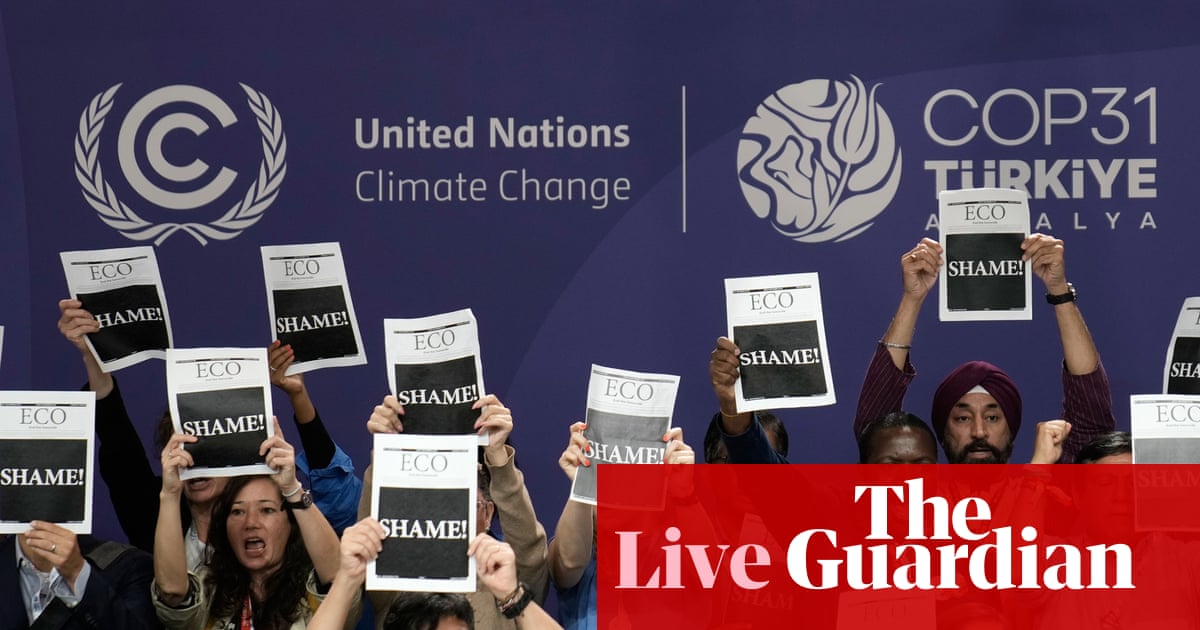
Essop and other civil society leaders spoke at a packed press conference, with dozens of activists stood behind them holding up copies of Eco, the Cop’s NGO newsletter.
Mohamed Adow, director of Power Shift Africa, said: “The Cop Presidents want to tell us this has been a great Cop. Well, I can tell you without any doubt that this has been the worst Cop ever.”
Graham Readfearn
In a huddle outside the African group’s media conference this morning, Dr Zanetor Agyeman-Rawlings, Ghana’s environment minister and chair of the African group of negotiators, has laid out her thoughts on the proposed global electrification target that is now sitting as one of the agreements in the draft text of the “cover decision”.
She said if electrification is included in the text without a means for African countries to develop electricity “then what you’re doing is creating a mirage”.
I asked her if the wording around the electrification push should include the word clean.
“Well, clean at what cost?” she said.
“The reason we’re here is not because Africa does not want to go clean, but the means from which Africa should go clean are not being provided, or being made so cumbersome that a lot of African countries cannot access it, and that is not justice.”
The International Indian Treaty Council, an international organisation of Indigenous Peoples, has said Cop31 has “failed across the board”, denouncing the draft text and decrying climate leadership.
At a press conference, the group called for stronger action to end fossil fuel reliance and protect their communities on the frontline of the climate crisis.
Bryan Bixcul, a Maya-Tz’utujil Indigenous rights advocate from Guatemala, said the leadership’s actions had not matched its rhetoric. “We came here looking for answers, for leadership, for real commitment to transitioning away from fossil fuels,” he said.
“Instead what we got was a ‘35 by 35’ electrification pledge that doesn’t truly commit to tying it to renewable energy production … We cannot trust these leaders to lead us out of the climate crisis,” he said.
Another advocate, Sunshine, criticised the draft for promoting carbon capture and saying nothing about phasing out fossil fuels. “We’re asking the presidency to remove language promoting that [carbon capture’] technology,” she said, warning it risked “keeping fossil fuel production going and delaying emission cuts at the source”.
Thomas Joseph Tsewenaldin, a member of California’s Hoopa Valley Tribe, said Cop31 had “failed across the board”.
“We demand real reduction of carbon,” he said, calling for emissions cuts and Indigenous rights to be included in the text. “Your very existence depends on our inherent collective rights as Indigenous Peoples.”
Any delegates looking for calm away from hectic climate talks can escape to the expo centre garden on the sidelines of Cop31. Designed to provide a reminder of what negotiators were seeking to protect, butterflies is the theme this year in the garden.
“We wanted to use the colourful wings of butterflies to raise awareness about nature conservation, biodiversity and the balance of ecosystems,” biologist Guler Ulucamlibel of the Konya Tropical Butterfly Garden told AFP.
“For the Cop31 process, we adapted this entire area to the climatic conditions the butterflies need,” she said.
Rich countries undermining credibility of Cop, African negotiators say
Damien Gayle
Rich countries are undermining the process, trust and credibility of the UN climate summit process by failing to live up to their commitments under the Paris agreement, African ministers said on Friday.
“We didn’t come here to beg,” said Zanetor Agyeman-Rawlings, chair of the African Group of Negotiators, in a press conference on the last official day of the Cop31 talks in Antalya on Friday.
“We came here to claim what is rightfully ours for our people who are suffering the brunt of anthropogenic activities of developed countries that they are now being asked to pay for in ways that they never asked.”
Africans were being “excluded by the use of technicalities, with the use of inaccessible finance, and with the use of shifting goalposts and lack of commitment and delivery on promises”, Agyeman-Rawlings said.
The strong statement by African ministers came after civil society groups highlighted the EU as leading a bloc of rich countries obstructing progress on finance, the just transition and adaptation at the summit.
“The draft text on the climate finance work program, the just transition mechanism, and the global goal on adaptation have yet to appear in a form that makes sense to the people of Africa,” Agyeman-Rawlings said.
She continued: “Africa is not a continent merely seeking assistance. We are asking the developed countries to keep promises that they already made.”
In an apparent reference to the US, she said: “There are countries who from the onset decided not to be a part of this agreement. There, they were plain and honest.
“What we do not appreciate are those who choose to remain a part of the framework and yet continue to undermine the process and undermining trust and the credibility of what we do.
“We ask that we are here ready to make the work constructive with the presidency and to all parties and to reach an outcome that is credible, ambitious, yet fair.”
Agyeman-Rawlings added: “Africa has a legitimate right to develop. Africa sadly was stripped of her people at some point during the transatlantic slave trade and then stripped further of resources during the colonial era. We do not have a desire to see this repeated with this new transition.
“Africa must take her rightful place and be a part of the transition and not merely a resource provider for the transition that others are going through.
Gabrielle Canon
Every day for the past two weeks, Turkish artist Ersut Biçkin has posted up in the breezy thoroughfare at the centre of the Blue Zone to beautifully transcribe names. Some have chosen to have their own names done. Others asked for causes or organisations. He’s done them all (along with some drawing or caricatures that were not publicly displayed).
On Friday morning a couple dozen people were waiting – perhaps the last chance to take a bit of personalised Turkish art home as the summit nears its end.
In a conversation through a interpreter, he estimated that he’s done thousands since COP31 began. It’s been a pleasure, he said, to meet so many people from around the world.
Graham Readfearn
“I need to go to sleep every night wondering what that means, you know?” says Albon Ishoda, leaning against a wall in a corridor at the UN climate summit in Turkey. “For us, it’s about existence.”
Ishoda is a diplomat who works for the Marshall Islands – a group of low-lying atolls that are specks on a map in the ocean between Hawaii and Australia.
As the Cop31 summit nears its close, with a scheduled finish of Friday but which is likely to push into the weekend, Pacific islanders are becoming increasingly frustrated with the UN’s decades-old system of annual climate summits.
The region has its own cash fund – the Pacific Resilience Facility – to pay for damages from climate-driven extremes and to prepare for the future.
The Australian government pledged US$67m (A$101m) three years ago, but the fund has otherwise struggled for support. It is still about US$300m (A$451m) short of a US$500m (A$751m) goal, and a “showcase” event at the summit with the Australian prime minister, Anthony Albanese, garnered only one new offer – US$5m (A$7.5m) from Andrew Forrest, an Australian miner and philanthropist.
It is a far cry from what has been promised.
“Disappointing is probably not strong enough a word,” Ishoda says. “We have money for wars but not to save communities.”
Ajit Niranjan
The end is in sight. If all goes as planned, countries as diverse as wealthy petrostates erecting new oil rigs and low-lying islands threatened by rising seas will reach an agreement tomorrow in Antalya, bringing the 31st UN climate summit to a close (though, as usual, the talks are likely to overrun).
But tensions – much like our global temperatures – are running high. A draft text that satisfies all the competing interests is a long way off, and negotiators are expected to argue into the night and then the weekend. On the table are the electrification of the global economy, the transition away from fossil fuels, and the response to the looming overshoot of the 1.5C (2.7F) temperature target. Deepening the divide are long-running disputes over who should pay what, and emerging fights over the fairness of the transition and assumptions in the underlying science.
Good morning. I’m Matthew Pearce, bringing you the Cop31 liveblog from London. Today is (supposedly) the final day of negotiations, and my colleagues on the ground will be guiding you through the conclusion of these contentious climate crisis talks.
Cop31 heads towards another late finish amid bitter divisions
Graham Readfearn
Welcome to the final day of Cop31 in Antalya where the hosts Turkey and the president of negotiations, Australia, will bring the UN climate summit to a gentle and uneventful close and everyone will go home on time.
Only joking.
Turkey and Australia face an uphill struggle today to bridge the practically permanent divides between rich developed countries and fossil fuel producers, and everyone else, on progressing climate action across a whole suite of areas.
An on-time finish isn’t impossible, but feels unlikely (the last time a Cop finished on time was Italy in 2003, according to Carbon Brief). We will probably still be here on Saturday (and possibly Sunday).
Turkey and Australia have pushed for a “cover decision” – an overarching agreement that sets the direction of travel for climate action, energy investment, science, climate finance and adaptation around the world.
The latest draft text came out yesterday afternoon, cutting the areas under discussion from more than 140 in Monday’s text to 79.
But it was derided for expunging the words “fossil fuels” while including “carbon capture and storage” – the technology mentioned so fulsomely by the fossil fuel industry for decades while delivering almost nothing.
The hoped for term to “transition away from fossil fuels” was replaced by a weaker pledge of an “irreversible global transition” to lower emissions and climate resilience.
This Cop is the first to admit that the 2015 Paris goal to work to limit global heating to 1.5C would be breached. Pacific countries want language to keep that goal alive.
And then what to do about Panama?
The UN climate convention works on consensus – meaning everyone has to agree. This protocol has been used in the past by high-emitting fossil fuel producers (looking at you, Saudi Arabia and Russia) to slow and block progress.
But Panama put a stake in the ground yesterday, writing to the Cop presidents to say it would formally object to any agreement that didn’t satisfy eight issues that run across plans to protect biodiversity, capping oil production at current levels, forcing big emitting countries to part with finance and changing the convention’s voting laws to allow majority voting instead of consensus.
So many questions, so little time.
#Cop31 #live #didnt #beg #African #ministers #climate #talks #enter #final #day #Turkey