wellnessfitpro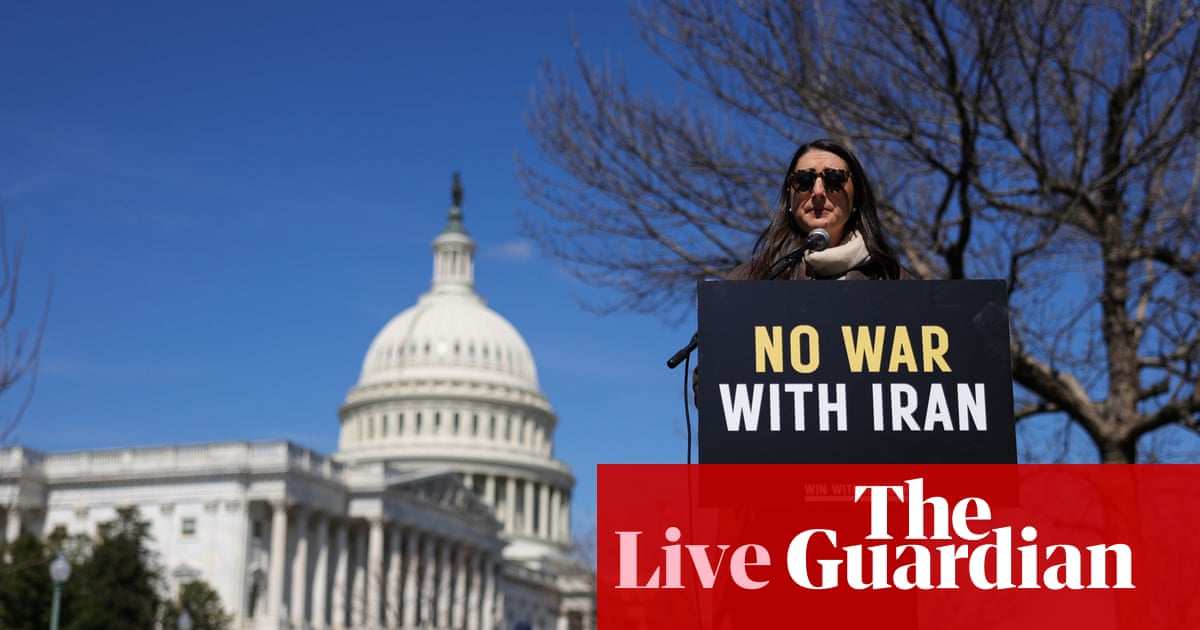
Senate Republicans defeat Democrats’ war powers resolution to check Trump on Iran
By a vote of 53-47, Senate Republicans blocked a war powers resolution that would have limited Donald Trump’s ability to prosecute the war on Iran he started last month.
The vote broke along mainly partisan lines, with only John Fetterman, the Pennsylvania Democrat, and Rand Paul, the Kentucky Republican, breaking with their parties on the resolution.
The vote was unchanged from that on a previous war powers resolution two weeks ago.
Key events

Lauren Gambino
Senate Republicans on Wednesday blocked a measure that aimed to reign in Donald Trump’s power to wage war against Iran without congressional authorization.
The 53-47 vote against taking up the measure fell almost completely along party lines, with no movement from earlier this month when Republicans blocked Democrats’ bid to limit Trump’s war-making power in the days after the joint US-Israeli strikes, known as Operation Epic Fury, began across Iran.
“We do not know Donald Trump’s goals. We do not know Donald Trump’s timeline. We do not know what victory even looks like in his eyes,” Chuck Schumer, the Democratic leader, said before the vote, urging Republicans to support the effort to force a debate on the war. “Enough is enough.”
The senator Rand Paul of Kentucky, who has led several war-powers efforts, was the only Republican to vote in support of the measure, while the senator John Fetterman of Pennsylvania, who has emerged as a staunch supporter of Israel, was the only Democrat to break with his party and vote against the resolution.
“If there’s anything that is plain in that constitution, it is that a president does not have the power to unilaterally bring a nation and its treasure, to bring a nation and its men and women, into conflict without a say of Congress,” the senator Cory Booker, who led the war-powers resolution, said in a floor speech before the vote.
Booker acknowledged that he would not succeed, but vowed to continue to introduce measures that would force Congress to debate and authorize military action.
House Democrats walk out of ‘fake hearing’ with Pam Bondi on Epstein files, after she refuses to commit to testifying under oath
Democrats on the House oversight committee walked out of a closed-doors briefing from the attorney general, Pam Bondi, on the Epstein files, leaving what California congressman Robert Garcia called “an outrageous fake hearing” after Bondi refused to commit to honoring a subpoena to testify under oath.
The committee voted to subpoena Bondi earlier this month, with five Republicans joining Democrats to demand that the attorney general answer questions under oath about the justice department’s failure to properly release files from the federal investigations into Jeffrey Epstein, the late child sex offender Donald Trump socialized with for nearly two decades.
Speaking outside the hearing room, Florida congressman Maxwell Alejandro Frost said: “We asked her multiple times, are you going to come and speak with us under oath? She would not say yes. Filibuster, filibuster, filibuster, would not say yes.”
“Our Republican colleagues say, ‘Is this not enough? Why don’t you want to peak to her now?’ We want her under oath because we do not trust her. Why don’t we trust her? Because she’s a liar,” Frost added. “Look at how that judiciary committee went. She was spying on members of Congress when they were in the DoJ looking at the documents unredacted. “Look at what she’s done, as far as not putting documents related to Donald Trump on the website.”
Pennsylvania congresswoman Summer Lee said that when she asked how the committee would respond if Bondi refused to testify, the Republican chair of the committee, James Comer, insulted her by accusing her of “bitching”.
Senate Republicans defeat Democrats’ war powers resolution to check Trump on Iran
By a vote of 53-47, Senate Republicans blocked a war powers resolution that would have limited Donald Trump’s ability to prosecute the war on Iran he started last month.
The vote broke along mainly partisan lines, with only John Fetterman, the Pennsylvania Democrat, and Rand Paul, the Kentucky Republican, breaking with their parties on the resolution.
The vote was unchanged from that on a previous war powers resolution two weeks ago.
Pentagon asks White House for $200bn more to fight Iran war – report
The Washington Post reports that the Pentagon “has asked the White House to approve a more than $200 billion request to Congress to fund the war in Iran, according to a senior administration official”.
As the Post explains:
The funding request is likely to stage a major political battle in Congress, as public support for the effort remains tepid and Democrats have been sharply critical. Republicans have signaled support for the forthcoming supplemental request but haven’t committed to a legislative strategy, or found a clear path to surpass the Senate’s 60-vote threshold.
President Donald Trump campaigned on ending American adventurism abroad and frequently hammered the Biden administration for the amount of money approved to finance the war in Ukraine. By December, Congress had approved roughly $188 billion in spending for the war in Ukraine, according to the U.S. special inspector general for Operation Atlantic Resolve.
As the Post notes, Donald Trump has repeatedly criticized his predecessor for helping Ukraine defend its territory from the full-scale Russian invasion that began in 2022. But Trump has constantly exaggerated or lied about how much the US has spent to help Ukraine deter Russia, offering vastly inflated estimates that could make the cost of his war with Iran seem small by comparison.
On Tuesday, Trump claimed, falsely, that “Biden gave them between $350 billion and $400 billion of equipment and cash,” doubling the actual spending documented by an independent inspector general on a publicly available website.
FBI is buying location data on Americans, Kash Patel tells Senate
The Federal Bureau of Investigation has started buying location data on Americans, the FBI director, Kash Patel, said under oath at the Senate intelligence committee worldwide threats hearing on Wednesday.
Patel’s admission came in response to a question from Ron Wyden, an Oregon Democrat who is a longtime opponent of the warrantless surveillance of Americans. Wyden told Patel that his predecessor, Christopher Wray, testified in 2023 that the FBI did not at that time purchase location data derived from internet advertising, although acknowledged that it had done so in the past.
“Is that the case still?” Wyden asked. “And if so, can you commit this morning to not buying Americans’ location data?”
“We do purchase commercially available information that’s consistent with the constitution and the laws under the Electronic Communications Privacy Act, and it has led to some valuable intelligence for us,” Patel responded.
“So you’re saying that the agency will buy Americans’ location data,” Wyden said. “I believe that that’s what you’ve said in kind of intelligence lingo. And I just want to say as we start this debate, doing that without a warrant is an outrageous end run around the fourth amendment. It’s particularly dangerous given the use of artificial intelligence to comb through massive amounts of private information.
“This is exhibit A for why Congress needs to pass our bipartisan, bicameral bill, the Government Surveillance Reform Act,” Wyden said, referring to legislation he is working to pass to rein in surveillance.
Wyden’s questioning of Patel on this issue was amplified on social media by Warren Davidson, a House Republican who introduced a House bill mirroring Wyden’s Senate measure with Democratic congresswoman Zoe Lofgren.
“This is a clear violation of the fourth amendment and is why I introduced the Government Surveillance Reform Act,” Davidson observed, “to close the data broker loophole that allows intelligence agencies to buy Americans’ private data.”
The fourth amendment to the United States constitution defines the “right of the people to be secure in their persons, houses, papers, and effects, against unreasonable searches and seizures” and specifies that “no Warrants shall issue, but upon probable cause, supported by Oath or affirmation, and particularly describing the place to be searched, and the persons or things to be seized”.
Elizabeth Warren says Trump wants new election law to ‘make it harder for Americans to vote’
Speaking on the Senate floor on Wednesday, Elizabeth Warren, a Massachusetts Democrat, argued that the changes to election law Republicans call the Save America Act will make it more difficult for US citizens to vote and could lead to people considered likely to vote for Democrats being removed from voter rolls by the Trump administration.
Here is the start of Warren’s floor speech:
Donald Trump is trying to stop American citizens from voting. Why? Because he knows his agenda is unpopular and Republicans can’t win based on what he’s doing, so he wants to rig the election by picking his own voters. That’s what the Save Act is all about.
Don’t let Trump and the Republicans in Congress fool you. They’ll say things like, ‘You should have to show ID to vote just like you do to buy a beer.’ But this is not an ordinary voter ID bill. This is not a bill that says everybody has to show either a driver’s license or student ID to vote.
This is a way to keep American citizens from voting. I’ll give you an example. If this bill passes, then in 45 of 50 states, your driver’s license won’t count as valid ID. Let’s say you’re a married woman who lives in Massachusetts. And let’s say that when you got married, you took your husband’s name. Well, when you go to the polls to vote, you can’t register by showing them your updated driver’s license. Why? Because Massachusetts is one of the 45 states where a driver’s license doesn’t prove citizenship.
So you bring along your birth certificate? Now can you vote? Nope. Your birth certificate is still under your maiden name. Yes, you can use a passport, if you have one. But remember that fewer than half of all Americans have a passport and it costs $165 to get one – and takes a month or two, if everything is working on time.
No passport and no birth certificate that matches your driver’s license? Well, Trump and the Republicans say you’re out of luck.
And that’s just one example of how this bill will actually make it harder for Americans to vote.
Here’s another deeply disturbing thing about this bill: it would require states to hand over sensitive information about voters to Trump’s Department of Homeland Security, so that some shadowy guys can do whatever they want with it.
Maybe they take you off the voter rolls. Maybe they use that information for something else. No one knows what will happen. This is an agency whose former leader Kristi Noem said, just a few weeks ago, ‘We need to … make sure that we have the right people voting.’ Guess who’s going to get swept off the voter rolls? People that the Republicans think are likely to vote Democratic.
So, sweep off Black people, sweep off Brown people, sweep off women, sweep off students, sweep off people in precincts who voted Democratic last time, sweep off people that you think might vote Democratic in the upcoming election.
I’ve heard this bill called Jim Crow 2.0, harking back to the days when states in the south blocked Black people from being able to vote with a whole series of tests and barriers in the way so they wouldn’t be able to vote.
The Trump bill is Jim Crow 2.0.
Warren went on to point out that noncitizen voting “is extremely rare”, noting that a 2024 audit of voter rolls carried out by Georgia’s Republican state government found just 20 noncitizens registered to vote out of 8.2 million registered voters.
‘A movement is about the people – not any one person,’ Pelosi says of César Chávez allegations
Nancy Pelosi, the former House speaker, and the only woman to ever hold that office, has released this statement on the allegations of sexual assault and abuse by the late labor organizer César Chávez:
It was with great sadness that I learned of the egregious revelations reported by the United Farm Workers about César Chávez. We must listen to the survivors, speak their truth, and uphold the values of dignity and justice in the face of conduct that deplorably betrays those principles.
“Words are inadequate to heal the trauma of Dolores Huerta and the courageous women who have already come forward, but may it be a comfort that so many people are praying and expressing support for them during this unimaginable time.
A movement is about the people – not any one person – and its strength lies in the values it upholds. We can honor the farmworker movement – and the generations who sacrificed to build it – while also confronting painful truths. No legacy is above accountability.”
Gabbard won’t say if White House claim Iran posed an ‘imminent nuclear threat’ is true
As our colleagues Joseph Gedeon and George Chidi report, Democrats on the Senate intelligence committee pressed Tulsi Gabbard, the director of national intelligence, to explain why her deputy, Joe Kent, said in his resignation letter on Tuesday that “Iran posed no imminent threat to our nation”, which contradicts weeks of statements to the contrary by Donald Trump.
The president and his aides have repeatedly described the threat posed by Iran as imminent to justify the war, although when he announced the start of “major combat operations in Iran” from his Florida beach club on 28 February, Trump declared that it was a mission “to defend the American people by eliminating eminent threats from the Iranian regime”, having apparently misread the word “imminent” on the Teleprompter.
In a carefully worded statement after Kent’s resignation on Tuesday, Gabbard, who made opposition to war with Iran the central plank of her failed run for the presidency in 2020, said that “determining what is and is not an imminent threat” was up to the president, not the intelligence community she oversees. She notably failed to say that the intelligence she had seen supported Trump’s claim that Iran was about to attack the US.
In his questioning of Gabbard, Senator Jon Ossoff, a Georgia Democrat, pointed out that on day 2 of the conflict the White House website called the US attack a “military campaign to eliminate the imminent nuclear threat posed by the Iranian regime”.
“Was it the assessment of the intelligence community that there was an ‘imminent nuclear threat posed by the Iranian regime’, yes or no?” Ossoff asked.
When Gabbard replied, “Senator, the only person who can determine what is and is not an imminent threat is the president,” Ossoff shot back: “False. This is the ‘Worldwide Threats’ hearing, where you present to Congress ‘national intelligence, timely, objective and independent of political considerations’. You’ve stated today that the intelligence community’s assessment is that Iran’s nuclear enrichment program was obliterated and that ‘there had been no efforts since then to try to rebuild their enrichment capability’.”
“Was it the intelligence community’s assessment,” he continued, “that, nevertheless, despite this obliteration, there was a quote ‘imminent nuclear threat posed by the Iranian regime’? Yes or no.”
“It is not the intelligence community’s responsibility to determine what is and is not an imminent threat,” Gabbard replied.
“No, it is precisely your responsibility to determine what constitutes a threat to the United States. This is the ‘Worldwide Threats’ hearing, where, as you noted in your opening testimony, quote, you ‘represent the IC’s assessment of threats’.”
When Ossoff again repeated the question of whether there was intelligence to support the White House claim Iran posed “imminent nuclear threat”, Gabbard repeated her claim that it was up to the president to say if a threat was imminent.
“You’re evading a question because to provide a candid response to the committee would contradict a statement from the White House,” Ossoff concluded.
Gabbard was also forced to admit that just last year the intelligence community’s annual threat assessment said clearly that Iran was not pursuing nuclear weapons. “We continue to assess Iran is not building a nuclear weapon and that Khamenei has not reauthorized the nuclear weapons program he suspended in 2003”, the 2025 report stated.
White House shows Trump returning from dignified transfer ceremony, without a hat
Donald Trump just returned to the White House from a second dignified transfer ceremony at Dover air force base in Delaware this month, where he paid his respects to US service members killed fighting his war on Iran.
This time, according to images of the president before and after the ceremony for six service members killed in a plane crash released by the White House, Trump appears to have ditched the sports hat he wore during a similar ceremony for the war dead two weeks ago, sparking a backlash and some creative news reporting from his allies at Fox News.
Despite the criticism of his decision to salute the fallen troops in his Trump-branded USA golf hat at the last ceremony, the president’s political action committee used a photograph of him doing so in a fundraising email last week. The email from Trump offered donors a so-called “National Security Briefing Membership”, which would give them access to “my private national security briefings, unfiltered updates on the threats facing America”.
Senator Jon Ossoff, a Georgia Democrat, held up a copy of the fundraising email at a Senate hearing on Wednesday and called it “a disgrace”.
Here’s a recap of the day so far
-
On Capitol Hill, lawmakers heard testimony from current Trump officials, and one lawmaker poised to take up a position in the administration. Senator Markwayne Mullin fielded questions from his colleagues in Congress in a confirmation hearing to take over as Donald Trump’s new homeland security secretary. Senators, including Republicans like Rand Paul, questioned Mullin’s temperament, how he would be different from his predecessor Kristi Noem, cryptic comments about classified “overseas” trips while in office, and the future of federal emergency management. While there were tense moments (see a particularly personal back-and-forth with Paul), Mullin tried to appear conciliatory and insisted he would make the Department of Homeland Security (DHS) stronger under his leadership.
-
The hearing comes amid a month-long shutdown of certain agencies within the DHS. Republicans and Trump today continued to blame Democrats for the lapse in funding, as they demand stronger guardrails on federal immigration enforcement. Today, Hakeem Jeffries launched a discharge petition to force a vote for a separate funding bill for the TSA, Fema, Cisa and the coast guard. It’s a long-shot effort, since he would need 218 signatures to proceed. Meanwhile Trump said the ongoing shutdown is “causing chaos at the airports”, branded Democrats as “lunatics” and said their demands are “totally unreasonable”.
-
Senators on the intelligence committee also had the chance to grill Tulsi Gabbard, the director of national intelligence, on the ongoing military operation in Iran. Gabbard, who established herself as an anti-interventionist candidate during her 2020 run for the Democratic presidential nominee, said that the US had “significantly degraded” Iran’s strategic position. However, Gabbard evaded questions from lawmakers about whether the regime posed any “imminent threat” to the US. This comes after her top counter-terrorism official resigned on Tuesday, claiming the Trump administration was pressured by Israel to launch the initial strikes at the end of February.
-
Speaking in Michigan, JD Vance acknowledged the soaring price of oil, and the subsequent increase at the fuel pump for most Americans. Meanwhile, Trump attended the dignified transfer for the air force crew that was killed when their refueling aircraft crashed over friendly airspace in Iraq. Bar a few Truth Social posts earlier, we’ve yet to hear from the president today.
-
The Federal Reserve held interest rates steady for the second time this year, a widely expected move amid turmoil in the Middle East and rising energy prices. All but one of the 12 voting members of the committee voted to keep rates at a range of 3.5% to 3.75%, resisting enormous pressure from Donald Trump to lower borrowing costs at the risk of driving up prices in the long term.
Coral Murphy Marcos and Michael Sainato
Lawmakers, union leaders and several community organizations expressed their dismay after allegations of inappropriate sexual behavior and abuse of young women or girls emerged against the late labor organizer César Chávez.
The New York Times released an investigation on Wednesday detailing the allegations, which revealed that for years the co-founder of the United Farm Workers (UFW) union had groomed and sexually abused girls who were involved in the movement.
The report has led to multiple cancellations or rebrandings of events that were meant to celebrate César Chávez Day, which is observed annually on 31 March, Chávez’s birthday. States including California, Arizona, Utah, Texas, Colorado, Oregon and Minnesota have recognized the holiday.
Before the Times released the report, media inquiries about the allegations prompted the UFW to cancel celebrations honoring Chávez, calling the allegations “disturbing”, “shocking” and “indefensible”.
The Times investigation includes allegations by Dolores Huerta, one of the country’s most influential labor activists and Chávez’s ally, who said he forced her to have sex with him in the 1960s. Huerta released a statement on Wednesday, saying she “can no longer stay silent”.
Huerta told the news outlet that Chávez drove her to a grape field in Delano, California, in 1966 and raped her. She was 36 at the time. The rape led to a pregnancy, as did a second sexual encounter, according to her statement.
Huerta had not publicly shared her story, and said in the statement that she chose to come forward after the Times “indicated that I was not the only one – there were others”.
Read the full report here:
Federal Reserve holds interest rates steady amid despite pressure from Trump
The US Federal Reserve held interest rates steady for the second time this year, a widely expected move amid turmoil in the Middle East and rising energy prices.
Fed officials faced a confluence of issues to consider in their meeting this week: soaring oil and gas prices, fluctuating inflation that still remains above the Fed’s target of 2%, and a weakened job market that unexpectedly saw 92,000 losses last month.
All but one of the 12 voting members of the committee voted to keep rates at a range of 3.5% to 3.75%, resisting enormous pressure from Donald Trump to lower borrowing costs at the risk of driving up prices in the long term.
In a statement, the board noted that “uncertainty about the economic outlook remains elevated” and “implications of developments in the Middle East for the US economy are uncertain”.
The Fed’s decision comes as the US and Israel approach their third week of war with Iran, forcing central banks across the world to decide how to weigh skyrocketing gas prices and their impact on the global supply chain.
Donald Trump is now attending the dignified transfer for the air force crew that was killed when their refueling aircraft crashed over friendly airspace in Iraq. All six on board were killed during the incident that involved another aircraft and was in support of the ongoing military operation in Iran.
The US military said the crash was not the result of hostile or friendly fire.
The event is closed to the press, and Trump took no questions from reporters as he traveled to the ceremony.
#Senate #Republicans #vote #Democrats #war #powers #resolution #check #Trump #Iran #politics #live #Trump #administration