wellnessfitpro
Reporting Highlights
- Lopsided Contracts: Experts say World Cup contracts lock host cities out of prospective revenues more than ever, leaving FIFA with a larger share of the revenue.
- Texans on the Hook: A Texas taxpayer-funded program helps cover costs, but the state struggles to calculate whether there is a benefit.
- Lacking Transparency: Many cities have fought the release of their contracts with FIFA. Those that are public have key cost and revenue information redacted.
These highlights were written by the reporters and editors who worked on this story.
When Texas dedicated $22 million to host the 2017 Super Bowl between the New England Patriots and the Atlanta Falcons, state officials expected a return on their investment.
But a state analysis after the Patriots’ thrilling comeback win said it was “impossible” to tell if Texas taxpayers broke even on their investments.
If anything, Texas came up $14 million short, according to a breakdown of tax revenues in the same analysis.
Texas taxpayers likely will be on the hook again when Houston and Dallas welcome the FIFA World Cup this June and July. The cities are among 11 in the U.S. that have agreed to shoulder hundreds of millions of dollars in costs for the soccer tournament, subsidizing a World Cup expected to generate $11 billion in profits for FIFA.
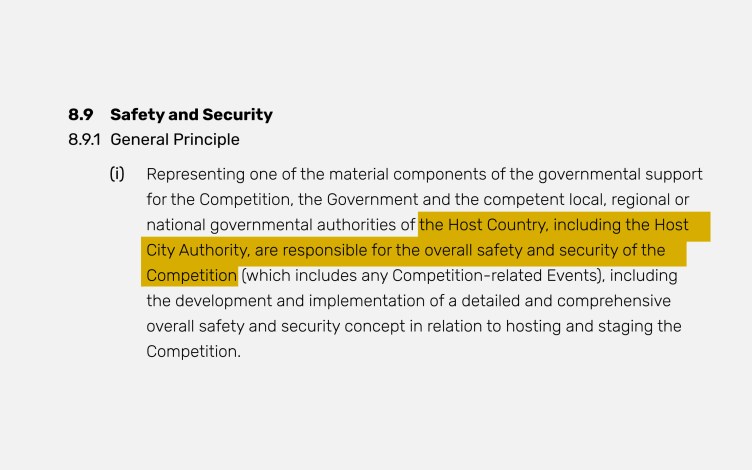
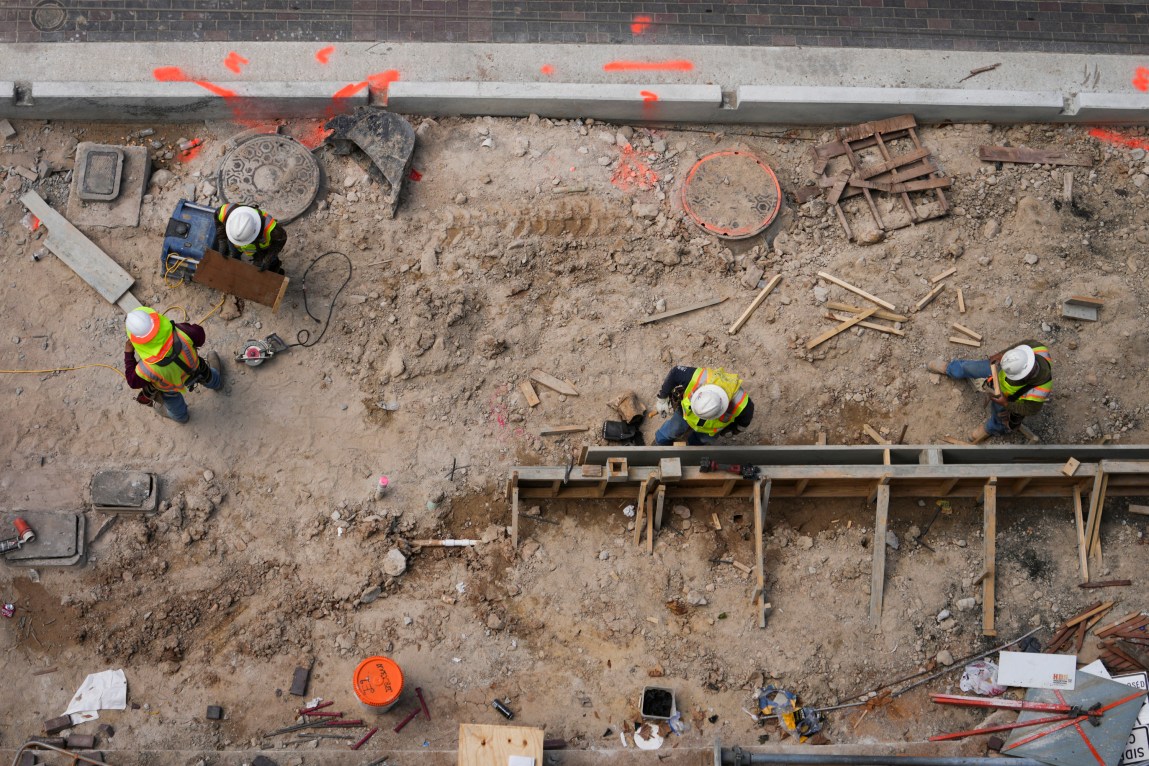
Host cities and their local organizing committees will pay for security at the matches, cover the cost of retrofitting their stadiums to better accommodate soccer and operate fan festivals in addition to the main matches. Originally, they were supposed to pay to transport FIFA officials to all matches, as well, though that requirement has been waived, according to Houston organizers.
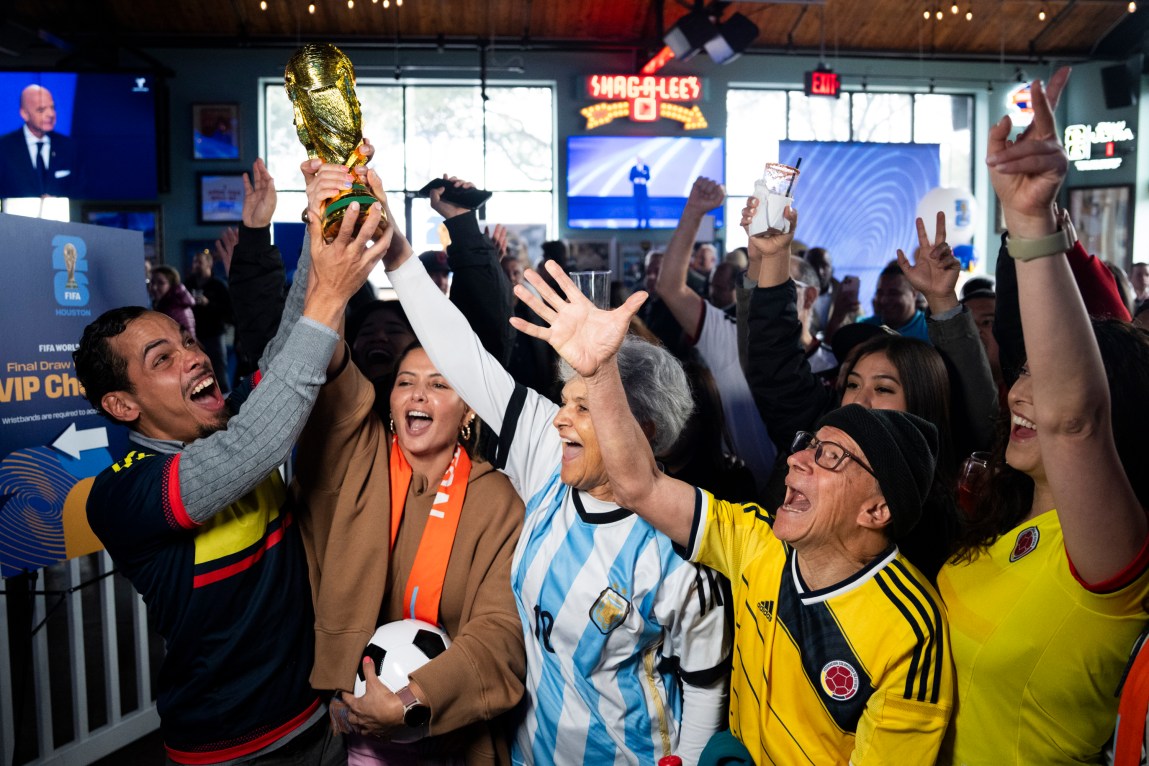
The cities get little tangible benefit in return. They do not see a slice of game-day revenues from ticket sales, concessions and merchandise, or parking. Even selling tickets or suites in exchange for corporate sponsorships — usually a key revenue generator for local organizers — was restricted by FIFA this year.
Cities had to agree to FIFA’s demands before the U.S., Mexico and Canada even submitted their bid in 2017 to host the World Cup, and many of those host city contracts remain secret. Now, as the event nears, some cities are questioning whether those agreements will leave them paying for more than they get in return.
“Everybody signed an agreement that was very, very one-sided,” said Alan Rothenberg, who is on the Los Angeles host committee for the 2026 World Cup and was the president of U.S. Soccer the last time the country hosted the tournament in 1994.
Then, some host cities would get a slice of game-day revenues, such as a share of the money made from selling food and drinks at the matches. U.S. Soccer also covered the bill for security at the games and other organizing expenses, Rothenberg said. That helped cities take in more money than they spent, making hosting a more attractive endeavor.
This time around, the agreement was so lopsided that at least one city, Chicago, withdrew during the bidding. And in some cities that moved forward, concerns have grown as the matches near. Officials in Foxborough, Massachusetts, threatened in February to withhold permits for the matches unless FIFA or the owner of the Patriots committed to paying $7.8 million in security costs ahead of time. Foxborough ultimately approved the permits after local World Cup organizers agreed to pay the bill in advance.
“At this point, I think a lot of people are looking at Chicago and thinking they were the smart ones,” Rothenberg said. “They looked at the terms of the agreement and said, ‘No, thanks.’ I don’t think anybody in the 11 host cities thought it would be as tough as it seems to be.”
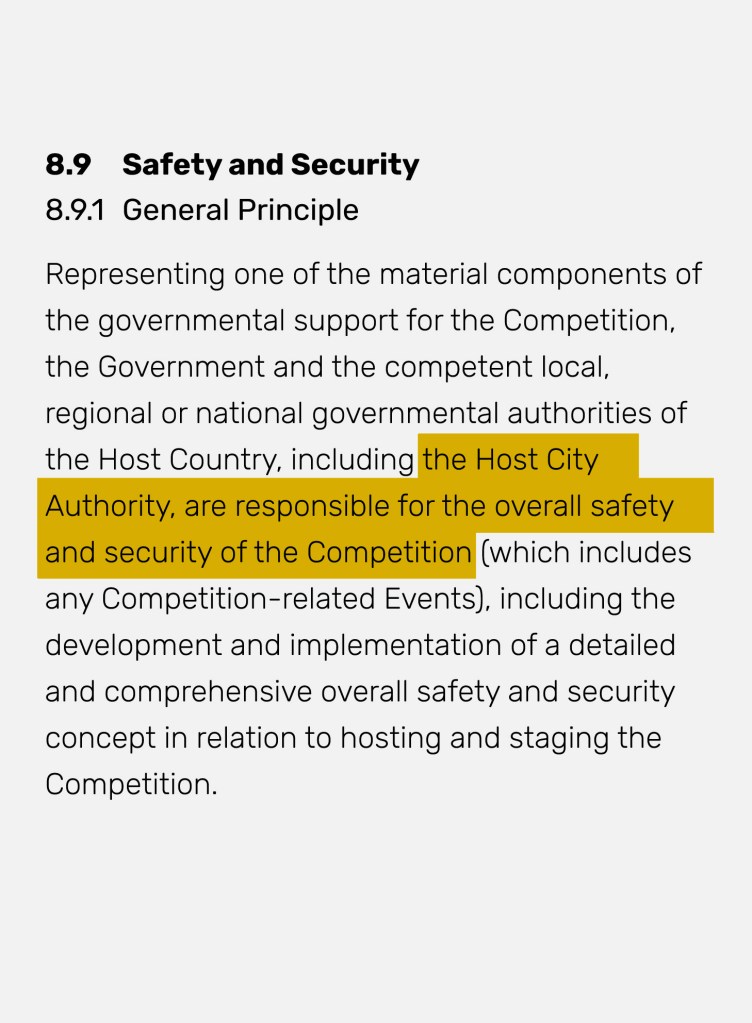
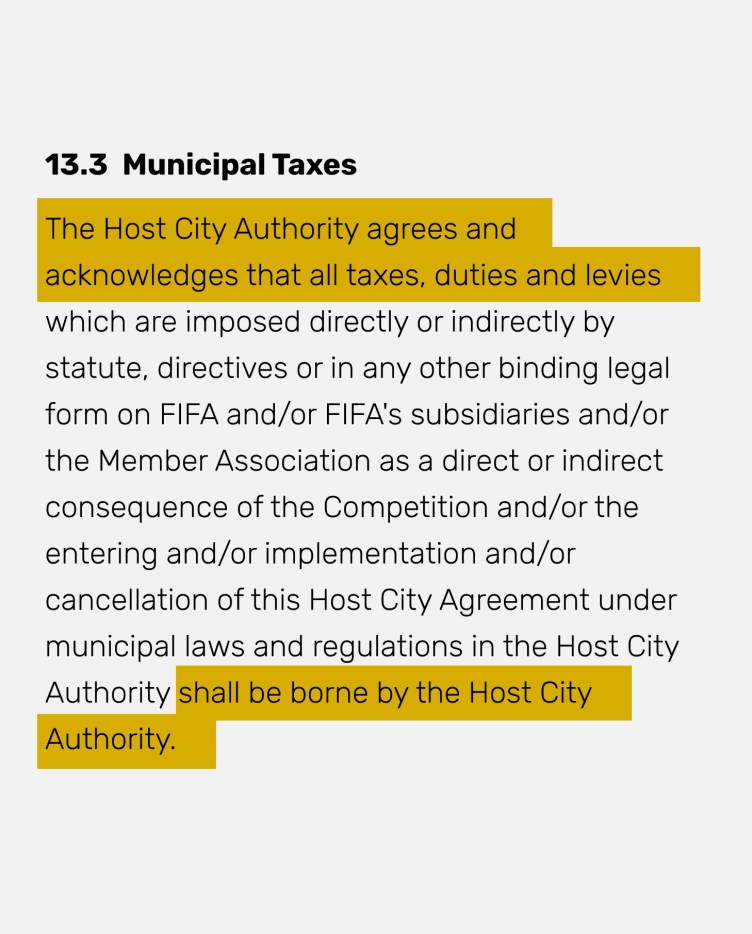
FIFA did not respond to questions about those criticisms. Instead, it provided a written response stating that it is working closely with its host sponsors and expects cities to benefit.
“The FIFA World Cup 2026 is projected to generate significant economic activity across Canada, Mexico and the United States, spanning tourism, hospitality, employment and long-term global visibility,” said Jhamie Chin, a FIFA spokesperson.
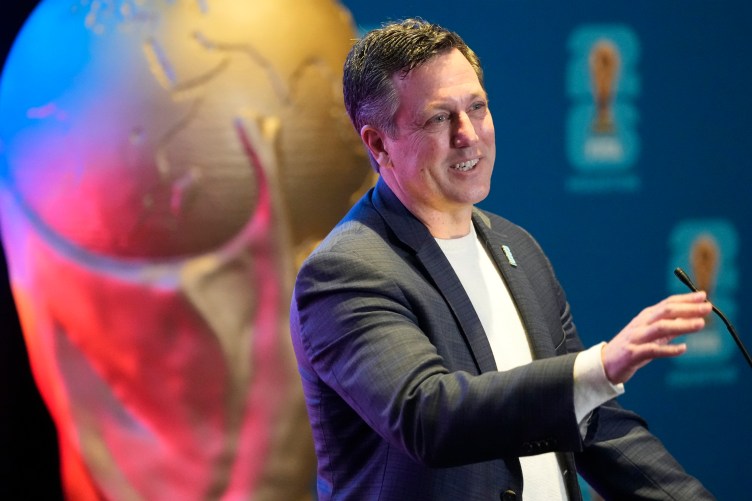
The host cities use external nonprofits to organize and run the tournament’s logistics and raise money for the costs of hosting. Chris Canetti, who runs Houston’s host committee, said the city’s organizers have been able to overcome any challenges the contract has presented.
“This event is going to have a substantial economic impact on our region, from hundreds of thousands of visitors coming through,” Canetti said. “We’re making an investment in that. I think this is good for our community at the end of the day.”
The Houston Chronicle sought to better understand the agreements cities made with FIFA and their implications for taxpayers by reviewing records from all U.S. host cities. Most refused to hand over the contracts, including Houston, which argued that releasing the documents would undercut its ability to negotiate for future events; Dallas did not oppose the release but sent the request to the Texas attorney general to allow third parties to object if they wanted.
The two cities asked the Texas attorney general for permission to keep them out of the public’s view. The attorney general’s office ruled that Houston and Dallas must release their contracts, though they were allowed to redact key financial figures, including how much FIFA is paying to rent stadiums for the event.
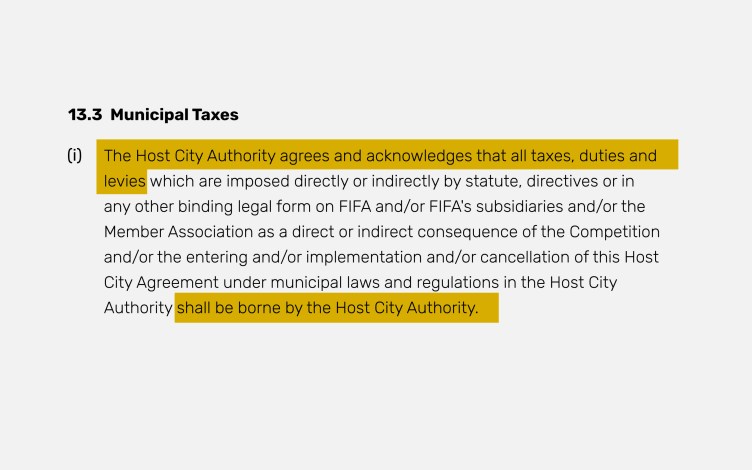
The Chronicle reviewed the two Texas contracts, along with those of four other host sites — Kansas City, New York/New Jersey, Philadelphia and Seattle — that made their agreements available. Together, the contracts show that almost all of the costs for organizing the tournament fall on the cities, whose ability to collect revenue is limited.
Those agreements, according to Rothenberg and other experts, lock host cities out of prospective revenues more than ever, leaving FIFA with a larger share of the revenue.
Texas Taxpayers on the Hook
In Houston, at least, most of the organizing costs are not expected to be borne by local governments.
“The host committee holds the contract with FIFA. We are 100% responsible for finding the funding to cover all of those expenses, and none of that comes from the city or the county,” Canetti said about the agreements.
The contracts do not make clear who is on the hook if the host committee cannot cover the costs. Canetti said he is confident Houston’s committee will have more money than it needs for the expenses, and any surplus funds would be donated to charitable efforts. The host committee that Canetti runs uses a mix of revenue generated from corporate sponsorships, the money FIFA pays to rent NRG Stadium and subsidies from state and federal governments.
That includes $65 million from the federal government to help Houston pay for security, part of a broader $625 million investment by American taxpayers in the World Cup.
The committee also expects to draw tens of millions of dollars from Texas’ Major Events Reimbursement Program, an offshoot of the state’s Event Trust Funds established in 1999 when Texas was vying to host the Olympics. Canetti did not reveal the precise amount Houston believes it will receive, and the Chronicle is still waiting for the governor’s office to respond to records requests for its communications with the committee.
The reimbursement fund was key to ensuring Houston did not lose money when it hosted the Super Bowl. It is expected to be a difference-maker again in covering World Cup costs, helping ensure Houston and Dallas are in a better position than other host cities that don’t receive state money. But it means Texas taxpayers bear a significant share of the costs.
Kelly Dowe, the city’s finance director when it hosted the Super Bowl in 2017, assumed the city would be left with the costs. He was surprised when the host committee for that event effectively paid the full bill, in large part with $22 million in state funds. But these big events, while a boon to specific industries like hotels, bars and restaurants, are hardly a driver in a city’s budget.
“It doesn’t make money for the city, per se,” Dowe said. “You’re glad to break even.”
Texas has made available about $263 million since 2015 to help cities cover the costs of dozens of events, subsidizing everything from a Super Bowl to Junior Olympics and cutting horse competitions. But program administrators have consistently struggled to verify that the events are creating a positive return on investment for taxpayers.
Under the program, cities seeking to host competitive sporting events apply for state funding, using estimates of how much they think revenue from sales, liquor and other state taxes will increase as a result of an event. That amount forms the basis of how much money the city is eligible for, and then it can submit expenses for reimbursement after the event. That included $21.9 million to Houston’s Super Bowl in 2017, $23 million to Austin’s Formula 1 United States Grand Prix event in 2019 and $31 million to the same event in 2021.
As the program grew, it began drawing criticism from across the political spectrum. Then-state Sen. Wendy Davis, a Democrat, pushed a bill in 2013 to audit the program, saying, “We’re handing these things out like candy.” The bill did not pass, but state auditors reviewed the program in 2015.
The audit suggested that officials in the Texas comptroller’s office, which originally administered the program, were not vetting the number of out-of-town visitors stringently enough to ensure an economic benefit. It also found they were not verifying that invoices sent by cities were directly related to the events they were hosting.
The comptroller’s office added rules in late 2014 clarifying what kinds of spending would be allowable for reimbursement, and, in 2015, the Legislature moved the trust funds to the governor’s office of economic development and tourism.
But the move has not made it any easier for the state officials who administer the program to distill complicated economic data, and they continue to write in their reports that they cannot tell whether the events bring a positive impact. In 2020, five years after the program was transferred to the governor’s office, the conservative Texas Public Policy Foundation, which has been a strong supporter of Gov. Greg Abbott, released a report criticizing the program, saying its vision “points to a misunderstanding of how economies work.”
Andrew Mahaleris, an Abbott spokesperson, said the governor’s office commissioned an economic impact analysis for the 2024 fiscal year that showed 840,000 nonlocal visitors spending more than $615 million in Texas, with a positive economic impact of more than $1.2 billion.
It’s unclear how the numbers in that study were calculated, and Mahaleris did not respond to requests to provide the study to the Chronicle.
“Event Trust Funds are critical tools that help Texas communities attract events to the state,” Mahaleris said.
When state officials review the taxes they collect after the events, they come to a different conclusion. State officials are limited in the types of economic indicators they assess. For example, they look at the amount of sales taxes collected in cities and counties, but that data does not identify how much comes from out-of-state visitors for the specific events the state is subsidizing.
“Houston is a giant economy, a region as big as some states,” said Dowe, the former Houston finance director. “As big a deal as the Super Bowl or the World Cup would be, it doesn’t move the overall economy as much as other factors — manufacturing, oil and gas, the refining that goes on at the ship channel. Any movement on those would far outweigh the noise in the signal from the World Cup.”
After every one of the last 40 events the state program has helped fund since 2015, state officials said that “neither a positive nor negative impact is determinable.”
FIFA Projection Is “Insanity”
Supporters of using taxpayer dollars to attract major sporting events maintain that host cities get economic benefits from the exposure that comes with the spotlight of widely watched matches.
Those figures are not insignificant, according to FIFA, which points to a study it released in April with the World Trade Organization that estimates the tournament will bring $47 billion in economic impact across the United States. FIFA deferred questions about the study to the WTO, which directed questions to OpenEconomics, an Italian firm that it said prepared the report. OpenEconomics did not respond to a request for comment.
Experts say such calculations are almost always exaggerated and that the true numbers are difficult to pinpoint. The billions promised in the report by FIFA and the WTO are “insanity,” said Victor Matheson, a professor at the College of the Holy Cross in Worcester, Massachusetts, who has studied the economics of big sporting events like the Super Bowl and the World Cup for decades.
“This would mean every game is generating $400 million, or roughly $5,000 to $7,000 per fan,” he said. “But the most telling thing is that FIFA is right on the front cover as an author/sponsor of a report that says that FIFA is awesome. This report is better thought of as a press release rather than a serious piece of economic research.”
Recent reports have shown hotel prices dropping as the tournament nears, which could indicate fewer people plan to travel for the games. That would be a major factor for host cities, since out-of-town visitors are key to driving a positive economic impact.
Houston does not receive a net benefit from its own residents attending the World Cup. Those people are spending money they likely would have spent in the city anyway, a principle economists call substitution. An event like the World Cup can also crowd out other events, like conferences, that would have drawn out-of-towners to the city. And, of course, much of the money spent at the games flows to entities like FIFA that are not based in Houston.
All of those factors make it difficult to assess the true economic impact on a city or state, Matheson said. That math requires a large set of assumptions, and promoters will usually tweak those assumptions in their favor to drive up the total.
It can be even harder to fully track the public spending needed to cover the hosting duties.
The contracts reviewed by the Chronicle include a clause under which cities promise to “agree to do all things necessary to preserve their confidentiality,” unless required by local law to release them. And the nonprofit organizing committees generally are not subject to public disclosure laws.
Chin, the FIFA spokesperson, said the contracts contain information that is “commercially sensitive,” and it is standard to withhold them for “global events of this scale.”
As a result, many of the details about taxpayers’ investments remain out of public view. They include figures about how much FIFA will pay each city to use its stadium, which local companies have agreed to donate millions toward preparations and what benefits they receive in return, the tax breaks that FIFA will enjoy from each city, and how each host committee plans to pay for the extensive preparations that go into hosting the tournament.
The contracts the Chronicle obtained provide broad categories of responsibility that fall under a host city’s purview — security, transportation and retrofitting stadiums, among them. But the documents rarely attach dollar figures to those efforts.
Academic experts say the system’s secrecy is by design.
“It’s atrocious how secretive they are with these sorts of taxpayer-funded events,” said David Cuillier, director of The Freedom of Information Project at the University of Florida. “These cities are going to invest a lot of money in hosting FIFA, and the people who are paying for that should know. They should know how much money and how it’s being spent. That’s why we have open records laws.”
#Money #Host #Cities #World #Cup #ProPublica