wellnessfitpro
Launched as a new kind of gun retailer in 2012, the Range USA chain was built to look and feel different from the smaller, unwelcoming shops and gun ranges often associated with the industry.
Its founder and president, Tom Willingham, wanted to make the experience of buying and shooting firearms more mainstream. So he modeled his company on big box chains, striving for bright, comfortable outlets that would be inviting to women, novices and others put off by some older gun stores.
Today, Range USA has bloomed into a formidable brand, with 50 stores in 14 states, a footprint that spans from the Mississippi River to the Atlantic Coast.
But despite efforts to set itself apart, the company is beset with the same vexing problems faced by more traditional retailers. Federal regulators have repeatedly cited its employees for failing at basic protocols designed to help thwart illegal sales, and guns purchased at its stores keep getting recovered by police.
Take the recent killing of Chicago police officer John Bartholomew, who was fatally shot on April 25. The suspect who used a 10-millimeter Glock 29 to shoot Bartholomew was not the original owner of the gun. It was first purchased in 2024, according to investigators, in an illegal transaction at a Range USA store in the northwest Indiana town of Merrillville, a short drive from Chicago.
Records obtained by ProPublica show that, in the years before the gun in the fatal shooting was purchased, the store was cited for serious compliance failures on multiple occasions by the Bureau of Alcohol, Tobacco, Firearms and Explosives, the federal agency tasked with oversight of the nation’s gun retailers.
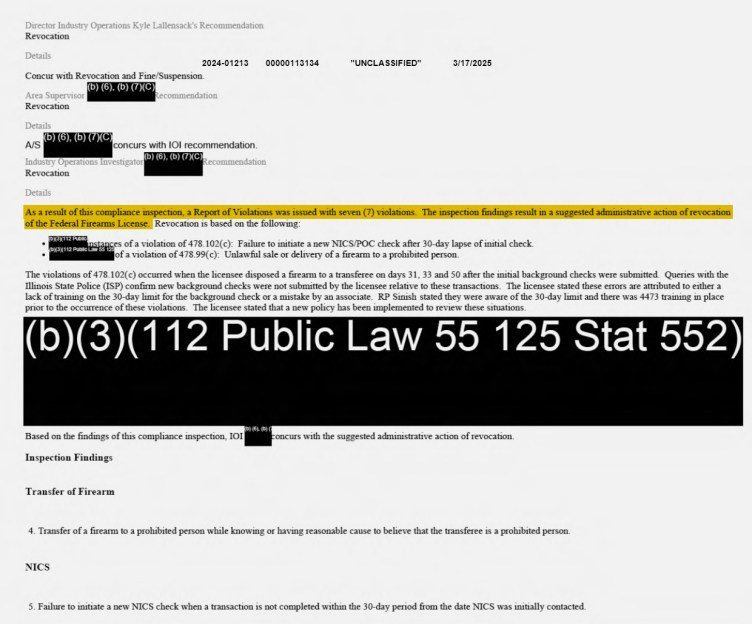
The Merrillville store faced revocation of its license following a 2022 inspection that determined a background check was missing for one sale, according to ATF inspection records. Inspectors also determined that the company made “no significant improvement” toward rectifying over a half dozen previous violations, ATF records show.
In their response to the findings, Range USA managers blamed the store’s antiquated system for filing federal sales paperwork, telling inspectors the underlying problems would be cured once the company moved to an electronic system. The ATF later rescinded the recommendation on the Merrillville store after proof was found that the background check had been conducted.
Records show that between 2020 and 2024, federal authorities recommended revoking the licenses of three other Range USA locations, including two in Ohio.
In 2021, inspecting the Range USA in Dayton, the ATF determined an employee sold a firearm to a person who failed a background check, records show. Company representatives admitted to the agency that the employee had failed to follow store policy and “missed the appropriate connections” concerning illegal sales, despite training. They said the company would implement new policies to head off additional lapses.
A year later, at the Range USA in Lewis Center, an ATF inspector found that a sales clerk had falsified records of a gun sale after accepting an expired conceal-and-carry permit in lieu of conducting a background check, records show. In response, Range USA managers disputed that its employees lied intentionally.
All the Range USA stores that faced revocations are currently open, according to the company’s website, though some have paid fines. Now, as Range USA contends with another controversial gun sale, the ATF is weakening Biden-era penalties for failures to ensure compliance with federal gun regulations, including those meant to deter criminals.
The company did not respond to ProPublica’s requests for comment. It has often responded to ATF findings by blaming employee mistakes and staff turnover while making promises of improved training, records show.
Meanwhile, the chain has continued to grow. In 2025, Range USA sales, according to industry trade publications, increased by just over 5% even as the industry cooled. With that momentum, the company is eyeing another expansion. It plans to open three new locations by 2027.
Amid this success, Willingham became a staunch advocate for the industry. In the last five years, he’s contributed to a political action committee that has sought to elect candidates friendly to the interests of gun retailers like Range USA.
Both Range USA and Willingham personally have given to a committee run by the National Shooting Sports Foundation, a trade association that lobbies for the gun retail industry. Range USA has given $35,000, and Willingham $5,000.
The violations cited at Range USA shops sometimes have grown out of investigations into straw sales, transactions where customers lie to purchase guns on behalf of someone prohibited by law from buying them. These guns are typically resold for profit and sometimes end up being used in crimes.
In Chicago, where gun sales are banned, Bartholomew is not the first officer to be killed with a straw sale executed in Indiana, just the most recent. Nearly five years ago, Ella French was shot to death by Emonte Morgan during a traffic stop. The gun he used was purchased by another man, Jamel Danzy, from Deb’s Gun Range in Hammond, Indiana, in March 2021.
Danzy lied by claiming on a required form that he was purchasing it for himself, when in fact he intended to pass it along to Morgan, according to federal investigators. He was ordered to serve two and a half years in prison for making false statements on federal forms. Morgan was sentenced to life without parole following his 2024 conviction for French’s killing.
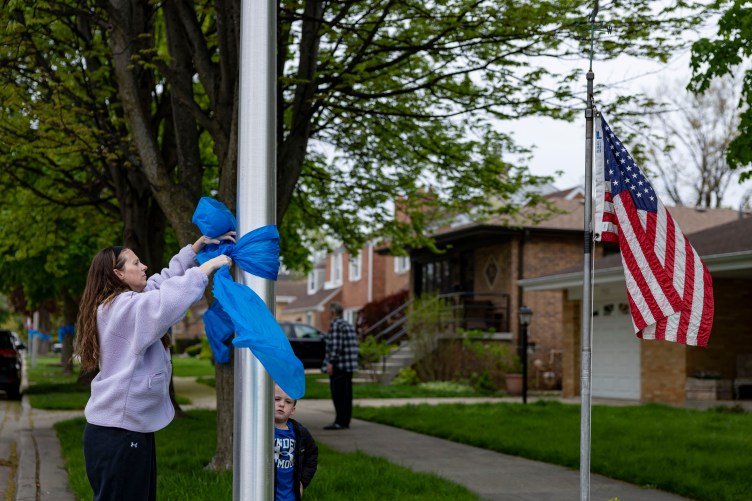
In recent weeks, Chicago was confronted with the loss of another public safety officer. Bartholomew was inside a hospital when he was shot to death while guarding Alphanso Talley, a suspect in an armed robbery who allegedly drew the concealed gun and opened fire. Talley has been charged with murder and has yet to enter a plea.
That gun was allegedly purchased two years prior at the Merrillville Range USA by Olivia Burgos, who now faces criminal charges for making false statements in order to facilitate the sale. According to federal investigators, Burgos told store employees that she was purchasing the gun for herself. In actuality, investigators allege, she bought the gun on behalf of her boyfriend, a felon prevented from legally purchasing one.
She also allegedly lied by indicating on federal purchase documents that she was not under the influence of drugs or alcohol at the time of the sale. According to federal investigators, Burgos told them she was addicted to fentanyl and was on the drug when she signed the papers for the gun. Federal authorities have charged her with making a false statement while purchasing a firearm.
The gun eventually made its way to Talley. An investigation into its path to Chicago is ongoing.
Last year, advocates with the gun control advocacy group Brady United alleged negligence by Range USA, several Range employees and Willingham in a straw sale from a different shooting, linked to its store in Shorewood, Illinois, about 50 miles outside Chicago. The suit grew from a 2023 incident where then-18-year-old Maxwell Williams shot a woman through the neck amid an argument at a large house party. He later pleaded guilty to aggravated battery with a firearm and is currently serving a 10-year sentence in Illinois state prison.
Williams, who at the time wasn’t old enough to buy a firearm, had his girlfriend illegally purchase one on his behalf, the suit alleged. According to court records, the Range USA sales clerk proceeded with the sale despite signs that the girlfriend was not the actual buyer. Video taken of the transaction shows Williams verbally directing her on which gun to buy and counting out the cash for the purchase himself, the lawsuit alleges. The girlfriend pleaded guilty to misdemeanor battery in the shooting.
Range USA has denied the allegations from Brady and moved to dismiss the lawsuit, claiming that its employees had no knowledge of any criminal intent by Maxwell or his girlfriend. Attorneys for the company also cited the federal Protection of Lawful Commerce in Arms Act, which they said preempts lawsuits against gun retailers and their employees over harm caused by guns bought at their stores.
A solution to the problem of detecting and preventing illegal sales like those that preceded the deaths of the two Chicago police officers has eluded lawmakers and industry figures alike. Employees at retail gun stores are generally taught to notice typical signs of straw purchases and are entitled to end any suspect transaction. But even with good-faith efforts, straw sales persist.
For its part, the ATF has established several surveillance programs requiring retailers to report potential or suspected straw purchases. The trigger for one such effort was so-called “crime guns,” those recovered by police within three years of being sold at retail. Stores with more than 25 such guns annually were targeted for enhanced scrutiny, a program known as Demand Letter 2.
Under the Biden administration, the program was used to connect guns purchased on underground markets to the original sellers. Last year, Trump officials announced the program would be discontinued.
According to an analysis by Brady, about two-thirds of Range USA locations were included in the Demand Letter 2 program between 2022 and 2023.
Gun industry figures consistently deny responsibility for straw sales, putting the blame on the buyers who are breaking the law by lying about their intentions. Part of their solution rests on educational programs and training for retailers on how to spot signs of straw buyers.
In 2021, under President Joe Biden, the ATF began a new strategy — sometimes referred to as the “zero-tolerance policy” — of conducting more frequent inspections and applying harsher penalties to retailers who repeatedly failed to comply with federal guidelines governing gun sales.
After it was adopted, the industry saw a huge increase in the number of recommendations for gun-store license revocations issued by the ATF. Those do not lead to immediate closures, as stores are allowed to fight the revocations through administrative hearings and court appeals that can last years. The revocations plummeted under Trump last year.
Whether the Biden-era policies effectively reduced gun trafficking is still a matter of debate. One expert reached by ProPublica said that the enhanced enforcement didn’t begin in earnest until the middle years of the Biden administration. Before it could take root, they said, the Trump administration upended the policy.
Last month, Trump officials gathered in Washington, D.C., to mark the agency’s pivot away from the Biden-era enforcement measures and usher in a more industry-friendly approach. ATF Director Robert Cekada said that as part of its new direction, the agency will streamline and modernize gun-sale paperwork to help cut down on clerical errors and make consequences for good-faith mistakes more lenient.
“We are proposing to remove unnecessary hurdles that were standing in the way of law-abiding citizens and businesses,” Cekada said. “We are proposing to restore clarity and predictability in our standards.”
He also stressed that public safety remains one of its top priorities. “ATF remains the greatest friend to state and local law enforcement officers, and we believe that these rules will not negatively impact public safety,” he said.
Asked to comment on the end of the zero-tolerance policy, an ATF spokesperson told ProPublica in an emailed statement: “These are administrative and regulatory changes to processes and definitions, not changes to the underlying prohibitions that keep firearms out of dangerous hands. The ATF does not believe any recently released proposed rules will jeopardize public safety.”
Professor Daniel Webster, a longtime researcher of gun trafficking at Johns Hopkins University, said the ATF’s new direction sends a “dangerous signal” to retailers and the public that surveillance of straw sales is no longer a priority. The new rules tell retailers, “Do whatever you want,” he said. “My take is that this ATF is more interested in protecting the industry than in the American public.”
In an emailed statement, NSSF spokesperson Mark Oliva said the organization and its members are “committed to ensuring firearms remain beyond the reach of those who cannot be trusted to possess them. That category includes criminals.”
#Range #USA #Dogged #Accusations #Straw #Sales #Guns #ProPublica