wellnessfitpro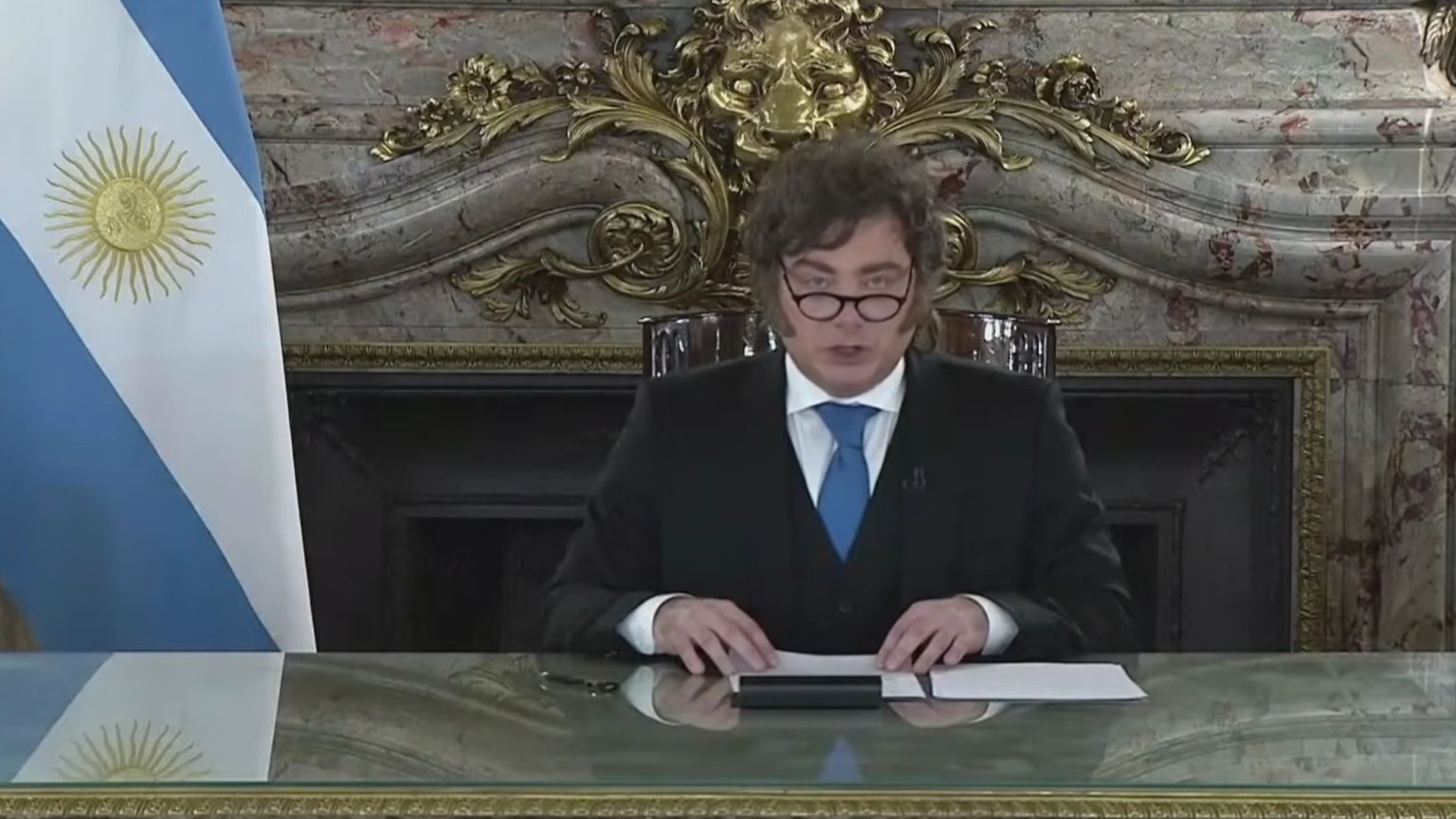
Argentine president Javier Milei finally went there. Addressing the nation last week, he reasserted Argentina’s claim on Las Malvinas – known to the rest of us as the Falkland Islands, the British Overseas Territory 300 miles off the coast of mainland Argentina.
‘The Malvinas are Argentine, historically and legally… there’s no debate about that’, Milei said of this remote South Atlantic archipelago, which was seized by Britain from a then newly independent Argentina in 1833. He was not threatening an invasion, like that undertaken by Argentina’s vicious right-wing military junta in 1982 – a move that led to war with Britain. Rather, he was threatening sanctions against any companies engaged in ‘oil-extraction initiatives’ in the North Falkland Basin.
The embrace of the cause of the Malvinas is something of an about-turn for this proud libertarian. Over the past two decades or so, his left-leaning predecessors all rhetorically exploited the Falklands issue as a righteous, anti-imperial cause of the Global South – and they were backed by their Latin American allies on the left, such as Venezuela’s Hugo Chávez and Bolivia’s Evo Morales. But the right-wing Milei was different. An avowed fan of British prime minister Margaret Thatcher (one of ‘the great leaders in the history of humanity’ as he put it in 2023), he used to downplay the significance of the Falklands War. In fact, he even echoed the British line that it was up to the 3,000-plus Falkland Islanders themselves to determine their own future, although he hoped that they might ‘one day decide to vote for us’.
So what’s changed? Why is Milei now eyeing up the Falklands?
Partly, there are domestic factors at play. Milei’s popularity ratings have plunged over the past year. His chainsawing cuts to state spending have brought sky-high inflation down to more manageable levels, but unemployment is still rising amid continuing economic struggles. So, with national elections now just over a year away, it seems Milei has pivoted to a rally-round-the-flag cause that has long proved popular among the Argentine public.
There is also a more material consideration in the shape of the vast, untapped oil fields in the seas around the islands. Indeed, Milei used his state address to announce sanctions on the firms planning to drill in the Sea Lion field – the Israeli company Navitas and its British partner, Rockhopper. Largely, one would surmise, because his administration wants Argentine companies in on the action, too.
Arguably, however, it is the geopolitical context that has done most to embolden Milei’s government, helping to turn this familiar Argentine flex into a major international flashpoint.
After all, his predecessors made similar statements, but these could comfortably be ignored. Milei’s intervention, however, arrives amid an increasingly violent rebalancing of global power, in which longstanding, postwar alliances and institutions are being pulled apart at the seams. This is partly what Milei meant in his national address, when he talked about the ‘winds of change’ blowing around the world favouring an Argentine claim on the Falklands.
The decay of NATO, in particular, is relevant here. Washington has long been irritated by European allies’ relative lack of investment in their own military and defence capabilities. What were once just cracks in this decades-old alliance have threatened to become ruptures since both Russia’s invasion of Ukraine and, above all, the US-Israel war in Iran. In both cases, the White House has felt that Europe is not pulling its weight. Indeed, it now seems that Britain’s failure to support the Trump White House in its assault on the Islamic Republic has prompted the US to explicitly cast doubt on the UK’s claim on the Falkland Islands.
In April, just over a month into the US’s Iranian venture, an internal Pentagon email, seen by Reuters, suggested the White House was considering withdrawing its formal recognition of Britain’s administration of the Falklands. This clearly sent a message to Milei, a Trump ally. Prior to this, any assertion of Argentine power – legal, military or otherwise – towards the Falklands would have risked damaging relations with the US. But no more. From that point on, the Malvinas have potentially been on the table for Argentina in a way they’ve not been for decades.
And then, just a few days before Milei addressed the nation last week, Trump told GB News that Britain was ‘not there to help me’ in Iran, before he brought up the Falklands, claiming that he doubted Britain would be capable of defending the islands in 2026 in the way it could in 1982. You didn’t have to be a Trumpographer to understand what The Donald was getting at – namely, that the UK will have to defend its claim on the Falklands without US support. Little wonder that when Milei said that the global ‘winds of change’ were behind Argentina’s sails, he explicitly cited ‘President Trump’s [declaration] that the US is re-evaluating its historic position in relation to the Malvinas’.
Milei’s national address also touched on another key factor that has helped reignite the Falklands row: the weakness and disorientation of the British state. Indeed, it is doubtful whether Britain has either the means or the will to defend these distant islands any more.
After all, Britain’s military strength is widely known to be at an all-time low. Its army is depleted, and its navy diminished – a worrying reality revealed to the entire world in March when Britain had to rely on French naval forces to defend a British airbase on Cyprus from a Hezbollah drone strike. And there’s little sign that the UK’s new government is committed to reversing this military decline.
But Britain’s weakness goes deeper than defence capabilities. It is intellectual and ideological, too. Britain is a nation whose political class is imbued with identitarian ideology and has little sense of the national interest, preferring instead to cleave to globalist institutions.
After all, Milei has already seen Britain try to relinquish its sovereignty over another of its overseas territories: the Chagos Islands in the Indian Ocean. The largest of the islands, Diego Garcia, hosts a critical joint UK-US airbase. Yet even this hasn’t stopped the UK government from trying to hand over the islands to Mauritius, a close ally of China, while paying billions to the Mauritians for the pleasure, all supposedly in the name of satisfying ‘international law’.
UK foreign secretary Ed Miliband has said of the Falklands that ‘the Islands are British and will remain so’. But his defiance is not very convincing. After all, this is a politician saturated in the globalist, legalistic thinking of New Labour.
Deeper still, there is now a profound indifference among the British public towards the status of a set of islands that are thousands of miles away. A YouGov poll in 2023 asked Brits how upset they’d be if the Falkland Islands stopped being British. Nearly half said ‘It wouldn’t bother me either way’. Among the young, the indifference is endemic, which is hardly surprising given they’ve grown up in a cultural and educational climate dominated by anti-Westernism and the ideology of decolonisation. According to a recent Telegraph poll, just 10 per cent of 18- to 24-year-olds want to keep the Falklands British.
None of this is to suggest that Argentina is actually about to make good on its claim on the Falklands. Milei’s focus is, for now, solely on the oil-drilling licences. Besides, the islands are actually far better able to defend themselves today than they were in 1982, with a garrison of 1,500 troops, backed by a state-of-the-art air-defence system, several fighter jets and a small naval force. And Argentina is far, far weaker militarily than it was under the rule of the junta.
But the Falklands row is not going away. Western fragmentation and Britain’s weakness have effectively advanced Argentina’s geographical and historical claim on the territory in a way that Javier Milei could never manage by himself. The future of these distant islands has rarely been as uncertain.
#Argentina #smells #blood #Falklands